Aphids on Tillandsia: Causes, Checks & Fixes
Quick answer
Aphids on Tillandsia are small sap-sucking insects that cluster on soft new pups, leaf bases, and flowering bracts. First step: remove the plant from its mount or globe, isolate it, and rinse all leaf surfaces with lukewarm water-then dry it upside down for at least four hours before any spray.
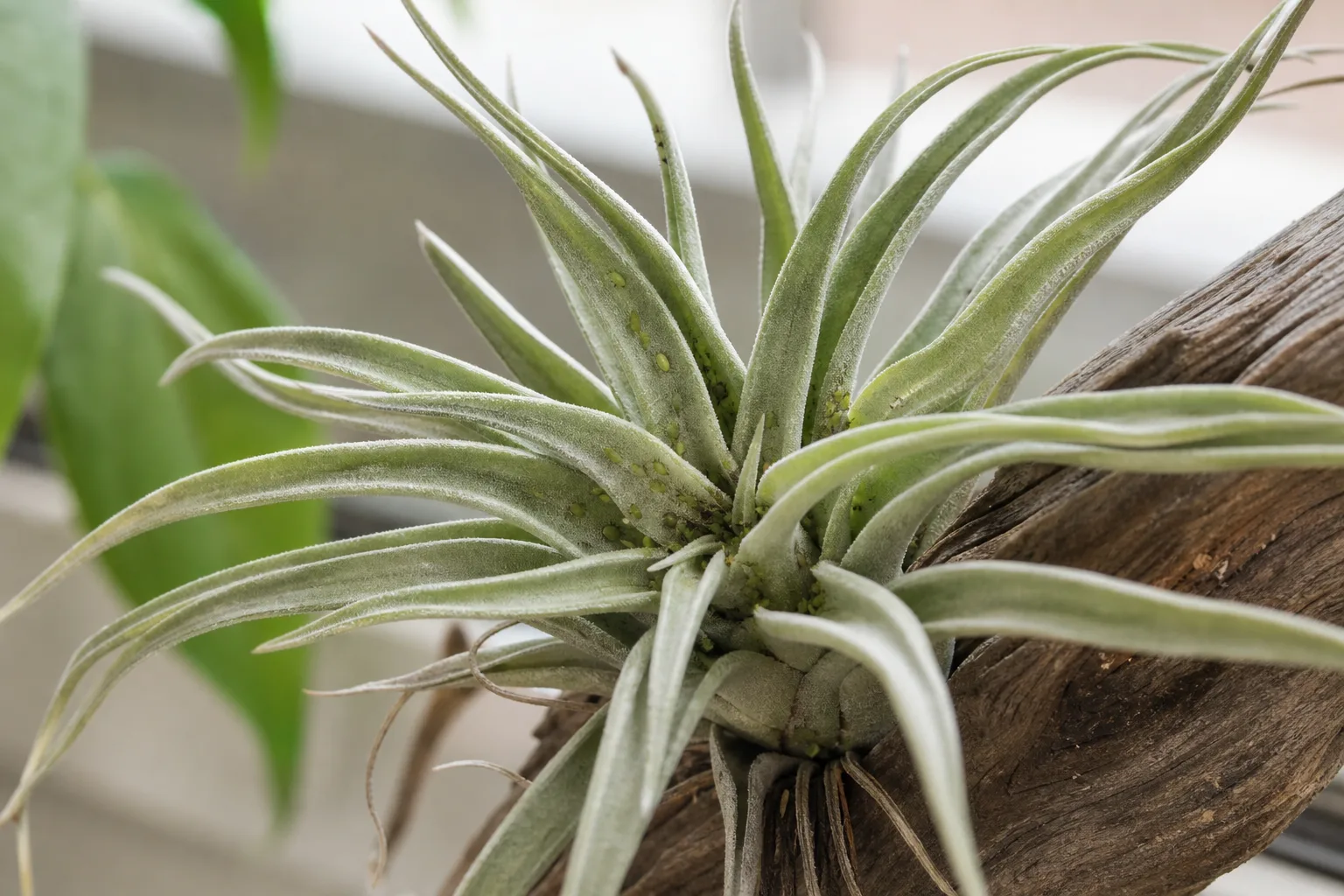
Aphids on Tillandsia: Causes, Checks & Fixes
This guide covers aphids on Tillandsia. See also the general Aphids guide, watering, and light pages for this plant.
Aphids on Tillandsia: Causes, Checks & Fixes
Quick answer
Aphids on Tillandsia are small sap-sucking insects that colonize soft new pups, expanding inner leaves, and inflorescence bracts-exactly where mesic air plants like Tillandsia ionantha put out their fastest growth. A cluster on one tender shoot can curl leaves, slow pup development, and leave shiny honeydew that attracts ants or sooty mold on your mount or globe.
First step: remove the plant from its display, isolate it from other air plants, and rinse all leaf surfaces with lukewarm water. Tillandsia drinks through foliar trichomes and has no soil reservoir, so the rinse is your diagnostic wash-not a long soak. After rinsing, shake out water and dry the rosette upside down for at least four hours before returning it to a mount or applying any spray. On air plants, trapped crown moisture is a bigger survival risk than a small aphid colony left wet for one afternoon.
For baseline soak-and-dry standards during recovery, see the Tillandsia watering guide. If you are unsure whether the insects are aphids or cottony mealybugs at the crown, compare with mealybugs on Tillandsia before choosing a treatment path.
What aphids look like on Tillandsia
On rosette air plants, aphids usually show up where tissue is still expanding:
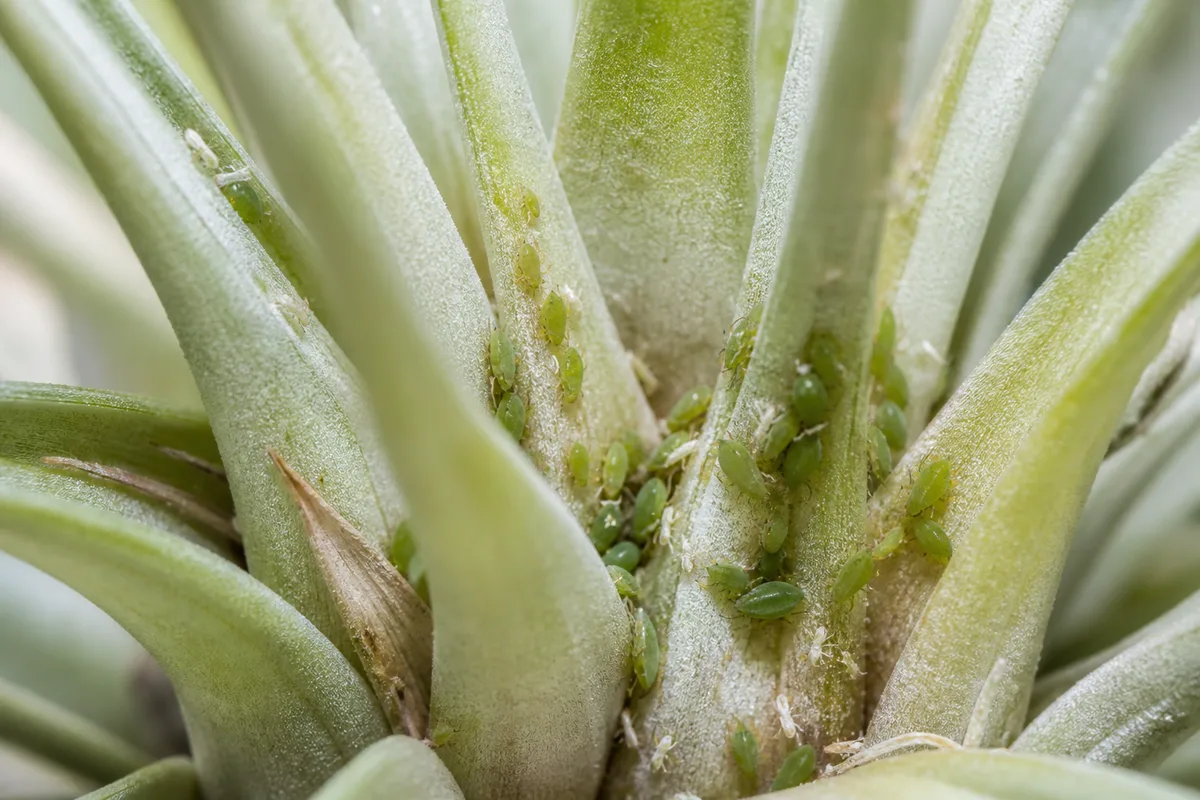
Aphids symptoms on Tillandsia - compare with healthy tissue on the same plant.
- Tiny pear-shaped insects (about 1/16 to 1/8 inch) clustered at pup bases, along inner leaf overlaps, or on flowering bracts
- Green, black, brown, or pink bodies-color varies by species, but clustering on soft new tissue is the tell
- Sticky, shiny honeydew on leaf surfaces, the mount, or inside a glass globe; nearby leaves may feel tacky
- White cast skins left behind when aphids molt, often stuck near colonies in tight rosette crevices
- Downward-curling or yellowing young leaves when feeding is heavy; older outer leaves may look fine while the pup is infested
Tillandsia often sits in globes, on wire frames, or in wall displays, which makes it easy to admire the silhouette and miss colonies tucked inside the rosette cup. You may spot stickiness on a leaf below the pup before you see the insects themselves. During bloom, aphids frequently move onto soft bracts and spike tissue where the plant is still pushing new cells.
Normal lookalikes to rule out first:
- Mealybugs - white, cottony clumps deep in leaf axils and at the crown; more common than aphids on many tillandsia collections
- Scale - immobile brown or tan bumps on older leaves or along the base; no legs visible
- Spider mites - fine stippling and webbing in very dry air, not pear-shaped colonies with honeydew
- Thrips - silvery streaks or scarring on leaves, with slender mobile insects rather than round clusters
- Dried mist residue - uniform film after frequent foliar misting; wipe away with water and recheck for moving insects
Why Tillandsia gets aphids
Aphids rarely mean your air plant is doomed. They mean soft, nitrogen-rich tissue is available and predators are absent-a common indoor setup.
New plant introduction is the top route. Aphids hitchhike on nursery stock, open windows in warm months, or plants briefly moved outdoors. A compact ionantha cluster hides early colonies inside the rosette until honeydew appears on the mount.
Fast spring and summer growth produces exactly what aphids want: tender shoots at pups and flowering spikes. Mesic tillandsia with smoother green leaves push new segments quickly in bright indirect light. If you fertilize heavily during that flush, the resulting soft tissue is easier for aphids to pierce and colonize.
Indoor conditions favor explosive colonies. Aphids reproduce quickly in warm rooms; females can produce live young, so numbers can jump between your normal weekly soak checks. Without ladybugs, lacewings, or parasitic wasps indoors, a small cluster on one pup becomes a multi-plant infestation before you notice.
Ant association speeds spread. Honeydew attracts ants that farm aphids and can carry crawlers between mounted displays on the same shelf. If ants appear around your air plant wall, inspect every tillandsia in that group-not just the one with visible insects.
Stress does not cause aphids, but it slows recovery. A chronically underwatering on Tillandsia xeric tillandsia with curled leaves is harder to rinse without repeated soaks, while an overwatered mesic type with a damp crown is more vulnerable to rot during treatment. Neither condition creates aphids; both make the recovery window narrower once pests arrive.
Tillandsia’s preferred bright light and moderate humidity do not prevent aphids. They may slow drying of honeydew on trichome-covered leaves, making sooty mold easier to spot on decorative mounts.
How to confirm the cause
Work through these checks in order:
- Inspect pups and inner leaves first - Gently spread overlapping leaves at the crown. Live aphids move when disturbed; scale and dried honeydew do not.
- Check for honeydew - Run a finger along the newest leaf or pup base. Sticky residue with visible insects confirms sap feeders.
- Look for cast skins and ants - White shed skins near colonies and ants on the mount or globe rim suggest an established aphid population.
- Use a hand lens or phone macro - Pear shape, visible legs, and antennae distinguish aphids from thrips or mite specks.
- Scan the collection - Examine every tillandsia sharing a shelf, terrarium, or hanging display. Aphids often arrive on one plant and spread to neighbors within days.
- Rule out care stress alone - Inward-curling silver leaves with no stickiness and no insects point to underwatering or low humidity, not aphids. Sticky new growth with clusters inside the rosette points to pests.
If you find insects but cannot identify them, treat as soft-bodied sap suckers with the same rinse-first approach-but do not assume aphids without seeing the classic clustering on soft new tissue. Cottony white masses without pear-shaped bodies are mealybugs; follow the mealybugs guide instead.
First fix for Tillandsia
Remove the plant from its mount or globe and isolate it before you treat anything.
Isolation stops winged aphids and crawlers from reaching nearby tillandsia, bromeliads, and other houseplants on the same display. Only after the plant is separated should you rinse it: hold the rosette under lukewarm running water and direct the stream into every leaf overlap, pup base, and bract where aphids hide. The goal is to dislodge live insects-not submerge the plant for a full soak on day one.
Immediately shake the plant upside down to expel water from the crown, then place it on a towel in bright indirect light with good airflow. Let it dry completely-aim for at least four hours before returning it to any holder. If the base still feels cool or damp at the center, extend drying rather than rushing back to a closed globe.
Recheck in 24 hours. If you still see moving aphids on new tissue, proceed to targeted treatment. If the rinse cleared them, keep monitoring daily for a week before declaring the plant clean.
Do not apply insecticidal soap, neem, or alcohol on day one without confirming live insects. Do not soak, fertilize, or mount onto wet moss at the same time-stacking moisture on an epiphyte that already lost sap from feeding raises crown-rot risk far more than aphids alone.
Step-by-step recovery
Once aphids are confirmed and the first rinse-and-dry cycle is done, work in this order:
- Manual removal on light infestations - Wipe visible clusters with a damp cloth or cotton swab along pups and inner leaves. For isolated groups, a swab lightly moistened with rubbing alcohol can kill aphids on contact; test one leaf first because alcohol can mark trichomes in hot direct sun.
- Insecticidal soap on a spot test - Spray one older leaf and wait 24 hours. If no burn appears, apply commercial insecticidal soap to all surfaces where aphids hide, especially inner leaf overlaps and pup bases. Soaps only kill on contact and have no residual effect, so coverage matters more than product strength.
- Repeat every five to seven days - New aphids hatch from eggs that soap does not kill. Plan at least two to three weekly passes until two inspections in a row show no live insects on new growth.
- Rinse soap residue, then dry upside down again - After each soap application, rinse the plant with clean water when the label allows, shake out droplets, and dry upside down before remounting. Soap left in a damp crown is as risky as skipping the dry step after a pest rinse.
- Prune only when necessary - If one pup or bract is tightly curled around a dense colony and spray cannot reach inside, snip that segment with clean scissors. Do not strip every pup; tillandsia needs active growth points to recover.
- Wash honeydew and sooty mold - Wipe sticky residue from leaves with a soft damp cloth. Sooty mold on the leaf surface clears once honeydew stops and the leaf is cleaned; it is not a separate disease on its own.
- Hold fertilizer until new growth looks clean - Resume light feeding only after two weeks with no aphids on fresh pups. Soft nitrogen-rich flushes after an infestation can invite a second wave.
- Re-check the collection - Treat or monitor any tillandsia that shared a shelf, terrarium, or hanging display.
For globe-mounted displays, leave the plant out of the enclosure during the entire treatment window. A closed globe traps humidity and turns every rinse into a crown-rot event.
Recovery timeline
Expect visible aphid numbers to drop within one to two treatment cycles if you are reaching inner rosette tissue and repeating weekly. Full clearance often takes two to four weeks indoors because overlapping generations hatch between sprays.
Signs recovery is working:
- No live aphids on the newest pup or inner leaves after two checks one week apart
- Honeydew stops appearing on leaf surfaces and the mount
- The next pup or leaf segment opens with normal firmness and minimal curl
- Ant activity around the display disappears
- The base stays firm and dry between soaks
Signs the problem is worsening:
- Colonies spread from pups down older leaves
- New segments emerge small, twisted, or fail to open
- Sooty mold covers large areas of foliage
- The base softens, darkens, or smells sour after rinses-see root rot on Tillandsia
- The same insects appear on plants that were not treated or isolated
Damaged leaves already curled or dulled from heavy feeding will not fully flatten or regain perfect trichome color. Judge success by clean new pups, not by repairing old blades.
Lookalike symptoms and causes to rule out
| What you see | Likely cause | Why it differs from aphids |
|---|---|---|
| Cottony white masses in leaf axils | Mealybugs | Static clusters; no pear-shaped bodies; see mealybugs guide |
| Fine stippling + webbing, dry air | Spider mites | No honeydew clusters; worsens when humidity drops; see spider mites guide |
| Silver streaks on leaves | Thrips | Slender insects; scarring without sticky coating |
| Brown immobile bumps on leaves | Scale | Does not move when touched |
| Inward-curling silver leaves, no stickiness | Underwatering or low humidity | No insects on new growth; see low humidity guide |
| Soft dark base, sour smell, no insects | Crown rot | Base failure from trapped moisture; see root rot guide |
Over-soaking a xeric tillandsia causes pale, soggy inner leaves but not sticky pup tips. If the plant is limp with a sour-smelling crown and no insects, suspect moisture stress before pesticides.
Mistakes to avoid
- Skipping isolation - treating one globe cluster while aphids crawl to a mounted neighbor on the same hook
- Returning a damp plant to a closed globe - crown pooling after a rinse kills tillandsia faster than most pest damage
- Using homemade dish soap - high risk of trichome burn on air plant foliage; use products labeled for plants
- One-and-done spraying - a single pass rarely clears eggs and hatchlings
- Blasting xeric trichomes with heavy water pressure - silver-leaved species like T. tectorum and T. xerographica need gentler rinses than smooth mesic types
- Applying soap or neem to sun-stressed, wet leaves - treat in bright indirect light, not after the plant sat in hot direct sun
- Soaking and soaping on the same day - pick rinse-first diagnostics, then add contact sprays only when live insects remain after drying
- Fertilizing mid-infestation - soft new growth from nitrogen flushes feeds the next aphid wave
When handling multiple treated plants, remember tillandsia is generally listed as non-toxic to cats and dogs-but keep pets away from wet soap residue and mounting wire during treatment.
Tillandsia care cross-check
While fighting aphids, keep baseline care steady rather than overcorrecting:
- Light: Bright indirect light supports recovery without scorching wet trichomes after treatment; see the Tillandsia light guide
- Water: Continue the normal soak 20 to 30 minutes weekly (or biweekly for heavy xeric trichomes), then shake and dry upside down for at least four hours before remounting-never skip drying because you are focused on pests
- Display: Open mounting on cork or wire is safer than closed globes during active infestation
- Species type: Mesic green types like T. ionantha tolerate fuller rinses; xeric silver types need shorter water contact and longer dry time between treatments
A plant in stable care pushes clean new pups faster once insects are gone. Swinging between drought and repeated soaking while spraying will show up as curled leaves that make it harder to tell whether aphids or watering are the problem.
How to prevent aphids next time
- Quarantine new air plants for 14 days and inspect pups before placing them on a shared mount or shelf
- Weekly pup and bract checks during spring and summer growth-aphids are easiest to rinse off when only a few are present
- Moderate fertilizer in active season; avoid heavy nitrogen that pushes overly soft shoots-see the Tillandsia fertilizer guide
- Inspect after outdoor summer breaks if you move houseplants outside; aphids hitchhike back indoors
- Check displays from multiple angles - colonies inside rosette cups are easy to miss when viewed from the side only
Prevention on tillandsia is mostly about early detection at pups and bracts, not sterile conditions. One quick look inside the rosette during your normal weekly soak routine stops most indoor outbreaks before they coat a whole wall display.
When to worry
Most established tillandsia survive aphids if you isolate early, rinse thoroughly, dry upside down, and repeat contact treatment until colonies stop. Consider the plant at higher risk if:
- More than half of active pups carry dense colonies
- New segments stop opening or emerge repeatedly distorted for three or more weeks despite treatment
- Crown rot symptoms (soft dark base, sour smell, inner leaves pulling free) appear after rushed drying-treat moisture first
- Pests spread to multiple mounted plants despite isolation
A single blemished outer leaf or shortened pup is cosmetic. A plant that stops producing clean new growth for a month after repeated treatment may still be saved through pup removal-though that outcome is uncommon when action starts at the first sticky new shoot.
Conclusion
Aphids on Tillandsia are a pest-and-timing problem more than a mystery disease. Confirm them with moving pear-shaped insects on soft pups and sticky honeydew, isolate before treating, rinse every leaf overlap, dry upside down for at least four hours, and repeat contact sprays until new growth stays clean. On air plants, crown moisture kills faster than aphids-so the dry step is treatment, not an optional extra.
Related guides: Tillandsia overview · Watering · Mealybugs · Spider mites · Root rot · Low humidity
Practical checks
Urgency check
Treat as urgent if bases soften, rot smell spreads, pests cover multiple pups, or several inner leaves fail at once while the plant stays damp in a closed globe.
Best inspection order
Newest pup or bract → inner leaf overlaps → honeydew on mount → base firmness → leaf surfaces for cast skins → neighboring air plants on the same display.
Severity note
Use spreading crown rot and multi-plant infestation-not a single blemished outer leaf-to decide how fast to act.
When to use this page vs other Tillandsia guides
- Tillandsia watering guide - Use for routine moisture checks before assuming aphids is the main issue.
- Tillandsia problems hub - Browse all 19 common issues on this species.
- Mealybugs on Tillandsia - Different entry point when symptoms overlap with aphids.
- Spider Mites on Tillandsia - Different entry point when symptoms overlap with aphids.
- Yellow Leaves on Tillandsia - Different entry point when symptoms overlap with aphids.