Low Humidity on Tillandsia: Causes, Checks & Fixes
Quick answer
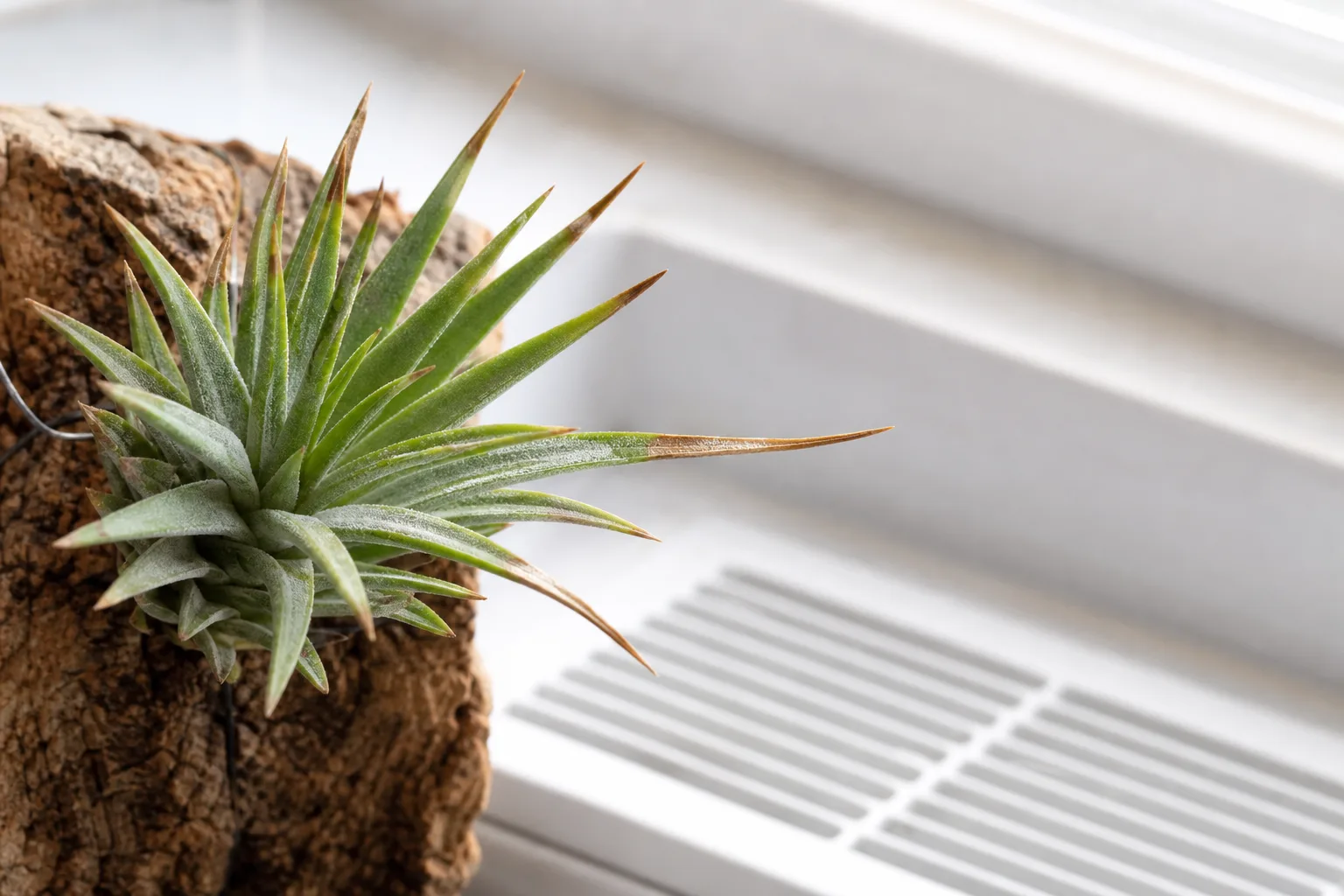
Low humidity on tillandsia shows as brown papery tips on mesic ionantha near heat vents, or tight inward curl and dull trichomes on silvery xeric types when winter air drops below 30% RH. First step: measure humidity, move the plant off the vent, and run a room humidifier or add supplemental misting-not a pebble tray under a cork mount.
Low Humidity on Tillandsia: Causes, Checks & Fixes
This guide covers low humidity on Tillandsia. See also the general Low Humidity guide, watering, and light pages for this plant.
Low Humidity on Tillandsia: Causes, Checks & Fixes
Quick answer
Tillandsia (Tillandsia spp.) drinks through leaf trichomes, not roots-so dry indoor air hits the same surface the plant uses for moisture uptake. When winter heating pulls room humidity into the 20–30% range, mesic types like Tillandsia ionantha often show brown, papery leaf tips first, especially on rosettes mounted above radiators or beside forced-air vents. Silvery xeric types such as Tillandsia xerographica more often curl leaves tight inward and lose their frosted trichome sheen before tips crisp.
First step: measure humidity with a hygrometer, move the plant off the direct path of heating vents, and raise ambient moisture with a room humidifier or supplemental misting between soaks. Do not reach for a pebble tray under a cork-mounted air plant as your primary fix-it raises humidity near a pot base, not around exposed leaf surfaces. Do not lengthen soak time on day one unless the crown is firm and leaves are dull from thirst, not from rot risk.
Judge progress by firm new center growth, not by expecting damaged leaf tips to green up again.
What low humidity looks like on Tillandsia
Dry-air damage on air plants has a species-dependent pattern because mesic and xeric tillandsias evolved in different humidity regimes:
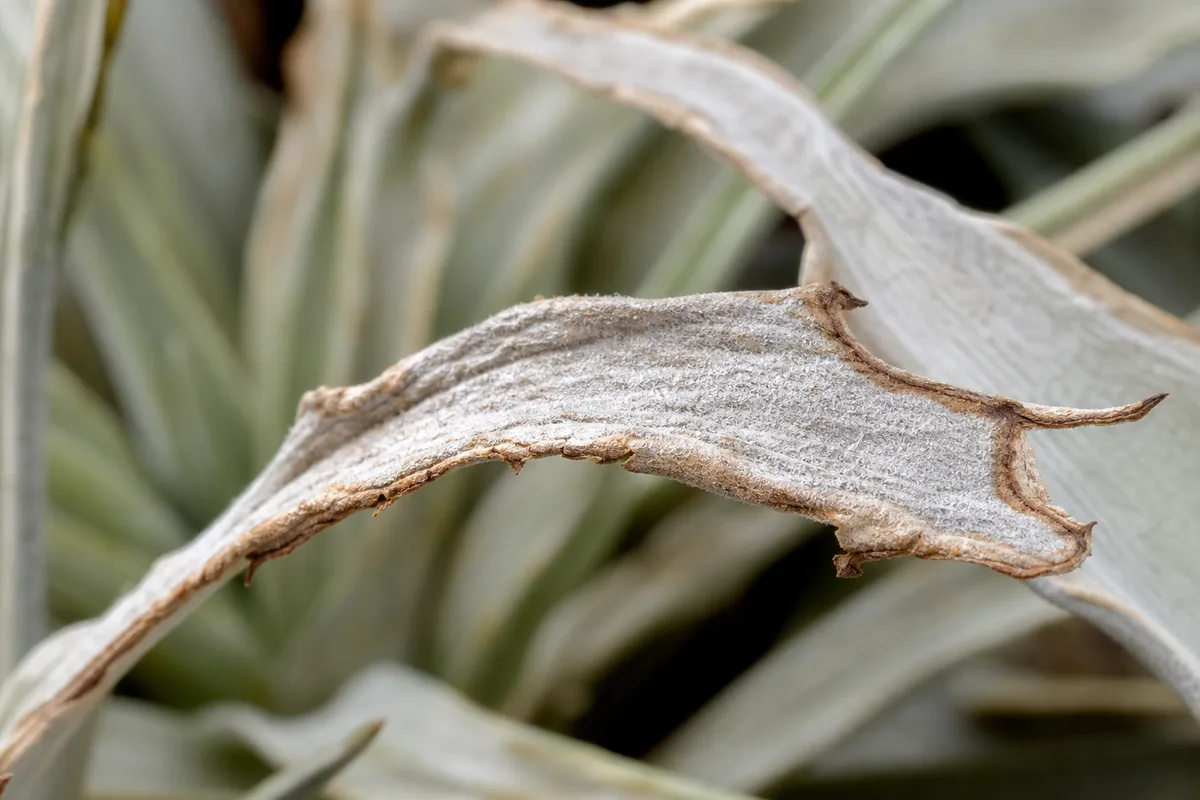
Low Humidity symptoms on Tillandsia - compare with healthy tissue on the same plant.
On mesic types (Tillandsia ionantha, Tillandsia capitata, Tillandsia brachycaulos):
- Brown, papery tips on otherwise firm green leaves-often worst on the outer leaf pointing toward a heat register
- Slight loss of gloss on smoother leaf blades; growth may slow before the base shows any softness
- No stippling, silk webbing, or moving specks on leaf surfaces
- Symptoms that appear or worsen when heat runs, a glass globe traps dry stagnant air, or a desk display sits in a direct HVAC draft
On xeric types (Tillandsia xerographica, Tillandsia tectorum, Tillandsia streptophylla):
- Leaves roll or curl tighter along their length, reducing visible surface area-curled or rolled leaves signal dehydration on tillandsia
- Dull, matte trichome patches where the silvery frost looks flattened rather than crisp brown tips at first
- Firm, dry crown-the overlapping leaf bases stay intact, unlike crown rot where the center turns dark and soft
- Damage often shows on the side of the rosette nearest dry airflow, not uniform bleaching across the whole plant
This is usually a low-to-moderate severity problem. Tillandsia rarely dies from dry tips alone if you still soak on schedule-but left through a full heating season, margins can spread, new leaves may emerge smaller, and spider mites often move into warm, dry displays. See the spider mites guide on Tillandsia if stippling or webbing appears alongside dryness.
Why Tillandsia reacts to dry indoor air
Tillandsia is an epiphytic bromeliad that absorbs water and nutrients through trichomes on every leaf surface. In nature, fog, rain, and humid canopy air keep those scales hydrated between showers. Indoors, you supply water by soaking, rinsing, or misting-then the plant must dry completely before the next wetting event.
Several tillandsia-specific traits explain why low humidity still marks leaves:
No soil reservoir. Potted houseplants can pull moisture from mix for hours after watering. Air plants have no root zone buffer. Once trichomes desiccate between soaks, damage concentrates at leaf tips and margins where water loss is highest-exactly where mesic ionantha browns first.
Heating vents and radiators. Penn State Extension warns that air conditioners and heating vents can quickly dry out air plants. Forced-air heat can pull indoor humidity well below what mesic tillandsias tolerate comfortably. A cluster mounted on a kitchen shelf above a register receives both hot dry blast and rising heat-outer leaves crisp while you still soak weekly.
Enclosed glass globes. Globes look humid but often trap stagnant dry air around the plant. You may soak faithfully every Sunday while weekday RH inside the globe sits in the low twenties. Condensation on glass without airflow is a warning sign, not proof the plant is hydrated.
Mesic vs xeric tolerance split. Mesic tillandsias from rainforest canopies want steadier atmospheric moisture and may need misting to run-off every other day in low household humidity. Xeric types with dense trichomes tolerate drier air longer but show tight curl as an early drought signal before papery tip browning. Treating a xeric xerographica like a thirsty mesic ionantha-soaking more often without raising air moisture-invites crown rot.
Winter soak-and-dry timing. Cool dim rooms slow drying after soaking. That is a separate problem from dry air-but owners sometimes skip supplemental misting in winter because they fear rot, which leaves trichomes desiccated for days between weekly baths.
Lookalike symptoms to rule out
| Pattern | Low humidity | Underwatering | Sun scorch | Spider mites |
|---|---|---|---|---|
| Leaf feel | Firm; crown dry | Papery, limp; may curl throughout | Firm; bleached patches on sun-facing side | Firm; stippled dots or dull patches |
| Base/crown | Dry and intact | Dry and firm | Dry and firm | Dry unless secondary rot |
| Key sign | Margin tips or xeric curl near vents; RH below 30% | Long gap since full soak; dull mesic leaves | Bleached or brown patches on leaf face in direct sun | Moving specks on tap test; silk in axils |
| First fix | Humidifier + supplemental mist; relocate from vent | Full soak, shake dry, resume rhythm | Move to bright filtered light | Isolate, rinse, treat pests |
Crispy leaves from dehydration often overlap with low humidity-see the crispy-leaves guide when the whole blade feels papery, not just margins near a heat source.
Underwatering shows uniform dulling and inward curl on mesic types after you have skipped soaks-not just winter edge browning with a recent soak on record. Compare your rhythm to the watering guide.
Crown rot from overwatering on Tillandsia produces a dark, soft center and sour smell-not dry papery tips alone. Do not lengthen soaks to fix humidity stress when the base is already questionable.
How to confirm low humidity (and rule out lookalikes)
Work through these checks before changing your whole care routine:
- Hygrometer reading - Place a meter beside the display for 24 hours. Readings consistently below 30% during heating season strongly support dry-air stress on mesic tillandsias. Xeric types may tolerate into the mid-thirties but still curl when air stays dry for weeks.
- Damage pattern - Even brown margins on multiple outer leaves near one heat source fit humidity. Random spots, bleached patches on the sun-facing side only, or yellow halos do not.
- Crown firmness - Press gently at the overlapping leaf bases. A firm, dry crown with crispy tips points away from rot. A dark, soft center means overwatering or poor drying-not low humidity as the primary issue.
- Soak rhythm - Note your last full submerge, not cosmetic mist alone. If you soaked within the past week and the crown is firm, extra soaking is not the first fix. A long gap with papery leaves throughout fits underwatering instead.
- Airflow sources - Map heat registers, radiators, fireplace drafts, and closed globes. Localized crisping on one side of a cluster often traces to placement, not a plant-wide disease.
- Pest inspection - Check leaf axils with light for stippling and fine silk (spider mites) or cottony clumps (mealybugs). Dry air encourages mites but they still leave distinct signs on a tap test.
Confirmed diagnosis: firm dry crown, normal soak rhythm, pest-free leaves, humidity below 30% (mesic) or prolonged dry air with xeric curl, and margin-focused browning or dull trichomes that started with seasonal dryness.
Suspected but not confirmed: papery leaves with no soak for two weeks (underwatering), soft dark crown after heavy soaking (rot), or bleached patches on leaves facing a hot south window (sun scorch).
First fix: raise leaf-surface humidity
Measure RH, relocate the plant away from heating vents, and run a cool-mist humidifier near the display-or add supplemental misting two to three times weekly between soaks.
A room humidifier is the most reliable way to hold 40–50% RH through winter for mesic tillandsias. Aim for room-level moisture, not a blast of mist directly on leaves 24 hours a day. Grouping plants together raises humidity in their vicinity more effectively than a pebble tray under a single cork mount, because mounted air plants have no pot base sitting above evaporating water.
While humidity stabilizes over the next few days:
- Hold your normal soak schedule for mesic types-typically a 20- to 30-minute weekly submerge, then shake dry and dry upside down within four hours.
- Add supplemental misting until leaves glisten with runoff, usually two to three times weekly in dry conditions, as Penn State Extension recommends for low household humidity.
- Shift the mount at least 60 cm (2 feet) from the nearest heat register or radiator top.
- Open enclosed globes during heating season, or move the plant to an open mount until RH recovers.
Do not use pebble trays as your only strategy for cork-mounted tillandsia. They help potted ferns; they do little for leaves hanging in open air. Do not lengthen soak duration on day one unless the crown is firm and leaves are uniformly dull-wet crowns in dry-looking plants often mean rot risk, not thirst.
Mesic vs xeric branches
Mesic ionantha clusters: Prioritize humidifier or grouped displays plus supplemental mist. Target 40–50% RH near the plant. Trim brown tips cosmetically after humidity steadies.
Xeric xerographica and tectorum: Often recover with relocated placement and modest RH improvement into the mid-thirties. Add light misting only until trichomes regain frost-avoid heavy soaking increases. Tight curl that relaxes after misting confirms dry air was the driver.
Step-by-step recovery
Once ambient humidity is addressed, support the plant in this order:
- Stabilize placement - Bright filtered light supports efficient trichome function once air moisture improves. Avoid moving the plant between rooms daily.
- Resume soak-and-dry discipline - Soak mesic types 20–30 minutes weekly; rinse or shorter-soak xeric types per the watering guide. Always shake vigorously and dry upside down at least four hours before remounting.
- Trim cosmetic damage - Snip fully brown tips at an angle with clean scissors if you prefer a neat rosette. Partial edge crispness can stay until new growth arrives.
- Watch for spider mites - Dry, warm conditions favor mites on tillandsia. If stippling appears, rinse leaf surfaces and treat the pest; raising humidity alone will not clear an established colony.
- Adjust soak rhythm only if crown is firm - If leaves stay dull after two weeks of better RH and supplemental mist, add one extra rinse midweek-not a longer soak-before increasing submerge time.
Recovery timeline
Within one to two weeks of steadier humidity, leaf edges should stop getting worse.
New center leaves with clean tips are the real success signal. Expect them in two to four weeks during active growth-ionantha clusters often push clean center foliage faster than large xerographica rosettes. Recovery can take longer if the plant sits in weak light or cool winter temperatures.
Permanent damage: browned or crisped tissue on old leaves does not green up again. Only new foliage replaces the look.
Worsening signs: dark soft crown, sour smell at the base, widespread tip browning despite humidifier use and firm crowns (re-check soak rhythm vs underwatering), or mite webbing spreading-those mean a different or additional problem and need a new diagnosis path.
What not to do
Do not soak longer or more often because leaf tips look dry while the crown is already damp from recent watering-tillandsia rots when water sits in overlapping leaf bases. Avoid heavy evening misting in dim corners where wet leaves linger overnight on mesic types. Do not assume underwatering if you soaked within the week and only outer tips near a vent are brown. Skip fertilizer as a first response to brown tips. Do not seal a dry-stressed plant inside a glass globe hoping humidity will fix itself-stagnant dry air often worsens the pattern.
Tillandsia care cross-check
Low humidity fixes work best when the rest of the routine matches this plant:
- Water: Soak, rinse, or mist leaves directly-never wet moss or soil against the base. Shake dry and dry upside down within four hours after every hydration event.
- Light: Tillandsia light guide; mesic types out of harsh afternoon sun; xeric types tolerate more morning direct sun.
- Humidity target: 40–60% suits most tillandsias; mesic types need supplemental mist below 30% RH; xeric types curl before tips brown.
- Temperature: Comfortable at 18–29°C (65–85°F); keep away from cold window glass and hot vent blasts.
- Display: Open mounts and grouped arrangements outperform pebble trays for epiphytes.
Tillandsia is generally non-toxic to cats and dogs, but mount plants out of reach-stiff leaves can irritate mouths if chewed.
How to prevent dry-air damage next time
- Run a humidifier from first frost through spring, or group mounted plants on the same wall or shelf.
- Place displays away from ceiling vents and radiator tops.
- Check a hygrometer in October before damage appears, not after half an ionantha cluster has crisp tips.
- Add supplemental misting two to three times weekly between soaks when RH stays low-paired with soaking, not instead of it.
- Open glass globes during heating season or choose open mounts for winter.
- Maintain bright filtered light so new leaves expand fully once humidity steadies.
Review the Tillandsia overview for mesic vs xeric identification and the full soak-and-dry baseline.
When to worry
Low humidity alone rarely kills tillandsia. Treat it as urgent when:
- Tips brown on multiple rosettes on one mount while crowns stay firm but humidity fixes fail for three weeks
- New center leaves fail to open or emerge stunted after you raised RH
- Stippling and silk webbing spread despite humidity improvements
- Crown softens or smells sour-rot has overtaken dry-air stress
Those patterns suggest dehydration, pest takeover, or crown failure-not just dry winter air.
Practical checks
Urgency check
Treat as urgent if tips brown on multiple rosettes at once, new center leaves fail to open, trichomes stay dull after two weeks of corrected humidity, or stippling and webbing appear under leaves.
Best inspection order
Hygrometer reading → heat vent distance → crown firmness → last full soak date → leaf pattern (mesic tips vs xeric curl) → axils for pests.
Severity note
Use spreading tip damage and crown firmness-not a single winter blemish on one outer leaf-to decide how fast to act.
Conclusion
Low humidity on tillandsia announces itself on mesic leaf tips and xeric leaf curl long before the crown fails. Measure the room, raise ambient moisture with a humidifier and supplemental misting, and keep mounted displays away from heating vents. Old brown tips will not heal-judge success by the next clean center leaves unfurling after humidity steadies.
Related guides: Tillandsia overview · Watering · Crispy leaves · Underwatering · Brown tips · Spider mites
When to use this page vs other Tillandsia guides
- Tillandsia watering guide - Use for routine moisture checks before assuming low humidity is the main issue.
- Tillandsia problems hub - Browse all 19 common issues on this species.
- Brown Tips on Tillandsia - Different entry point when symptoms overlap with low humidity.