Mealybugs on Tillandsia: Causes, Checks & Fixes
Quick answer
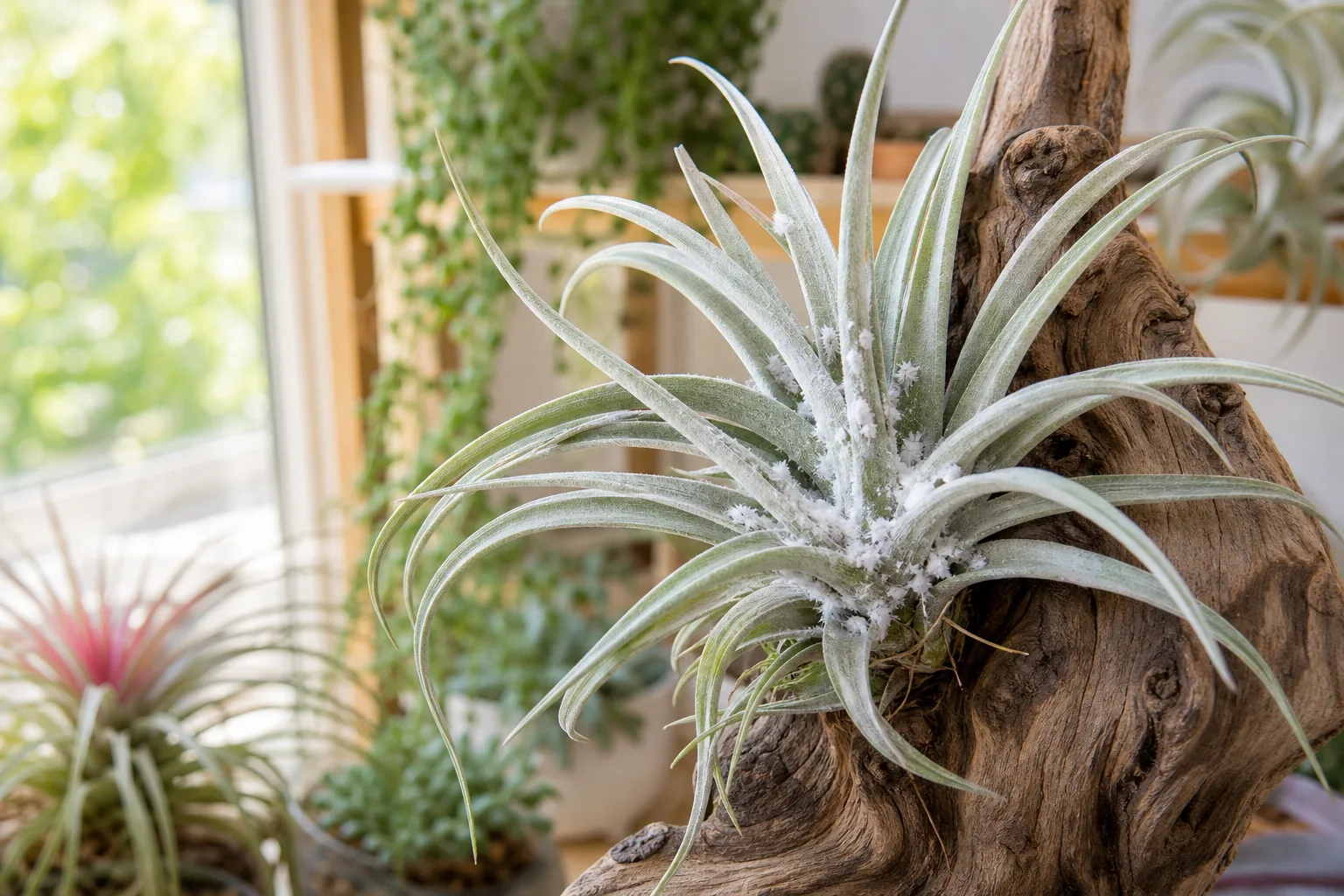
Mealybugs on Tillandsia appear as white cottony clusters tucked into leaf axils at the rosette base and along pup overlaps, often with sticky honeydew on trichome-covered leaves. First step: remove the plant from its mount or globe, isolate it, rinse every leaf overlap, then dry it upside down for at least four hours before dabbing visible wax with 70% alcohol on a cotton swab.
Mealybugs on Tillandsia: Causes, Checks & Fixes
This guide covers mealybugs on Tillandsia. See also the general Mealybugs guide, watering, and light pages for this plant.
Mealybugs on Tillandsia: Causes, Checks & Fixes
Quick answer
Mealybugs on Tillandsia (Tillandsia spp.) show up as white cottony clusters tucked into leaf axils at the rosette cup, along pup overlaps, and sometimes at wire-mount contact points where moisture lingers. They suck sap through the same trichome-covered leaves your air plant uses to drink, leaving sticky honeydew that can dull silver foliage and attract ants or sooty mold on mounts and inside glass globes.
First step: remove the plant from its display, isolate it from other air plants, and rinse every leaf overlap under lukewarm running water. Tillandsia has no soil reservoir-so the rinse knocks down exposed insects without a long submersion on day one. Immediately shake out water and dry the rosette upside down for at least four hours before dabbing wax with alcohol or remounting. On air plants, trapped crown moisture during pest treatment is a bigger survival risk than a small mealybug colony left dry for one afternoon.
For baseline soak-and-dry standards during recovery, see the Tillandsia watering guide. If pear-shaped insects cluster on soft new pups instead of cottony wax, compare with aphids on Tillandsia before choosing a treatment path.
What mealybugs look like on Tillandsia
On rosette air plants, mealybugs hide where leaves overlap and water pools after misting or soaking:
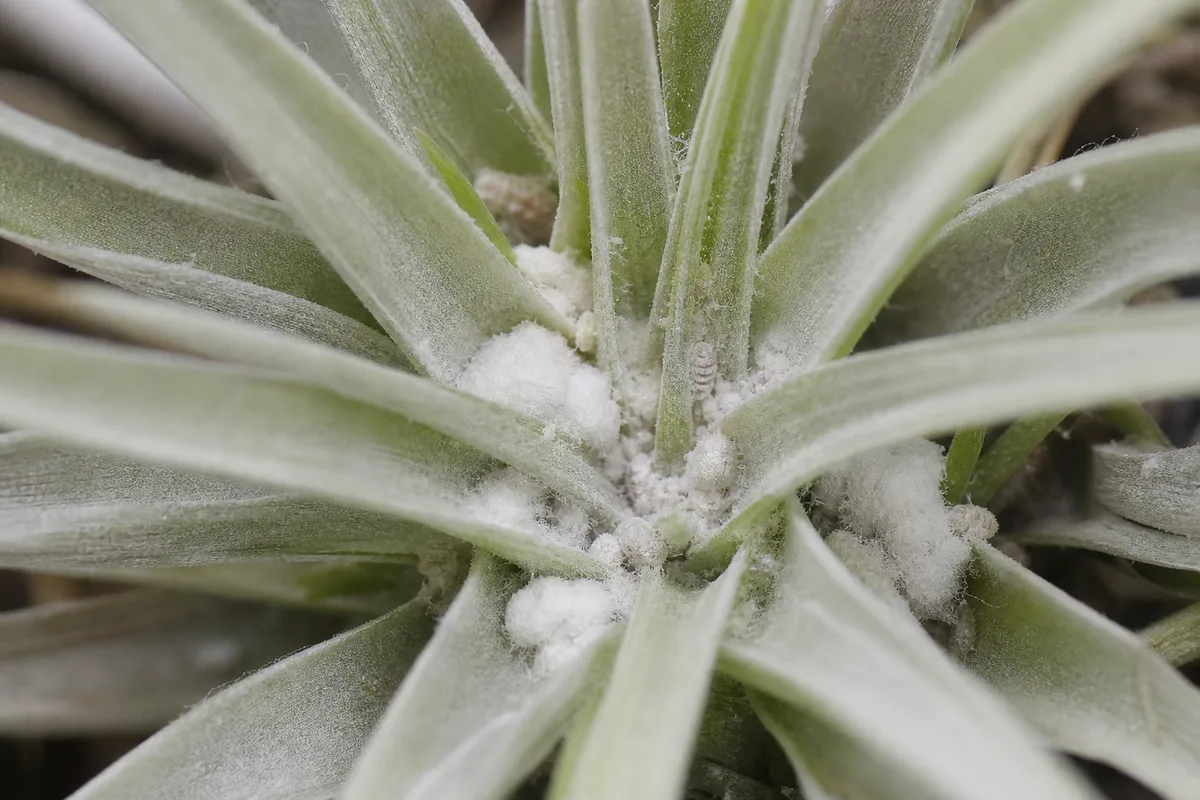
Mealybugs symptoms on Tillandsia - compare with healthy tissue on the same plant.
- White or gray cottony ovals deep in the rosette cup and at pup axils on clustered types like Tillandsia ionantha and Tillandsia capitata
- Waxy filaments that look like tiny cotton balls-not the even silver frosting of healthy xeric trichomes on Tillandsia xerographica or Tillandsia tectorum
- Sticky, shiny honeydew on leaf surfaces, the mount, cork backing, or inside a closed globe
- Black sooty mold on honeydew-coated leaves in heavy infestations
- Pinkish or yellowish smear when a cottony patch is crushed with a dry swab-mealybug body fluid, not mineral dust; alcohol-dabbed mealybugs turn orange-brown
- Ants on the shelf, globe rim, or wire frame farming honeydew from crown colonies
- Slow yellowing or stunted pups when feeding is heavy, while older outer leaves still look partially firm
Tillandsia in wall displays and hanging globes is easy to admire from the side and hard to inspect at the crown. You may notice stickiness on a lower leaf or sooty film on a mount before you spot cotton inside the rosette cup.
Trichome fuzz vs. cottony wax
| Feature | Normal trichome frosting (xeric types) | Mealybugs |
|---|---|---|
| Pattern | Even silver-gray coating following each leaf | Discrete cottony tufts in axils and crown crevices |
| Location | Across leaf surfaces, uniform | Clustered at overlaps, pup bases, mount points |
| Touch test | No stickiness; no pink smear when rubbed | Sticky nearby; pinkish fluid when wax is crushed |
| Movement | Static, part of leaf texture | Crawlers may appear when tuft is disturbed |
| After alcohol dab | Unaffected | Wax collapses; insects turn orange-brown |
Mesic green types like T. ionantha have smaller, smoother trichomes-mealybug wax can look more obvious against green tissue. On silver xeric species, learn your plant’s normal fuzz pattern first so you do not treat healthy trichomes as pests.
Why Tillandsia gets mealybugs
Mealybugs are common sap-sucking pests on houseplants that usually arrive on new nursery stock, shared tools, or nearby infested plants-not because tillandsia is uniquely prone, but because its growth form gives pests protected hiding spots.
Wet rosette cups and pup axils. Tillandsia drinks through foliar trichomes and has no soil to drain excess moisture. After misting, soaking, or a closed globe display, water can linger in the center cup where overlapping leaves meet. Mealybugs colonize those sheltered, slightly humid crevices-the same spots rinse water reaches last if you do not shake and flip the plant.
Tight clustered rosettes multiply hiding sites. Multi-pup T. ionantha clusters pack dozens of leaf axils in one fist-sized ball. A few cottony tufts inside one pup can spread to neighbors on the same wire before honeydew appears on an outer leaf.
Warm indoor rooms without predators. Mealybugs reproduce steadily in mild indoor temperatures where ladybugs, lacewings, and parasitic wasps are absent. A single overlooked tuft at a pup base can coat a whole mounted group between your normal weekly soak checks.
Soft new pup tissue. Fresh offsets push tender cells at the crown-easier for mealybugs to pierce than hardened outer leaves. Heavy nitrogen feeding during active growth can produce softer shoots, but introduction and sheltered crown moisture are the usual drivers.
Shared mounts and terrariums. Air plants wired to the same cork slab, driftwood, or enclosed terrarium share contact points where crawlers walk and honeydew accumulates. Treat every tillandsia on a shared display when one shows wax-not only the visible plant.
Stress from underwatering on Tillandsia or crown rot does not cause mealybugs, but it narrows recovery once sap loss and moisture mistakes stack during treatment.
How to confirm the cause
Work through these checks in order:
- Remove from mount or globe first - Inspect before returning the plant to any holder that traps moisture.
- Rosette cup and pup axils - Spread overlapping leaves under bright light. Stationary white cottony clumps with waxy filaments confirm mealybugs; uniform silver trichomes do not.
- Honeydew test - Run a finger along the newest inner leaf or pup base. Sticky residue with visible wax supports sap feeders.
- Crush or alcohol test - Touch a white patch with a dry swab. Mealybugs smear pinkish body fluid when crushed. Dabbing one tuft with rubbing alcohol collapses the wax and leaves treated insects orange-brown.
- Check mount, wire, and neighbors - Inspect cork, moss, globe interiors, and every tillandsia on the same display. Ants on the shelf often point to hidden crown colonies.
- Rule out care stress alone - Inward-curling silver leaves with no stickiness and no wax point to underwatering. Soft dark base with sour smell and no insects points to crown rot-see root rot on Tillandsia.
If you find insects but cannot tell mealybugs from aphids, note the shape: cottony static clusters in axils are mealybugs; pear-shaped moving insects on soft new pups are aphids. Both leave honeydew and share a rinse-first, dry-upside-down workflow.
First fix for Tillandsia
Remove the plant from its mount or globe and isolate it before you treat anything.
Isolation stops crawlers from reaching nearby tillandsia, bromeliads, and other houseplants on the same wire or shelf. Hold the rosette under lukewarm running water and direct the stream into every leaf overlap, pup base, and crown crevice where wax hides. The goal is to dislodge exposed insects-not submerge the plant for a full soak on day one.
Immediately shake the plant vigorously upside down to expel water from the crown, then place it on a towel in bright indirect light with good airflow. Let it dry completely-aim for at least four hours before dabbing alcohol or remounting. If the base still feels cool or damp at the center, extend drying rather than rushing back to a closed globe.
Once the plant is fully dry, dab every visible cottony cluster with a cotton swab moistened with 70% isopropyl alcohol, pressing into axils the rinse missed. Test alcohol on one outer leaf first on xeric silver types in hot direct sun-alcohol can mark trichomes if it pools on sun-stressed foliage.
Recheck in three to four days. Repeat alcohol dabs on any new wax. Do not apply neem oil, insecticidal soap, or alcohol on day one before confirming live mealybugs and completing the first dry cycle. Do not mount onto wet moss, fertilize, or return to a closed globe while the crown is still damp-stacking moisture on an epiphyte that already lost sap raises crown-rot risk far more than mealybugs alone.
Step-by-step recovery
After the first isolate-rinse-dry-alcohol cycle, work in this order:
- Dab all visible wax with 70% alcohol - Work axil by axil on clustered ionantha; dispose of swabs in sealed trash.
- Repeat alcohol dabs every three to four days - Weekly at minimum until no new cottony tufts appear for two inspections one week apart. Eggs and crawlers hide in protected crown folds and survive a single pass.
- Optional insecticidal soap after a spot test - If alcohol dabs are not reaching deep axils, spray one leaf and wait 24 hours. If no burn appears, apply commercial insecticidal soap to inner overlaps and pup bases. Soaps kill only on contact and have no residual effect-coverage matters more than strength.
- Rinse soap or neem residue, then dry upside down again - After any spray, rinse with clean water when the label allows, shake out droplets, and dry upside down before remounting.
- Inspect pups separately on multi-head clusters - Mealybugs often jump from mother rosette to offsets. Treat or remove heavily waxed pups if alcohol cannot reach inside curled tissue.
- Wipe honeydew and sooty mold - Clean sticky residue from leaves and mounts so mold does not return. Sooty mold clears once honeydew stops-it is not a separate disease.
- Hold fertilizer until new growth stays clean - Resume light feeding only after two weeks with no wax on fresh pups.
- Re-check the collection - Monitor every tillandsia that shared a mount, terrarium, or hanging display.
For globe-mounted displays, leave the plant out of the enclosure during the entire treatment window. A closed globe traps humidity and turns every rinse into a crown-rot event.
Neem oil vs. alcohol on tillandsia trichomes
Alcohol dabs are the standard first contact treatment for light mealybug clusters on houseplants-targeted, fast, and unlikely to coat the whole leaf when used on the wax mass only. Neem oil can work on persistent colonies but coats trichomes and may reduce water uptake if over-applied on xeric silver types. If you use neem, dilute per label, test one leaf, apply in bright indirect light-not on sun-hot wet leaves-and rinse and dry upside down afterward. Many tillandsia growers clear mild crown infestations with repeated alcohol dabs alone before reaching for oils.
Mounted and terrarium display cautions
- Take every plant off shared wire before treating-crawlers walk along mounts.
- Open closed globes and terrariums for the full treatment period; remount only when crowns are bone dry.
- Avoid moist sphagnum or moss against the crown during active infestation-it holds humidity where mealybugs thrive.
- Keep pets away from wet alcohol or soap residue until leaves are fully dry; tillandsia is generally non-toxic, but treatment products are not food.
Recovery timeline
Expect visible wax tufts to collapse within days of targeted alcohol dabbing. Full clearance indoors often takes three to four weeks because overlapping generations hatch between treatments.
Signs recovery is working:
- No new cottony tufts on the newest pup or inner leaves after two checks one week apart
- Honeydew stops appearing on leaf surfaces and the mount
- The next pup or leaf segment opens firm and clean
- Ant activity around the display disappears
- The base stays firm and dry between soaks
Signs the problem is worsening:
- Wax spreads from one pup to most of the cluster
- New segments emerge small, twisted, or fail to open
- Sooty mold covers large areas of foliage
- The base softens, darkens, or smells sour after rinses-see root rot on Tillandsia
- Mealybugs appear on plants that were not treated or isolated
Damaged leaves already dulled or scarred from heavy feeding will not fully regain perfect trichome sheen. Judge success by wax-free new growth and a firm base, not by repairing old blades.
Lookalike symptoms and causes to rule out
| What you see | Likely cause | Why it differs from mealybugs |
|---|---|---|
| Even silver-gray leaf frosting | Normal xeric trichomes | Uniform coating; no stickiness; no discrete cotton tufts |
| Pear-shaped insects on soft pups | Aphids | No fluffy wax coat; see aphids guide |
| Fine stippling + webbing, dry air | Spider mites | No honeydew cotton; see spider mites guide |
| Brown immobile bumps on older leaves | Scale | Does not crush pink; no waxy filaments |
| White crust on leaf tips only | Hard-water mineral deposits | Wipes away with vinegar rinse; no axil clusters |
| Soft dark base, sour smell, no wax | Crown rot | Base failure from trapped moisture; see root rot guide |
Mistakes to avoid
- Skipping isolation - treating one globe cluster while crawlers reach a mounted neighbor on the same hook
- Returning a damp plant to a closed globe - crown pooling after a rinse kills tillandsia faster than most pest damage
- One-and-done alcohol dab - a single pass rarely clears eggs and hidden crawlers in pup axils
- Pooling alcohol in the rosette cup - dab the wax mass only; do not flood the crown
- Long soak as day-one treatment - rinses dislodge exposed insects; soaks without upside-down drying trap water where mealybugs already shelter
- Using homemade dish soap - high risk of trichome burn on air plant foliage; use products labeled for plants
- Applying neem or soap to sun-stressed wet leaves - treat in bright indirect light after the plant is fully dry
- Fertilizing mid-infestation - soft new growth from nitrogen flushes feeds the next wave
When handling multiple treated plants, remember tillandsia is generally listed as non-toxic to cats and dogs-but keep pets away from wet alcohol or soap residue until leaves are fully dry.
Tillandsia care cross-check
While fighting mealybugs, keep baseline care steady rather than overcorrecting:
- Light: Bright indirect light supports recovery without scorching wet trichomes after treatment; see the Tillandsia light guide
- Water: Continue the normal soak 20 to 30 minutes weekly (or biweekly for heavy xeric trichomes), then shake and dry upside down for at least four hours before remounting-never skip drying because you are focused on pests
- Display: Open mounting on cork or wire is safer than closed globes during active infestation
- Species type: Mesic green types like T. ionantha tolerate fuller rinses; xeric silver types need shorter water contact and longer dry time between treatments
A plant in stable care pushes clean new pups faster once insects are gone. Swinging between drought and repeated soaking while dabbing alcohol will show up as curled leaves that make it harder to tell whether mealybugs or watering are the problem.
How to prevent mealybugs next time
- Quarantine new air plants for 14 days and inspect rosette cups before placing them on a shared mount or shelf
- Weekly crown and pup checks during spring and summer growth-mealybugs are easiest to dab when only one or two tufts are present
- Dry upside down after every soak or mist so wet rosette cups do not become pest shelters-see the Tillandsia watering guide
- Inspect displays from multiple angles - wax inside rosette cups is easy to miss when viewed from the side only
- Treat the first white cotton spot before mealybugs coat a whole ionantha cluster on one wire
Prevention on tillandsia is mostly about early detection at the crown and keeping the rosette cup dry between waterings, not sterile conditions.
When to worry
Most established tillandsia survive mealybugs if you isolate early, rinse thoroughly, dry upside down, and repeat alcohol dabs until colonies stop. Consider the plant at higher risk if:
- Wax covers most pups in a multi-head cluster despite three or more treatment cycles
- New segments stop opening or emerge repeatedly distorted for three or more weeks
- Crown rot symptoms (soft dark base, sour smell, inner leaves pulling free) appear after rushed drying-treat moisture first
- Mealybugs spread to multiple mounted plants despite isolation
A single blemished outer leaf is cosmetic. A plant that stops producing clean new growth for a month after repeated treatment may still be saved through pup removal-though that outcome is uncommon when action starts at the first cottony tuft in the cup.
Conclusion
Mealybugs on Tillandsia reward systematic crown inspection, not a single spray. Confirm cottony wax in rosette axils with sticky honeydew, isolate before treating, rinse every leaf overlap, dry upside down for at least four hours, and repeat 70% alcohol dabs until new growth stays clean. On air plants, crown moisture kills faster than mealybugs-so the dry step is treatment, not an optional extra.
Related guides: Tillandsia overview · Watering · Light · Aphids · Spider mites · Root rot
Practical checks
Urgency check
Treat as urgent if bases soften, rot smell spreads, wax covers multiple pups, or several inner leaves fail at once while the plant stays damp in a closed globe.
Best inspection order
Rosette cup and pup axils → honeydew on mount → crush/alcohol test on white tufts → base firmness → neighboring air plants on the same display → trichome fuzz vs. wax comparison on silver types.
Severity note
Use spreading crown rot and multi-plant infestation-not a single blemished outer leaf-to decide how fast to act.
When to use this page vs other Tillandsia guides
- Tillandsia watering guide - Use for routine moisture checks before assuming mealybugs is the main issue.
- Tillandsia problems hub - Browse all 19 common issues on this species.
- Yellow Leaves on Tillandsia - Different entry point when symptoms overlap with mealybugs.
- Slow Growth on Tillandsia - Different entry point when symptoms overlap with mealybugs.
- Spider Mites on Tillandsia - Different entry point when symptoms overlap with mealybugs.