Yellow Leaves on Tillandsia: Causes, Checks & Fixes
Quick answer
One dry yellow outer leaf on a firm Tillandsia ionantha cluster is often normal senescence; yellow spreading from a soft wet base is not. First step: pinch the lowest leaf bases-if firm and dry, decide whether yellow is outer-only aging, pale stretch from low light, dull fade from thirst, or chalky bleach from excess sun before you soak or trim.
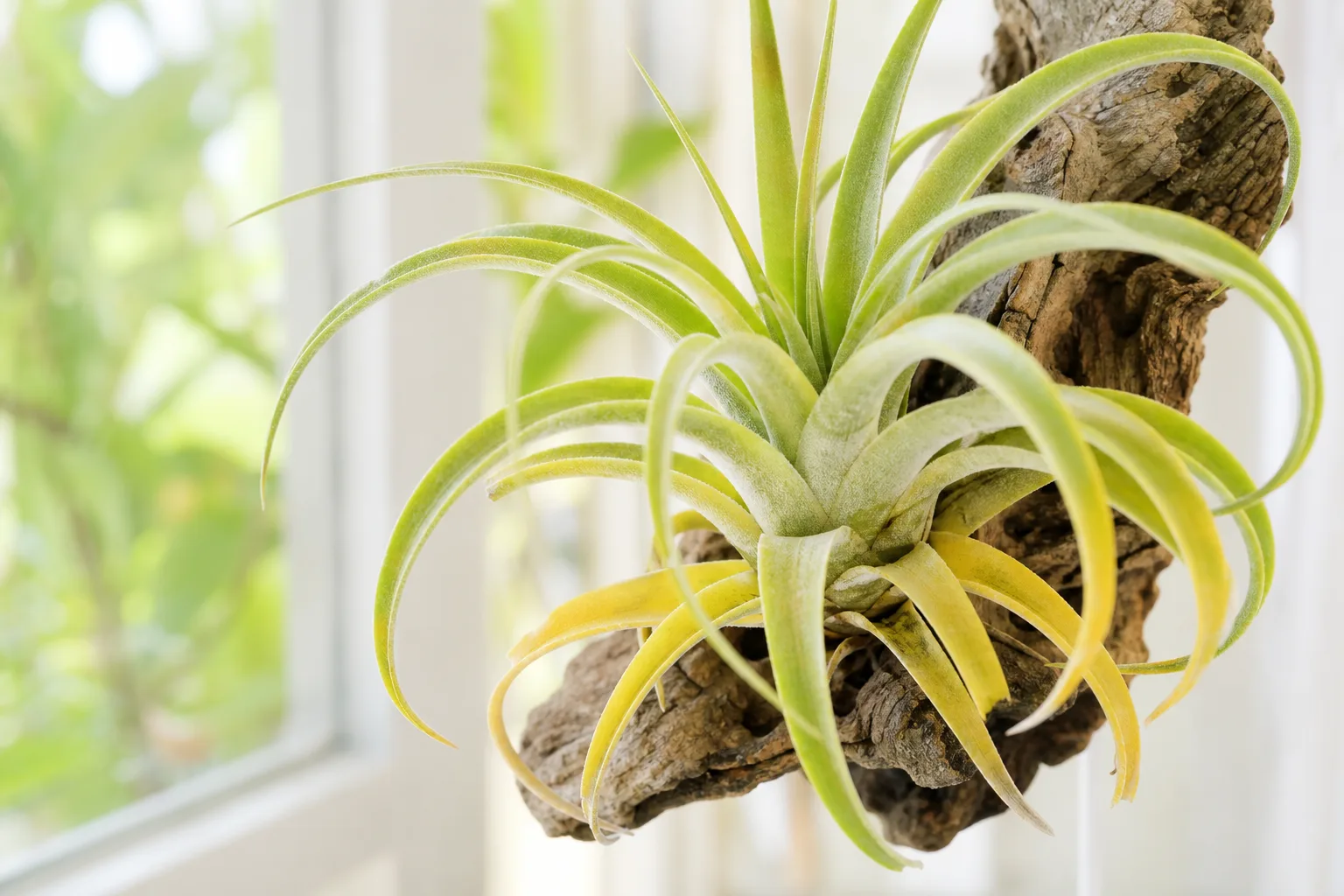
Yellow Leaves on Tillandsia: Causes, Checks & Fixes
This guide covers yellow leaves on Tillandsia. See also the general Yellow Leaves guide, watering, and light pages for this plant.
Yellow Leaves on Tillandsia: Causes, Checks & Fixes
Quick answer
Yellow leaves on Tillandsia (air plants) split into two very different stories. One dry yellow outer leaf on a firm Tillandsia ionantha cluster is often normal senescence as the plant sheds its oldest sheath. Yellow spreading inward from a soft, wet base is crown failure-usually trapped water after a soak, not a soil problem.
First step: pinch the lowest overlapping leaf bases. If firm and dry, use the pattern table below to decide whether you are seeing outer aging, pale low-light fade, dull underwatering fade, or chalky sun bleach. If soft, dark, or sour-smelling, stop soaking and route to overwatering or crown rot-do not treat yellow like a potted fern with dry mix.
Tillandsia has no soil root zone to inspect. On air plants, where yellow appears (outer vs. center) plus base firmness replace the “check the potting mix” test. Judge recovery by firm new center growth, not by expecting old yellow blades to turn green again.
What yellow leaves look like on Tillandsia
Yellow on air plants is a pattern, not one uniform color. Four common patterns cover most cases:
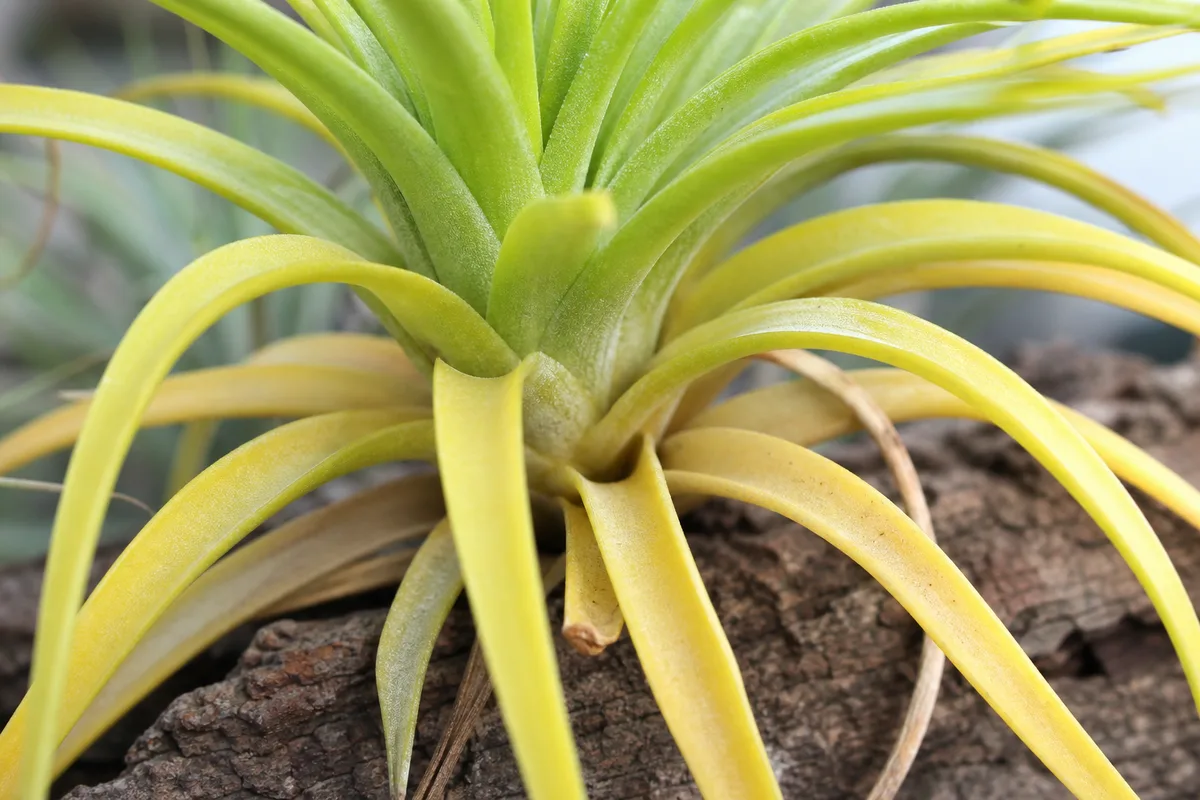
Yellow Leaves symptoms on Tillandsia - compare with healthy tissue on the same plant.
Outer-leaf aging (normal on clumping species):
- Single oldest leaf at the outside of a cluster turns solid yellow, then tan and papery
- Center and pups stay green; base feels firm and dry
- Common on Tillandsia ionantha clumps after bloom or pup formation
- Leaf separates cleanly when fully dry-no mush, no smell
- Differs from disease: yellow does not march inward week after week
Crown rot yellow-green (wet failure):
- Inner or center leaves turn translucent yellow-green before browning or blackening
- Base softens; gentle tug may pull inner leaves free
- Sour or musty smell at the core
- Often follows soak without upside-down drying, closed terrarium misting, or returning a damp plant upright to a globe
- Outer leaves may still look green while the center is already failing-the signature overwatering pattern on tillandsia
Sun bleach (excess direct light):
- Chalky yellow-white or pale patches on the leaf surface facing the window
- Base stays firm; no odor
- Hits mesic green types-Tillandsia bulbosa, T. caput-medusae, greener T. stricta-faster than silvery xeric rosettes
- May progress to crispy brown tips on the bleached zone
- See Tillandsia light needs for mesic vs. xeric placement
Underwatering dull fade (thirst before brown tips):
- Whole rosette shifts dull gray-green or washed-out silver before tips crisp
- Leaves feel papery but base remains firm
- Yellowing is even and dry, not translucent or slimy
- Follows mist-only routines, overdue soaks, or dry winter air without mid-week mist
- Differs from rot: no soft base, no sour smell-see underwatering
Low-light pale stretch (before full yellow):
- New growth looks pale yellow-green or washed-out, rosette opens and stretches
- Base firm; often mistaken for nutrient deficiency
- Chronic dim placement-not a single missed soak
- Route to not enough light if stretch dominates
Species baseline matters: Silvery Tillandsia xerographica and T. tectorum naturally read paler than green mesic types-judge yellow against your plant’s normal trichome color, not a generic “houseplant green.”
Why Tillandsia gets yellow leaves
Tillandsia is an epiphytic bromeliad that drinks through leaf trichomes, not roots in mix. Leaves are the entire intake and support system-when water, light, or age stress the rosette, color shifts on the blade before the plant collapses. That is different from a potted philodendron yellowing from nitrogen loss in soil; you cannot fertilize your way out of a wet crown or a bleach patch without fixing the trigger.
Trapped crown moisture → yellow before black rot
Rosette tillandsias funnel water into the leaf base when they dry upright or sit in humid enclosures. UF/IFAS air plant guidance stresses light, airflow, and periodic hydration-conditions that fail when water pools in overlapping leaf axils. Inner tissue turns translucent yellow-green as cells break down; crowns rot when water is not drained after watering, and advanced cases blacken and smell. The yellow phase is your warning window-act before the core pulls out.
Outer-leaf senescence on clumping species
Mother tillandsias bloom once and slowly decline while pups form at the base. On clustered Tillandsia ionantha, the oldest outer leaves yellow and dry as energy shifts to pups-a normal lifecycle signal, not rot. Remove only fully dry sheaths; do not pull green-yellow transition tissue.
Light stress: too little and too much
Too little light bleaches new growth pale yellow-green and stretches the rosette. Too much direct sun-especially on mesic greens-produces chalky yellow-white burn patches on exposed surfaces. Bright filtered light is the indoor baseline; mesic types need diffusion, while xeric silvers tolerate some morning sun when acclimated.
Gradual dehydration
When trichomes run low on moisture, leaves dull and fade toward gray-green or silvery yellow before tips brown. The base stays firm. Mist-only care in dry apartments is a common trigger-soaking charges trichomes; light misting often does not.
Shipping and display stress
Transit can yellow outer leaves only on an otherwise firm plant. Closed globes and wet moss nests yellow from the center outward when humidity stalls drying-different fix (airflow and open mounting), not more water.
Lookalike symptoms to rule out
| Pattern | Key clues | Likely cause | Where to go |
|---|---|---|---|
| Single dry yellow outer leaf, firm base | Center green, no smell | Normal aging / post-bloom | This page-monitor only |
| Translucent yellow-green center, soft base | Sour smell, inner pull-out | Crown rot / overwatering | Overwatering, crown rot |
| Dull gray fade, papery feel, firm base | Long dry gap, mist-only | Underwatering | Underwatering |
| Pale stretch, open rosette, firm base | Dim location | Low light | Not enough light, light guide |
| Chalky patch on sun-facing side | Firm base, recent window move | Sun bleach | Light guide-reduce direct rays |
| Brown crispy tips, firm base | Dry air, salt, sun edge | Tip burn | Crispy leaves, brown tips |
| Pinpoint yellow dots, fine webbing | Axil silk on ionantha | Spider mites | Spider mites |
| Loose outward hang, firm base | Not primarily yellow | Droop / wilt overlap | Drooping leaves, wilting |
If base firmness and smell disagree with leaf color, trust the base first. Firm and dry almost never means active crown rot.
How to confirm the cause
Work through these six checks in order. Each step narrows the cause before you act.
- Base squeeze - Pinch lowest overlapping leaf bases. Firm and dry supports aging, light, thirst, or sun bleach paths. Soft, dark, or smelly means stop-route to overwatering or crown rot.
- Outer vs. center - Yellow on one dry outer leaf only on a firm cluster = likely senescence. Yellow moving inward or center translucent = crown stress.
- Recent water event - Soak, heavy mist, terrarium, or globe in the last 48 hours? Wet failure yellows from the core. Long dry gap with dull fade = thirst.
- Light audit - New pale stretch in a dim corner? Low light. Chalky patch on the window-facing side after a recent move? Sun bleach. Compare to mesic vs. xeric placement.
- Trichome texture - Papery and dull on a firm base = dehydration. Plump but discolored with soft base = rot. Crisp bleached surface with firm base = sun.
- Smell and tug - Sour odor or inner leaves pulling free confirms crown damage. Neutral dry scent with a single yellow outer sheath supports aging.
Confirmed outer aging: one dry yellow outer leaf + firm base + healthy center + no odor.
Confirmed crown rot yellow: translucent center leaves + soft base + recent wet event + possible smell.
Confirmed sun bleach: chalky yellow-white patch on exposed side + firm base + strong direct sun exposure.
Confirmed thirst fade: dull even yellow-gray + papery trichomes + firm base + overdue soak or mist-only routine.
First fix for Tillandsia
Match one fix to the confirmed pattern-do not soak, fertilize, and prune on the same day.
If outer aging only (firm base, single dry yellow leaf)
Remove the fully dry yellow outer leaf with a gentle tug or clean scissors. Do not soak extra “to help.” Monitor center growth weekly. No treatment stack needed if pups and inner leaves stay firm and green.
If crown rot yellow-green (soft or smelly base)
Stop all water immediately. Hold the plant upside down, shake out trapped droplets, and dry in bright indirect light with airflow until the base is completely dry-within about four hours. Do not rescue-soak. Trim only soft, mushy tissue with clean scissors once dry; leave firm leaves. Check for firm pups to salvage. Full triage: crown rot guide.
If underwatering dull fade (firm base, papery leaves)
Give one full 20–30 minute soak, then dry upside down until the base is dry. Shorten the interval between soaks going forward; add mid-week mist only as a supplement-not a replacement for soaking. Details: watering guide.
If low-light pale yellow-green stretch
Move to bright filtered light within a few feet of an east or diffused south/west window-not a dark shelf. Wait 10–14 days and judge new center leaves, not old stretched blades. See light placement.
If sun bleach (firm base, chalky patches)
Move back from direct sun to bright indirect light. Acclimate gradually if you increase sun later-xeric types only, morning rays first. Old bleached tissue will not re-green; watch emerging leaves for clean color.
Recovery timeline
Outer aging: the yellow leaf dries and sheds over 1–3 weeks; no recovery of that blade-pups and center should stay firm throughout.
Thirst fade: visible firming often within 24–48 hours after a proper soak and dry if the base stayed sound; full rosette color may take one to two soak cycles.
Low light: new growth improves over 2–4 weeks after a brighter placement; old pale leaves may stay slightly washed out.
Sun bleach: new leaves open clean within 2–3 weeks once exposure is corrected; bleached patches on old leaves are permanent.
Crown rot yellow: if caught early with firm tissue remaining after dry-down, 2–4 weeks to see whether new center leaves emerge. Advanced mush with odor often means the mother plant is lost-salvage pups if firm.
Recovery marker everywhere: firm new center growth and stable base, not repaired yellow old leaves.
What not to do
Do not soak a soft, sour-smelling crown as a rescue-that accelerates rot. Do not fertilize yellow leaves before you confirm cause; stressed tillandsias rarely need feed first. Do not judge recovery by old yellow blade color-watch the core. Do not keep misting because leaves look tired when the base is still damp from yesterday’s soak. Do not assume all yellow means underwatering-a wet tillandsia yellows from the center outward, the opposite of thirst. Do not pull green-yellow transition leaves on a firm plant; wait until they are fully dry. Do not treat air plants like potted ferns-there is no root zone to dry out; crown firmness is the equivalent signal.
How to prevent yellow leaves next time
Follow the soak-and-dry workflow from the Tillandsia watering guide: remove from holder, submerge 20–30 minutes, shake upside down until droplets stop, dry in bright airflow until the base is fully dry, then remount openly. Match light to mesic vs. xeric type per the light guide. Inspect bases during every soak-catch translucent yellow-green early. On ionantha clusters, expect occasional outer yellow leaves and distinguish them from center failure. Avoid closed globes and wet moss collars; see overview for display basics.
Practical checks
Urgency check
Treat as urgent if yellow spreads inward, the base softens, rot smell appears, multiple inner leaves fail at once, or yellow follows repeated soaks without drying. A single dry outer yellow leaf on a firm ionantha is not urgent.
Best inspection order
Base firmness and smell → outer vs. center yellow pattern → recent soak/mist/display → light exposure side → trichome texture (papery vs. plump) → pest stippling on undersides.
Severity note
Use inward spread and base softness-not one yellow outer leaf-to decide how fast to act. When in doubt on wet vs. dry yellow, squeeze the base before you soak.
Related Tillandsia problems
- Overwatering - trapped water after soak
- Crown and base rot - soft black core triage
- Underwatering - dull fade before brown tips
- Not enough light - pale stretch
- Crispy leaves and brown tips - tip burn overlap
- Wilting and drooping leaves - posture loss on firm bases
- Watering · Light · Overview
Conclusion
Yellow leaves on Tillandsia are a routing problem: outer dry yellow on a firm ionantha is often lifecycle aging; translucent yellow-green at a soft base is crown failure; chalky patches mean sun; dull fade means thirst. Pinch the base first, match one fix to the pattern, and judge success by new firm center growth-not by re-greening old yellow blades.
When to use this page vs other Tillandsia guides
- Tillandsia watering guide - Use for routine moisture checks before assuming yellow leaves is the main issue.
- Tillandsia problems hub - Browse all 19 common issues on this species.
- Overwatering on Tillandsia - Different entry point when symptoms overlap with yellow leaves.
- Underwatering on Tillandsia - Different entry point when symptoms overlap with yellow leaves.
- Not Enough Light on Tillandsia - Different entry point when symptoms overlap with yellow leaves.