Scale Insects on African Violet: Causes, Checks & Fixes
Quick answer
Scale on African Violet looks like immobile waxy bumps along petioles and inside the tight rosette center. First step: isolate the plant and brush each visible scale with a soft toothbrush dipped in 70% isopropyl alcohol-do not shower fuzzy leaves or spray the crown.
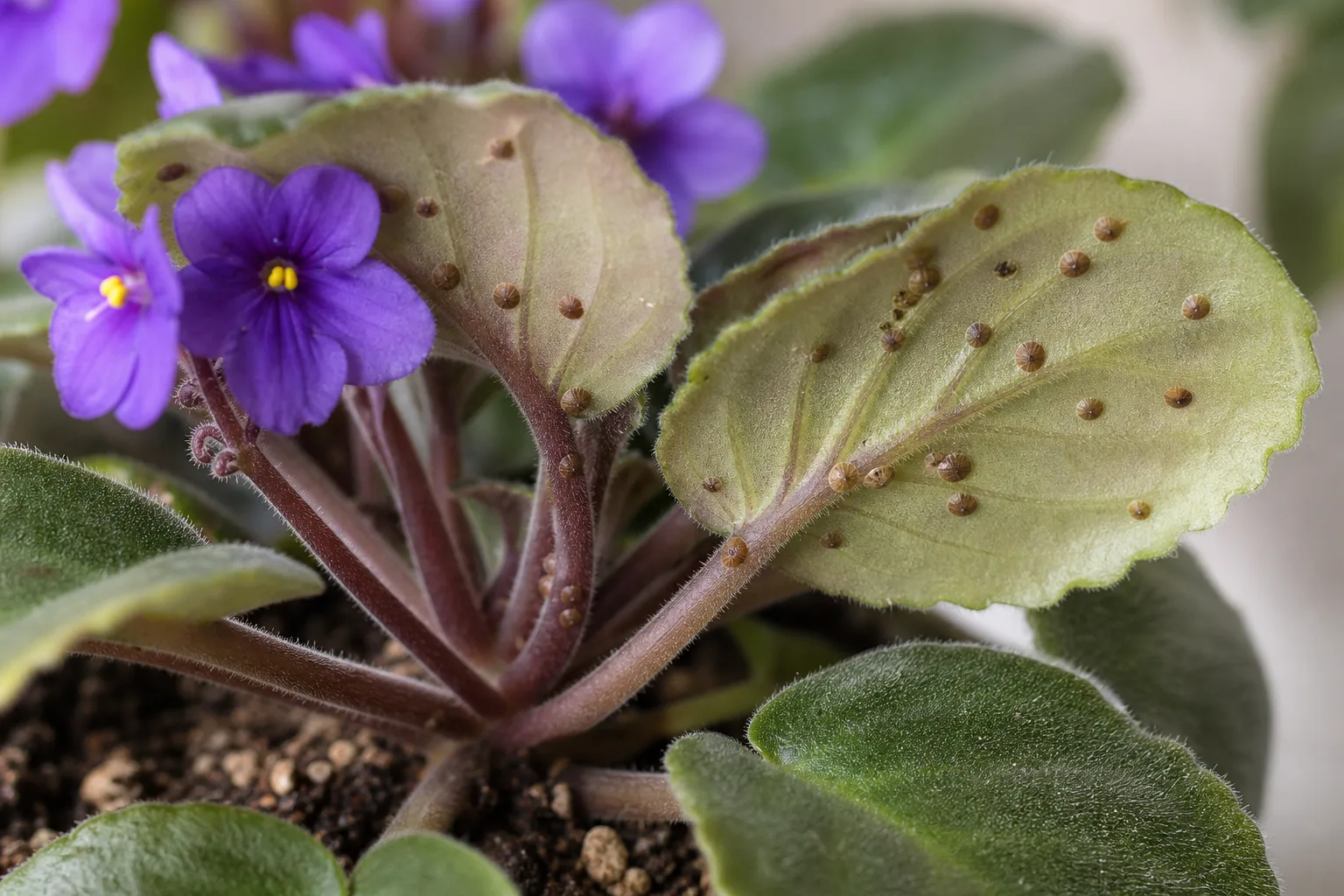
Scale Insects on African Violet: Causes, Checks & Fixes
This guide covers scale insects on African Violet. See also the general Scale Insects guide, watering, and light pages for this plant.
Scale Insects on African Violet: Causes, Checks & Fixes
Quick answer
Waxy bumps tucked along petioles or inside your African Violet rosette are usually scale insects-immobile sap feeders protected by a hard or waxy shell. On Saintpaulia, the tight crown and fuzzy leaves give them shelter exactly where foliar sprays miss and where you inspect least during routine bottom-watering.
First step: isolate the plant and brush every visible scale with a soft toothbrush dipped in 70% isopropyl alcohol. Work petiole by petiole and lift inner leaves to reach the rosette center. Do not shower fuzzy foliage or spray the crown with cold water-that causes permanent ring spots and crown rot on a plant that must stay dry on top.
Why African Violet gets scale insects
Scale usually hitchhikes on a new purchase, a shared cutting, a grocery-store violet, or a neighboring houseplant that already had a low-level infestation. African violet is listed among flowering houseplants affected by indoor scale species, including fern scale and brown soft scale-the two species commonly found on African violets.
Several traits of African Violet culture make scale harder to spot and harder to treat than on smooth-leaved houseplants. The compact rosette shelters insects between overlapping fuzzy leaves and inside tight crown folds. Bottom-watering keeps foliage healthy but means you may not look closely at petiole bases unless you lift leaves during weekly care. Crowded shelves under grow lights let crawlers move pot to pot without you noticing.
Warm indoor rooms suit scale year-round. Multiple overlapping generations can occur on indoor plants when mild temperatures and absent natural enemies let populations build quietly. A recent show-plant purchase or a violet pushed into a dim corner with slow growth often coincides with the first visible bumps along inner petioles.
What scale insects look like on African Violet
Scale insects are slow-moving pests with round, oyster-shaped bodies measuring roughly 1/16 to 1/4 inch. They can attach to almost any part of African Violets, feeding on sap from leaves and stems. If left untreated, heavy infestations can kill the plant.
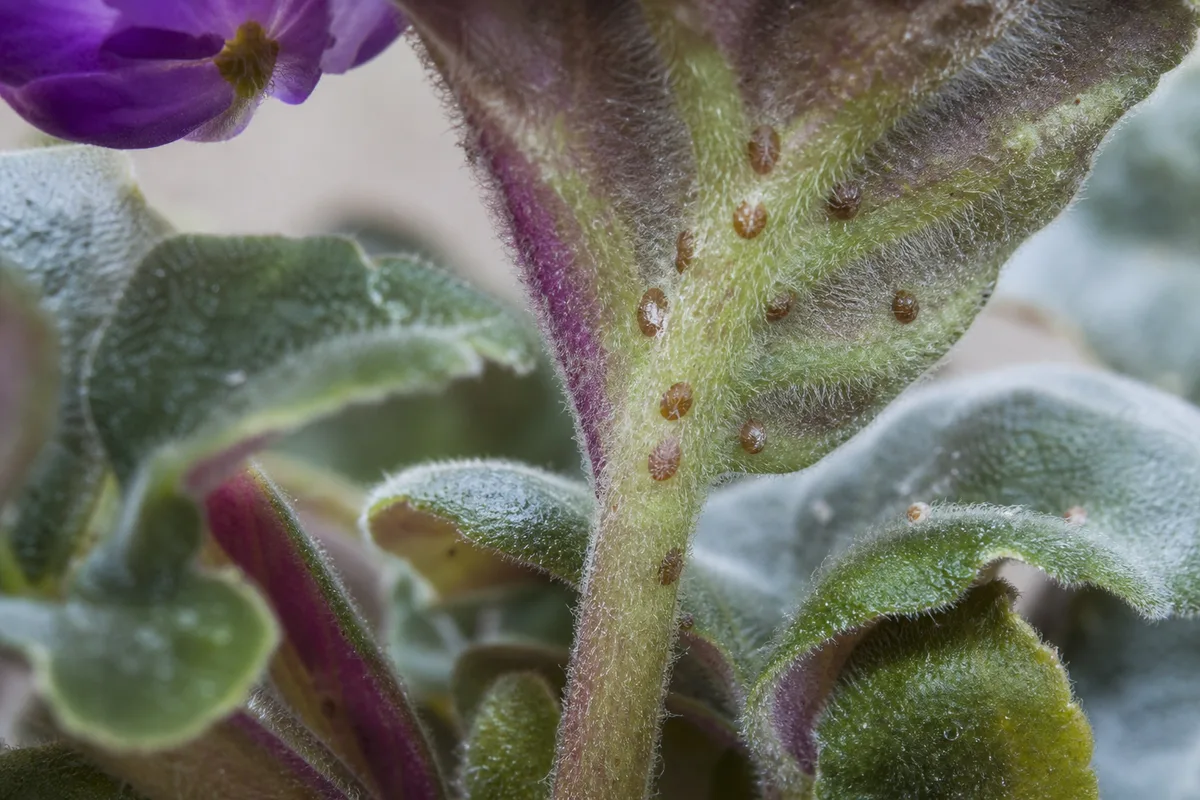
Scale Insects symptoms on African Violet - compare with healthy tissue on the same plant.
On African Violet, look for:
- Flat or dome-shaped bumps in white, tan, brown, or gray along petioles, leaf undersides, and the rosette center
- Sticky, shiny honeydew on upper leaf surfaces where droplets fall from infested tissue above (typical of brown soft scale)
- Black sooty mold as tiny dark speckles on sticky leaves; it wipes off but returns until insects are controlled
- Ant trails on pot rims or saucers-ants harvest honeydew and protect scale colonies
- Pale, yellowing, or slow-growing center leaves when feeding is sustained
Armored vs. soft scale on fuzzy foliage
The two species most often seen on African Violet behave differently-and that changes what you notice first.
Fern scale (Pinnaspis aspidistrae) is an armored scale. Female covers are pear- or oyster shell-shaped, flat, and light to dark brown. Males produce prominent white flecking that can look like dust on fuzzy leaves. Armored scale rarely produces much honeydew; damage shows as yellow spotting and slowed center growth.
Brown soft scale (Coccus hesperidum) is a soft scale. Mature covers are oval, tan to yellow-brown, and may produce large quantities of honeydew that attracts ants and supports sooty mold. On African Violet, soft scale often lines petioles and leaf veins on undersides where overlapping leaves hide colonies.
Press a suspect bump with a fingernail or toothpick. Scale should flake off with gentle pressure; mineral spots, perlite specks, and normal leaf texture stay attached. Mealybugs smear waxy cotton instead of lifting as a hard shell-see mealybugs on African Violet for that lookalike.
How to confirm the cause
Do not treat from one tan speck on an outer leaf. Use this inspection order:
- Isolate first - Move the violet away from your collection before handling so crawlers do not walk to neighboring pots.
- Rosette center - Lift the two innermost leaf rows and inspect where new growth emerges; scale often concentrates here first.
- Petiole bases - Follow each petiole from the crown outward with bright light and a magnifying glass.
- Leaf undersides - Check veins and margins on the lower leaf rows, especially where leaves overlap.
- Pot rim and soil line - Look along the main stem where it meets the mix and on unglazed pot edges.
- Scrape test - Pry a bump with a toothpick. Scale shells lift; edema blisters, chalky deposits, and normal fuzz do not.
- Neighbor check - Inspect African Violets and any plants on the same shelf for bumps or honeydew.
Lookalike symptoms to rule out
| What you see | Likely cause | Quick check |
|---|---|---|
| White cottony clusters in axils | Mealybugs | Smears pink when crushed |
| Silvery streaks on petals | Thrips | Insects jump when disturbed |
| Sticky leaves + clustered soft insects on buds | Aphids | Pear-shaped bodies on tender growth |
| Flat white film across leaf blade | Powdery mildew | Wipes to powder, not discrete bumps |
| Clear raised blisters on margins | Edema | No bumps on petioles; linked to overwatering on African Violet |
| Evenly distributed leaf fuzz | Normal Saintpaulia trichomes | Uniform across blade, not clustered at joints |
If stems are firm, the crown is tight, and the only issue is immobile bumps with optional stickiness, scale fits. Soft, spongy crown tissue with sour-smelling mix points to crown rot-a different emergency.
First fix for African Violet
Isolate the plant and brush every visible scale with a soft toothbrush dipped in 70% isopropyl alcohol.
That single action removes adults you can reach and confirms the pest is alive before you commit to sprays. Optimara recommends removing light infestations with a soft-bristled toothbrush dipped in soapy water or 70 percent isopropyl alcohol. On African Violet, contact brushing beats a blanket foliar spray because overlapping fuzzy leaves shield the rosette center and wet hairy foliage sunburns easily under grow lights.
Work from the crown outward-inner petioles first, then outer leaves. A fine artist’s brush reaches crevices a toothbrush cannot. Wipe honeydew from leaf surfaces with a fresh swab so sooty mold does not take hold. Keep the plant out of direct sun while any treated foliage dries.
Repeat brushing every six to seven days for at least three cycles to catch newly hatched crawlers before they settle under a new shell. Adult scales are protected by their waxy covering, so one pass rarely clears an established colony.
Why foliar sprays miss the rosette center
African Violet leaves overlap in a tight rosette. Spray mist pools on outer fuzz, runs off before reaching inner petioles, and can wet the crown-inviting rot in a plant you normally water from the bottom. Alcohol brushing targets individual bumps without soaking the center. If you must spray, tilt the plant, shield the crown with a paper cone, and treat undersides only in indirect light.
Insecticidal soap and neem for heavier infestations
If bumps persist after several alcohol-brush rounds:
- Insecticidal soap - Use a product labeled for houseplants, not dish detergent. Soaps are contact insecticides with no residual effect, so spray must wet crawlers directly on leaf undersides and petioles. Test one leaf, wait 48 hours, then repeat at label intervals (often four to seven days).
- Horticultural oil - Oils suffocate insects by blocking breathing pores and can help armored-scale crawlers if applied thoroughly. On fuzzy African Violet foliage, oil residue can scorch under bright grow lights-apply in dim light, keep the crown dry, and watch for leaf burn over 72 hours.
- Labeled systemic drenches - Systemic products are effective on brown soft scale but less reliable on armored species. Reserve for persistent soft scale after manual removal fails, and follow indoor label directions exactly.
Optimara notes that heavier infestations may require labeled sprays repeated every six to seven days. Malathion can discolor flowers; keep spray off open blooms when possible. Many household sprays contain additives that damage African Violet leaves-prefer products formulated for sensitive houseplants.
Do not fertilize a pest-stressed violet hoping to push new growth. Soft tissue from extra nitrogen gives crawlers more feeding sites exactly when you want the plant to recover slowly.
Recovery timeline and bloom expectations
Light infestations often show progress within one to two weeks of consistent alcohol brushing. Plan three to four weekly passes because eggs hatch on staggered schedules and crawlers resettle quickly in the rosette.
Judge success by clean new center leaves, no fresh honeydew, and no new bumps at petiole bases-not by whether old yellowed outer leaves look perfect again. Badly marked foliage may never fully recover; remove it once the plant is insect-free and producing healthy new growth.
During active bloom, expect slower visual recovery if you must work around open flowers. Remove a heavily infested flower stalk rather than soaking petals with alcohol or soap.
Sooty mold and ant management
Sooty mold is a surface fungus that grows on honeydew from soft scale-not a separate disease. Once insects are controlled, wipe leaves with a swab lightly dampened with alcohol to lift black speckles. Ants farming honeydew protect scale colonies; clean sticky pot rims and consider ant barriers on shelves until the infestation clears.
What not to do
Do not shower fuzzy leaves with cold tap water or spray the crown with insecticidal soap. Cold water on foliage causes permanent ring spots on African Violet, and wet crowns invite rot.
Do not use heavy oil sprays or homemade soap solutions without a label test-fuzzy leaves hold residue and can scorch under grow lights. Do not return the violet to a shared shelf after one treatment round.
Do not compost heavily infested leaves indoors where crawlers can reach other pots. Do not assume scale lives in the soil; you do not need to repot solely for scale control unless the plant needs fresh mix for other reasons.
How to prevent scale insects on African Violet
Isolate new African Violets until you confirm they are not infested. AVSA recommends isolating newly acquired plants for 60 to 90 days with frequent inspections-two weeks is a minimum, not a guarantee.
Fold pest checks into your normal bottom-watering routine: lift inner leaves, scan petiole bases under magnification, and glance at neighbors on the same shelf. Wash hands before handling healthy plants after touching an infested pot.
Before African Violet repotting guide a recovered violet, pasteurize soil and disinfect pots with a 10 percent bleach solution (one part bleach to nine parts water). Avoid nitrogen spikes during warm months; steady feeding per the African violet overview produces less pest-friendly soft tissue.
When to escalate - chronic infestations and disposal
Treat as urgent when bumps cover multiple inner leaves, ants swarm the pot, honeydew coats the rosette, center growth stalls, or scale reappears within days of thorough brushing. Heavily infested indoor plants are often best discarded rather than fighting endless chemical cycles while crawlers spread to your collection.
For a cherished cultivar with salvageable tissue, take a clean leaf cutting from an uninfested outer row and discard the mother plant once the cutting roots-see African violet propagation for technique. That is often faster than repeated sprays on a violet whose crown is already peppered with scale.
A single small cluster on one petiole with firm crown growth elsewhere is manageable with isolation and alcohol brushing-not an emergency, but act within days before crawlers spread to mealybugs’ favorite hiding spots in the same rosette.
If scale returns after three full treatment cycles, contact your local extension office or an African Violet Society chapter for chronic-indoor-pest guidance before rotating stronger pesticides.
For related sap feeders, compare aphids and thrips. For baseline culture-mix, light, and watering method-start with the African violet overview.
When to use this page vs other African Violet guides
- African Violet watering guide - Use for routine moisture checks before assuming scale insects is the main issue.
- African Violet problems hub - Browse all 52 common issues on this species.
- Yellow Leaves on African Violet - Different entry point when symptoms overlap with scale insects.
- Mealybugs on African Violet - Different entry point when symptoms overlap with scale insects.
- Aphids on African Violet - Different entry point when symptoms overlap with scale insects.