Staghorn Fern Care: Mount, Water & Light Guide
Platycerium bifurcatum
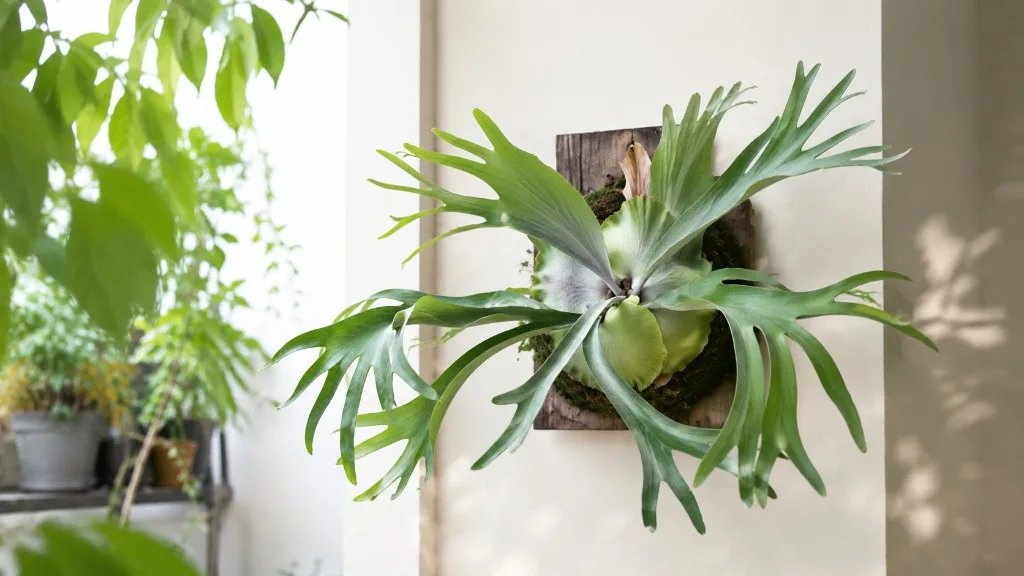
Staghorn Ferns are epiphytic and thrive when mounted on wood. Soak the mount thoroughly then let it nearly dry-they tolerate brief neglect better than overwatering.
Staghorn Fern Care: Mount, Water & Light Guide
Start with wateringThe most common care mistake for Staghorn FernWatering guide →Staghorn Fern care essentials
Light
bright indirect light
Water
Soak the mounted board or root mass fully then let nearly completely dry before the next watering.
Soil
Staghorns are epiphytic-typically mounted on wood with sphagnum moss rather than potted in soil.
Humidity
50–70%
Temperature
16–27°C (60–80°F)
Fertilizer
Use balanced liquid fertilizer diluted into soaking water, or banana peel tucked behind shield fronds and stop if the plant is stressed, newly repotted, or not actively growing. Over-fertilizing; focus on organic methods.
About Staghorn Fern
Staghorn Fern is native to Australia, Southeast Asia, typically reaches 60–90 cm wide when mounted; antler fronds up to 90 cm indoors, with slow to moderate growth. Staghorn Fern has a rosette growth habit and part of the Polypodiaceae family. It is also known as Common Staghorn Fern and Elkhorn Fern.
| Detail | Information |
|---|---|
| Also known as | Common Staghorn Fern, Elkhorn Fern |
| Native region | Australia, Southeast Asia |
| Mature size | 60–90 cm wide when mounted; antler fronds up to 90 cm |
| Growth rate | Slow to moderate |
| Growth habit | Rosette |
| Scientific name | Platycerium bifurcatum |
| Family | Polypodiaceae |
Staghorn Fern Care: Mount, Water & Light Guide
What Is a Staghorn Fern?
Staghorn fern is not a typical potted houseplant pretending to be a fern - it is an epiphyte, a plant that in nature grows attached to tree trunks and rock faces rather than rooted in soil. The name refers to the forked, antler-shaped foliar fronds that make mature specimens look like mounted trophy heads on a wall. The most common species in shops and collections is Platycerium bifurcatum, though you may also encounter P. superbum, P. veitchii, and other species with similar silhouettes but slightly different tolerances. Roughly 18 species exist in the genus Platycerium, and all share the same broad care logic even when frond size and pup behavior differ.
Indoors, a well-grown P. bifurcatum on a board typically reaches 60 to 90 cm (2 to 3 feet) wide with antler fronds up to 90 cm long over several years. Growth is slow to moderate in average home conditions - faster in warm, humid, bright setups and noticeably slower in cool, dry winter rooms. The plant does not behave like a rosette succulent or a fast-spreading pothos. It builds mass gradually, layering new shield fronds at the base and extending antler fronds outward from the center. That slow pace is part of why staghorn ferns feel like living sculpture rather than temporary décor.
If you are deciding whether Staghorn Fern overview fits your home, the honest summary is this: staghorn fern rewards mount culture, Staghorn Fern light guide, and a soak-and-drip Staghorn Fern watering guide - and it punishes soggy pots, dark corners, and calendar watering in winter. It is easier than many finicky tropicals once you accept that it is not a soil plant, and harder than a snake plant if you insist on treating it like one. The payoff is one of the most distinctive displays in indoor horticulture: a fern you hang on a wall like art. One additional advantage for pet households: the common staghorn fern is non-toxic to cats, dogs, and horses according to the ASPCA.
Botanical Background and the Two Frond Types
Staghorn ferns belong to the family Polypodiaceae, the same broad fern family that includes many classic houseplant ferns - but epiphytic Platycerium species follow different rules than terrestrial pot ferns. Across the humid tropics worldwide - with P. bifurcatum native from Java through tropical Australia to New Caledonia - staghorns colonize humid rainforest canopies and rocky outcrops, catching organic debris in their frond bases and absorbing moisture from rain, mist, and humid air. NC State Extension notes that small plants can be grown in containers, but in habitat they are found attached to trees - which is why mount culture aligns with their biology far better than a dense peat pot.
Every staghorn fern displays two distinct frond types, and confusing them causes most beginner mistakes. Shield fronds - also called basal or nest fronds - are the rounded, kidney-shaped leaves that press flat against the mount or tree bark. They start green and firm, then gradually turn papery and brown as they age. Their job is to anchor the plant, trap leaf litter and water, and protect the delicate growing point at the center. Antler fronds - foliar or fertile fronds - are the branched, upright “stag horns” that most people buy the plant for. They photosynthesize, release spores from brown patches on their undersides, and can absorb some moisture directly from the air.
Do not treat brown shield fronds as automatic death signals. A mature staghorn often carries a stack of dried brown shields layered beneath fresh green ones - that layering is normal architecture, not neglect. Problems arise when you remove living green shields, let water sit stagnant inside a closed shield cup for days, or mistake a rotting center for routine aging. The growing point sits at the junction where new shields and antlers emerge; damage there is far more serious than brown paper on older shields below.
Species choice matters at the margins. P. bifurcatum is the forgiving workhorse most shops sell; P. superbum and P. veitchii can be more demanding on humidity and space. If your plant arrived without a tag, assume P. bifurcatum unless growth habit clearly suggests otherwise.
Why Mount Culture Beats Traditional Potting
Staghorn ferns are often sold in small pots for shipping convenience, but long-term pot culture is a compromise that causes more failures than mount culture in home settings. In a pot, the plant sits in a thick, water-retentive mix that stays wet longer than an exposed moss pad on a board. Epiphytes evolved for fast drainage and constant airflow around the root zone; a standard houseplant pot works against both. The Old Farmer’s Almanac notes that staghorn ferns often develop root rot when cultivated in pots, whereas mounted plants rarely suffer the same fate because excess water simply drains away.
Mounting also matches how you should water. A mounted staghorn is watered by submerging the entire mount - the soak-and-drip method - which saturates sphagnum moss and shield tissue evenly without leaving a perched water table at the bottom of a pot. The weekly soak becomes a built-in health check: you handle the plant, feel the moss, inspect for pests, and notice early wilting before it becomes collapse. That rhythm is harder to maintain when a potted fern sits on a shelf and only receives a quick pour from a watering can.
Display is the other practical argument. Staghorn ferns are living wall art. On a wooden plaque, cork slab, or bark board, the shield fronds eventually engulf the hardware and the antlers arch outward in three dimensions. In a pot, the same plant looks like an awkward fern in soil - visually underwhelming and harder to position for the bright, airy exposure it wants. You can keep a young plant in a loose orchid-style mix temporarily, but plan to mount within the first year if you want the lowest-maintenance path.
Pot culture is possible in very open orchid-style mixes in shallow, slatted containers, but remounting onto wood is usually simpler than fighting compaction in a pot that has outgrown its drainage.
Best Growing Conditions for Staghorn Fern
Staghorn fern does best when your space approximates the warm, humid, bright canopy conditions of its native range. The four variables that decide almost every outcome are light, water, mount substrate, and temperature with humidity. Get those aligned and feeding, pup division, and remounting become occasional tasks. Get one badly wrong - especially winter overwatering or dark placement - and the plant declines slowly through wilting antlers and a softening center long before you identify a single obvious culprit.
Light Requirements
Staghorn ferns need bright, indirect light for most of the day. Think dappled canopy light: strong enough to keep antler fronds firm and green, filtered enough that direct midday sun does not scorch them. Indoors, east-facing windows are often ideal - gentle morning sun, then bright indirect exposure. North windows work if the room is genuinely bright and you are growing P. bifurcatum. South- and west-facing exposures can work too, but pull the mount back from the glass or filter harsh afternoon sun with a sheer curtain. The Old Farmer’s Almanac recommends keeping indoor plants out of direct light because burned antler tips do not recover aesthetically even if the plant survives.
The fastest diagnostic for incorrect light is new antler growth. Compact, upright branching with good silver-green color means the plant is probably happy. Thin, elongated antlers reaching toward the window mean the plant wants more light. Bleached patches, crispy brown tips on the sun-facing side, or midday curling mean it wants less direct exposure or a slower acclimation to a brighter spot. Acclimate over one to two weeks when moving from a dim shop shelf to a bright wall - fronds formed in low light burn easily if you jump straight into afternoon sun.
Outdoor culture works in USDA Hardiness Zones 9 and warmer on shaded patios or tree trunks; in hot climates, bright shade beats direct sun. It has naturalized in Florida and Hawaii, where it is considered invasive in some regions. In cooler zones, bring mounts indoors before frost. If winter light is weak, a full-spectrum grow light on a 10–12 hour timer prevents thin, pale antlers.
Temperature and Humidity
Staghorn ferns prefer stable temperatures between 55 and 75°F (13 and 24°C). They tolerate brief heat above that range when humidity and watering keep pace, but they dislike cold drafts below about 50°F (10°C) and sustained chill near windows in winter. Watch problem spots: directly under an AC vent, against a single-pane window on freezing nights, and near a heating radiator that blasts dry air across the fronds. Each can stress the plant within hours even if the room average temperature looks fine.
Humidity matters more for staghorn ferns than for many common houseplants because antler fronds absorb moisture from the air in addition to what the root zone provides. UF/IFAS Gardening Solutions notes that staghorn ferns are epiphytes that draw moisture and nutrients from the air as well as their mount medium. Aim for 60 to 75% relative humidity if you can measure it; many homes sit at 40–50% in summer and drier in winter. At humidity below about 30%, antler tips brown faster and spider mites become more likely. A small humidifier near the plant, grouping it with other tropicals, or growing in a bright bathroom with good airflow all help more than occasional misting - which raises humidity briefly and can leave wet frond surfaces that invite fungal spotting if air circulation is poor.
Good air circulation is the partner of humidity. Staghorn ferns are not sealed terrarium plants. They want moist moss and moist air, but not stagnant pockets inside a closed shield stack. After soaking, always let the mount drip dry completely before hanging it back on a wall without airflow behind it.
Mounting Materials and Substrate
Mount culture starts with three components: a solid backing, a moisture-holding layer around the roots, and hardware that holds everything together until the plant anchors itself. The goal is not to recreate soil - it is to recreate the thin, airy, drainable pad of moss and debris that collects behind a shield frond on a tree trunk.
Choosing a Board, Moss, and Hardware
Backing material should be rot-resistant and capable of carrying weight as the fern matures. Redwood and cedar planks are traditional choices because they resist decay in wet cycles. Cork bark slabs, driftwood, hardwood rounds, and coconut-fiber boards also work. Avoid soft pine that rots within a season or thin plywood that warps. Size the board for the plant you have now plus two to three years of growth - remounting is normal, but starting absurdly small forces emergency remounts every few months.
Sphagnum moss is the standard moisture layer for home mounting. Long-fiber sphagnum holds water well while staying open enough for air to reach the roots. Soak moss thoroughly before use and pack a generous pad - roughly 2 to 3 inches (5 to 7 cm) thick behind the root mass - so the plant does not dry out in a single afternoon on a hot wall. Some growers add a little orchid bark or coarse fern fiber mixed into the moss for extra structure; the exact recipe matters less than avoiding fine, compaction-prone peat as the primary mount medium.
Hardware is temporary scaffolding. Fishing line, nylon stockings, soft plant wire, or coated twist ties secure the fern to the board through the first growing season. Place lines across the shield frond - never piercing living green tissue in the center - and anchor into the board edges. As new shield fronds grow, they hide the ties. A D-ring or picture-hanging hardware on the back of the board makes wall display straightforward. For heavier mature specimens, use a sturdy hook rated for the wet weight of a soaked mount.
To mount a nursery plant, remove it from the pot and gently tease away dense soil without tearing healthy roots. Press the root ball and lowest shield against the soaked moss pad, pack additional moss around the sides, secure with ties, and hang in bright indirect light. The first two weeks are establishment: avoid direct sun and do not let the moss go bone dry, but also do not soak daily - one thorough soak, full drip dry, then wait until the moss lightens is the repeating rhythm.
How to Water a Mounted Staghorn Fern
The general rule for a mounted staghorn fern is: soak the entire mount until the moss is fully saturated, let it drip dry completely, then wait until the moss approaches dryness before soaking again. More precisely, plan around weekly soaks in moderate indoor conditions as a starting point, then refine based on how fast your specific mount dries in your home. Mount type, room humidity, light intensity, and season all change the interval, so a calendar answer is a starting point, not a final law.
Mounted moss dries faster than potting mix because air contacts the substrate on every side. That is an advantage - it makes overwatering harder - but it also means summer walls and heating vents can pull moisture quickly enough to stress the plant within days. Check moisture by pressing the moss pad with your fingers: cool, spongy, and slightly damp means wait; lighter color, warmer feel, and a stiff dry moss surface mean it is time to soak.
The Soak-and-Drip Method
Watering a mounted staghorn is a submersion ritual, not a pour-over. This is the single most important technique to learn, and it is why mounting rewards you with fewer root problems than pot culture.
Fill a basin, sink, or bucket with room-temperature water - filtered or rainwater if your tap water is very hard or heavily chlorinated. Submerge the entire mount so water covers the moss and lower fronds. Hold it under for 15 to 20 minutes, or until the moss darkens evenly and feels heavy with water. If the mount floats, weigh it down gently with a clean stone or hold it submerged by hand. Remove the mount, let it drip vertically for 30 to 60 minutes over the sink or outdoors, then hang it back in its display spot only when dripping has slowed to an occasional drop.
This method waters both the moss root zone and the shield fronds, which also absorb moisture. A quick mist or a splash from a watering can wets only the surface and leaves the center dry - the classic setup for wilting antlers on apparently “watered” plants. If your antlers look limp in late afternoon on a hot day but perk up by morning, that is often temporary heat stress. If wilting persists past evening on a mount that was merely misted, you are behind on soaking.
Seasonal Watering Adjustments
Spring through fall, when daylight is long and indoor heating is off, growth accelerates and moss dries faster. Weekly soaks are typical for many mounted indoor plants; outdoor mounts in summer heat may need soaking twice weekly if wilting appears regularly by evening. This is also the window to resume light feeding once a month if the plant is actively producing new antlers.
Winter is when most staghorn ferns die from kindness, not neglect. Lower light and cooler room temperatures slow growth, so the moss stays wet longer after each soak. Cut frequency by roughly 30 to 50% - many indoor mounts need soaking only every 10 to 14 days in dim, cool conditions. A plant sitting at 60 to 65°F (15 to 18°C) in winter light may tolerate even longer intervals if the moss still has slight give. The failure mode to fear is soaking on a summer schedule while the plant is semi-dormant, which leaves the center soggy and invites rot.
Seasonal rhythm summary for mounted indoor plants: weekly in active growth, every 10 to 14 days in winter, with checks - not dates - as the final authority. Outdoor plants follow rainfall in mild climates but still need manual soaking during dry spells.
How to Feed Staghorn Fern
Staghorn fern is a modest feeder. Use a balanced water-soluble fertilizer diluted to one-quarter of the label rate, applied monthly from spring through early fall in the soak water. NC State Extension recommends monthly feeding in spring and summer. Pause feeding in winter and after remounting until new growth appears. Overfeeding shows up as crispy antler tips and white mineral crust on moss - flush with plain water soaks and resume at half strength only when new antlers emerge.
Remounting and Long-Term Maintenance
Remounting is the epiphytic equivalent of Staghorn Fern repotting guide. As a staghorn fern matures, it outgrows its board, engulfs hanging hardware, or builds a shield stack so thick that the moss behind it collapses and stops holding water evenly. Wisconsin Horticulture Extension recommends remounting when moss or boards fail, ideally during active growth in spring through early summer - though many growers successfully remount in spring when new basal fronds are visibly accelerating.
To remount, soak the plant thoroughly first so shields are pliable. Cut fishing line or wire carefully without slicing into green center tissue. Remove old, structurally dead brown shields only if they crumble away easily - never peel living green shields to “clean up” the plant. Transfer the root mass onto a larger board with fresh soaked sphagnum, secure with new ties, and hang in bright indirect light. Expect a short pause in antler growth while the plant re-anchors; resume normal soaking rhythm without increasing frequency “to help it along.”
Trim only fully dead antler fronds that are brown and brittle end to end; solve partial tip browning by adjusting humidity and soak depth, not scissors.
Propagation by Pups and Division
The practical home propagation method for staghorn fern is pup division, not spore sowing. Spores can produce new plants - you will see brown fuzzy patches on antler undersides - but spore culture takes years and sterile technique most hobbyists do not want to maintain. Pups are the free, fast path.
A pup is a small offset that emerges from the base of a mature plant, often tucked under older shield fronds. Species such as P. bifurcatum pup freely; some solitary species rarely offset and are poor candidates for division. When pups appear, you can leave them for a natural colony look or remove them to share and expand your collection.
When a Pup Is Ready to Separate
Separate a pup only when it can survive on its own root mass - patience prevents the most common propagation failure. Ready pups show at least 10 to 15 cm (4 to 6 inches) width, their own distinct green or maturing shield frond, and a woody rhizome bridge connecting them to the parent. Smaller pups often rot on the mount because they lack stored energy and root surface to handle the trauma of separation.
In spring, soak the parent mount, then slice cleanly once with a sterilized knife behind the pup’s shield, taking as much of the pup’s root tissue as possible without gouging the mother’s growing center. Sawing back and forth crushes tissue and invites rot. Mount the pup immediately on a small board with fresh moss, secure gently, and keep it in bright indirect light with the normal soak-and-drip rhythm - slightly more frequent checks the first month, but not daily soaking. Expect slow establishment for several weeks; new shield growth is the sign of success, not instant antler size.
Common Staghorn Fern Problems
Most staghorn fern problems are environmental or mechanical, not mysterious diseases. The plant communicates through antler firmness, shield texture, and center softness long before the entire specimen collapses. The useful habit is to check soak adequacy, light, and humidity in that order before assuming pests or nutrient deficiency.
Shield Frond Browning, Wilting, and Pests
Brown shield fronds are often normal. Older basal fronds naturally turn papery and tan as new shields grow above them. Concern is warranted when green shields soften, darken, and smell sour, or when the central growing point turns black and mushy - that pattern points to overwatering, poor drainage after soaking, or water trapped in a wall pocket without airflow. Fix by improving drip-dry time, reducing winter soak frequency, and ensuring air reaches the back of the mount.
Wilting antler fronds usually mean underwatering or uneven watering. If antlers are limp and the moss is dry and light, soak thoroughly and drip dry. If antlers wilt while moss stays constantly wet, suspect center rot from overwatering and inspect the growing point carefully. Partial afternoon wilt on hot days with recovery by morning is heat stress; persistent wilt is a watering problem.
Brown antler tips commonly reflect low humidity, insufficient soaking, or salt buildup from over-fertilizing. Increase humidity, verify soak depth, and flush with plain water soaks if fertilizer crust appears on moss.
Pests include scale, mealybugs, and spider mites in dry winter air. Catch infestations during weekly soaks. Manual removal, a gentle shower, and insecticidal soap handle most issues if you act early.
Is Staghorn Fern Safe for Pets?
Staghorn fern is non-toxic to cats, dogs, and horses according to the ASPCA listing for common staghorn fern (Platycerium bifurcatum). That makes it one of the safer statement plants for pet households - with an important practical caveat. Non-toxic does not mean good to chew. Fishing line, moss, and woody mount material can cause mechanical irritation or gastrointestinal upset if ingested in quantity, and a knocked-down mount can damage both the plant and nearby objects.
Place wall mounts high enough that dogs cannot jump into them and away from shelves cats use as launch pads if you want to preserve the fronds. For curious chewers, secure mounts firmly and consider a dedicated plant room. If a pet ingests a large amount of plant material or shows persistent vomiting, contact your veterinarian or the ASPCA Animal Poison Control Center at (888) 426-4435 - consultation fees may apply. This is general information, not veterinary advice.
Because common names overlap in horticulture, confirm Platycerium bifurcatum on the tag when pet safety is a deciding factor. The ASPCA entry applies to common staghorn fern specifically; exotic Platycerium species are widely treated as safe in hobby culture, but the documented listing centers on P. bifurcatum.
Conclusion
Staghorn fern (Platycerium bifurcatum and close relatives) is an epiphytic fern that makes sense only when you stop treating it like a soil plant. Mount it on rot-resistant wood with a sphagnum moss pad, hang it in bright indirect light, and water with a full soak followed by a full drip dry on a rhythm that tightens in summer and loosens in winter. Brown papery shield fronds are often architecture, not alarm. Wilting antlers usually mean the soak did not reach the moss core. Feed lightly during active growth, remount before the board is engulfed, and divide pups when they show real shields and roots of their own.
When something looks wrong, read the plant in context: thin reaching antlers mean more light; bleached tips mean less direct sun; limp antlers on dry moss mean soak; a mushy center on wet moss means rot. Fix mount culture first - drainage, airflow, and soak depth - before chasing fertilizer or misting routines copied from terrestrial ferns. Do that, and staghorn fern becomes one of the most rewarding wall plants you can grow: slow, sculptural, pet-safe according to the ASPCA, and unlike anything else in a typical houseplant collection.
When to use this page vs other Staghorn Fern guides
- Staghorn Fern overview - Canonical hub for this species - care topics and problems branch from here.
- Staghorn Fern problems - Symptom-first path when you already know something is wrong.
Related Staghorn Fern guides
How to care for Staghorn Fern?
How much light does Staghorn Fern need?
bright indirect light
- bright indirect light - bright indirect light.
When should you water Staghorn Fern?
Soak the mounted board or root mass fully then let nearly completely dry before the next watering.
- Lift the mount-it should feel nearly lightweight before watering. Brown papery shield fronds are normal - Soak the mounted board or root mass fully then let nearly completely dry before the next watering.
- do not remove them
- Drain excess water - Soak the mounted board or root mass fully then let nearly completely dry before the next watering.
What soil works best for Staghorn Fern?
Staghorns are epiphytic-typically mounted on wood with sphagnum moss rather than potted in soil.
- sphagnum moss - Staghorns are epiphytic-typically mounted on wood with sphagnum moss rather than potted in soil.
- orchid bark - Chunky bark pieces that create air pockets and mimic epiphytic growing conditions.
- coconut husk
Grower notes for Staghorn Fern
What matters most with Staghorn Fern
Staghorn Fern is less forgiving of dry air and missed watering than tough foliage plants. The trick is steady moisture with oxygen, not a swampy pot. In practice, the care checkpoint is simple: bright indirect light. Pair that with staghorns are epiphytic-typically mounted on wood with sphagnum moss rather than potted in soil, and avoid changing water, pot size, and placement all at once.
Best placement in a real home
Staghorn Fern belongs where bright indirect light is realistic for most of the day, not only where the pot looks good. Soak the mounted board or root mass fully then let nearly completely dry before the next watering. If the pot stays wet longer than expected, move the plant into better light or reassess the mix before watering again. Humidity target: 50–70%. Temperature comfort zone: 16–27°C (60–80°F).
Before you buy this plant
Choose Staghorn Fern with firm new growth, clean leaf undersides, and soil that does not smell sour or feel compacted. Be cautious if you see brown spots, sticky residue, collapsed crowns, or a pot that is wet in poor light. Cosmetic old-leaf damage is less worrying than weak roots or active pests.
First month after bringing it home
Do not repot Staghorn Fern on day one unless the mix is failing or pests are obvious. Quarantine it, learn how fast the pot dries, and keep care boring while it adjusts. Watch especially for brown spots, slow-growth, and wilting. If problems appear, correct the condition first rather than stacking fertilizer, repotting, and pruning together.
Pet-aware note for Staghorn Fern
Staghorn Fern is a better choice for pet-aware homes than toxic ornamentals, but pet safe does not mean the plant should be chewed. Use hanging, shelf, or room placement if pets dig in soil or shred leaves, and choose sturdier plants for high-traffic pet zones.
How to tell Staghorn Fern is settling in
Also sold as Common Staghorn Fern and Elkhorn Fern, this plant should be judged by stable new growth rather than label names alone. If you plan to multiply it later, common methods include Pup (offset) separation and Spores (advanced). Repot only when you see mount falling apart and plant outgrowing mount. If slow-growth shows up early, inspect light, watering, and roots before assuming the plant is permanently weak.
Is it pet safe?
Staghorn Fern is generally considered pet safe.
Watering Staghorn Fern
For Staghorn Fern, lift the mount-it should feel nearly lightweight before watering. Brown papery shield fronds are normal; do not remove them. and water every 7–10 days; every 2–3 weeks in winter. Reduce watering in winter when growth slows.
| Detail | Information |
|---|---|
| How often | Every 7–10 days; every 2–3 weeks in winter |
| How to check | Lift the mount-it should feel nearly lightweight before watering. Brown papery shield fronds are normal; do not remove them. |
| Seasonal changes | Reduce watering in winter when growth slows |
Signs of overwatering
- black spots at base of antler fronds
- foul smell from mount
- mushy root area
Signs of underwatering
- wilting antler fronds
- very lightweight mount
Soil & potting for Staghorn Fern
Use a mix of sphagnum moss, orchid bark, coconut husk for Staghorn Fern. Excellent; mounted culture provides natural drainage. Target soil pH around 6.0–7.0. Repot remount every 3–5 years when the board deteriorates, ideally in spring.
| Detail | Information |
|---|---|
| Recommended mix | sphagnum moss, orchid bark, coconut husk |
| Drainage | Excellent; mounted culture provides natural drainage |
| Soil pH | 6.0–7.0 |
| Repotting frequency | Remount every 3–5 years when the board deteriorates |
| Best season to repot | Spring |
Signs it needs repotting
- mount falling apart
- plant outgrowing mount
Humidity & temperature for Staghorn Fern
Staghorn Fern prefers 50–70%, though normal home humidity is usually fine. Keep temperatures around 16–27°C (60–80°F).
| Detail | Information |
|---|---|
| Humidity | 50–70% - normal home humidity is fine. |
| Ideal temperature | 16–27°C (60–80°F) |
Fertilizer & pruning for Staghorn Fern
Use use balanced liquid fertilizer diluted into soaking water, or banana peel tucked behind shield fronds and stop if the plant is stressed, newly repotted, or not actively growing. Over-fertilizing; focus on organic methods. for Staghorn Fern.
| Detail | Information |
|---|---|
| Fertilizer type | Use balanced liquid fertilizer diluted into soaking water, or banana peel tucked behind shield fronds and stop if the plant is stressed, newly repotted, or not actively growing. Over-fertilizing; focus on organic methods. |
Common problems on Staghorn Fern
Slow Growth
LowLikely cause: Low light or insufficient nutrients
Quick fix: Move to brighter spot; fertilize monthly in season
Full fix guide →Wilting
MediumLikely cause: Roots dried out in the mount
Quick fix: Soak mount in water for 20–30 minutes
Full fix guide →Aphids
MediumLikely cause: Aphids on Staghorn Fern gather on tender new antler frond tips at the crown, suck sap, and leave sticky honeydew. First step: isolate the mount and rinse antler fronds with room-temperature water befo
Quick fix: See plant-specific guide for step-by-step fixes.
Full fix guide →Brown Tips
MediumLikely cause: Brown tips on Staghorn Fern antler fronds usually mean dry air, inconsistent soaking, fluoride in tap water, or direct sun scorch-not fungus. Lift the mount, check humidity, and switch to filtered wat
Quick fix: See plant-specific guide for step-by-step fixes.
Full fix guide →Drooping Leaves
MediumLikely cause: Drooping antler fronds on Staghorn Fern mean the plant lost turgor-most often because the mount dried out, but also when soggy moss kills roots. First step: lift the mount and check weight before you
Quick fix: See plant-specific guide for step-by-step fixes.
Full fix guide →Fungus Gnats
MediumLikely cause: Fungus gnats on Staghorn Fern mean sphagnum moss or potting mix has stayed damp too long between waterings. First step: skip the next soak until the mount feels nearly lightweight and the moss surface
Quick fix: See plant-specific guide for step-by-step fixes.
Full fix guide →Leggy Growth
MediumLikely cause: Leggy growth on Staghorn Fern means weak, stretched antler fronds reaching toward light-almost always from a dim indoor spot. First step: move the mount gradually to bright indirect light with filtere
Quick fix: See plant-specific guide for step-by-step fixes.
Full fix guide →Low Humidity
MediumLikely cause: Low humidity on Staghorn Fern shows as brown, crisp antler frond tips and slow growth in dry heated rooms-not on aging shield fronds. First step: run a humidifier or move the mount to a bright bathroo
Quick fix: See plant-specific guide for step-by-step fixes.
Full fix guide →Mealybugs
MediumLikely cause: Mealybugs on Staghorn Fern hide as white cottony clusters in frond axils, crown moss, and shield-frond overlaps. Isolate the mount, dab visible bugs with 70% alcohol, then spray insecticidal soap on r
Quick fix: See plant-specific guide for step-by-step fixes.
Full fix guide →Mold on Soil
MediumLikely cause: Fluffy white or gray growth on Staghorn Fern sphagnum moss or potting mix is usually harmless surface mold from a mount that stays damp too long. First step: scrape the top layer, let the mount dry un
Quick fix: See plant-specific guide for step-by-step fixes.
Full fix guide →Not Enough Light
MediumLikely cause: Not enough light on Staghorn Fern shows as pale, small, or slow antler fronds and a mount that stays wet too long. First step: move the mount to bright indirect light with some filtered sun and acclim
Quick fix: See plant-specific guide for step-by-step fixes.
Full fix guide →Overwatering
MediumLikely cause: Overwatering on Staghorn Fern shows as a mount that stays heavy for days, black spots at antler frond bases, or sour smell from wet moss-especially after soaking on a calendar instead of when nearly d
Quick fix: See plant-specific guide for step-by-step fixes.
Full fix guide →Root Rot
MediumLikely cause: Root rot on Staghorn Fern means moss at the crown stayed wet too long and tissue at the growing point is failing-especially on mounts that never fully dry. Stop soaking immediately, peel back crown mo
Quick fix: See plant-specific guide for step-by-step fixes.
Full fix guide →Spider Mites
MediumLikely cause: Spider mites on Staghorn Fern cause pale stippling and fine webbing on antler fronds, especially in hot dry rooms. First step: move the mount away from other plants and rinse antler fronds thoroughly
Quick fix: See plant-specific guide for step-by-step fixes.
Full fix guide →Underwatering
MediumLikely cause: Underwatering on Staghorn Fern shows as wilting antler fronds and a very lightweight mount. Soak the root mass for 20–30 minutes, drain face-up until dripping stops, then resume weight-based soaking-n
Quick fix: See plant-specific guide for step-by-step fixes.
Full fix guide →Yellow Leaves
MediumLikely cause: Yellow antler fronds on Staghorn Fern are a stress signal on mounted epiphytes-most often from overwatering, underwatering, or too much direct sun, not nutrient deficiency. First step: lift the mount
Quick fix: See plant-specific guide for step-by-step fixes.
Full fix guide →