Staghorn Fern Growing Medium: Sphagnum Moss and Mount Media
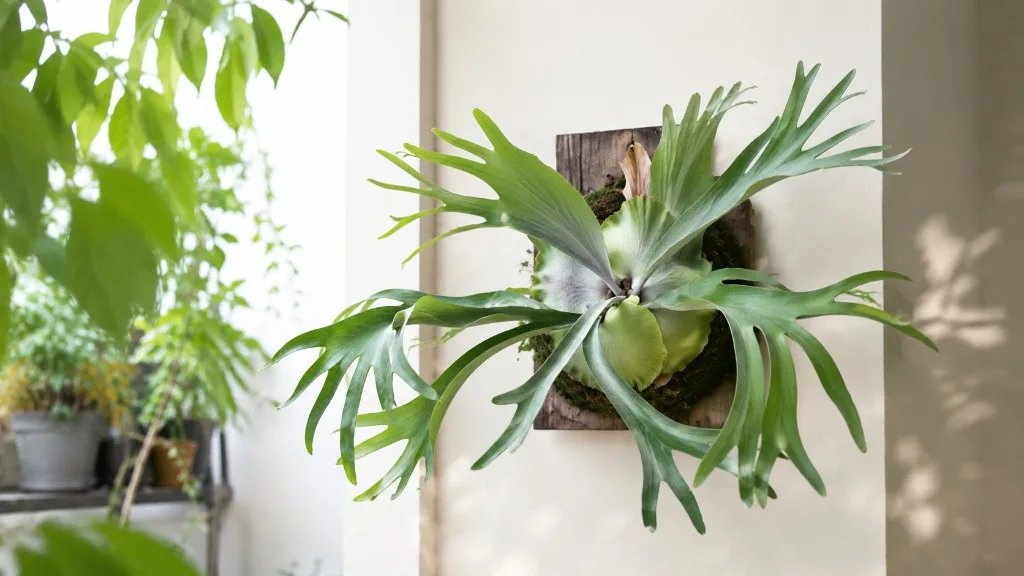
Staghorn Fern Growing Medium: Sphagnum Moss and Mount Media
Staghorn Fern Growing Medium: Sphagnum Moss and Mount Media
If you walk into a garden center and grab a bag labeled “potting soil,” you have already made the wrong choice for a staghorn fern. Platycerium bifurcatum is an epiphyte - a plant that grows on tree trunks and branches in the wild, not in the ground. Its roots evolved to grip bark, breathe freely, and absorb moisture from a thin layer of forest debris and moss. Indoors, that biology translates into one non-negotiable rule: the growing medium must be airy, fast-draining, and moisture-retentive without ever becoming waterlogged. For most home growers, that means long-fiber sphagnum moss packed into a modest pad on a board mount. It does not mean peat-heavy potting mix, garden soil, or any dense substrate that holds water around the crown for days.
The University of Wisconsin-Madison Division of Extension describes staghorn ferns as plants that “do not grow in soil, but attach to trees when growing in nature,” and notes that indoor specimens are typically mounted on wooden boards or bark slabs with sphagnum or peat moss provided for the roots to grow into.
That single sentence captures the entire philosophy behind staghorn fern growing medium: you are not filling a pot with dirt. You are engineering a small, breathable moisture reservoir that mimics what the plant would find wedged into a tree crotch in tropical Australia or Southeast Asia.
If symptoms persist, see the Slow Growth on Staghorn Fern guide.
Why Staghorn Ferns Never Belong in Regular Potting Soil
Standard potting mix is engineered for terrestrial plants with roots that tolerate - and often prefer - sustained contact with moist organic matter. Staghorn fern roots are built for the opposite environment. They need oxygen moving through the root zone within hours of watering, and they need the crown (the central growth point where new fronds emerge) to stay exposed to air and light. Dense soil violates both requirements simultaneously.
What Epiphytic Roots Actually Need
Epiphytic roots serve three jobs at once: anchoring the plant to a surface, absorbing water and dissolved nutrients during brief wet periods, and surviving extended dry intervals between rain events. In nature, a staghorn fern’s shield fronds - the flat, brown, plate-like basal fronds that many beginners mistake for dead leaves - press against the tree bark and gradually envelop the root zone. Behind those shields, a thin pad of accumulated moss, leaf litter, and organic debris holds just enough moisture for the roots to drink from, while the surrounding air keeps everything breathable.
The Missouri Botanical Garden notes that staghorn ferns can be grown in containers with a “rich and very well-drained medium,” but emphasizes that the essential requirement is perfect drainage.
That wording matters. “Rich” does not mean peat-heavy and fine-textured. It means the medium contains enough organic material to hold moisture between waterings while remaining structurally open. Think of a sponge with large pores, not a mud pie.
When you evaluate any growing medium for a staghorn fern, run it through three tests mentally. First, does water exit quickly when you soak the mount or pot, rather than pooling at the bottom? Second, can you squeeze the medium after soaking and feel air pockets returning within a few seconds? Third, does the crown remain above the medium line with shield fronds able to breathe? If any answer is no, the medium will eventually cause problems regardless of how carefully you water.
The Core Failure Pattern in Dense Soil
The most common staghorn fern death indoors follows a predictable sequence. A well-meaning grower pots the fern in regular potting soil because that is what every other houseplant uses. The mix looks fine for the first few weeks. Then the center of the plant - the shield fronds at the base - starts turning dark brown or black. The texture goes from firm and papery to soft and mushy. New antler fronds stop emerging, or they emerge stunted and wilt immediately. By the time the grower notices, crown rot has usually advanced past the point of easy recovery.
This is not a watering-frequency problem in isolation. It is a medium problem. Dense soil holds water in the root zone long after the surface appears dry. The shield fronds, which are designed to catch debris and protect roots in nature, become a trap for stagnant moisture when buried in fine potting mix. Anaerobic conditions develop. Root tissue suffocates. Pathogens that thrive in wet, airless organic matter - particularly when temperatures are warm - colonize the crown. The plant declines from the center outward, which is exactly the opposite of how a healthy staghorn should grow.
If your staghorn’s shield fronds are turning black and mushy, the growing medium is the first thing to check, before you adjust light, fertilizer, or Staghorn Fern watering guide. No amount of care refinement fixes a substrate that is fundamentally incompatible with epiphytic roots.
Long-Fiber Sphagnum Moss: The Gold Standard Mount Medium
For mounted staghorn ferns, long-fiber sphagnum moss (often abbreviated LFSM in plant forums) is the consensus best choice among experienced growers, botanical gardens, and commercial fern nurseries. It is not the only option, but it is the one most likely to succeed for beginners because it balances water retention and airflow better than any readily available alternative.
Long-fiber sphagnum can hold up to 20 times its dry weight in water while still maintaining air pockets between the fibers - a combination that directly mirrors what epiphytic roots need. The fibers are long, springy, and structurally resilient, which means they resist compaction far longer than short-fiber peat or crumbled sheet moss. When you build a moss pad on a cedar board or cork plaque, those long fibers interlock like a loose mesh, creating a dome that stays damp on the inside while the outer surface dries down between soakings.
Why Long-Fiber Moss Beats Sheet Moss and Peat
Not all moss products are interchangeable, and confusing them is one of the most expensive mistakes in staghorn fern care. Here is the distinction that matters.
Long-fiber sphagnum moss comes in loose, tangled strands - often labeled “New Zealand sphagnum” or “Chilean sphagnum” depending on origin. New Zealand grades (sometimes sold under brands like Spagmoss) are widely considered the premium option because the fibers are exceptionally long, clean, and free of sticks and debris. Chilean moss works too, though it may contain more twiggy material and shorter fibers. Either is dramatically better than the alternatives below.
Peat moss (often sold as “sphagnum peat moss” in soil amendments) consists of partially decomposed, short, crumbly particles. It compacts under its own weight, especially when wet. Wisconsin Horticulture Extension notes that staghorn ferns are mounted with sphagnum moss for roots to grow into - not dense potting soil that compacts around the crown.
Packed behind a mounted staghorn, peat moss becomes a dense, airless plug within weeks. It is excellent for seed-starting mixes and terrestrial plants. It is a poor choice as the primary medium for an epiphytic fern.
Sheet moss, reindeer moss, and Spanish moss sold in craft and floral aisles are often dead, dyed green, and chemically treated for decorative use. They lack the water-holding capacity and structural integrity that living staghorn roots need. Some growers use a thin layer of decorative sheet moss on top of a proper LFSM pad for aesthetics, but it should never replace long-fiber sphagnum as the functional growing medium.
The acidifying properties of true sphagnum moss also provide a secondary benefit: the mildly acidic environment inhibits bacterial growth compared to neutral or alkaline substrates. This is not a substitute for proper watering discipline, but it does give mounted ferns a small biological edge against rot in humid home environments.
Soaking and Squeezing: Getting Moisture Right
Raw sphagnum moss straight from the package is dusty and hydrophobic. You cannot simply mist it and expect even moisture distribution. The correct preparation method is a full soak followed by a controlled squeeze.
Place a generous handful of long-fiber sphagnum in a bowl or bucket of room-temperature water. Let it absorb water for 10 to 20 minutes, pressing it down occasionally until every fiber is saturated. Then lift it out and squeeze firmly with both hands until water stops streaming but the moss still feels heavy and spongy. You want damp, not dripping. A properly prepared moss pad should release a few drops when squeezed hard, but it should not leak water when you set it on the mount board.
This soak-and-squeeze step is not optional cosmetic prep. It establishes the baseline moisture level that your watering routine will maintain going forward. Moss that is only surface-misted tends to have a wet exterior and a dry core, which stresses roots and encourages uneven growth. Moss that is soaked and squeezed starts uniformly damp throughout, which means your subsequent soak-waterings will penetrate evenly and dry-down will happen at a predictable rate.
Mount Media Options Beyond Sphagnum
Sphagnum moss is the functional growing medium, but the mount itself is part of the system. The board, slab, or basket you choose affects drainage path, airflow around the root pad, and how quickly the moss dries between waterings. A perfect moss pad on a mount that traps water against a wall will still cause problems.
Cork Bark, Cedar Boards, and Tree Fern Slabs
Western red cedar, cypress, and untreated hardwood are the traditional choices for board mounts because they resist rot in humid, repeatedly soaked conditions. Cedar and cypress contain natural oils that slow fungal decay. Oak and other hardwoods work if they are untreated - never use pressure-treated lumber, painted wood, or chemically sealed boards, because leaching compounds can damage roots over time.
Cork bark has become increasingly popular for staghorn mounts because it is lightweight, naturally rot-resistant, and visually resembles tree bark. Cork’s irregular surface gives roots something to grip as the plant matures, which reduces dependence on fishing line or twine ties over time.
Tree fern fiber slabs and plaques represent the premium end of mount options. Tree fern fiber is itself an epiphyte-friendly substrate - porous, moisture-retentive, and structurally stable. Some experienced growers mount staghorns directly onto tree fern slabs with little or no additional moss, because the slab itself functions as both support and medium. This approach works best for established plants with vigorous shield-fronds already gripping the surface.
Whatever mount material you choose, attach a sturdy picture hanger or eye bolt to the back before you mount the plant. A mature staghorn fern with a soaked moss pad is surprisingly heavy, and a mount that fails at the hanger sends the entire plant crashing down.
Wire Baskets and Hanging Setups
Wire hanging baskets offer a different mount architecture with their own medium requirements. The basket itself provides 360-degree airflow, which is excellent for drainage but means the moss dries faster than on a flat board. Line the basket with a layer of long-fiber sphagnum moss - roughly an inch thick - pressed against the wire frame. Then fill the interior with an epiphyte-style mix of sphagnum moss and chunky pine bark or orchid bark if the basket is large enough to hold a substantial root mass.
The lining serves as both a moisture barrier and a root-gripping surface. Roots will eventually grow through the wire and into the moss lining, anchoring the plant from multiple directions. Wire baskets suit larger specimens that have outgrown flat boards, though they dry faster indoors and need more frequent watering than board mounts in the same room.
Epiphyte-Style Mixes When You Must Use a Pot
Mounting is the ideal presentation for a staghorn fern, but it is not the only viable option. Small plants, recently shipped specimens, newly divided pups, and growers still learning the plant’s drying rhythm often do better in a pot for the first year. The medium inside that pot must still follow epiphytic rules - it just fills a container instead of forming a pad on wood.
Orchid Bark, Pine Bark, and Coco Coir Ratios
A workable potted staghorn fern mix prioritizes chunky, slow-compacting materials with only a modest portion of moisture-holding fiber. A reliable starting recipe:
- 50% chunky orchid bark or pine bark (Orchiata pine bark in Power+ or Super grades is a popular choice among fern growers)
- 30% long-fiber sphagnum moss (loosely packed, not compressed)
- 20% coco coir or perlite for additional aeration
The goal is a mix you can stick your finger into and feel distinct chunks and voids, not a uniform crumb. Avoid commercial orchid mixes that list peat moss or fine compost as the first ingredient unless you heavily amend them with bark and perlite. Use an orchid pot with large side drainage holes, a slatted basket, or a standard pot with multiple drainage holes - a closed ceramic pot with one small hole will hold moisture at the bottom even with a good mix.
When Potting Makes Sense Over Mounting
Potting offers three practical advantages that mounting cannot match for certain situations. First, pots buffer moisture more effectively, which means less frequent watering - a significant benefit for growers in dry climates or those who travel regularly. Second, small pups and recently separated offsets recover faster in a pot because the contained environment reduces transplant shock while roots establish. Third, beginners can learn the plant’s drying rhythm by checking a pot’s mix moisture without the added variable of mount orientation and airflow.
The trade-off is aesthetic: potted staghorns rarely achieve the sculptural quality of a well-mounted specimen. Most collectors eventually transition established plants to board mounts once roots are vigorous - do not wait until the plant is root-bound and stressed.
How to Build the Moss Pad for a Board Mount
Building a moss pad is straightforward once you understand the goal: create a modest, domed nest of damp long-fiber sphagnum that cradles the root ball without burying the crown. Here is the process in full.
Start with a rot-resistant board sized for the plant’s current dimensions plus room for two to three years of shield-frond growth. Soak your sphagnum moss as described earlier - full saturation, firm squeeze, damp sponge texture. Place a mound of prepared moss on the board center, shaping it into a dome roughly 2 to 3 inches (5 to 7.5 cm) thick at its highest point and slightly wider than the fern’s root ball.
Position the staghorn fern on the moss mound with the shield fronds facing the board and the antler fronds pointing upward or outward. The central growth bud - the point where new fronds emerge - must remain fully exposed to air and light. Never cover this bud with moss, wire, or any material. Doing so is the mount equivalent of burying a terrestrial plant’s stem below the soil line.
Pack additional moss around the sides and back of the root ball, sculpting a rounded mound that mimics a tree burl. Secure the plant with fishing line or soft twine in a criss-cross pattern over the root ball - never across living green fronds. New shield fronds will eventually cover the ties and anchor the plant to the board. Hang the mount where water can drip freely after soaking; a mount pressed flat against a wall with no air gap will stay wet on the back and encourage rot.
How Much Growing Medium Your Staghorn Actually Needs
One of the most common overcorrections in staghorn fern care is using too much growing medium. Beginners see a sizable plant and assume it needs a large, deep moss ball. In reality, epiphytic roots need a thin, breathable pad - not a softball-sized sponge.
For a board-mounted Platycerium bifurcatum, a moss dome 2 to 3 inches thick beneath the root ball is sufficient for most indoor specimens. Larger, mature plants with extensive shield-frond coverage may benefit from a slightly thicker pad - up to 4 inches at the center - but the pad should taper toward the edges rather than forming a uniform ball. The shield fronds themselves become part of the moisture system over time, trapping humidity and debris against the board.
For wire basket mounts, line with about 1 inch of moss against the wire and fill the interior loosely with bark-moss mix to a depth that accommodates the root ball without burying the crown. The total medium volume in a basket is typically more than a flat board mount, but it should still feel light and airy when you press on it - never dense or heavy.
For potted specimens, choose a container only slightly larger than the root mass. An oversized pot holds wet mix around roots that are not yet using that space, which is the potted equivalent of a moss ball that is too thick. Match pot size to current roots, not to the size you hope the plant will reach next year.
The squeeze test remains your best ongoing diagnostic for medium volume. Between waterings, press the moss pad or pot mix firmly. If it feels rock-hard and bone dry, the pad may be too thin or your watering interval too long. If it feels squishy and water seeps out under gentle pressure, the pad is too thick, the mix is too dense, or you are watering before the previous soak has dried adequately.
Mounted vs Potted: Medium Requirements Compared
The growing medium serves the same biological purpose in both setups - hold moisture for epiphytic roots while maintaining airflow - but the physical constraints differ enough that you should not blindly copy a mount recipe into a pot or vice versa.
| Factor | Mounted (board or slab) | Potted (container) |
|---|---|---|
| Primary medium | Long-fiber sphagnum moss pad | Chunky bark + moss + aeration |
| Ideal depth/volume | 2–3 inch dome under root ball | Slightly larger than root mass |
| Drainage mechanism | Gravity drip from open mount | Drainage holes + airy mix |
| Drying speed | Faster (more air exposure) | Slower (contained volume) |
| Watering method | Soak entire mount 15–20 min | Water through until drain |
| Refresh interval | 12–18 months (moss compaction) | 1–2 years (bark breakdown) |
| Best for | Display, mature plants, experienced growers | Pups, beginners, recovery |
Mounted ferns need a thin, even pad that wets and dries uniformly. Potted ferns need a chunky mix that resists compaction in the center of a closed container. The failure mode for mounts is a moss pad that stays wet in its core while the surface looks dry. The failure mode for pots is a mix that has compacted at the bottom while the top still looks chunky.
When to Refresh or Replace Your Mount Medium
Long-fiber sphagnum moss does not last forever. Over 12 to 18 months of regular soaking, the fibers break down, lose their springy structure, and compact into a denser mass that holds water longer and breathes less. Tree fern fiber and bark components in potted mixes follow a similar degradation curve, though chunky bark typically lasts longer than moss.
Refresh the moss pad when it feels firm and less springy, water sits on the surface instead of absorbing, roots are exposed on the sides, or you detect a sour smell from the root zone. Soak the mount, peel away old moss without damaging shield fronds, pack fresh soaked sphagnum, and re-tie if needed. For potted ferns, refresh when bark has broken down into fine particles or water runs straight through without moistening the center.
Common Growing Medium Mistakes
Even growers who understand that staghorn ferns are epiphytes make predictable medium errors. Avoiding these saves more plants than any single watering tip.
Using regular potting soil, garden soil, or compost-heavy mixes. This is the number-one killer. These substrates are too fine, too moisture-retentive, and too prone to compaction for epiphytic roots. If you inherited a staghorn in potting soil, remount or repot into proper medium immediately, even if the plant looks healthy today.
Buying craft-store sheet moss or dyed green moss. These products are decorative, not functional. They dry out unevenly, hold almost no water relative to LFSM, and may contain dyes or preservatives harmful to roots.
Building a moss ball that is too large. A thick, dense moss sphere stays wet in its core for days after the surface dries. Roots in the center suffocate while you think the plant is drying properly because the outer moss feels dry to the touch.
Covering the central growth bud with moss or ties. The crown must see light and air. Burying it causes the same decline as planting a terrestrial plant too deep.
Using treated, painted, or sealed mount boards. Chemical leaching from treated lumber damages roots over months and years. Use untreated cedar, cypress, cork, or hardwood only.
Never refreshing degraded moss. Compacted moss is functionally identical to dense soil - it holds water without airflow. If you have not refreshed a mount in over two years, the moss is almost certainly underperforming.
Adding a gravel drainage layer at the bottom of a pot. This does not improve drainage for potted staghorns and can create a perched water table that keeps the bottom of the mix wetter than the top. Focus on an airy mix and proper drainage holes instead.
Signs Your Medium Is Wrong Before Rot Sets In
Crown rot is the terminal stage of medium failure, but the plant sends earlier warnings if you know what to look for. Catching problems at this stage often allows a full recovery with nothing more than a medium change and a few weeks of careful watering.
Watch for shield fronds shifting from papery brown to soft black at the crown, new antler fronds that emerge pale and wilt immediately, moss that stays wet deep inside a week after soaking, a sour smell from the root zone, dark slimy roots on the moss surface, or water pooling on the moss during soaks instead of absorbing. Any of these means the medium is failing. Remove the plant, trim mushy tissue with a clean blade, and remount or repot into fresh long-fiber sphagnum or epiphyte mix. Hold off on fertilizer until new growth appears.
Conclusion
Staghorn fern growing medium is not a bag of soil from the garden center. It is a thin pad of soaked long-fiber sphagnum moss on a rot-resistant mount, or a chunky bark-and-moss mix in a well-drained container, designed to give epiphytic roots brief moisture, constant airflow, and a crown that stays exposed. Start with New Zealand or Chilean long-fiber sphagnum for mounts, or a 50/30/20 bark-moss-aeration blend for pots. Soak and squeeze moss before every build and refresh. Keep the pad modest at 2 to 3 inches, and replace the medium every 12 to 18 months before compaction turns your airy pad into rot-prone debris.
When to use this page vs other Staghorn Fern guides
- Staghorn Fern overview - Start here for whole-plant context before deep-diving this topic.
- Staghorn Fern problems hub - Jump to symptom-specific fix guides when this care topic does not resolve the issue.