Staghorn Fern Light Requirements: Best Window and Sun Guide
Staghorn Fern Light Requirements: Best Window and Sun Guide
Staghorn Fern Light Requirements: Best Window and Sun Guide
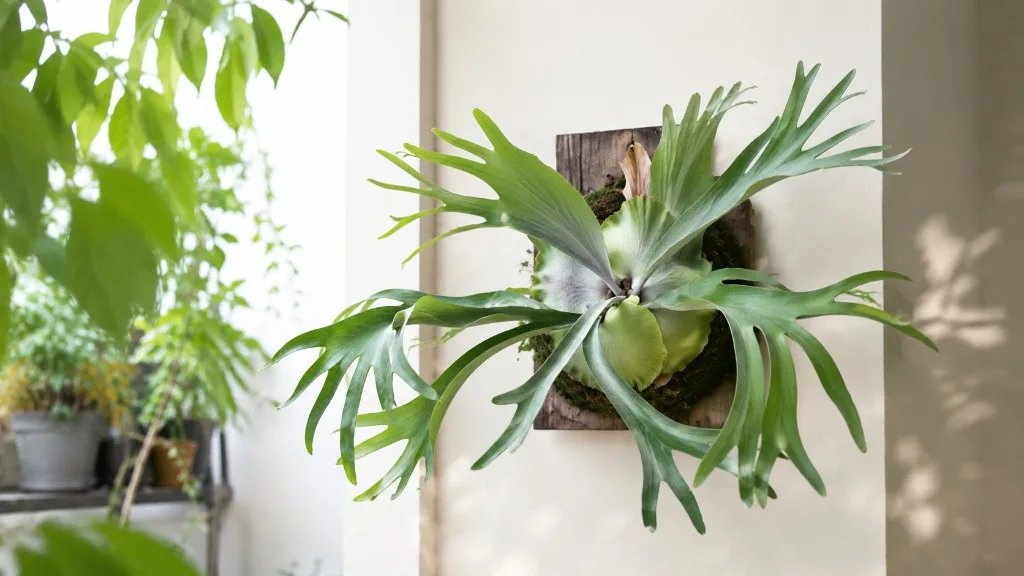
A mounted staghorn fern looks like living sculpture until the wrong light turns those antler fronds pale, crisp, or impossibly slow. Platycerium bifurcatum and its relatives are not generic ferns that survive in a dim corner. They are rainforest canopy epiphytes that evolved to catch filtered brightness high in the trees - more light than a maidenhair fern wants, less brutality than a cactus tolerates. Get that balance right and the plant produces firm new fertile fronds, healthy shield growth at the mount, and the slow, architectural spread that makes staghorns worth the wall space. Miss it and you get a plant that hangs on for months while quietly declining.
The practical target is bright indirect light: strong enough that new growth stays compact and green, soft enough that fronds do not bleach or scorch. For most homes that means an east-facing window, a bright north window at higher latitudes, or a filtered south or west exposure where sheer curtains or several feet of distance take the edge off afternoon sun. Outdoors in frost-free climates, partial sun with morning exposure usually works; harsh midday and afternoon beams do not. When natural light is weak - especially October through March - a full-spectrum grow light on a 10- to 14-hour timer fills the gap more reliably than hoping a pretty but dim room is enough.
This guide focuses on placement you can act on today: how much light staghorn ferns actually use, which window to choose, what direct sun really means for mounted plants, when to add artificial light, and how to read warning signs on the fronds themselves before damage becomes permanent.
If symptoms persist, see the Slow Growth on Staghorn Fern guide.
How Much Light Staghorn Fern Actually Needs
Bright indirect light is the baseline recommendation across botanical gardens, nursery care sheets, and serious Platycerium growers - and it is the phrase worth unpacking instead of treating it as a vague label. Staghorn ferns in the wild grow attached to tree trunks and branches beneath an open canopy. They receive dappled sunlight that shifts through the day: bright when the sun angles through gaps, never the full sustained blast of an open field. The New York Botanical Garden notes that staghorns sit high in the rainforest canopy and are accustomed to strong indirect light, not the deep shade of the forest floor. (NYBG Staghorn Fern Guide)
Translated indoors, that usually means four to seven hours of bright, indirect natural light daily - light bright enough to read by near the plant without sunbeams hitting the fronds directly for long stretches. Brightness drops sharply with distance from the glass - which is why a staghorn on a coffee table six feet from a window behaves differently from one hung at pane height in bright indirect light.
If natural light cannot reach that level - common in north rooms, interior walls, and winter at mid-latitudes - supplemental lighting becomes the main source. Most mounted indoor staghorns perform well with 10 to 14 hours of full-spectrum artificial light daily on a timer, mimicking the longer effective day length plants receive when window light alone is insufficient. The Old Farmer’s Almanac staghorn care guidance aligns with this split: bright indirect light indoors, partial sun outdoors, and a firm rule to keep plants out of direct light that burns sensitive leaves. (Almanac Staghorn Fern Care)
Judge success by new frond development, not the cosmetic state of old tissue. A staghorn that receives adequate light pushes antler fronds with good color, reasonable thickness, and steady spacing over the season. One that is starved may keep old green fronds for a long time while new growth arrives smaller, paler, or not at all.
The Short Answer for Mounted and Potted Plants
If you want the compressed version before fine-tuning, use these three rules. Indoors at a window: hang or place the staghorn where it receives bright indirect light for most of the day, ideally within a few feet of an east or bright north window, or a filtered south/west window with sheer curtain or distance. Outdoors in warm climates: choose partial sun with gentle morning exposure and protection from harsh afternoon rays. When the room is genuinely dim or seasons shorten: add a full-spectrum LED grow light 12 to 24 inches (30 to 60 cm) from the frond surface and run it 10 to 14 hours daily on a timer.
After any placement change, wait two to three weeks and inspect the newest fertile frond or the leading edge of antler growth. Firm texture, appropriate green or silver-green color for your species, and uninterrupted unfurling mean the light level is working. Bleaching, crisp tips, or a complete stall mean you adjust before changing watering, fertilizer, or remounting.
Why Staghorn Ferns Need More Light Than Shade-Loving Ferns
Not all ferns share the same light ecology, and treating staghorns like shade-tolerant terrestrial ferns is one of the most common placement mistakes. Maidenhair, bird’s-nest, and many classic houseplant ferns evolved closer to the forest floor where light is diffuse and limited. Platycerium species occupy a different niche: they anchor on bark and absorb moisture and nutrients from the air and trapped debris while their fronds intercept canopy-level brightness.
That position explains why staghorns fail in dark hallways and dim corners, why dim light slows mount drying and invites rot if watering stays on a bright-room schedule, and why antler fronds show stress first as the main photosynthetic tissue. Platycerium bifurcatum, the common shop species, is among the more adaptable in the genus; rarer types such as P. veitchii often want brighter conditions within the same indirect band.
Understanding Staghorn Anatomy and Light Capture
Light management for staghorns improves when you know which frond does what. Staghorn ferns produce two frond types. Shield fronds (sterile basal fronds) start green and often turn brown and papery as they mature. They clasp the mount, collect organic debris, and help retain moisture around the root mass. Fertile fronds - the antler-shaped leaves - emerge from the center and handle most of the visible photosynthesis that fuels growth.
Both types respond to light, but fertile fronds show damage first because they are thinner, more exposed, and constantly renewed. Shield fronds can look rough or brown as part of normal aging; that is not automatically a light problem. When new shield tissue emerges pale, thin, or stunted while antler fronds also shrink, light is usually limiting. When antler tips bleach white or tan while shields remain intact, exposure is probably too intense or too sudden.
Harsh direct sun damages the silvery trichomes and chlorophyll beneath, producing permanent bleached patches. When diagnosing stress, check fertile antler fronds first for bleaching or crisp patches; evaluate shield fronds only if antlers also look weak - old brown shields alone are normal. Over-lighting shows as localized antler damage; under-lighting as generalized paleness and long gaps between new pushes. On wall mounts, hang where the front face of the antler fronds receives the brightest indirect band.
Best Window Placement for Indoor Staghorn Ferns
Indoor staghorn success starts at the window, not the watering can. Human eyes adapt to dim rooms; staghorns do not. The best window is the one that delivers consistent bright indirect light to the frond surface for enough hours daily without casting direct sunbeams onto antler tissue for extended periods.
Hang or place the mount close enough that the plant receives real brightness, not ambient room glow. A staghorn on a wall opposite a south window may look well lit to you while receiving a fraction of the light available at the glass. Conversely, a staghorn pressed against hot summer glass may receive too much direct radiation even if the window direction is theoretically correct.
East-facing windows are the safest default in most homes. Morning sun tends to be bright but cooler than afternoon sun, and many staghorns tolerate one to two hours of gentle direct morning light once acclimated. Wisconsin Horticulture Extension recommends bright indirect light with good air circulation for indoor staghorn fern culture. North-facing windows work when unobstructed and bright - especially in summer at higher latitudes - but often need supplemental light in winter. South-facing windows can be excellent with sheer curtains, three to six feet of distance, or placement offset from the direct beam track. West-facing windows are the highest-risk orientation indoors because afternoon sun carries heat; use diffusion or treat west exposure as a seasonal location rather than a year-round default.
Consider what sits outside the glass. A deep overhang, deciduous tree, or neighboring building may filter light enough to make a south window behave like east. An unobstructed west window over pavement can behave like a magnifier in July.
East, North, South, and West Windows Compared
An east window offers strong indirect brightness through midday plus optional mild morning direct sun - the best balance for most indoor staghorns. A north window provides steady indirect light without direct beams; it can sustain bifurcatum in summer but usually needs a grow light from late autumn through early spring. A south window is brightest and most seasonal - excellent in winter, risky in summer unless filtered. A west window demands the most caution because late-day heat produces sudden crisp edges; use sheer curtains or hang the mount farther into the room.
Distance from the glass changes intensity fast - aim for one to three feet (30 to 90 cm) from the pane, adjusting closer in dim north exposures and farther in hot south or west exposures. Avoid the “bright room” trap: a mount on a distant console may receive low daily totals even when the room feels luminous. Walk to the hook at 10 a.m. and 3 p.m. on a clear day; if you would not read comfortably there without a lamp, the staghorn probably cannot either.
Outdoor Light for Staghorn Ferns in Warm Climates
In USDA zones 9 and warmer, or equivalent frost-free regions, staghorn ferns often live outdoors on trees, fences, or shaded patios for part or all of the year. Outdoor light is generally stronger and more complete than indoor window light, which sounds ideal - and it is, until afternoon sun and heat enter the picture.
Outdoor placement should mimic partial shade under open canopy: bright all day without sustained direct beams on antler fronds. Under a tree with filtered shade, on a covered porch, or on a north- or east-facing wall outdoors often works well. A workable formula for bifurcatum is morning sun plus afternoon shade - in nature, staghorns often sit on the east side of tree trunks where morning light arrives but afternoon rays are buffered. Watch reflected heat from walls and pavement; a mount in “shade” near bright stucco can still scorch. Season matters: spring and fall angled sun may be perfect where midsummer sun burns.
Direct Sun Tolerance: What Staghorn Fern Can and Cannot Handle
Direct sunlight means sunbeams strike the frond surface without meaningful diffusion. Staghorn ferns generally cannot tolerate prolonged direct sun, especially harsh afternoon exposure. The Almanac and NYBG both warn that direct light bleaches color and leaves blotchy or crisp damage on fronds. That matches what growers see on mounts moved too quickly from low shop light to unfiltered west windows.
Brief gentle morning sun differs from midday or afternoon direct sun - many acclimated bifurcatum tolerate short morning sessions but burn in two hours of unfiltered July west sun. Reflected direct sun from mirrors or glass doors counts too. Increase exposure incrementally and watch fertile frond tips daily; damage shows within three to seven days on new tissue.
Acclimation Steps Before Increasing Exposure
Sudden light jumps cause more staghorn damage than steady moderate brightness. Plants grown under shade cloth in nurseries or held in dim garden centers have fronds formed for lower intensity. Moving them immediately to a hot south or west pane produces sun scorch even though the “correct” long-term home might be that window with diffusion.
Use a 7- to 14-day acclimation: start farther from the glass or behind a sheer curtain, then move six inches (15 cm) closer every few days if antler tips stay unbleached. Do not simultaneously change fertilizer or watering frequency - stacked adjustments obscure cause and effect. If scorch appears, step back immediately to the last safe position.
Low-Light Limits and Why Dim Rooms Fail Long Term
Staghorn ferns can survive low light longer than many sun-loving tropicals, which creates a dangerous illusion of success. Survival is not vigor. In chronically dim conditions, bifurcatum often stops producing impressive antler fronds, opens new growth smaller and paler, and enters a slow decline where old fronds persist while the root mass weakens.
Low light also extends drying time on mounts. A staghorn that needed soaking every seven to ten days in bright indirect light may stay wet for weeks in a dim corner. That mismatch invites root and shield rot, especially on heavy sphagnum mounts. Growers sometimes blame watering when light was the primary throttle.
North windows deep in winter, interior walls with no window sightline, and rooms relying on a single distant lamp are common low-light failure zones. If you cannot hang the plant within a few feet of a genuinely bright window, plan on grow lights from day one rather than treating them as emergency rescue.
Compare species expectations. P. bifurcatum tolerates lower light better than many ornamental Platycerium, but “better” still means moderate indirect brightness, not closet darkness. If antler fronds shrink for two consecutive growth cycles, light is insufficient regardless of how green the old fronds look.
How Indoor Light Differs From Rainforest Canopy Conditions
Indoors, mounts receive static directional light from one window while glass filters intensity and day length shrinks in winter. Human perception misleads - a room that feels adequately lit for daily activities often delivers far too little brightness for canopy epiphytes accustomed to strong filtered light. Winter adds double pressure: lower intensity and shorter photoperiod. Move the mount to the brightest pane, add grow light hours to 12 to 14, and do not compensate with extra fertilizer on a plant that is not growing.
Grow Lights When Natural Light Falls Short
When windows cannot deliver enough brightness - common for wall mounts away from glass, north rooms in winter, and office-adjacent living spaces - a full-spectrum LED grow light is the most reliable solution. Staghorns respond well to modern LEDs because they run cooler than older HID fixtures and can sit closer to fronds without heat scorch if positioned sensibly.
Choose a full-spectrum white LED rated for houseplants, not a standard room bulb. Coverage matters - light that hits only the center of the antler cluster leaves outer fronds weaker.
Choosing Fixtures, Distance, and Photoperiod
Hang a full-spectrum LED 12 to 24 inches (30 to 60 cm) from the fertile fronds and run it 12 hours daily on a timer. If growth stays pale after three weeks, increase to 14 hours or move the fixture two inches (5 cm) closer - not both at once. Use new frond quality as feedback; bleaching under the lamp alone means raise the fixture or shorten hours. Combine window light plus LED when possible for the most natural frond color.
Warning Signs Your Staghorn Is Getting the Wrong Light
Make one placement change, then wait 10 to 14 days before adjusting watering or fertilizer - light and water stress symptoms overlap, and changing everything at once makes diagnosis guesswork. Read new fertile frond tissue first; old damage is permanent.
Symptoms of Too Much Light
Too much light damages fertile antler fronds first. Watch for bleached white or tan patches, crisp brown edges after a move to a brighter window, curling antler tips during peak brightness, and sudden drying on the sun-facing side after an unacclimated move. Fixes: pull back from the glass, add sheer diffusion, and acclimate gradually. Do not confuse normal aging brown shield fronds with sun damage - shields turn papery with age, while scorch hits young antler tissue first.
Symptoms of Too Little Light
Under-lighting is quieter than scorch but equally serious over months. Watch for small or pale new antler fronds, long gaps between fertile frond emergence, leaning toward the brightest corner, and a persistently wet mount because evaporation slowed. Old green fronds can mask the problem for months. Fixes: move closer to the brightest window, add a grow light on a 12- to 14-hour timer, and reduce watering until drying rate matches slower metabolism. Expect improvement on new fronds only after two to four weeks.
The Hand-Shadow Test and Practical Field Checks
You do not need expensive equipment to estimate light quality at the mount. The hand-shadow test is widely used for bright-indirect plants including Platycerium: hold your hand 12 inches (30 cm) above the mount surface in the spot where the fronds face the light source during midday brightness.
If you see a sharp, dark, well-defined shadow, light is likely too intense for staghorn ferns without diffusion or acclimation - think direct beam or very close hot glass. If you see a soft, faint shadow with blurred edges, you are in the bright indirect band that staghorns prefer. If you see no meaningful shadow at all, the spot is probably too dim for long-term vigor unless you supplement.
Combine the shadow test with the new-frond test after any change - old damage is historical, but new antler color, size, and unfurling speed tell you whether the current spot works. Check heat separately: a spot that passes the shadow test but leaves the mount hot to the touch by afternoon still fails.
How Light Changes Affect Watering on Mounted Plants
Light and watering are coupled on staghorn mounts more tightly than many soil-potted houseplants. Photosynthetically active fronds drive transpiration and dry the sphagnum or moss root mass. When light increases, the mount dries faster; when light drops, it stays wet longer.
After moving a staghorn brighter, check mount weight or moss dryness every few days until you learn the new rhythm. A soak schedule that worked in a dim corner will overwater the same plant under a grow light unless you adjust. After moving dimmer - rarely intentional, but common after scorch retreat - extend the interval between soaks to prevent rot.
Feed only when the plant is actively growing in adequate light. Humidity (50 to 70 percent) does not replace brightness. Make one variable change at a time - move the mount, wait two weeks, read new fronds, then adjust soaking frequency.
Conclusion
Staghorn ferns reward honest bright indirect light with the slow, sculptural antler growth that makes them worth mounting in the first place. Indoors, that usually means an east or bright north window, a filtered south or west exposure, or a full-spectrum grow light running 10 to 14 hours when seasons or room layout cannot deliver real brightness at the mount. Outdoors in frost-free climates, think partial sun with morning exposure and afternoon protection, not open-sky blazing.
The plant communicates on new fertile fronds before anywhere else. Firm green or silver-green antlers, steady emergence, and a mount that dries on a predictable rhythm mean your placement works. Bleaching, crisp sun-facing patches, shrunken pale new growth, or months without antler pushes mean the current spot is wrong - regardless of how bright the room feels to you.
Fix light first. Use the hand-shadow test to compare hooks, acclimate gradually when increasing exposure, and adjust watering only after the mount has sat in its new light level long enough for new tissue to tell the truth. That sequence - light, observation, then water - is how a staghorn fern becomes a living wall feature instead of a slowly fading conversation piece.
When to use this page vs other Staghorn Fern guides
- Staghorn Fern overview - Start here for whole-plant context before deep-diving this topic.
- Staghorn Fern problems hub - Jump to symptom-specific fix guides when this care topic does not resolve the issue.
Related Staghorn Fern guides
- Staghorn Fern overview
- Staghorn Fern watering
- Staghorn Fern soil
- Staghorn Fern propagation
- Staghorn Fern fertilizer
- Staghorn Fern repotting
- Staghorn Fern problems
Where to go next
Use this page as the hub for Staghorn Fern care. Follow the linked watering, light, and soil guides for day-to-day rhythm, and open problem pages when a specific symptom appears.