Staghorn Fern Watering: Mounted Plant Guide
Staghorn Fern Watering: Mounted Plant Guide
Staghorn Fern Watering: Mounted Plant Guide
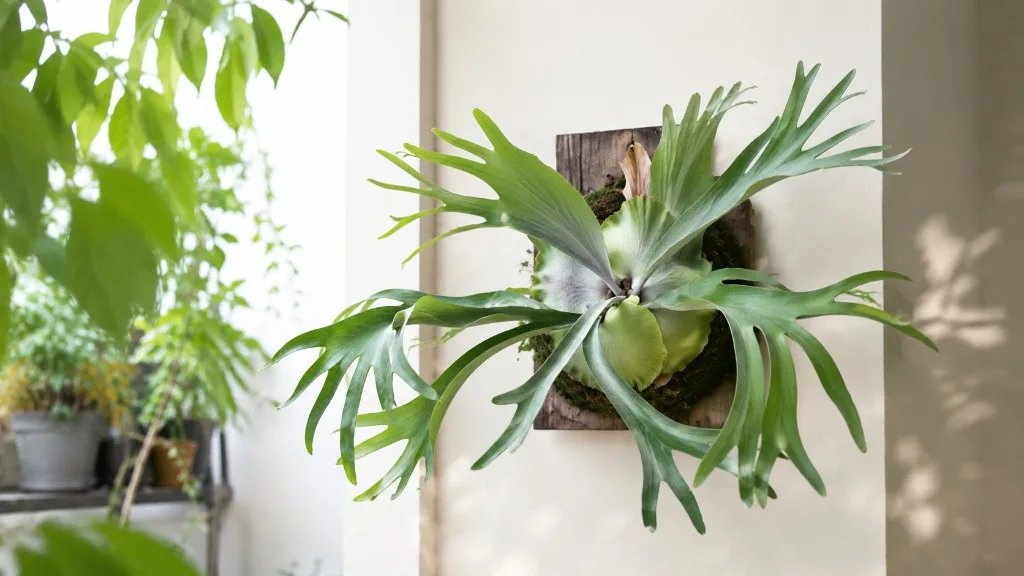
A mounted staghorn fern (Platycerium bifurcatum) is not watered like a pothos in a pot. It lives on a thin layer of sphagnum moss wrapped around a wooden plaque, exposed to air on every side, with roots tucked behind a flat shield frond that acts as a living catch basin. That architecture dries fast, drinks deep, and punishes both extremes - bone-dry moss for weeks, or a mount that never fully drains between soakings. The good news is that mounted staghorn watering is simpler than it looks once you stop treating the calendar as the boss and start treating the mount’s weight as the signal.
This guide is written specifically for wall-mounted and plaque-mounted plants. If yours still lives in a basket or pot, some principles overlap, but the rhythm, method, and drying time are different enough that potted schedules will mislead you. For mounted plants, the core method is soak-and-dry: fully saturate the moss and root mass, let the mount drain completely, then wait until it feels noticeably light before soaking again.
Why Mounted Staghorns Need a Different Watering Method Than Potted Plants
In the wild, staghorns grow epiphytically on tree trunks and branches across Australia and Southeast Asia, where rain arrives in bursts and airflow strips moisture away within hours. Cultivated mounts mimic that exposure. A potted fern sits inside a contained volume of mix that holds water two to three times longer than a thin moss pad on open wood. Pouring a cup of water onto a mount the way you would top-water a houseplant barely reaches the root zone behind the shield, and it almost never saturates the inner moss evenly.
Mounted staghorns also absorb water through more than just roots. The shield frond - the round, flat basal frond pressed against the board - collects debris, holds moisture against the root mass, and protects the growing point. The antler fronds (foliar fronds) handle photosynthesis and transpiration. When you soak a mount properly, you hydrate the entire system: moss lattice, roots, and the shield’s inner surface. When you skimp with a spray bottle or a quick pour, the surface looks damp while the core stays dry, and the plant slowly dehydrates despite your effort.
Epiphytic Roots and the Shield Frond as a Living Reservoir
Staghorn roots are fine, fibrous, and adapted to cling to bark - not to sit in dense, airless mud. They need alternating cycles of moisture and oxygen. Long-fiber sphagnum moss works as a mount medium because it holds water inside individual moss strands while leaving open spaces - macropores - between strands for air. That balance collapses when moss is packed too thick, compressed, or kept constantly wet indoors where airflow is weak.
The shield frond is part of the watering system, not decoration. Young shields emerge green and cup-shaped, then gradually turn papery brown as they age - a normal lifecycle event, not a death sentence. Wisconsin Horticulture Extension advises that tan or brown basal fronds should not be removed even if they look dead until they fall off naturally. Never remove old brown shields; they insulate roots, trap organic matter that feeds the plant, and regulate moisture at the base.
Your job is to keep that zone hydrated on a deep-soak schedule, then let it dry down enough that roots can breathe before the next soak.
How Often to Water a Mounted Staghorn Fern
There is no universal “every Tuesday” rule. A useful starting framework for an average indoor mount in Staghorn Fern light guide looks like this:
| Season / conditions | Typical soak interval for indoor mounted plants |
|---|---|
| Active growth (spring–summer, normal room temps) | About every 7–10 days |
| Shoulder seasons (fall) | About every 10–14 days |
| Slow growth (winter, cooler/dimmer rooms) | About every 14–21 days (2–3 weeks) |
| Hot, dry, or very bright placement | As often as every 4–6 days |
| Cool room (16°C / 60°F or below) with low light | As infrequently as every 2–3 weeks |
Treat those ranges as orientation, not commandments. Your home’s humidity, mount size, moss thickness, and how close the plant sits to a heating vent or sunny window will shift the rhythm within days. A mount that dries in five days in July may take eighteen days in January without you changing anything except the season.
The Old Farmer’s Almanac staghorn fern care guidance aligns with this pattern: soak regularly during active growth, then reduce watering in winter - often cutting frequency to roughly once every two to three weeks when growth slows. Specialist mounted-fern resources emphasize the same split: mounted plants in indoor conditions typically need weekly soaks in warm months and significantly less in cold months, with outdoor mounts drying even faster.
The Weight Test: Your Most Reliable Schedule
The weight test replaces calendar reminders. Within the first two weeks of owning a mounted staghorn, pick it up after a full soak and drain cycle - note how heavy it feels. Pick it up again when the moss at the base feels dry to the touch and the mount feels substantially lighter. That lighter weight is your green light to soak again. If it still feels cool, dense, or heavy in your hands, wait two more days and test again.
You can combine weight with a finger check: press gently into the moss near the base of the shield. If the surface and the first inch feel fully dry and the mount feels light, soak. If the moss is still cool and slightly springy with moisture, hold off. Over time you will calibrate by feel alone, which is exactly how experienced growers operate. The weight test also catches problems early - a mount that stays heavy for ten days after you thought you watered may have drainage issues, packed moss, or too-cool placement slowing evaporation.
The Soak-and-Dry Method Step by Step
How do you water a mounted staghorn fern? Remove it from the wall, saturate the moss and root mass fully, let it drain completely, then rehang only when dripping has stopped. Here is the full workflow:
- Take the mount down. A saturated board can double in weight and drip for half an hour. Soaking in place destroys drywall and warps wood over time.
- Choose your vessel. A sink, bathtub, or large bin filled with room-temperature water works. The water should cover the moss and root zone; antler fronds can stay mostly above the water line if space is tight.
- Submerge or drench. Either place the mount moss-side down in water or hold it under a gentle shower stream. See the next subsection for timing differences.
- Wait for full saturation. The moss should darken evenly. Air bubbles rising from the mount are a good sign the inner layers are filling. A properly soaked mount feels uniformly heavy.
- Drain face-up. Set the mount on a rack, dish rack, or prop it at an angle so water runs off the shield and out of the moss - not pooling behind the frond. Allow 20–30 minutes minimum; large mounts may need longer.
- Rehang when drip-free. The moss should feel wet but not streaming. No water should run down the wall when you hang it back up.
- Reset the cycle. Do not water again until the weight test says dry.
This method gives roots a full drink followed by a real dry-down - the epiphytic rhythm they expect. Shallow, frequent splashes keep the surface damp while the core starves, which produces the frustrating pattern of a plant that gets “watered” regularly yet still shows drought stress on antler tips.
Submersion vs Shower Soaking: Which Works Better
Both work if the inner moss actually gets saturated. Submersion - placing the mount in a sink or tub of water - is the most reliable method for thorough, even hydration. UF/IFAS Gardening Solutions notes that staghorn ferns should be watered when the growing medium feels dry, with the entire root ball and moss mount soaked thoroughly. Most growers soak 10 to 20 minutes for a standard indoor mount, though smaller mounts with thin moss layers may need only 5 to 10 minutes. Watch for bubbles slowing and the board feeling uniformly heavy rather than watching the clock alone.
Shower soaking - running room-temperature water over the shield and moss for several minutes - suits mounts too large for your sink or growers who prefer not to lift heavy boards. Run water slowly over the shield frond and moss pad until water runs freely out the bottom and the moss no longer lightens immediately when you pause the stream. The risk with shower-only watering is missing dry pockets in thick moss; rotate the mount and direct water at multiple angles.
Either way, use room-temperature water. Cold water shocks tropical roots. Hot water damages fine root hairs. If you submerge, support the antler fronds so they are not crushed under the mount’s weight for extended periods.
Drain Time Before Rehanging
Drain time is not optional. Rehanging a dripping mount is the fastest route to overwatering symptoms indoors: blackening at the shield base, sour smell from moss, and soft tissue where fronds meet the mount. Staghorns tolerate high humidity but not stagnant wetness against wood and roots in still indoor air.
After soaking, set the mount face-up so the shield frond sheds water outward. A dish rack, cooling rack, or a few chopsticks under the board works. Touch the moss at the base after twenty minutes - it should feel wet but not squish water when pressed. If water still pools in the shield cup, tilt the mount to pour it off before rehanging. Large or densely mossed mounts in humid bathrooms may need forty-five minutes to an hour. Rushing this step causes more mounted staghorn losses than underwatering.
Why Misting Is Not Enough for a Mounted Staghorn
Misting raises ambient humidity for a few minutes. It wets antler frond surfaces and the outer moss crust. It does not reliably hydrate the root mass tucked behind the shield, often several inches deep in the moss pad. A spray bottle cannot replace periodic deep soaks for mounted plants.
That does not mean misting is useless. In dry winter rooms or near heating vents, light misting on antler fronds - not as your sole watering - can reduce tip browning from low humidity. Humidifiers and naturally humid rooms (bathrooms with good light, kitchens away from stove heat) also help. But humidity and hydration are different problems. A staghorn can sit in 60% humidity and still dehydrate if the moss core never gets soaked. Conversely, a well-soaked mount in dry air still needs its dry-down cycle - do not mist so heavily that fronds stay wet for hours, which invites fungal spotting.
If you have been misting daily and the mount still feels light and the antler tips crisp, switch to soak-and-dry as your primary method and treat misting as optional humidity support only during dry spells.
Seasonal Watering Adjustments for Indoor Mounted Plants
The same mount can need water twice as often in August as in January without any change in your habits - because the plant’s growth rate, transpiration, and moss drying speed all shift with season and indoor climate.
During spring and summer, new antler fronds and occasional fresh green shields signal active growth. Transpiration increases, moss dries faster, and roots pull water more aggressively. Weekly soaks are common for indoor mounts in this period, with hot or bright placements sometimes needing water every four to six days. Watch the weight test, not the calendar - a heat wave can compress your interval dramatically.
During fall and winter, growth slows. Many indoor staghorns need water thirty to fifty percent less often than in summer. The Old Farmer’s Almanac and multiple specialist care guides recommend reducing from roughly weekly summer soaks to every two to three weeks in winter for many indoor setups. This is the season when overwatering kills more plants than underwatering: the moss stays wet longer in cool, dim rooms, and growers who maintain summer frequency rot the root zone while the plant looks merely “quiet.”
Summer Heat and Winter Slowdown
Summer adjustments are usually about watering more when the weight test demands it - not about changing the method. If your mount dries to light weight in four days during a heat spell, soak at four days. Add humidity support if antler tips brown despite correct soak timing; sometimes dry air mimics underwatering on frond edges while the moss is actually fine.
Winter adjustments require restraint. Move the mount away from cold window glass that chills the moss overnight, but do not compensate for slow drying by soaking on schedule if the mount is still heavy. A staghorn in a 16–18°C (60–65°F) room with short daylight may need water only every fourteen to twenty-one days. Skip fertilizer in winter unless you are in a warm, brightly lit room with visible new growth. Fertilizer during slow, wet-cool conditions adds stress without benefit.
Signs Your Mounted Staghorn Is Overwatered
Overwatered mounted staghorns fail at the base first. Watch for these signals together, not in isolation:
- Black or dark brown mushy tissue at the center of the shield frond or where antler fronds meet the moss - soft to the touch, not papery
- Foul smell from the mount - sour, stagnant, or rotting organic matter
- Persistent heaviness - mount still feels waterlogged days after soaking
- Black spots spreading on green tissue, especially with wet patches that do not dry
- New antler fronds stunted or collapsing while moss stays constantly damp
- Moss that never lightens between supposed dry periods
Overwatering on mounts usually traces to one or more causes: rehanging before full drain, soaking on a calendar without a weight check, moss packed too thick, low light slowing evaporation, or cool winter rooms where the plant cannot use water at summer speed. Staghorns are epiphytic - they want moisture with oxygen, not a swamp pressed against wood.
If several overwatering signs appear, stop watering until the mount dries to a genuinely light weight. Inspect the moss layer; remove only material that is clearly black and mushy, not dry brown shield tissue. Improve airflow around the mount and confirm bright indirect light. Resume soaking only after the weight test passes, and consider a thinner moss layer or less frequent soaks going forward.
Rot vs Natural Brown Shield Fronds
This distinction saves mounted staghorns from unnecessary surgery every week. Natural brown shield fronds are dry, papery, tan to caramel in color, and firm - like aged parchment. They may cover older green shields beneath as the plant grows. They do not smell bad, do not feel mushy, and are not removed. They protect roots and are part of a healthy lifecycle.
Rot and overwatering damage looks and feels different: black or dark wet brown tissue, softness, odor, and sometimes spreading marks on green fronds nearby. If you are unsure, touch and smell before cutting anything. Dry papery brown - leave it. Wet black mush - address watering and airflow immediately, and seek local advice if damage is extensive.
| Trait | Natural aging shield | Overwatering / rot |
|---|---|---|
| Texture | Dry, papery, firm | Soft, mushy, wet |
| Color | Tan, caramel, light brown | Black, dark wet brown |
| Smell | None | Sour, foul, stagnant |
| Action | Leave in place | Stop watering, improve drain and airflow |
Antler frond tips browning from underwatering typically start at frond edges and progress when the mount is very light and moss is dry throughout - the opposite moisture profile from rot.
Signs Your Mounted Staghorn Is Underwatered
Underwatered mounts tell a clearer story on the antler fronds:
- Wilting or limp antler fronds on Staghorn Fern that recover after a thorough soak
- Crispy brown tips progressing down frond edges when dry spells repeat
- Very lightweight mount - dramatically lighter than your post-soak reference
- Moss pulling away from the board or feeling dusty and hydrophobic
- Slowed new growth during active season despite good light
A single dry episode is usually recoverable. Soak thoroughly, drain fully, and return to weight-based scheduling. Repeated drought stresses fine roots and makes the plant react poorly when water finally returns - antler fronds may brown unevenly and recovery takes weeks.
Do not fix underwatering with daily misting or tiny splashes. Give one full soak, let it drain, then wait for the next dry-down. If your mount dries out in three days every cycle, you may need more moss volume (not denser - slightly more long-fiber pad), higher humidity, or a placement away from drying heat sources - not more frequent partial watering.
How Mount Type, Moss, and Airflow Affect Drying Time
Not all mounts dry at the same rate. A small plaque with a thin moss pad in a bright bathroom may need water twice weekly in summer. A large board wrapped in a thick sphagnum ball in a dim hallway may stay wet for two weeks after one soak - a dangerous setup indoors.
Mount orientation matters. Vertical hanging is standard and allows water to run off the shield. Mounts displayed at steep angles or flat on shelves hold water longer in the moss cup. Board material - cedar, oak, tree fern fiber, or cork - affects how much water the backing absorbs and releases. Room airflow from fans, open windows, or HVAC vents accelerates drying; still corners do not.
Moss volume should be enough to anchor roots and hold moisture, but not so thick that the center stays anaerobic for days. Many mounted staghorns fail because the initial mounting used a softball-sized moss wad “for safety.” Indoors, thinner and airier beats thick and soggy.
Long-Fiber Sphagnum vs Dense Media
Use long-fiber sphagnum moss, not garden peat or milled moss products. Long fibers create a sponge-like lattice: water inside strands, air between strands. Peat and finely milled moss compress into dense pads that hold water without draining - essentially wet concrete against roots. Some growers tuck a small amount of coarse orchid bark behind the moss to improve airflow; the moss layer itself should still be the primary moisture reservoir.
When remounting or refreshing moss, pre-moisten sphagnum and squeeze out excess so it is damp, not dripping, before wrapping. Pack firmly enough to hold the plant, but avoid cramming moss into a solid mass. If your mount never dries within ten days in an average indoor environment, suspect moss density before blaming the plant.
Water Quality, Temperature, and Fertilizer During Soaks
Staghorns are not ultra-sensitive, but harsh water and cold shocks add stress. Room-temperature tap water is fine in most municipalities. If your tap water is very hard or heavily chlorinated and antler tips persistently brown despite correct soak timing, try filtered or rainwater for a few cycles and compare results - improvement is anecdotal for many growers but worth testing in problem setups.
Fertilizer belongs in the soak water during active growth, not on dry moss in winter. Use a balanced liquid fertilizer diluted to one-quarter to one-half strength, monthly or every two weeks during spring and summer, mixed into the soak water so it distributes through the moss evenly. Wisconsin Horticulture Extension recommends fertilizing monthly during warmer months with balanced, diluted liquid fertilizer as part of regular watering.
Do not pour full-strength fertilizer onto dry roots. Skip feeding entirely when growth is visibly paused in a cool winter room.
Never use kitchen-scrap hacks (banana peels, egg shells buried in moss) on mounted indoor plants. They rot, attract pests, and disrupt the open moss structure staghorn roots require.
Common Mounted Staghorn Watering Mistakes and Fixes
Mistaking calendar for judgment. Fix: weight test every time; calendar is a reminder to check, not to soak.
Soaking in place on the wall. Fix: always take the mount down; protect walls and allow full drain.
Rehanging while dripping. Fix: minimum twenty to thirty minutes face-up drain; longer for large mounts.
Misting instead of soaking. Fix: deep soak as primary; mist only for humidity if needed.
Removing brown shield fronds. Fix: leave dry papery shields; distinguish from rot.
Thick, compressed moss. Fix: remount with thinner long-fiber layer; optional bark for airflow.
Same winter frequency as summer. Fix: cut interval thirty to fifty percent; prioritize dry-down in cool rooms.
Ignoring light’s role in drying. Fix: bright indirect light speeds healthy drying; dim rooms need longer intervals between soaks, not more water.
Soaking a rotting mount repeatedly. Fix: pause water, dry out, inspect; resume only when weight test and tissue condition allow.
Quick Reference Checklist Before Every Soak
Run through this list until the habits are automatic:
- Mount feels light and moss at base feels dry
- Plant is removed from wall before water touches it
- Water is room temperature
- Moss and root zone get fully saturated (submersion or thorough shower)
- Mount drains face-up 20+ minutes until drip-free
- No fertilizer in winter soak unless plant is in active growth with warmth and light
- Brown papery shields left intact; only mushy black tissue flagged for attention
- Rehang only when weight is uniformly heavy-wet, not streaming
Conclusion
Staghorn fern watering for mounted plants comes down to one repeatable cycle: soak deeply when the mount feels light, drain completely before rehanging, and adjust frequency by season and home conditions - not by a rigid weekly rule. The weight test beats every calendar app. Misting supports humidity but never replaces soaking. Brown papery shield fronds are normal armor; black mushy tissue and foul smells are emergencies. Get those distinctions right and a mounted Platycerium bifurcatum becomes one of the most satisfying wall plants you can grow - dramatic antler fronds, minimal potting mess, and a weekly ritual that catches problems before they spread. Check the mount’s weight today, soak only if it asks for water, and let the next dry-down teach you how your specific room really works.
When to use this page vs other Staghorn Fern guides
- Staghorn Fern overview - Start here for whole-plant context before deep-diving this topic.
- Staghorn Fern problems hub - Jump to symptom-specific fix guides when this care topic does not resolve the issue.
- Wilting on Staghorn Fern - Escalate here when watering adjustments are not enough.