Staghorn Fern Fertilizer: When, How, and Mistakes to Avoid
Staghorn Fern Fertilizer: When, How, and Mistakes to Avoid
Staghorn Fern Fertilizer: When, How, and Mistakes to Avoid
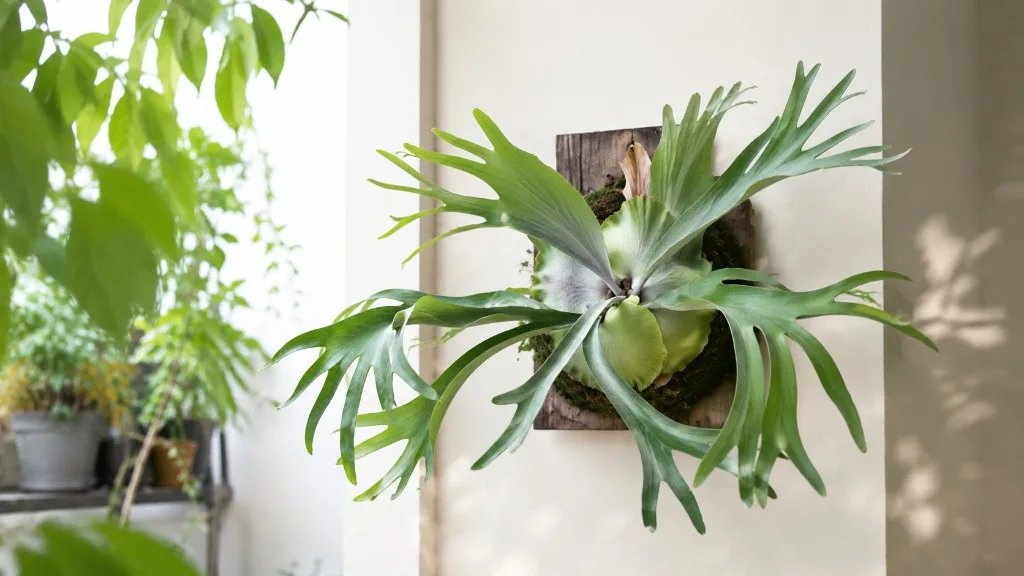
Staghorn fern fertilizer is one of the few care topics where doing less usually produces better results than doing more. Platycerium species - most commonly P. bifurcatum in homes and garden centers - are epiphytic ferns that evolved in nutrient-poor treetop and rock-face habitats from Java through tropical Australia to New Caledonia. In the wild, they do not root into rich soil. They anchor to bark or stone with shield-shaped basal fronds, catch falling leaves and debris in that cup, and slowly digest whatever organic matter drifts their way. That is their natural fertilizer system: small, irregular, and low in nitrogen compared with what a potted houseplant typically receives.
Indoors or on a patio mount, your staghorn cannot collect forest litter on its own. A light, diluted feeding during active growth replaces what soaking and root expansion pull from the moss or bark mount - but only if you respect the plant’s low appetite. Feed too much, too often, or onto dry roots, and brown antler tips, scorched shield fronds, and sudden frond drop follow faster than on most foliage plants. The practical default for most growers is a balanced water-soluble fertilizer at quarter to half the label strength, applied monthly from spring through early fall while new fiddleheads are emerging, with no fertilizer from late fall through winter for typical indoor setups. Mounted plants are fed by soaking the root mass in diluted solution, not by spraying concentrated liquid on open fronds.
This guide covers when to fertilize, how much to use, which products work best, how to feed wall-mounted specimens safely, how to use banana peels without creating pest problems, and the mistakes that cause more damage than skipping a month ever would.
If symptoms persist, see the Slow Growth on Staghorn Fern guide.
Why Fertilizer Matters for Staghorn Ferns
Staghorn ferns grow slowly to moderately in cultivation, reaching roughly 60–90 cm wide on a mature mount with antler fronds up to 90 cm on well-grown P. bifurcatum. Even at that pace, the plant builds new shield tissue, extends antler fronds, and expands the root mass behind the basal cup - drawing nitrogen, phosphorus, and potassium that soaking leaches from moss mounts. Fertilizer fills the gap, but only to the point epiphytic roots absorb without salt injury.
University of Florida IFAS Gardening Solutions recommends a 1:1:1 ratio, with young plants fed monthly in warm months and mature specimens thriving on one or two applications per year (UF IFAS - Staghorn Fern). TFEPS echoes balanced 10-10-10 or 20-20-20 formulas during the growing season (TFEPS - Staghorn Ferns). Staghorns are light feeders - think maintenance for an actively growing mount, not a rescue for a sun-scorched or chronically dry fern. Fix light and watering first, then feed conservatively.
When to Fertilize Staghorn Ferns: Active Growth vs Rest
Timing follows the plant’s metabolism more than a date on the calendar. Feed when the staghorn is actively producing new shield growth and coiled antler fiddleheads, and stop when frond production stalls. Outdoors in USDA zones 9–11, that rhythm tracks warm nights and long days. Indoors, heated rooms and bright windows can extend the window - but most houseplant staghorns still slow noticeably in late fall and winter even when old fronds look green and intact.
A common trap: the mount looks alive all December, so growers keep feeding on a July schedule. Lower light and shorter days reduce new shoot production while roots still absorb water more slowly. Unused nutrients accumulate as soluble salts on moss and shield tissue - a direct path to tip burn and weak spring comeback. Staghorn ferns punish off-season feeding more reliably than they reward enthusiastic winter doses.
Spring and Summer Feeding Window
Start feeding when you see fresh growth - tightly coiled antler fiddleheads unfurling, new green shield tissue expanding at the base, or pups pushing out from an established mount. Outdoors in temperate climates, that usually means mid-spring through early fall, roughly April through September depending on your zone and whether the fern hangs under a porch roof or sits in a bright bathroom. Indoors with consistent warmth, you may begin slightly earlier if new tissue is clearly forming.
During this active window, a quarter- to half-strength balanced liquid feed every four to eight weeks works for most mounted plants. Wisconsin Horticulture Extension recommends fertilizing monthly during warmer months with balanced, diluted liquid fertilizer. Young, vigorously growing plants can sit at the monthly end. Large, established specimens that add only a few new antler fronds per year often need less - sometimes a single spring feed and one mid-summer top-up.
| Month (temperate climate) | Growth phase | Feeding guidance |
|---|---|---|
| March–April | Waking up, fiddleheads emerge | Start half-strength soak if active growth visible |
| May–August | Peak frond production | Every 4–8 weeks; young plants on shorter end |
| September | Slowing slightly | Reduce to every 6–8 weeks or taper off |
| October | Wind-down | Final light feed if still growing, then pause |
| November–February | Low growth indoors/outdoors | No fertilizer for typical setups |
The table is a framework, not a law. A staghorn on a humid Florida porch under tree canopy may grow steadily from March through October. A north-facing indoor plaque may produce only two flushes of antler fronds all year. Watch the plant: if fiddleheads are forming and shield fronds look plump and green, the timing is right. If growth is static, solve light and watering before adding food.
Fall Taper and Winter Pause
Taper feeding in early to mid-fall as day length drops and indoor humidity shifts with heating systems. One practical approach: give a final half-strength soak in early fall if you still see new growth, then stop entirely from late fall through winter. Most indoor staghorn ferns do fine with no fertilizer from November through February, especially in cooler rooms or lower-light placements.
Winter rest is not full dormancy like a deciduous tree shedding leaves, but metabolic demand drops sharply. UF IFAS advises reducing fertilizer to every other month during cooler periods when growth slows, and mature plants may need only one or two yearly applications total (UF IFAS - Staghorn Fern). For typical room-grown mounts, the cleaner rule is simpler: no fertilizer in winter. Resume only when you see active fiddleheads in spring, then rebuild to the regular frequency over two to three weeks rather than doubling the first spring dose to “make up” for the pause.
Exception: if you grow under strong supplemental grow lights and the fern keeps producing new antler fronds all winter, you can feed lightly - still at quarter to half strength - but extend the interval to every eight to ten weeks and watch shield fronds for white salt residue. Even then, skipping winter feeds is safer than forcing growth with nutrients the roots cannot process in cooler, slower conditions.
Best Fertilizer Type for Staghorn Ferns
The best staghorn fern fertilizer for most homes is a complete, water-soluble, balanced formula with equal parts nitrogen, phosphorus, and potassium. You want nitrogen for frond expansion and deep green shield tissue, phosphorus for root and energy function at modest levels, and potassium for overall vigor and drought tolerance between soakings. Micronutrients on the label - iron, magnesium, manganese - matter because pale new growth on otherwise well-watered mounts sometimes traces to trace-element gaps rather than macronutrient hunger.
Avoid shopping by the word “fern” on the bottle unless you already trust the brand’s dosing guidance. A standard balanced indoor or orchid formula used conservatively outperforms most specialty products applied at label strength on an epiphyte that evolved for nutrient poverty.
Balanced Liquid Formulas and NPK Ratios
A 10-10-10 or 20-20-20 water-soluble fertilizer diluted to quarter or half strength is the default recommendation across horticultural sources for staghorn ferns. Equal ratios keep feeding simple when your main goal is steady frond development, not flowers or fruit - staghorns reproduce by spores, not seeds, so bloom-booster formulas with high middle numbers add little value and increase salt risk.
A slightly nitrogen-leaning ratio such as 9-3-6 is reasonable for foliage emphasis. Skip high-phosphorus bloom boosters - concentrated salts accumulate on shield fronds and cause necrotic patches. Mix at half label strength (or quarter strength for monthly feeding), soak the moss pad until saturated, and drain before rehanging. Balanced orchid or epiphyte formulas work equally well when diluted conservatively.
Organic Options, Banana Peels, and What to Skip
Banana peels are the most popular organic supplement in staghorn culture - and one of the most misunderstood. Master Gardeners of San Diego County note that peels tucked into the upright portion of the basal fronds provide potassium as they decompose, functioning almost like a slow-release patch.
That mimics wild debris capture. But peels are not a complete fertilizer: they contain little nitrogen, so they supplement - not replace - balanced liquid feeding.
Practical banana peel rules: use small pieces of peel tucked behind shield fronds, one to two peels per month maximum on a large mount during the growing season, and wash non-organic peels before use because conventional banana skins may carry fungicide residues not approved for edible portions. Indoors, decomposing peel can attract fruit flies or harbor mold; soaking peel in water for a few days, discarding the peel, and using the infused water for a light soak is a cleaner indoor alternative. Master Gardeners of San Diego County note that occasional peel is fine but too much rotting vegetative material attracts pests (Master Gardeners San Diego - Staghorn Ferns).
Fish emulsion at very weak dilution works outdoors but is less ideal indoors than diluted balanced liquid fertilizer at quarter strength. Compost and kitchen scraps suit outdoor tree mounts with rain and airflow; indoors they increase rot risk - use sparingly or skip. Slow-release granules behind shield fronds suit large outdoor mounts; on small indoor plaques, choose liquid or slow-release, not both. Keep mounts and soak water away from pets.
How Much Fertilizer to Use on Staghorn Ferns
If you remember one number, make it half strength or weaker - never full label strength on a mounted staghorn unless you have years of experience flushing salts and the label specifically targets dilute epiphyte culture.
Staghorn ferns are very light feeders - far less hungry than tomatoes and more salt-sensitive than most potted foliage plants. Cut label rates to half strength as the default; use quarter strength for monthly feeding or burn-prone mounts. If the bottle says 1 teaspoon per gallon, use ½ teaspoon (half) or ¼ teaspoon (quarter). Measure precisely - a moss pad buffers far less than a gallon of potting soil. Pale new antler tissue usually signals light or water stress, not hunger.
How Often to Fertilize Staghorn Ferns
Frequency should follow plant age, growth rate, and salt management - not guilt about whether you are “doing enough” for a plant that naturally grows slowly.
For most mounted staghorn ferns indoors or on a sheltered patio:
- Every 4 to 8 weeks with quarter- to half-strength balanced liquid from mid-spring through early fall
- Monthly at half strength if the plant is young, pushing pups, or producing steady fiddleheads in bright humidity
- Every 6 to 8 weeks if the mount already contains decomposing organic matter or occasional banana peel supplements
- Once in early fall at half strength if growth is still visible, then stop
- No fertilizer from late fall through winter for typical room-grown plants
- One to two soaks per year for large, mature specimens that add minimal new frond length - often a spring and mid-summer feed only
For outdoor tree-mounted staghorns in zones 10–11 where leaf litter and rain naturally supplement nutrition:
- Often no additional feeding if vegetative debris collects in the shield cup and fronds look deep green and firm
- Optional monthly half-strength soak during peak summer if growth is slow and debris is sparse
That monthly-to-bimonthly range beats feeding at every watering for most owners because constant low-dose fertilizer stacks salts in moss faster than the epiphytic roots can use them, especially on small plaques. Staghorn ferns do better with a clear feeding schedule and plain-water soaks between feeds.
| Situation | Suggested frequency | Strength |
|---|---|---|
| Active growth, Staghorn Fern light guide, young mount | Every 4 weeks | Half label strength |
| Active growth, moderate light, established mount | Every 6–8 weeks | Quarter to half strength |
| Mature specimen, slow frond production | 1–2 soaks per year | Half strength |
| Outdoor tree mount with natural debris | Often none needed | - |
| Early fall, slowing growth | Once, then pause | Half strength |
| Winter indoors, low light | Skip | - |
| Winter under grow lights, new fiddleheads | Every 8–10 weeks | Quarter strength |
| After remounting or major root disturbance | Wait 4–6 weeks | Then resume half strength |
| Recovering from over-fertilizing | Pause 6–8 weeks | Flush; resume at quarter strength |
The table is a starting framework. Your room, species, water quality, and soaking habits matter. A P. bifurcatum in a steamy bathroom may use nutrients slightly faster than a P. superbum in a dry living room. Staghorns in hard tap water also carry a double mineral load - if you see tip burn while feeding modestly, switch to filtered or rainwater for soaks before increasing fertilizer.
Step-by-Step: How to Feed a Mounted Staghorn Fern
Safe feeding is mostly about order of operations. The fertilizer brand matters less than whether the moss was moist first, whether the plant was stressed, and whether salts were already visible on shield fronds.
Here is a reliable soaking routine for wall-mounted or wire-basket staghorns:
- Check the calendar and the plant. Confirm you are inside the active growth window and see fiddleheads or new shield tissue forming. If it is winter and nothing is growing, stop here.
- Inspect for salt crust or frond burn. White residue on shield fronds or brown antler tips mean skip feeding and flush instead.
- Prepare plain water if the mount feels dry. If moss is crispy and lightweight, soak with plain water first and fertilize a day or two later when tissue is hydrated. Never soak a dry mount in concentrated fertilizer solution - salts penetrate stressed tissue faster.
- Mix fertilizer at quarter to half strength in room-temperature water in a basin, sink, or tub large enough to submerge the moss pad.
- Submerge the mount so the root mass and lower shield fronds are fully underwater for 10 to 20 minutes. Do not pour concentrated solution over upright antler fronds - aim nutrition at the moss and root zone.
- Remove, drain thoroughly, and rehang only when excess water has stopped dripping. Shield fronds should not stay waterlogged for days.
- Mark the date on a calendar or plant note so you do not double-soak in an enthusiastic week.
For potted staghorns, apply diluted solution to moist moss until a little drains, then discard saucer water.
Pre-Feed Checks and the Moist-Medium Rule
Before every feed, check moss moisture, newest frond color, and season. If moss is dusty-dry, plain-water soak first - never fertilize dry tissue. If moss is waterlogged, wait. Pale or stunted new growth usually means insufficient light or inconsistent soaking, not hunger. Active fiddlehead production gets food; winter metabolism gets plain water only.
Signs Your Staghorn Fern Needs More Nutrition
Under-fertilizing is real but less common than over-fertilizing on mounted staghorns, especially when moss is fresh and the plant recently received compost or banana peel supplements. Most “hungry” diagnoses are actually insufficient light, inconsistent soaking, root damage from staying wet too long, or natural senescence of older antler fronds.
When a mount truly needs more nutrients, signs are gradual and appear on new growth while older fronds still look reasonably healthy:
- Slower fiddlehead production during peak spring and summer despite good light and regular plain-water soaks
- Uniformly paler new antler fronds, not isolated brown spots from sun scorch or disease
- Thin, undersized new fronds compared with the previous season’s growth
- Overall lack of vigor after more than a year on the same depleted moss pad with no feeding or organic supplementation
If only older antler fronds brown at the tips while new fiddleheads look fine, suspect natural aging, underwatering, or low humidity before fertilizer. Staghorns periodically shed or brown older fertile fronds; that is not automatically a nutrient call.
When you do increase feeding, move from every eight weeks to every six weeks at half strength for one season - not from bimonthly to double concentration overnight. Staghorn ferns respond to frequency adjustments more safely than concentration spikes.
Signs of Over-Fertilizing and Salt Buildup
Over-fertilizing is the most common fertilizer mistake on staghorn ferns, and the symptoms show up on fronds long before roots visibly fail. Because mounts hold little moss and staghorns absorb nutrients during soaks, salts concentrate quickly when feeding is too frequent, too strong, or applied to dry tissue.
Watch for these warning signs:
- Brown or black tips on antler fronds, often appearing within days of a heavy soak
- Scorched patches on shield fronds, sometimes with a bleached or necrotic center
- White crusty residue on moss, shield tissue, or the wooden mount
- Sudden frond drop or wilting despite moist moss - osmotic stress from salts
- Stunted new growth after an initial burst - roots damaged by salt accumulation
- Sour or musty smell from moss combined with crust - salt stress plus poor drainage
These symptoms overlap with underwatering, sun scorch, and cold damage, so check your recent feeding history first. If you soaked at full strength, fed twice in one month, or applied fertilizer in winter when growth was stalled, salt stress is the leading suspect. If you have not fed in a year and fronds scorched after moving the mount to a south window, sun is the leading suspect.
How to Flush a Staghorn Fern After Over-Feeding
Recovery starts with removing salts, not with adding more products. Think of flushing as resetting the mount’s mineral load so roots can function again.
Follow this sequence:
- Stop all fertilizer immediately - including banana peels and fish emulsion - for at least six to eight weeks.
- Soak the mount in plain room-temperature water for 20 to 30 minutes, drain, and repeat two to three times over one week. Each soak should use fresh water, not recycled basin water.
- If white crust is visible, gently rinse shield fronds with plain water from a shower head or spray bottle after soaking - do not scrub living tissue aggressively.
- Rehang only when draining is complete and airflow can reach the moss pad. Stagnant wet moss after flushing invites rot.
- Resume plain-water soaks on your normal schedule and watch for new fiddleheads as the signal that recovery is underway.
- When you resume feeding, use quarter strength at the longer interval - every eight weeks - for the first full growing season after burn.
Scorched frond tissue will not green up - wait for new growth to replace it.
Seasonal and Situational Adjustments
Stretch feeding intervals in late summer as fiddlehead production slows. Resume in early spring with one half-strength soak when the first coiled antler appears, then rebuild frequency over two to three weeks - never double the first spring dose. After remounting or dividing pups, hold fertilizer four to six weeks. During heat waves, plain-water soak before feeding; during cool cloudy stretches, extend the interval even in summer.
Young Plants, Mature Specimens, and Species Differences
Young mounts and pups are establishing shield fronds and root attachment simultaneously. They benefit from slightly more frequent feeding - every four weeks at half strength during their first one to two growing seasons - because moss volume is small and nutrients deplete quickly. Watch for burn, but do not starve a actively pupping specimen.
Mature specimens that cover a large board and produce only a handful of new antler fronds per year are the group UF IFAS and TFEPS describe as thriving on one or two yearly feeds (UF IFAS - Staghorn Fern; TFEPS - Staghorn Ferns). If your ten-year-old mount looks deep green, firm, and proportionally stable, resist the urge to feed monthly out of habit. Over-feeding mature staghorns is how experienced collectors lose fronds.
Species differences matter at the margins. P. bifurcatum and P. veitchii are among the more forgiving species for beginners, tolerating a range of feeding schedules if dilution stays conservative. P. superbum and some rarer species may prefer leaner feeding and sharper attention to salt - when in doubt with a non-bifurcatum tag, start at quarter strength every eight weeks and adjust upward only if growth is clearly sluggish under good light and watering.
Fertilizer and Other Staghorn Fern Care
Fertilizer only works when light, water, and mount health are already in range. Bright indirect light drives the photosynthesis that converts nitrogen into frond tissue - increasing feed without adequate light just stacks salts. Staghorns are soaked, not dribbled; a mount that stays constantly damp ferments moss and holds dissolved salts against roots for days. Collapsed, impermeable moss that looks like hunger is often root suffocation - remount first, then feed lightly four to six weeks later. Below roughly 10–13°C (50–55°F), nutrient uptake slows; pause feeding in cool winter bathrooms even if a calendar reminder fires.
Common Staghorn Fern Fertilizer Mistakes
The damage list is short but repeatable: full label strength, fertilizing dry moss, winter feeding on stalled growth, spraying concentrate on antler fronds instead of soaking the moss pad, stacking slow-release granules + banana peels + monthly liquid without watching for salt crust, feeding stressed or recently remounted plants, and ignoring hard tap water that doubles the mineral load every soak. Half strength is the ceiling; quarter strength is wiser for monthly schedules. When in doubt, plain water and stable conditions beat another bottle on the shelf.
Conclusion
Staghorn fern fertilizer is less about finding a magic product and more about respecting how Platycerium species actually eat in nature: small, intermittent doses of diluted nutrients delivered to moist roots and moss, mostly while new fiddleheads are forming. A balanced 10-10-10 or 20-20-20 liquid fertilizer at quarter to half strength, soaked into the mount every four to eight weeks from spring through early fall, covers most indoor and patio setups. Pause in winter, flush salts if fronds scorch, and feed mature specimens less than eager pups. Banana peels and tucked organic matter can supplement potassium but will not replace a balanced liquid program. When light, soaking rhythm, and feeding schedule align, staghorns reward you with slow, sculptural growth that needs far less intervention than the Instagram comments section suggests - and when in doubt, the safer error is always less fertilizer, not more.
When to use this page vs other Staghorn Fern guides
- Staghorn Fern overview - Start here for whole-plant context before deep-diving this topic.
- Staghorn Fern problems hub - Jump to symptom-specific fix guides when this care topic does not resolve the issue.
Related Staghorn Fern guides
- Staghorn Fern overview
- Staghorn Fern watering
- Staghorn Fern light
- Staghorn Fern soil
- Staghorn Fern propagation
- Staghorn Fern repotting
- Staghorn Fern problems
Related tool
Try the Fertilizer Dilution Calculator with staghorn-fern pre-selected to estimate needs for your setup.