Staghorn Fern Propagation: Pups and Spores Guide
Staghorn Fern Propagation: Pups and Spores Guide
Staghorn Fern Propagation: Pups and Spores Guide
Staghorn fern propagation splits cleanly into two paths: dividing pups (offsets) from a mature colony, or sowing spores from fertile fronds. For most home growers working with Platycerium bifurcatum - the common staghorn fern sold in nurseries and mounted on plaques - pup separation is the practical default. It produces a genetically identical clone in weeks to months, requires no laboratory setup, and teaches you how these epiphytic ferns actually live: pressed against a substrate, anchored by roots behind a shield frond, with antler-like fertile fronds reaching outward for light.
Spore propagation is the collector’s route. It is slower - often 12 to 18 months from dust to mountable plant - and demands sterile technique, but it unlocks species that never produce pups and gives you genetic diversity you cannot get from division alone. This guide covers both methods with the depth a real grower needs: anatomy that explains why each step matters, species-level expectations, mounting workflows that prevent rot, and honest timelines so you do not discard a healthy pup that is simply still establishing.
If symptoms persist, see the Slow Growth on Staghorn Fern guide.
How Staghorn Ferns Reproduce in Nature
Staghorn ferns are epiphytic Polypodiaceae - they perch on tree trunks and branches in humid forests across Australia, Southeast Asia, and surrounding regions, capturing falling leaf litter with specialized basal fronds rather than drawing nutrients from soil. Platycerium bifurcatum, the species most indoor growers know, forms spreading colonies as its rhizome creeps outward and produces new plantlets at the edges. That colony habit is the biological foundation for pup propagation: you are not forcing an unnatural split; you are redirecting a growth pattern the plant already uses.
Ferns also reproduce sexually through spores - not seeds. Mature fertile fronds bear sporangia in brown patches called sori on their undersides. Released spores germinate into microscopic gametophytes (prothallia), which produce eggs and sperm under wet conditions; fertilization yields a new sporophyte - the staghorn fern you recognize. Wisconsin Horticulture Extension notes that while spore propagation is possible, division of pups is the standard approach for P. bifurcatum because it is faster and more forgiving for non-specialists.
Understanding both cycles helps you choose the right tool: pups for multiplication, spores for breeding, species access, or the satisfaction of completing a full fern life cycle.
Shield Fronds, Fertile Fronds, and Pups
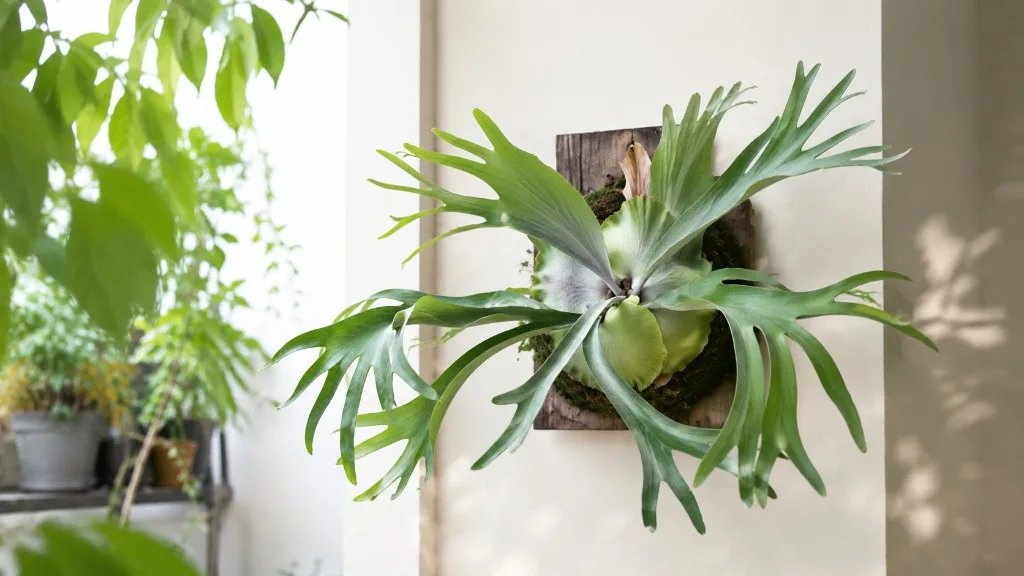
Every staghorn fern displays dimorphic fronds - two distinct leaf forms on one plant. Shield fronds (sterile fronds) are rounded, papery, and pressed flat against the mounting surface. They protect the crown, trap organic debris that becomes root-zone compost, and turn brown as they age without indicating disease. Fertile fronds (sporophylls) are the antler-shaped, gray-green photosynthetic leaves that arch outward; in P. bifurcatum they may reach 60–90 cm (2–3 feet) indoors and bear spores on their undersides when mature.
A pup is a young offset emerging from the creeping rhizome, usually visible as a miniature copy of the parent - small shield frond plus emerging fertile fronds - often tucked beneath or beside older brown shields. According to the North Carolina Extension Gardener Plant Toolbox, P. bifurcatum develops plantlets from rhizomes and large colonies can be divided. The critical propagation insight: a viable pup needs its own shield frond and root tissue, not merely a loose fertile frond tip. Fertile fronds alone cannot regenerate a crown; the shield and rhizome connection is the plant’s engine room.
When you evaluate propagation material, look behind the decorative antlers. Healthy roots hide under shields, clinging to moss or bark. Damage the shield severely and the pup loses its ability to hug the mount and regulate moisture at the crown - the most common reason separated pups fail after an otherwise clean cut.
Pup-Producing vs Solitary Platycerium Species
Not every staghorn fern offsets in cultivation. Colony-forming species - including P. bifurcatum, P. veitchii, P. hillii, P. willinckii, and P. stemaria - produce pups readily and suit home division projects. Occasional puppers like P. alcicorne and P. elephantotis may offset but less predictably. Solitary giants - P. grande, P. superbum, P. ridleyi, P. wandae, P. coronarium - typically do not produce pups at all; propagation relies on spores or specialist lab techniques.
This distinction saves months of frustration. If you purchased a solitary species expecting easy division, spore culture (or buying additional specimens) is the realistic path. If you own P. bifurcatum and it has outgrown its plaque, pup propagation is not only possible but eventually inevitable - mature colonies routinely push offsets beyond the original mount. Match method to species biology before investing in boards, moss, and patience.
When to Propagate Staghorn Fern
Timing for staghorn fern propagation is about plant metabolism, not calendar superstition. Active growth - new fertile frond elongation, green shield expansion, visible root fuzz in moist moss - means cells divide quickly and wounds callus faster. Propagation during stress - immediately after shipping, mid-drought recovery, or while treating scale - stacks failure rates even when technique is correct.
That said, indoor growers with stable warmth (16–27°C / 60–80°F), Staghorn Fern light guide, and consistent humidity can separate pups outside classic spring windows if the plant shows clear vigor. Adjust aftercare downward in cool dim months: less frequent moss soaking, more patience before judging success. Never propagate because the parent looks sick unless you are deliberately rescuing a clean pup attached to a failing crown.
Best Season for Pup Separation
Spring through early summer is the best season for staghorn fern pup propagation in most temperate homes. NC State Extension lists division as the recommended propagation strategy for P. bifurcatum. Rising humidity, lengthening days, and warming rooms align with the natural growth flush Platycerium experiences after winter slowdown. Late April through June is widely cited by experienced growers as prime division time because pups separated then have months of warm weather to root before autumn dryness and indoor heating stress.
If you miss spring, early autumn can work in mild climates or climate-controlled rooms - but avoid late fall and winter unless you can maintain 50–70% humidity and stable warmth. Cold, dry air slows root initiation and keeps moss wet longer relative to plant uptake, inviting crown rot. Spore sowing similarly benefits from warm bright seasons, though indoor enclosed containers are less season-dependent once sealed.
Water the parent plant 24 hours before division to hydrate tissues and reduce shock. Well-hydrated rhizome tissue separates cleaner and mounts without the immediate desiccation stress that a drought-stressed pup cannot survive.
Signs a Pup Is Ready to Remove
Size and attachment matter more than age in months. A pup is ready when it reaches roughly 10 cm (4 inches) or more in width, carries its own distinct shield frond, and shows visible roots when you gently lift the edge of surrounding moss or shield tissue. Small nubs without roots may eventually grow, but removal too early forces the offset to rebuild infrastructure from limited reserves - failure rates climb sharply.
Ready pups often sit slightly apart from the parent crown, connected by a narrow rhizome bridge you can slice or wiggle through. If removing the pup would leave a wound larger than one-third of the parent colony, wait or choose a different offset. Multiple fertile fronds on the pup are encouraging but not sufficient alone; confirm shield and root presence.
Avoid propagating when the parent shows widespread brown fertile frond tips from underwatering, black mush at the crown, or pest honeydew. Stabilize the colony first - remount, adjust Staghorn Fern watering guide, treat insects - then take offsets from clean growth zones.
Propagating Staghorn Fern From Pups
Pup propagation is asexual cloning: the offset is genetically identical to its parent, preserving cultivar traits and frond form. The workflow moves from assessment to separation to immediate remounting - pups are not stem cuttings you can desk-dry for a week. Epiphytic ferns expect continuous humidity at the root-shield interface even while wounds heal.
Two separation styles dominate home practice. Knife division uses a sterilized blade to slice rhizome connections precisely - ideal when pups are tightly packed or deeply embedded under overlapping brown shields. Wiggle separation loosens a partially detached pup by hand after wetting the colony - less traumatic when offsets are already loose. Choose based on attachment, not ideology; tight colonies need blades, loose pups need patience and water.
Tools and Mounting Materials You Need
Gather supplies before touching the plant:
- Sterilized sharp knife or pruning shears - flame or 70% isopropyl alcohol between cuts
- Long-fiber sphagnum moss (not fine peat alone) for moisture retention with airflow
- Mounting board - cedar, redwood, or hardwood plaque 20–30 cm (8–12 inches) for a single pup; larger for multiples
- Monofilament fishing line, nylon stockings strips, or coated wire for securing moss and pup
- Screws with washers or mounting hooks if attaching to wall hardware later
- Spray bottle for misting shields during work
- Optional: clear plastic bag or humidity tent for the first two weeks after mounting in dry homes
Skip dense potting soil as the primary mount medium. Staghorns are litter-trapping epiphytes; roots want to breathe while accessing steady moisture. Moss against wood mimics bark crevice habitat better than a soggy peat pot. Small wire baskets lined with moss work when boards are impractical - the physics remain the same: shield against substrate, fertile fronds outward, roots embedded in moist but not sodden moss.
Label pups if you are running multiple batches or species; juvenile Platycerium can look similar before antler division deepens.
Step-by-Step Pup Separation
Follow this sequence to protect both parent and offset:
- Hydrate the colony - spray shields and moss, or soak the mount briefly, then let excess drain until moss is damp, not dripping.
- Identify the target pup with adequate shield, roots, and size. Map where rhizome connects to the parent.
- Clear access by gently folding back overlapping brown shields only as needed - minimize tearing live green tissue.
- Separate using either a single clean cut through the rhizome bridge leaving maximum root mass on the pup, or careful hand wiggle until the offset releases. Never yank antler fronds; force travels to the crown and breaks roots.
- Inspect the pup immediately. Trim black mush or crushed rhizome with a sterile blade until tissue looks pale green and firm.
- Mount within the hour if possible - prolonged bare drying kills fine epiphytic roots faster than succulent stem cuttings tolerate.
The University of Wisconsin-Madison Division of Extension emphasizes that each division should retain some fertile fronds, sterile shield tissue, and roots - mirroring what you would want on any fern division. If a pup loses most roots but retains a healthy shield, it can still establish with excellent aftercare, but treat it as a high-maintenance recovery case.
Limit removals to no more than one-third of pups from a single parent per session. Over-harvesting weakens the colony’s photosynthetic capacity and stresses the rhizome network that feeds future offsets.
Mounting Pups for Strong Rooting
Mounting is not decorative finishing - it is propagation for staghorn ferns. The shield must sit flush against moist moss so roots re-enter contact and new rhizome growth anchors the plant. Poor mount contact creates an air pocket at the crown where water pools unpredictably: the shield desiccates above while tissue rots below.
Orientation is fixed: shield against moss, fertile fronds pointing outward and upward from the board face. Upside-down mounting defeats gravitropic growth patterns and delays establishment by weeks.
Sphagnum Moss Setup on Board or Basket
Prepare moss before the pup is bare. Soak long-fiber sphagnum in water 10–20 minutes, then squeeze until damp but not streaming - a handful should release only a few drops, matching specialist spore-sowing guidance adapted for mount work. Pack a pad slightly larger than the pup’s shield (3–5 cm / 1–2 inches thick) against the board where the pup will sit.
For wire baskets, line the interior with moss similarly, creating a nest for the shield. Hardwoods resist rot; sealants are optional and rarely necessary if moss is moisture-managed rather than constantly saturated. Pre-drill small holes for fishing line if using a board - thread line beneath the moss pad to cross over the shield without cutting frond tissue.
Avoid peat-heavy mixes pressed into solid mats; they compact and suffocate epiphytic roots. Chunky long-fiber sphagnum maintains air channels while wicking water - the balance staghorns expect on tree bark.
Securing the Pup Without Damaging Tissue
Place the pup’s shield frond flat against the moss pad, nestling roots into the fibers below. Hold position with fishing line or soft nylon crossed over the shield - not over delicate fertile frond tips. Tie or twist behind the board, keeping tension firm enough to prevent wobble but not so tight that the shield cracks.
Some growers use plastic mesh or stocking strips for broader pressure distribution on large shields. Coated wire works in dry climates but can cut soft tissue if over-tightened. Expect to leave ties in place two to three months until roots grip the board independently; remove gradually if fronds show indentation marks.
Position the mount in bright indirect light - an east window or several feet from south glass. Direct midday sun on a freshly separated pup desiccates fronds before roots recover. If household humidity drops below 40%, a loose clear bag over the mount (not sealed against the board) raises local humidity for the first 10–14 days; vent daily to prevent mold.
Initial watering: mist the moss lightly the day after mounting rather than drenching. After 48 hours, resume a soak-and-dry rhythm matching mature staghorn care - full moss hydration followed by near-complete drying before the next soak. Freshly mounted pups fail more often from overwatering than underwatering because damaged roots cannot uptake excess moisture.
Aftercare for Newly Separated Pups
Treat the first 8–12 weeks after pup separation as establishment phase, not display phase. Success signals are subtle before they are obvious: new green shield tissue at the crown edge, white root tips visible when you lift moss slightly after month two, and firm fertile frond bases without black spreading from the shield junction.
Watering rhythm should mirror parent plants but with tighter error margins. Soak mounted moss thoroughly, allow it to approach dry before the next soak - often every 5–10 days in warm active growth, less in cool months. Never let water sit stagnant in crown crevices. If fronds wilt slightly but moss is still wet, hold water and improve airflow rather than adding more moisture.
Fertilizer is unnecessary until new growth clearly accelerates - typically six to eight weeks post-mount in spring divisions. When you begin feeding, use quarter-strength balanced liquid fertilizer monthly during active growth, applied to moss during a soak so salts distribute gently. Over-fertilizing fresh roots causes tip burn on fertile fronds.
Humidity target 50–70% suits establishment. Kitchen and bathroom mounts often succeed without gadgets; dry heated rooms benefit from pebble trays near - not under - the mount so evaporation raises ambient moisture without wicking rot into moss from below.
Timeline expectations: most P. bifurcatum pups show meaningful new fertile frond extension within two to three months under good conditions; slower in winter is normal, not death. Avoid remounting or tug-testing roots weekly - disturbance breaks fragile new attachments. If fertile fronds brown from tips inward while shields stay firm, reassess light and underwatering before assuming propagation failure.
When the pup holds firmly without ties and pushes a second generation of antler growth, graduate it to standard mature staghorn care - including occasional dilute fertilizer and seasonal moss refresh without full crown disruption.
Propagating Staghorn Fern From Spores
Spore propagation rewards patience and precision. You are growing two generations in sequence: first the prothallium gametophyte carpet, then juvenile sporophytes that eventually resemble staghorn ferns. Timeline from sowing to a mount-worthy plant commonly runs 12 to 18 months - faster with optimal warmth and light, slower in cool rooms or if contamination forces restart.
Choose spore propagation when species biology demands it (solitary Platycerium), when you want multiple genetically diverse seedlings, or when the project itself - watching dust become ferns - is the goal. Pup division remains superior for everyday multiplication of P. bifurcatum.
Collecting Ripe Spores From Fertile Fronds
Spores ripen on fertile frond undersides as brown, fuzzy sori - patches of sporangia that release golden-brown dust when mature. Unripe sori look pale green or tan without loose powder. Collect when fronds are fully developed and sori crumble lightly to touch, typically in warm humid months when spore production peaks indoors.
Two collection methods work:
- Frond imprint: Cut a fertile frond section carrying ripe sori. Place it spore-side down on clean white paper in a dry, draft-free area 24–48 hours. Spores fall as a fine dust pattern on the paper.
- Direct scraping: Hold paper beneath the frond and gently scrape sori with a clean spoon or knife to release powder.
Store spores in a dry paper envelope labeled with species and date if not sowing immediately. Viability drops over months; fresh spores germinate best within weeks to a few months. Avoid moisture in storage - wet spores activate prematurely and die.
Use fertile fronds from healthy vigorous plants, not stressed specimens shedding aborted sporangia. One frond can yield thousands of spores, far more than a home sowing requires; share excess with local fern societies if available.
Sterile Sowing and Prothallium Care
Contamination is the spore grower’s primary enemy. Mold outruns fern gametophytes in non-sterile open pots within days. Home-scale sterility targets the medium and container, not surgical-lab perfection.
Medium preparation: Finely chop long-fiber sphagnum or use a peat-perlite seed mix (fine texture, no large bark). Pack 2–3 cm (1 inch) into a clear lidded container or jar. Pour boiling water through the medium to kill surface organisms; drain excess after cooling until damp-not-wet. Alternative: bake moist mix at 180°F (82°C) for 30 minutes in an oven-safe dish, then cool covered.
Sowing: Dust spores thinly and evenly across the surface - overcrowding causes weak prothallia and damping off. Do not bury spores; light aids germination. Seal the container immediately.
Environment: Place in bright indirect light at 21–24°C (70–75°F). Avoid direct sun hitting the sealed container - greenhouse effect cooks gametophytes. Do not open the container for 4–6 weeks after sowing; humidity near saturation supports germination.
Within 2–6 weeks, a green film appears - thousands of heart-shaped prothallia, each only millimeters wide. A hand lens confirms structure; to naked eye it resembles algae until density increases. At this stage, ventilate briefly every few days if condensation fully obscures walls, then reseal - balance gas exchange against drying.
Maintain consistent moisture by misting only if medium lightens through the container wall, or bottom-water from a tray if using perforated trays inside a bag. Never flood. Prothallia lack roots in the conventional sense; desiccation kills the carpet in hours once opened carelessly.
From Fernlets to Mount-Ready Plants
Sexual reproduction happens invisibly on the prothallium layer - sperm swim to archegonia when film stays wet. Cross-fertilization between genetically distinct prothallia improves sporophyte vigor; single-spore sowings may yield weaker stands, another reason to sow thinly and allow multiple thalli interactions.
Sporophytes - first true fern shoots - emerge 4–8 months after sowing as tiny upright green spears from the prothallium mat. Early leaves look nothing like staghorns: narrow, undivided straps. Antler bifurcation develops after the fifth or sixth frond on each plant, a milestone that tests patience.
When sporophytes reach 3–5 cm (1–2 inches) tall with several fronds, prick out clusters gently onto fresh moist sphagnum in open trays with humidity dome, acclimating gradually to ambient air over 2–4 weeks. Reduce dome time as new shield fronds form.
Mount individual juveniles on small boards or cork plaques using the same shield-against-moss technique as pup propagation, but with lighter ties and finer moss. Spore-grown plants may take another year to reach decorative size - plan bench space accordingly.
Spore propagation teaches fern biology deeply; pup propagation teaches mount craft. Many collectors use both over a lifetime of growing Platycerium.
Common Propagation Mistakes and How to Fix Them
Most staghorn fern propagation failures trace to biology misunderstood, not bad luck.
Removing pups too small without independent roots forces the offset to starve while rebuilding. Remedy: remount if recently separated and still firm; otherwise discard and wait for the next offset to size up. Prevention beats rescue.
Shield frond destroyed during separation leaves the pup unable to regulate crown moisture. If partial shield remains, mount immediately with extra moss contact and humidity tent; if the shield is gone, success odds drop sharply - learn cleaner access techniques for the next attempt.
Potting in dense soil instead of mounting suffocates epiphytic roots and holds stale water against the crown. Transplant to moss-on-board promptly if you inherited a pup in peat; trim blackened roots first.
Overwatering freshly mounted pups causes crown rot masked as “transplant shock.” Let moss dry deeper between soaks; improve airflow; remove affected brown tissue with sterile tools.
Over-harvesting pups weakens the parent colony and reduces future offset production. Re-mount the parent securely and pause division for 12 months.
Spore sowing too thick produces mold and weak gametophytes. Start a fresh sterile batch with lighter dusting rather than fighting a contaminated carpet.
Opening spore containers too early dries prothallia instantly. Rehydrate carefully if caught early; restart if the film turned gray and crispy.
Propagating stressed parent plants spreads weakness. Fix watering, pests, and mount integrity before dividing - propagation multiplies health or problems equally.
Conclusion
Staghorn fern propagation succeeds when you match method to species biology and plant condition. For colony-forming Platycerium bifurcatum and relatives, pup separation during active spring growth - taking offsets with their own shield fronds and roots, then mounting immediately on damp long-fiber sphagnum - is the reliable home path. Expect two to three months of careful soak-and-dry rhythm before new antler growth confirms establishment; skip dense soil, avoid overwatering fresh roots, and never remove more than one-third of pups at once.
Spore propagation opens solitary species and genetic diversity but demands sterile sowing, sealed humidity, and 12–18 months of attentive culture from prothallium film to mount-ready sporophytes. Collect ripe brown sori, sow thinly on boiled sphagnum, and resist opening containers until the green gametophyte carpet stabilizes.
If you remember three rules, make them these: protect the shield frond, mount epiphytically rather than potting like a terrestrial, and propagate only from vigorous colonies. Master pup division first; attempt spores when curiosity and patience align. Done correctly, one mature staghorn becomes a wall of living plaques - or a tray of seedlings you raised from dust.
When to use this page vs other Staghorn Fern guides
- Staghorn Fern overview - Start here for whole-plant context before deep-diving this topic.
- Staghorn Fern problems hub - Jump to symptom-specific fix guides when this care topic does not resolve the issue.
Related Staghorn Fern guides
- Staghorn Fern overview
- Staghorn Fern watering
- Staghorn Fern light
- Staghorn Fern soil
- Staghorn Fern fertilizer
- Staghorn Fern repotting
- Staghorn Fern problems
Related tool
Try the Propagation Success Calculator with staghorn-fern pre-selected to estimate needs for your setup.