Staghorn Fern Remounting: Board-Mount Care Guide
Staghorn Fern Remounting: Board-Mount Care Guide
Staghorn Fern Remounting: Board-Mount Care Guide
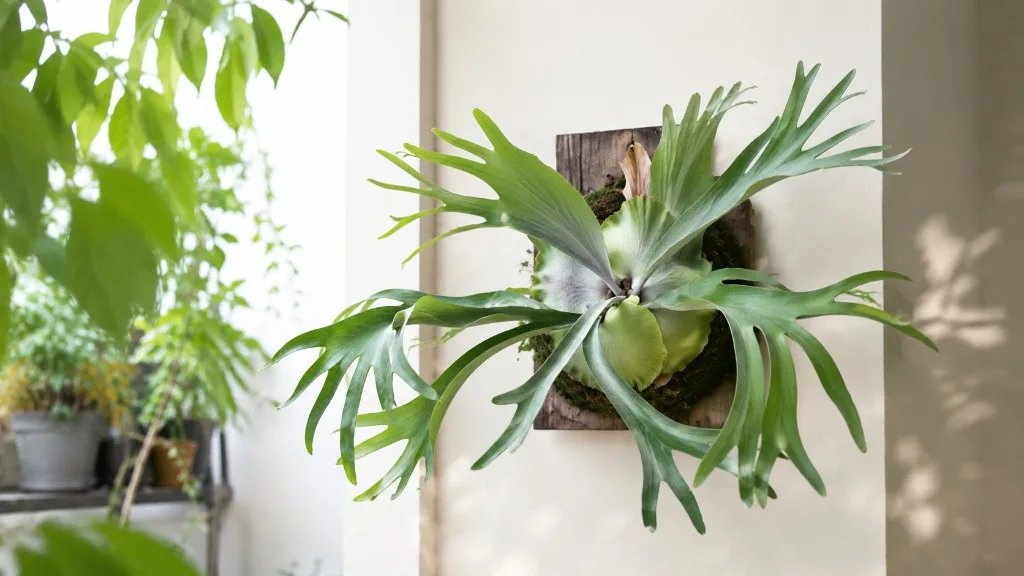
Staghorn fern remounting is the care task most people label “repotting” - and that label sends them down the wrong path. Platycerium bifurcatum, the species sold as staghorn fern in most nurseries and online shops, is an epiphytic fern that anchors to tree bark and rock in the wild, not to soil in a pot. Indoors, the closest mimic is a board mount: a rot-resistant plaque or bark slab, a pad of sphagnum moss, and fishing line or wire that holds the plant steady until its shield fronds fuse to the surface. When that system ages, you do not move the fern into a larger pot of potting mix. You remount it - refresh the moss, upsize or replace the board, and re-tie the plant without damaging the single most important structure on the entire specimen: the growth point, the fuzzy bud where every new frond originates.
This guide treats remounting as board-mount maintenance, not traditional repotting. You will learn when remounting is necessary versus optional, how to choose a board that lasts several seasons, how to prep moss so it holds moisture without suffocating roots, and how to secure a heavy wall display without crushing the crown. If your staghorn wobbles when you water, the moss smells sour, or shield fronds are creeping over the board edge, the fix is almost always a remount - done carefully, in the right season, with the growth point facing up and plenty of air in the moss sandwich.
If symptoms persist, see the Slow Growth on Staghorn Fern guide.
Why Staghorn Ferns Are Not Repotted Like Other Houseplants
Most “repotting” advice assumes a soil-rooted root ball with fibrous absorbing roots. Staghorn ferns break that model. What looks like roots on a mounted plant are often fine attachment structures and the underside of shield fronds - flat basal fronds that hug the mount, store water and starch, and trap organic debris into a self-feeding pocket. The Royal Horticultural Society describes Platycerium bifurcatum as an epiphytic fern suited to mounting on bark or boards, which reflects how the plant actually lives.
Repotting into soil works for small nursery staghorns still in pots, and some growers keep mature plants in open baskets with coarse orchid mix. For a fern already on a wall mount, remounting is the correct upgrade path - replacing the deteriorating board, moss, and hardware, not transplanting into a deeper container. Treating remounting like pot repotting leads to bare-rooting shield tissue, burying the growth point under wet moss, or removing brown shield fronds the plant still needs for structure.
Epiphytic Growth and Shield Frond Anatomy
Understanding anatomy prevents the damage that turns a routine remount into a permanent setback. A mature staghorn fern has four visible parts working together. Shield fronds (basal or sterile fronds) are the rounded, plate-like structures pressed against the mount. They start green and flexible, then turn brown and papery as older tissue is consumed - that browning is normal aging, not death. Antler fronds (fertile fronds) are the branched, antler-shaped leaves that produce spores on their undersides. The growth point (bud point or crown) sits at the top of the shield mass, usually covered in silvery stellate trichomes - star-shaped hairs that protect delicate meristem tissue from drying and UV damage. Beneath the shield, fine attachment roots grip the mount; they anchor more than they feed, while the shield frond system handles much of the water and nutrient capture in epiphytic life.
The growth point is the plant’s only forward direction. Many cultivated P. bifurcatum specimens carry multiple bud points because nursery pots often contain several small plants fused together, but each crown is still individually vulnerable. Damage the bud - by wire crossed directly over it, moss packed wet against it for weeks, or a careless knife slice during removal - and you may lose that entire growth axis. Single-bud species and rare hybrids are even less forgiving. This is why experienced remounters repeat one rule louder than any other: identify the bud, face it up, and never cover or constrict it. Everything else in remounting serves that rule.
Shield frond protocol fits here too. Do not remove brown shield fronds just because they look dead. They provide rigidity, protect the rhizome, and continue storing reserves. Remove them only when tissue is black, mushy, or smells rotten - a rotten shield acts like a wet blanket, trapping anaerobic bacteria against living tissue. Wisconsin Horticulture Extension is explicit that tan or brown basal fronds should not be removed until they fall off naturally. Green shield fronds should never be stripped for aesthetics during remounting; you need every intact plate for stability while the plant re-anchors.
What Board Mounting Actually Replaces
Board mounting replaces three functions soil serves poorly here: a vertical surface matching epiphytic habit, a renewable moisture buffer in sphagnum between plant and wood, and a display system you soak, drip-dry, and rehang. Remounting preserves the shield architecture a long-mounted specimen spent years building - think replacing the mattress and bed frame, not moving the sleeper to the floor. Moss compacts and breaks down over soak cycles; boards rot if you chose soft plywood or trap water against a wall; hardware fatigues under wet weight.
If you searched “repotting” because your mounted fern looks unhappy, assess moss health, board integrity, mount stability, and crown dryness first. The fix lives in remounting or expanding the mount, not in potting mix.
When Your Staghorn Fern Needs Remounting
Remounting is periodic maintenance, not an emergency default - but waiting too long turns maintenance into rescue. The right moment sits where moss still holds structure, the board is solid, and the plant is in active growth so it can fuse new roots into fresh material within weeks.
Signs the Mount or Moss Has Failed
Start with the moss pad, because it fails before wood in most indoor setups. Healthy sphagnum feels springy and fibrous when damp, dries evenly between soakings, and smells neutral or lightly earthy. Failing moss turns dense and slimy, stays wet in the center while the surface looks dry, or develops a sour, anaerobic smell when you press it. Color shift toward black or peat-sludge green in the core - not the normal tan of outer dried fibers - means decomposition has advanced. If water runs off the surface instantly during a soak while the board feels waterlogged for days, the pad has collapsed into a waterproof mat. That pattern invites crown rot because moisture lingers where air cannot enter.
Next inspect the board. Soft spots, fungal lines, flaking plywood layers, or a flex that was not there last season mean rot. Cedar, redwood, and cork resist decay better than construction-grade pine or non-breathable plywood sealed only with stain. A rotting board is not a cosmetic issue; screws pull out, cleats slip, and the fern drops. Check hardware strain: wire cutting into green shield tissue, screws working loose, or a French cleat that no longer seats flush after repeated wet-dry cycles. If the mount wobbles when you shake the board after watering, roots cannot anchor - tie tension failed or the moss pad shrank away from the shield.
Finally read plant geometry. Shield mass crowding the board edge with antler fronds unbalanced on one side means the next growth flush has nowhere to attach. Watering becomes stressful - too heavy to lift safely, too messy to soak indoors, too slow to dry because the moss pad is oversized and poorly ventilated. Those are mount-design problems, not personal failure. Plan a larger board or a basket transition before fronds snap under their own weight.
How Often Remounting Typically Happens
As a working baseline, most healthy Platycerium bifurcatum wall mounts need full remounting every two to five years. That range is wide because water chemistry and moss quality dominate lifespan. Hard tap water loads minerals into sphagnum, accelerating breakdown; reverse-osmosis or rainwater extends pad life noticeably. New Zealand long-fiber sphagnum (often graded AA or 5-star) outlasts lower-grade Chilean moss in the same conditions because longer fibers maintain pore space longer. Board species matters equally - a cedar or cork plaque on stand-offs with a moisture barrier behind it may survive multiple moss cycles; a flat plywood plaque glued to drywall may rot in one.
Partial refresh can bridge full remounts. Top-dressing fresh moss into gaps behind the shield - without removing the plant - works when the core pad is still airy but the outer layer eroded. Sandwich expansion (covered later) adds territory without disturbing the rhizome when the fern fused too thoroughly to lift safely. Reserve full remount for moss core failure, board rot, orientation errors (growth point not upright), or pest and rot contamination you cannot isolate. Spring through early summer is the safest window in most climates because warmth and lengthening days support reattachment; fall can work in frost-free indoor settings; mid-winter remounting is possible for urgent rot but expect slower recovery and stricter dryness discipline at the crown.
Choosing the Right Mount Board
The board is infrastructure, not decoration - though a well-chosen mount is beautiful. It must survive repeated full saturation, carry wet weight without flexing, accept screws or eye hooks securely, and allow air behind the moss pad. Flat display boards suit vertical wall art; shallow baskets suit heavier specimens you soak in a tub. Either way, rot resistance and sizing logic beat aesthetic grain pattern every time.
Avoid non-breathable construction plywood unless you fully seal all edges and accept a shorter lifespan. Untreated plywood wicks water into layers, swells, and delaminates - the opposite of what an epiphyte mount needs. Reclaimed wood is fine if you know it is not chemically treated with preservatives toxic to plants or irritating indoors.
Rot-Resistant Wood and Bark Options
Proven materials include cedar, redwood, and cypress - lightweight and naturally rot-resistant - plus cork bark slabs and tree fern fiber boards for superior breathability at higher cost. Avoid construction plywood that delaminates when wet. Pair heavy mounts with a French cleat for safe shower soaking, rubber stand-offs behind the board, and anchors rated for wet weight - not lightweight picture hooks on drywall.
Sizing the Board for Future Growth
Size the board for two to three seasons of shield expansion, not today’s frond spread alone. A practical rule used by mount specialists: choose a board that extends at least 7–13 cm (3–5 inches) beyond the current outer edge of the shield mass on all sides that will receive new shield growth. P. bifurcatum expands shield fronds outward in layers; antler fronds may eventually overhang farther, but stability depends on shield attachment width. A too-small board forces annual remounting - doable, but each cycle risks frond breakage and never lets roots deeply anchor.
Oversizing has limits too. A gigantic board on a small fern looks fine initially but holds a thick moss pad that stays wet too long if you pack moss to fill empty space prematurely. Build a modest pad under the existing root mass and let the plant grow into surrounding board territory across seasons; you can add moss behind advancing shield fronds later without full remount. Balance display weight with maintenance: if soaking the mount requires two hands and a shower, confirm you can repeat that ritual weekly in summer. When wet weight exceeds comfortable solo handling, transition toward a hanging basket with open sides for airflow even if you keep a wooden back plaque inside the basket for aesthetics.
Materials You Need for a Clean Remount
Gather everything before you cut wire: new board if needed, moss, line, hardware, soak bucket, and sterilized cutting tool. Work on a towel-covered table with time to drip-dry before rehanging - remounting is hands-on craft, not a five-minute pot shake.
Sphagnum Moss Selection and Prep
Long-fiber sphagnum moss is the standard mounting medium because it holds water while retaining pore space when handled correctly. UF/IFAS Gardening Solutions recommends sphagnum moss alone or mixed with bark or tree fern fiber as an excellent medium for staghorn ferns. Buy from reputable horticultural suppliers; avoid dyed craft moss or products with unknown additives. You need enough volume to build a base pad on the board and pack gently around the shield without stuffing the crown.
Prep moss by soaking 15–30 minutes in clean water until fully hydrated, then wring firmly - like a damp towel, not a dripping sponge. Moss that drips when squeezed will rot the crown; moss wrung too dry will not wick water to roots during the first weeks. The target is evenly damp throughout with air still visible between fibers when you fluff it. Prepare more moss than you think you need; fluffed fiber compacts when tied. Optional: mix a small amount of horticultural charcoal into the rear pad on humid setups to buffer decay - helpful, not mandatory.
Slow-release fertilizer pellets (products like Osmocote at low rates) can go behind the shield mass in the moss, not touching the growth point directly. One or two pellets for a medium mount supplies months of gentle feeding without salt-burning the crown. Skip fertilizer entirely if you are remounting because of rot or if the plant is stressed; restart feeding only after new green shield or antler growth confirms reattachment.
Hardware, Line, and Hanging Systems
Stainless steel screws or coated deck screws anchored into solid board thickness hold better than nails in soft wood. Place attachment points where line crosses will not traverse the bud. Nylon fishing line (6–10 lb test is typical) is nearly invisible and easy to tension; soft plant wire or black aluminum wire gentler on green shield edges if you prefer visible structure. Avoid copper wire that oxidizes and can injure tissue. Cut enough line to crisscross the moss ball in a yarn-winding pattern from side screws, pulling firm enough to eliminate wobble without cutting into green shields.
For wall hanging, eye hooks rated above the wet mount weight, French cleats rated for furniture weight, or D-ring hangers on a horizontal batten all work if installed into studs or proper anchors - never a lightweight picture hook on drywall alone. A mature staghorn soaked weekly can exceed 7–9 kg (15–20 lb); treat it like a small cabinet, not a poster. Keep a spray bottle for misting peripheral moss during recovery, sterilized scissors or a thin knife for separating fused moss or trimming truly rotten tissue, and rubbing alcohol for blade cleaning between cuts if rot was present.
Step-by-Step Remounting Process
Full remounting follows a sequence: hydrate and remove, inspect and trim only what is necessary, build moss bed, seat plant with correct orientation, pack and tie, soak once, drip-dry, hang in Staghorn Fern light guide. Skipping inspection or rushing tie-down causes most post-remount failures - not mysterious staghorn temperament.
Work in spring or early summer when possible. If rot forces a winter remount, keep the crown drier than usual for the first month and avoid cold drafts below 10°C (50°F).
Removing the Fern Safely
Start by soaking the entire current mount 10–20 minutes until moss is fully saturated. Wet moss releases the plant more cleanly than dry tearing. Support the antler fronds in one hand while you cut fishing line on the back or sides with scissors. Peel line away without yanking fronds. If the fern is fused deeply into degraded moss, slide a thin sterile knife behind the shield fronds parallel to the board, cutting moss - not green shield tissue - to free the mass. Never pry antler fronds backward; they snap at the base.
Some specimens lift as a single unit with old moss still attached; others leave layers of brown shield on the board - also fine. Keep as much ** intact shield architecture** as possible. Shake off only the sludgy, black, or odoriferous moss from the back; leave a thin layer of old moss against the rhizome if it is still fibrous and clean. Bare-rooting a staghorn like a pothos destroys attachment roots and fine hairs that take weeks to regenerate. If multiple separate plants share one mount and you want a cleaner display, this is the moment to divide - but only if each division has its own growth point and enough shield mass to survive.
Inspect the crown under bright light. Mushy bud tissue, persistent black slime, or foul smell means crown rot - remounting alone may not save the plant; remove infected moss, keep the crown open to air, and remount with minimal moss near the bud while you monitor. Healthy buds look fuzzy, silvery-green or brown-green, and firm at the center.
Positioning the Growth Point Correctly
Lay a fluffed moss base on the new board - often a oval or circle slightly smaller than the shield width. Seat the fern so shield fronds lie flat against the board face and antler fronds project outward in their natural direction. Locate the growth point and confirm it faces upward - top of the mount when hung on a wall. P. bifurcatum often produces new antler fronds in a line; mounting with that line vertical and newest emergence at the top prevents twisted, energy-wasting reorientation. Upside-down mounting does not always kill the plant immediately, but new growth contorts for months and weakens the specimen.
Position the plant slightly above center on the board if you hang vertically - future antler weight hangs downward, and you want margin below for moss expansion. Step back and sight along the board edge before tying anything. This thirty-second check prevents permanent orientation errors. Never bury the growth point in moss. Moss goes around and below the bud, not on top of it. If moss slides down after tying, pull it back and re-cross line lower on the shield, not over the bud.
Securing Moss and Shield Fronds Without Damage
Pack damp fluffed moss around the sides and base of the shield mass like a loose sandwich - firm enough to eliminate wobble, loose enough that you could still press a finger into fibers. Remember: air is as important as water in epiphytic culture. A rock-hard moss ball is a future rot site. Tie fishing line from a side screw, wind back and forth across the moss and shield in a figure-eight or ball-of-yarn pattern, and anchor to the opposite side. Cross over brown shield fronds freely; they are armor. Go under or lightly beside green shield fronds when possible rather than crushing their edges. Never pass line directly over the fuzzy growth point - that is the fastest way to decapitate the plant.
Tension until a gentle shake does not move the fern. Wobble prevents attachment roots from gripping new moss; overtightening slices green tissue. Trim line ends on the board back, not dangling near antler tips. Optional: a mesh net over the moss for the first month on large remounts adds stability without crown pressure if tied only below the bud line.
Finish with an initial soak of the entire new mount 5–10 minutes, then drip-dry at least 45–60 minutes before rehanging on the wall. The first soak settles moss around roots; dripping prevents wall moisture damage and confirms drainage paths are open.
The Sandwich Technique for Large Specimens
When a staghorn has grown fused to a board for years - shield fronds overlapping the edges, antler span too wide to lift safely, or root mass so integrated that knife separation risks crown damage - do not force full removal. Use the sandwich technique: mount the entire old board onto a larger new board and pack fresh moss into the gap between them.
Cut or select a new plaque several inches larger on the needed sides. Lay a bed of fresh moss on the new board. Place the old board with fern attached on top, centered with room for expansion toward the open edges. Fill the perimeter gap between old and new boards with fluffed moss - the “sandwich filling” - and tie through both boards if screw holes align, or cross line over the outer moss ring only while the inner plant stays undisturbed. Roots and new shield growth migrate outward into the fresh aerated moss over months while the core rhizome stays stress-free.
This method also rescues historic mounts where the original plaque has sentimental or aesthetic value you do not want to destroy. You preserve the face while upgrading support behind it. Water into the outer moss ring preferentially during the first season so new territory stays hydrated while the old core continues its established rhythm. Expect slower visual change than a full remount, but far less shock - ideal for large specimens that would otherwise bleed attachment roots and sulk half a year.
The sandwich technique fails if the old moss core is already anaerobic. Expanding rotten material just gives rot more volume. Smell the core before sandwiching; if sour, you must surgically remove decayed moss from the back without damaging the bud, even on large plants - then sandwich fresh moss under that cleaned zone.
Aftercare and Recovery After Remounting
Remounted staghorns need a stabilization phase, not immediate business-as-usual soaking on the old aggressive schedule. The first two to four weeks are about reattachment, not forcing new antler length. Keep the plant in bright indirect light - an east window or several feet back from south glass. Avoid direct sun on a stressed mount; wet moss in hot sun steams the crown. Maintain good airflow; a stagnant humid corner invites mold on fresh ties and moss.
Water with a lighter rhythm initially. Let the outer moss approach dry before the next soak; the center near old tissue may stay damp longer, so use weight and touch together - a light board and dry surface fibers mean drink time. When in doubt, wait an extra day at the crown. Skip fertilizer for the first month unless you used a tiny slow-release pellet behind the shield; salt in liquid feed on open attachment wounds burns fine roots. Resume dilute balanced feeding only when new green shield tip or antler tip appears.
Recovery signals arrive in stages: stable antler tips and springy moss in weeks one to two, visible attachment roots in outer moss by weeks three to six, and new frond growth beyond that - the clearest success marker. Avoid oversoaking a core that stays wet while the surface dries, cutting sound brown shields, rehanging before drip-dry completes, and heavy fertilizing to “help stress.” Patience beats intervention loops.
Conclusion
Staghorn fern remounting is the real “repotting” for board-mounted Platycerium - a refresh of moss, board, and hardware that respects epiphytic anatomy instead of forcing soil logic onto a fern that never evolved for it. Remount when moss decays, boards rot, ties fail, or shield mass outgrows the plaque - typically every two to five years, adjusted for your water and moss quality. Choose rot-resistant boards sized for several seasons of shield growth, prep long-fiber sphagnum damp-not-wet, and secure the plant so it does not wobble while keeping the growth point upright, uncovered, and unconstricted.
For massive fused specimens, the sandwich technique expands territory without tearing the rhizome free. After remounting, lighten watering, protect the crown from stagnant wetness, and wait for new frond growth before you declare success. If you remember three rules, make them these: face the bud up, leave sound brown shields intact, and prioritize air in the moss as much as moisture. Get those right and remounting becomes a predictable maintenance rhythm - the difference between a staghorn that dominates a wall for decades and one that slowly suffocates on a rotting pad nobody knew how to replace.
When to use this page vs other Staghorn Fern guides
- Staghorn Fern overview - Start here for whole-plant context before deep-diving this topic.
- Staghorn Fern problems hub - Jump to symptom-specific fix guides when this care topic does not resolve the issue.
Related Staghorn Fern guides
- Staghorn Fern overview
- Staghorn Fern watering
- Staghorn Fern light
- Staghorn Fern soil
- Staghorn Fern propagation
- Staghorn Fern fertilizer
- Staghorn Fern problems
Related tool
Try the Pot Size Calculator with staghorn-fern pre-selected to estimate needs for your setup.