How to Prune Staghorn Fern: Shield vs Antler Fronds
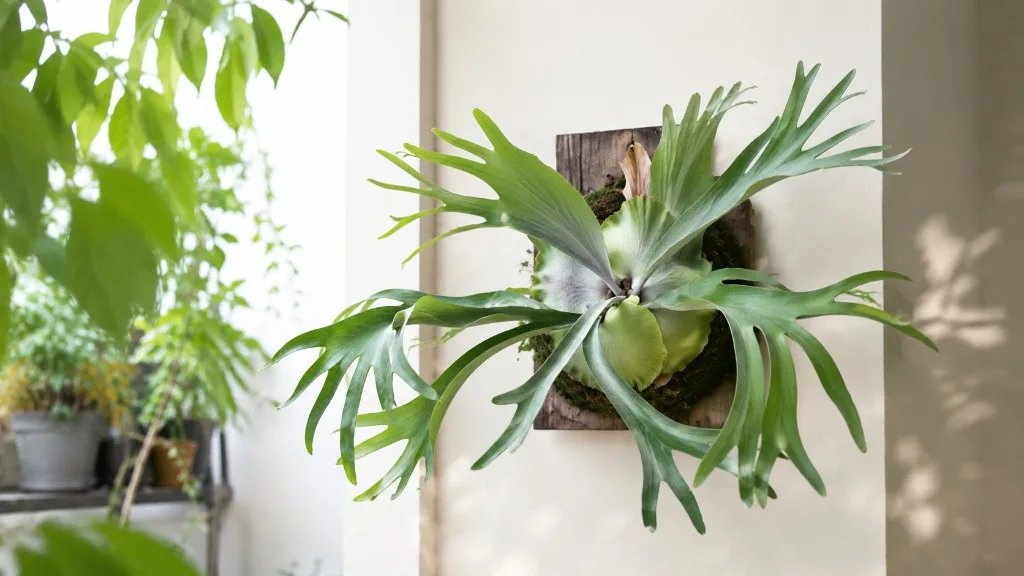
How to Prune Staghorn Fern: Shield vs Antler Fronds
How to Prune Staghorn Fern: Shield vs Antler Fronds
Quick Answer - Identify Fronds Before You Cut
First action: look at the base of your mount and name what you see. Flat, rounded, papery brown plates pressed against the board are shield fronds - leave them alone, even when they look dead. Green, forked, antler-shaped fronds arching outward are fertile fronds - remove only those that are fully dry and brittle throughout, cutting at the base with sterilized shears. Staghorn fern pruning is not shaping. It is selective cleanup of spent antler tissue while protecting the shield layer that anchors roots and traps nutrients.
Two Frond Types Control Every Pruning Decision
Platycerium bifurcatum and other Platycerium species are epiphytic ferns in the family Polypodiaceae that grow from short rhizomes and produce two architecturally distinct frond categories. University of Wisconsin Horticulture Extension describes mature plants as forming rounded, clasping sterile basal fronds at the base and brighter green, forked fertile foliar fronds above them (University of Wisconsin Horticulture). Houseplant pruning logic - pinch above a node, remove one-third of foliage, shear for bushiness - does not apply. Ferns do not branch from cuts along a frond blade. A mid-antler snip browns backward without producing new growth.
| Feature | Shield fronds (sterile) | Fertile fronds (antler) |
|---|---|---|
| Shape | Rounded, heart-shaped, flat plates | Forked, strap-like, antler-shaped |
| Position | Pressed against mount or pot surface | Arching outward and upward |
| Color over time | Green when young → papery brown | Bright green when healthy |
| Role | Anchor, protect rhizome, trap litter | Photosynthesize and bear spores |
| Pruning rule | Do not cut or pull | Remove only when fully dead |
Shield Fronds (Sterile Basal Plates)
Shield fronds - also called basal fronds, sterile fronds, or back plates - clasp the growing surface and overlap like shingles. Young shields emerge dull green and somewhat succulent, then flatten and turn papery brown with age. NC State Extension notes that shield leaves turn brown at maturity while remaining functional: they trap falling leaf litter, cover the root crown, and shelter rhizome tissue. Wisconsin Extension is explicit that tan or brown shield-like basal fronds should not be removed even if they look dead, because they help anchor and protect the plant (University of Wisconsin Horticulture).
On mounts, fasteners pass through dead brown shields, not soft green ones - Wisconsin Extension advises wrapping wire or fishing line over brown shields until new growth hides the ties (University of Wisconsin Horticulture). Pulling or cutting a shield exposes roots to dry air and can destabilize the mount. New green shields grow over older brown layers. A shield leaves only when it naturally detaches.
Fertile Fronds (Antler or Foliar Fronds)
Fertile fronds are the photosynthetic and reproductive engine. They arch outward, branch into antlers, and carry grey scales that slow transpiration - do not wipe that felt off living blades. Dark brown sori on the undersides of fertile tips are spore clusters, not mold or dieback. Wisconsin Extension notes that withered fertile fronds can be pruned off as part of routine care (University of Wisconsin Horticulture).
Remove a fertile frond when it is fully dead, brittle throughout, severely sun-bleached beyond recovery, or pest-damaged past the point of green tissue recovery. The cut belongs at the base where the stipe emerges from the crown - not partway along the antler, not at the spore tip alone, and not through overlapping shield plates beneath it. Cosmetic shortening of healthy antlers rarely works indoors; the stub browns and persists until the whole frond finally dies.
Does Your Staghorn Fern Actually Need Pruning?
A healthy staghorn on an appropriate mount may go years with only occasional dead-antler removal. Pruning here is curatorial, not scheduled shaping. The plant’s natural silhouette - layered shields and arching antlers - is the goal. Your job is to take out what is clearly finished and leave everything still working.
Remove a fertile frond when it is uniformly dry and brittle, collapsed after physical damage, or consumed by pests or disease despite treatment. Inspect before cutting. A frond with a dried tip but firm green base tissue is still alive - fix the cause (underwatering, sun scorch, salt buildup) rather than removing the whole antler. A frond that snaps cleanly with no green fibers visible at the break is a removal candidate.
What to Inspect Before Picking Up Shears
Scan the mount in good light before any cut. Note which plates are flat brown shields versus which growth is antler-shaped. Check fertile frond tips for fuzzy brown sori on otherwise green tissue - those stay. Flex suspect antlers near the crown: leathery resistance means living tissue; papery cracking means dead. Look under dried antlers for scale, mealybug colonies, or fungal spotting that may have motivated the cleanup. Confirm mounting hardware still passes through brown shields, not green ones. If the real problem is a mount falling apart or a clump outgrowing its board, division or remounting may matter more than scissors today.
When to Prune Staghorn Fern
Timing splits along one line: are you removing tissue the plant has already abandoned, or are you cutting living green antler tissue?
Dead Antler Removal Anytime
Fully dead fertile fronds can leave whenever you identify them - including mid-winter. You are not stimulating new growth; you are deleting material the fern has already shed internally. A dried antler hanging from a December mount is not helping photosynthesis, and removing it does not shock the plant the way a green-tissue cut in dry heated air can.
Living-Tissue Cuts in Spring Through Early Summer
Any pruning that touches living green antler tissue belongs in spring through early summer, when the fern is producing new shield layers and extending fertile fronds. Light levels are rising, temperatures are stable, and the plant has metabolic budget to seal wounds. Avoid heavy cosmetic antler work in late fall and winter when growth slows and indoor humidity often drops. If you do an annual maintenance pass, pair it with a spring mount check: refresh moss if needed, confirm new green shields are layering outward, and remove accumulated dead antlers.
Tools and Sterilization
Use sharp pruning shears or precision scissors that make one clean snip without crushing the fibrous stipe. Dull blades tear tissue and leave ragged edges that dry slowly. Wipe blades with rubbing alcohol before starting and between plants - scale and mealybugs spread on tools. A soft brush clears debris from shields without pulling them. Rest the mount on a stable surface while cutting; never tug a dead frond free by hand.
How to Remove a Dead Fertile Frond Step by Step
Work one frond at a time after confirming it is fertile, fully dead, and safe to remove.
- Trace the dead antler to where its stipe meets the crown near the shield layer.
- Gently lift the frond and confirm no green tissue remains in the blade.
- Sterilize shears. Position blades parallel to the mount so the cut angles slightly rather than punching straight into the crown.
- Snip the stipe at the base in one motion. The frond should separate cleanly without tearing neighboring shields.
- Brush lightly for hidden pest residue or old stipe stubs. Do not scrape shield plates with hard tools.
Step back between cuts. Removing every slightly imperfect antler in one session can leave a lopsided silhouette that will not fill in symmetrically for months.
The Crown Cut Without Hitting Shield Tissue
Fertile fronds emerge from the rhizome region under overlapping shields. Your blade severs only the fertile stipe - not the green or brown shield beneath it, and not an adjacent living antler. If a dead frond hangs by a dry thread, cut that connection rather than pulling. Pulling tears shield layers. If a short dry stub sits embedded under a shield, leave it until it releases naturally rather than prying shields apart.
Never cut brown spore patches off living fertile fronds for tidiness. Those sori are seasonal reproductive tissue on fronds that may remain attached for a year or more. Removing them wastes the plant’s investment and damages healthy blades without improving branching - ferns do not fill in from mid-frond cuts.
How to Tell Living Antlers From Dead Ones
Color alone misleads. A fertile frond can look pale or slightly wilted after a drought cycle and recover once watering and humidity stabilize. Dead fronds are uniformly dry along the full length, lighter in weight, and brittle when bent.
The base flex test is the most reliable check. Living tissue feels leathery and resists snapping near the crown. Dead tissue cracks with little resistance. If only the tip is brown but mid-frond and base tissue are firm and green, the frond is alive. Winter dulling from low light can mimic death - compare suspect fronds to the newest antler and wait two weeks with consistent care before cutting when uncertain.
Pruning Mounted vs Potted Staghorn Ferns
Most cultivated P. bifurcatum specimens are mounted on wood, bark slabs, or wire baskets with sphagnum moss. Mounting changes access, not biology. Shield fronds press flat against the board and may extend beyond the edges - still do not trim them. Fertile fronds arch into room space and are what you occasionally remove when dead.
Stabilize the board on a table before cutting. Check mounting hardware while close: Wisconsin Extension describes securing ferns with monofilament fishing line or wire wrapped over dead brown shield fronds (University of Wisconsin Horticulture). If a prior bad cut damaged a shield you were counting on to cover hardware, add fresh moss and re-tie through a brown shield layer.
Potted staghorns in well-drained epiphytic mix follow the same frond rules. Never bury living shield fronds under mix. Brown plates at the pot rim stay put. Base-cut technique is identical; division or remounting solves overcrowding better than antler trimming.
How Much You Can Safely Remove
There is no one-third rule for staghorn ferns. Safe removal means only fully dead fertile fronds, typically one to several per session depending on how many have senesced. Small plants with few green antlers have little spare photosynthetic capacity - take only tissue that is clearly finished. Removing multiple living antlers for size control stresses the plant without producing bushier replacement growth.
If several dead antlers accumulated over a dry winter, you can clear them in one session because you are not cutting green tissue. Spread any work involving living green antler shortening across the growing season, and keep sessions light. A mature mount with a full antler display should still read as a staghorn after grooming, not a stubbed remnant.
When Division Beats Antler Trimming
When a staghorn outgrows its mount, division of pups solves size better than repeated antler shortening. Wisconsin Extension explains that each plant is really a collection of offsets and propagation is typically done by carefully cutting off small pups with a sharp knife, ensuring each piece has some fertile and sterile fronds and roots (University of Wisconsin Horticulture). A pup ready for separation has its own green shield frond and at least one small fertile frond or visible root mass at the clump edge.
Spring is the best division window for the same reasons it suits living-tissue cuts: active growth helps pups root into fresh moss. Use a sterile knife for rhizome separation, not shears. If your goal is a fuller single specimen, patience and proper feeding beat antler shortening. If your goal is a manageable board or a giftable second plant, division wins. Never divide a plant that recently lost shields to bad pruning - let new green shields cover the crown first.
Biggest Pruning Mistakes to Avoid
The costliest errors are category mistakes, not dull scissors.
- Removing brown shield fronds - brown reads as dead on nearly every other houseplant; on staghorns it is functioning infrastructure until natural detachment
- Cutting fertile fronds in the middle for ceiling clearance - the tip dies, the stub browns, and the plant keeps the remnant until the whole frond finally senesces
- Stripping spore tips from healthy antlers because sori look like mold
- Pulling instead of cutting, which tears shield layers and exposes rhizome tissue
- Pruning heavily in winter when the plant cannot replace lost photosynthetic area
- Using dull blades that crush stipes and invite slow-drying ragged bases
- Confusing division with pruning - shortening antlers does not replicate a crowded clump the way pup separation does
Stripping shields deserves extra emphasis. Under each brown plate is root and rhizome tissue adapted to stable humidity beneath the canopy. Remove a plate and those roots meet dry room air. Recovery requires a full growing season or longer as new green shields must cover the exposed zone.
After Pruning - Recovery and Maintenance
Dead-tissue removal does not demand a special recovery regime. Continue Staghorn Fern light guide with good air circulation - Wisconsin Extension recommends those conditions for indoor culture (University of Wisconsin Horticulture). Hold watering on your soak-and-dry rhythm: soak moss and frond surfaces thoroughly, then let the root mass approach dryness before the next soak. Staghorns rot easily when kept soggy.
If you pruned only dead fronds, fertilizer changes are unnecessary. If you trimmed living green tissue cosmetically in spring, pause liquid feeding for two to three weeks to avoid pushing soft antler growth while wounds seal. Keep moderate humidity with airflow - avoid sealed bags that invite fungal spotting. New fertile fronds emerge seasonally from the crown; dead-frond removal does not trigger an immediate flush like shrub hard pruning does.
Ongoing maintenance means leaving shields intact, removing dead antlers as they appear, inspecting for pests when clearing spent tissue, and dividing pups when the clump outgrows its mount rather than repeatedly shortening living antlers.
Conclusion
Staghorn fern pruning is restraint and identification more than cutting. Shield fronds protect roots, anchor mounts, and trap nutrients - they stay, brown or green, until they detach naturally. Fertile fronds photosynthesize and reproduce - remove them only when fully dead, always at the base with sterilized sharp tools, without touching shield tissue beneath. Dead antlers can leave any time; living-tissue work belongs in spring through early summer. When size is the real problem, division beats antler shortening. If you remember one rule: do not remove the brown shield fronds. They are not dead weight. They are the foundation everything else grows from.
When to use this page vs other Staghorn Fern guides
- Staghorn Fern overview - Start here for whole-plant context before deep-diving this topic.
- Staghorn Fern problems hub - Jump to symptom-specific fix guides when this care topic does not resolve the issue.
- Slow Growth on Staghorn Fern - Escalate here when pruning adjustments are not enough.