Philodendron White Knight Care Guide: Light, Water & Soil
Philodendron erubescens 'White Knight'
Philodendron White Knight needs bright indirect light for white variegation, watering every 7–10 days when top 3–5 cm is dry, 55–70 % humidity, and a climbing support. Toxic to pets.
Philodendron White Knight Care Guide: Light, Water & Soil
Start with wateringThe most common care mistake for Philodendron White KnightWatering guide →Philodendron White Knight care essentials
Light
bright indirect light, medium indirect light (variegation fades)
Water
Every 7–10 days in summer - allow top 3–5 cm to dry. Every 10–14 days in winter.
Soil
Chunky aroid mix: potting mix + perlite + orchid bark. Well-draining. pH 5.5–6.5.
Humidity
Moderate to high humidity (55–70%)
Temperature
18°C to 29°C (65–85°F)
Fertilizer
Feed lightly during active growth. Use monthly in spring and summer..
About Philodendron White Knight
Philodendron White Knight has a upright growth habit.
| Detail | Information |
|---|---|
| Growth habit | Upright |
| Scientific name | Philodendron erubescens 'White Knight' |
Philodendron White Knight Care Guide: Light, Water & Soil
Philodendron White Knight is the kind of plant people buy for one reason and keep for another. You notice the white-and-green leaves first. You stay for the burgundy stems, the slow deliberate growth, and the quiet satisfaction of keeping a fragile variegated climber stable in an ordinary room. This guide is built for that reality: a collector-grade Philodendron erubescens cultivar that climbs, shows sectoral white variegation, and punishes sloppy watering faster than a plain green philodendron forgives it.
By the end, you should know how to identify White Knight correctly (stem color matters more than leaf pattern), where to place it, how to water and feed it, when to add a moss pole, what to do when white sections brown or green growth takes over, and why Philodendron White Knight overview belongs on a high shelf if you have pets.
What Philodendron White Knight Actually Is
Philodendron White Knight is a variegated cultivar associated with the Philodendron erubescens hybrid group in the Araceae (arum) family. The parent species is a climbing tropical perennial native to Colombia, where it grows as an epiphytic vine in wet rainforest understory, clinging to trees and reaching heights far beyond what any living room allows. Indoors, the North Carolina Extension Gardener Plant Toolbox describes typical houseplant dimensions around 3 feet tall and 16 inches wide for P. erubescens, though a supported White Knight can grow taller over several years if light, humidity, and structure stay consistent.
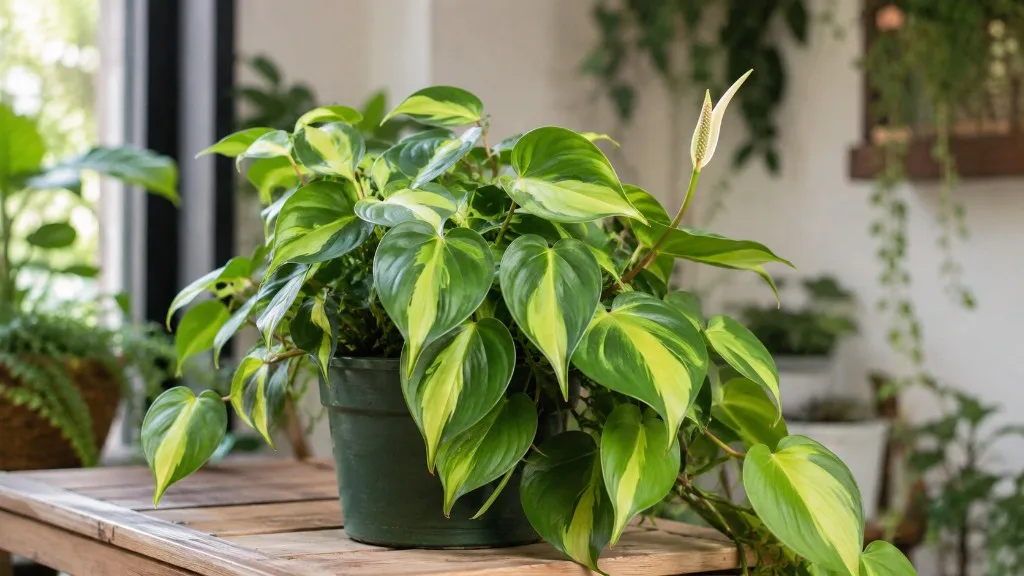
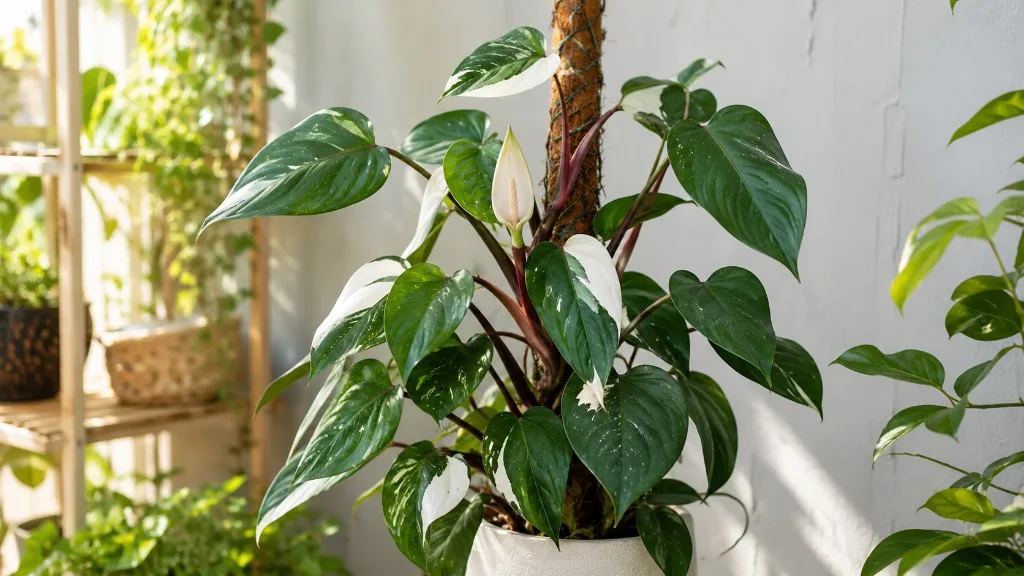
What makes White Knight visually distinct is the combination of white-to-cream sectoral variegation on green cordate leaves and deep burgundy to purple-dark stems and petioles, often with white striping along the cataphylls (the small sheaths that wrap new leaves). The leaves are glossy, heart-shaped, and somewhat leathery compared with softer variegated philodendrons. Growth is upright and climbing rather than self-heading: given a moss pole or trellis, the plant produces shorter internodes and larger foliage; left unsupported, it can look leggy and less impressive than the photos that sold you on it.
White Knight is a collector cultivar, not a beginner default. It grows more slowly than all-green climbing philodendrons because heavily variegated leaf tissue photosynthesizes less efficiently. That slower metabolism changes everything downstream - watering tolerance, fertilizer demand, recovery time after stress, and how quickly you notice when conditions drift wrong.
How It Differs From White Wizard and White Princess
The three “white philodendrons” - White Knight, White Wizard, and White Princess - get mislabeled constantly because leaf variegation alone is unreliable. All three can produce green-and-white leaves in sectoral or marbled patterns. The repeatable ID shortcut is stem and petiole pigmentation, which stays more consistent leaf to leaf than variegation patterns alone among these closely related P. erubescens cultivars.
White Knight: dark burgundy to purple-brown stems and petioles with white striping. If the stem is clearly burgundy, you are most likely looking at White Knight, not the other two.
White Wizard: clean green stems and petioles with white striping, typically no pink blush and no burgundy-dark pigmentation. Leaves tend to be broader and can grow larger under strong support and good humidity.
White Princess: green stems with pink to rosy striping alongside white markings. Leaves are often narrower and more elongated, especially in juvenile growth.
Leaf shape and growth speed vary plant to plant and are poor primary identifiers at the nursery bench. Two White Knights side by side can show dramatically different white coverage on the same growth cycle. Stem color is the feature that stays consistent leaf to leaf. If you paid collector prices, verify the stem before you verify the variegation pattern.
Why Variegation Changes the Care Equation
Variegation on White Knight is genetic, not a light trick you can switch on and off. Light influences how strongly the contrast reads and how compact the growth stays, but it does not create white tissue where the plant’s chimera does not produce it. That distinction matters because two failure modes follow from misunderstanding it.
The first failure mode is chasing all-white leaves. Fully white leaves look stunning in photos and disastrous on the plant. They contain little to no chlorophyll, produce almost no energy, and often brown or die while the plant stalls. The best long-term White Knight is not the whitest one; it is the one that keeps producing balanced green-and-white leaves on a burgundy stem with active nodes.
The second failure mode is treating White Knight like a fast green vine. Variegated tissue is more sensitive to direct sun, drought stress, and root rot on Philodendron White Knight. White sections show damage first - brown crispy patches, translucent spots, or sudden collapse - while green tissue looks fine for a few days longer. When you diagnose problems, read the white areas as the early warning system.
Reversion - when new leaves emerge mostly or entirely green - is a separate issue tied to the plant’s unstable variegation genetics. It is not fixed by fertilizer alone. Pruning back to a node on a stem that still shows white striping is the standard corrective, covered later in this guide. Accept that variegation will swing leaf to leaf; the goal is a repeatable stem pattern and sustainable growth, not a frozen Instagram snapshot.
Light: Bright, Indirect, and Carefully Balanced
White Knight wants bright, indirect light for most of the day, the same dappled-understory position its parent species occupies in Colombian rainforest. The North Carolina Extension profile for P. erubescens lists partial shade and dappled sunlight as appropriate cultural conditions, which translates indoors to a bright east-facing window, a north-facing window in a well-lit room, or a south- or west-facing window behind sheer curtains or set back several feet from the glass.
Think of light as a brightness dial, not a on/off switch. Enough brightness keeps internodes short, stems firm, and variegation contrast sharp. Too little light and the plant reverts toward green, stretches between nodes, and dries the pot slowly - a dangerous combo that tempts overwatering. Too much direct sun, especially hot afternoon sun, burns white leaf sections faster than green tissue, leaving tan or brown patches that do not heal.
A practical placement test: within roughly 3–6 feet of a bright window with filtered light, or under a quality grow light running 10–12 hours daily at moderate intensity. If you are measuring, many experienced aroid growers target roughly 10,000–20,000 lux for strong indirect growth without scorching pale variegation, though exact meters are optional if you read the plant’s feedback.
Acclimate gradually when you move the plant. A week of shifting it a few inches closer to the light source each day prevents shock on fresh white leaves. Sudden jumps from a dim corner to a south window are how collectors lose a perfect leaf in an afternoon.
Signs Your Light Level Is Wrong
Too little light shows up as long internodes, smaller new leaves, weak burgundy stem color fading toward plain green-brown, and increasing green dominance in variegation over several growth cycles. The pot stays wet longer than you expect. Spider mites become more likely in dry winter air combined with weak growth.
Too much light shows up as bleached white sections, brown scorched patches on exposed leaf faces, curled or crisped leaf margins, and stalled new growth after sun shock. Damage concentrates on the side facing the window.
About right looks like firm stems, moderate internode length, new leaves opening with visible white variegation matching the parent stem’s pattern, and a pot that dries on a predictable rhythm you can learn within two weeks of observation.
Watering: Let the Pot Dry, Not the Calendar
Watering is where White Knight care is won or lost. The general rule from LeafyPixels plant-care data and consistent aroid practice: water when the top 3–5 cm (1–2 inches) of mix is dry, then water thoroughly until excess runs from the drainage holes. In many homes that works out to roughly every 7–10 days in the active growing season and every 10–14 days in winter, but the interval is a starting point, not a schedule.
Variegated philodendrons use water more slowly than all-green vines in the same pot size because they grow more slowly and transpire less when white-dominant leaves are present. A calendar watered every Sunday will eventually keep the roots too wet, especially in winter or after a move to lower light. The safer habit is check the mix, then decide.
Use room-temperature water. Cold water shocks tropical roots. If your tap water is very hard, filtered or rainwater reduces mineral buildup that shows up as brown tips - especially on white tissue, which highlights edge burn.
Always empty the saucer within 15–30 minutes of watering. Roots sitting in runoff are the fastest route to stem rot at the base of a burgundy petiole, which is both ugly and structurally damaging on a climber you are trying to train upright.
Reading Soil Moisture by Touch
The finger test remains the most reliable tool. Push your index finger to the second knuckle. Dry at that depth means water. Cool and slightly damp means wait. For deeper pots, a dry wooden chopstick inserted and left for a few minutes tells you whether moisture lingers lower down - useful when the top crust dries fast but the core stays wet.
Lift the pot. A freshly watered White Knight in a plastic nursery pot feels noticeably heavier than one ready for water. Learning that weight difference takes three or four watering cycles and then becomes automatic.
If the mix stays wet for more than 5–7 days after a thorough watering in normal indoor temperatures, do not water again “to be safe.” Fix the cause: too little light, mix too dense, pot too large, or poor drainage holes. Wet roots on a slow variegated climber lead to yellow leaves, soft stems, and root rot within days once the decline starts.
Humidity and Temperature Indoors
White Knight is a tropical understory plant, so it prefers moderate to high humidity - roughly 55–70% - and stable warmth. It tolerates average household humidity in the 40–50% range if light and watering are otherwise correct, but dry air shows up first on white leaf sections as brown, papery edges and makes the plant more attractive to spider mites.
Raising humidity effectively means a small humidifier nearby, grouping plants to share transpiration, or a pebble tray with the pot sitting above the water line. Misting is a poor substitute: the humidity bump lasts minutes, and wet variegated foliage in stagnant air invites fungal spotting.
Temperature comfort zone is 18°C to 29°C (65–85°F), matching normal indoor living. Avoid sustained exposure below 15°C (59°F). The North Carolina Extension entry notes USDA hardiness zones 10a–12b for outdoor culture; indoors, the practical risks are cold window ledges in winter, air-conditioning vents blowing directly on the foliage, and drafty doorways. A plant that looked fine in October can stall all winter on a glass sill that drops 10°F overnight.
Good airflow matters as much as humidity percentage. A gentle fan in the room, or space between plants, reduces stagnant pockets where moisture sits on leaves and stems. Collector plants fail more often from “humid but stuffy” corners than from honestly dry air.
Soil, Pots, and Climbing Support
White Knight needs a chunky, well-draining aroid mix, not standard moisture-retentive houseplant soil. A workable recipe: potting mix + perlite + orchid bark in roughly equal parts, adjusted slightly toward more bark in humid homes or more perlite in dimmer spots. The target is a mix that holds moisture briefly, drains fast, and keeps oxygen around roots. Target pH 5.5–6.5, which most peat- or coco-based aroid blends already approach without adjustment.
Avoid garden soil, heavy peat-only mixes, and dense propagation mediums left over from tissue-culture or wet-stick rooting. White Knight cuttings are often sold before they are fully established, still sitting in moss or water propagation substrate that stays wet too long in a home pot. If the mix smells sour, compacts when you squeeze it, or water runs straight down the sides without soaking in, repot into proper aroid mix - but not on day one unless rot is already present (see quarantine section).
Drainage holes are non-negotiable. Decorative cache pots are fine only if the inner nursery pot lifts out. Terracotta dries faster and forgives slight overwatering; plastic retains moisture longer and suits growers who tend to underwater. Match pot material to your habits, not to aesthetics alone.
Go up one pot size at a time when Philodendron White Knight repotting guide. An oversized pot holds water the small root system cannot use, which is the most common post-repot root-rot trigger on slow growers.
Moss Poles and Larger Leaves
White Knight is a climbing philodendron. In nature it adheres to tree trunks and grows toward brighter broken canopy light. Indoors, a moss pole, coco pole, or rough wooden plank gives aerial roots something to grab and signals the plant to produce larger, more mature foliage.
Attach the stem loosely with soft plant ties or velcro tape, positioning nodes against the moist pole surface. Keep the pole medium slightly damp, not dripping, if it is a live moss pole. Unsupported plants often produce smaller leaves and longer bare stems that read as “leggy” even when the plant is technically healthy.
You do not need a pole on day one, but add one before the plant reaches 12–18 inches if you want the mature collector look. Once a stem hardens and grows away from the pole, it is harder to train without snapping petioles.
Fertilizer Schedule and Strength
Fertilizer supports growth; it does not rescue bad light or rotting roots. Feed lightly during active growth - typically monthly in spring and summer with a balanced liquid fertilizer diluted to half strength on already-moist soil. Pause feeding in late fall and winter when growth slows, after repotting for at least four weeks, and any time the plant shows stress (yellowing, stalling, recent pest treatment, or root work).
Variegated plants need less fertilizer than hungry all-green vines because they produce less biomass per month. Overfeeding accumulates salts that burn leaf margins, visible first on white sections. If you see crusty white deposits on the mix surface or tip burn despite good humidity, flush the pot with plain water until runoff runs clear and skip the next feeding.
A modest slow-release fertilizer mixed into the top layer at repotting is an acceptable low-maintenance alternative for growers who forget monthly liquids. Watch new growth: if leaves emerge small and pale despite good light and watering, a single half-strength feed after flushing is reasonable. If leaves emerge normal but old ones yellow while soil stays wet, fertilizer is not the problem.
Repotting Without Losing Variegation
Repot White Knight roughly every 1–2 years, or when roots circle the drainage holes, water runs straight through without soaking, or the mix has broken down into fine, water-holding particles. The best timing is early spring into early summer, as new growth is starting. Repotting during winter dormancy or mid-heatwave adds recovery time a slow plant does not have.
Steps that reduce stress: water the plant lightly the day before, choose a pot only one size larger, use fresh chunky aroid mix, and set the plant back at the same depth - never bury the stem deeper to stabilize a wobbly pole. Water lightly after repotting and keep light bright but indirect without direct sun for the first week.
Do not repot, fertilize, prune heavily, and move rooms in the same week after purchase. Collector plants die from stacked interventions more often than from one imperfect watering. Change one variable, watch for two weeks, then adjust again.
Pruning and Managing Reverted Growth
Pruning on White Knight serves two jobs: remove damaged leaves that will not recover, and redirect growth back to variegated nodes when reversion appears.
Cosmetic browning on old white tissue is common and permanent on that leaf - trim the damaged section or remove the whole leaf if it is mostly brown. Active rot at the node is different: soft, dark tissue at the stem base needs immediate inspection, not cosmetic trimming.
When several new leaves emerge mostly green despite a variegated stem, cut back to a node above a leaf that still shows good white patterning. Use clean, sharp shears. Sterilize between cuts if you suspect rot. The plant will branch from nearby nodes on climbing philodendrons, though response is slower than on green pothos. Expect weeks, not days, for the next leaf to prove whether variegation stabilized.
Avoid hard pruning when the plant is mostly white-leaved and already stressed. A heavily white plant with stalled growth needs gentler conditions, not more loss of photosynthetic tissue. Let one or two greener leaves carry energy until balance returns.
Propagation by Node Cuttings
The standard home propagation method is node cuttings from sections with visible white variegation on the stem, not just on the leaf. Each cutting needs at least one node and one healthy leaf, though some growers prefer two nodes for faster establishment on slow cultivars.
Cut below the node with sterile shears. You can root in moist sphagnum, perlite-heavy aroid mix, or water (transferring to mix once roots reach 2–5 cm). Keep humidity high with a clear cover or propagation box, provide Philodendron White Knight light guide without direct sun, and open the cover daily briefly to prevent mold. Roots typically form over 2–6 weeks depending on temperature and node vigor; variegated cuttings can be slower than green ones.
The cutting inherits the parent’s variegation tendency but not a guarantee on every future leaf. Propagate from the most stable stem on the plant, not the whitest leaf. Never propagate from a plant in active rot recovery or obvious pest infestation - fix the parent first.
Buying and Quarantining a Collector Plant
White Knight is still sold at collector prices in many markets, and mislabeling among the white philodendron trio remains common. Before you pay a premium, verify burgundy stem color with white striping, firm petioles, and at least one active growth point with a visible spear or new leaf emerging.
Check whether the plant is rooted in real aroid mix or still in dense propagation medium (wet moss, straight perlite, or water-rooted plugs). The first sign of trouble on a fresh cutting is a soft node or stalled spear - rot starting where humidity was too high and airflow too low.
Inspect leaf undersides and stem joints for thrips, spider mites, and mealybugs, which spread fast through rare-plant collections. Quarantine new plants 2–3 weeks in a separate room, monitor Philodendron White Knight watering guide in your home’s light, and resist repotting on day one unless the mix is clearly failing or pests are present. Learn how fast the pot dries before you change anything else.
Cosmetic brown edges on older white leaves are normal wear. Rot at the node is not normal. Pass on plants with mushy bases, sour-smelling soil, or no new growth during warm months.
Toxicity to Pets and People
Philodendron White Knight is toxic to cats and dogs. Like all philodendrons, it contains insoluble calcium oxalate crystals that cause oral irritation, drooling, pawing at the mouth, vomiting, and difficulty swallowing if chewed or ingested. The ASPCA lists Philodendron species as toxic to cats and dogs, and the mechanism applies to this cultivar regardless of variegation.
This is not a plant for floor pots in pet households, low shelves within jump range, or rooms where puppies explore with their mouths. Hanging baskets, tall plant stands, or closed cabinets are the practical options if you keep both pets and collector aroids. If ingestion is suspected, contact ASPCA Animal Poison Control at 888-426-4435 (US) and your veterinarian promptly.
For humans, sap can irritate sensitive skin on contact. Wash hands after pruning or repotting. Ingestion can cause mouth and throat irritation; call poison control for significant exposure. The risk is generally moderate and dose-dependent, but the plant should be treated as genuinely unsafe around children who mouth objects, not as mildly unpleasant greenery.
Common Problems and Real Fixes
Most White Knight problems are environmental and show up in a repeating pattern. The diagnostic order that saves plants: check root moisture and stem firmness, then light, then humidity, then pests, then water chemistry. Fix the condition first; prune damaged leaves after the plant stabilizes.
Brown patches on white leaf sections usually mean too much direct sun, acute low humidity, or salt burn from hard water and overfertilizing. Move the plant back from harsh light, raise humidity, flush the pot, and wait for the next leaf to judge whether the fix worked. Old damaged tissue will not green up again.
Yellow leaves with wet mix and soft stems point to overwatering and root rot. Unpot, trim black mushy roots with sterile tools, repot into fresh airy mix, and withhold water until the plant shows signs of recovery. Yellow lower leaves on dry mix may be normal senescence - remove them and adjust watering.
Leggy growth with small leaves is low light. Move brighter gradually or add a grow light. Do not compensate with extra water.
Reversion (mostly green new leaves) needs pruning back to a variegated node on a stem that still shows white striping, plus adequate bright indirect light. Genetics sets the ceiling; light helps display and stability, not magic restoration.
Stalled spear on a firm stem often means root stress, cold, or recent overwatering. Dig gently into the top of the mix without disturbing roots - if it is wet and cool days after watering, improve drainage and airflow before the spear rots.
Pests on Variegated Foliage
Spider mites are the primary indoor pest, especially in dry winter air. Look for fine webbing, stippled yellow-white flecks, and dusty-looking leaf surfaces. Shower the plant to knock mites off, raise humidity, and treat with insecticidal soap or horticultural oil following label directions. Test oil on one leaf first; variegated tissue can be slightly more sensitive.
Mealybugs appear as cottony clusters in leaf axils and along burgundy stems. Dab with 70% isopropyl alcohol on a swab, then follow with soap sprays weekly for three cycles. Thrips leave silvery scars and black specks; rinse and use soap or labeled thrips treatment, quarantining the plant during control.
Scale looks like hard brown bumps on stems. Scrape gently and treat as for mealybugs. Fungus gnats mean the mix surface stays too wet - let the top layer dry, add a perlite top dress, and address overwatering before reaching for pesticides.
On all pests, catch infestations early. A variegated slow grower loses months of progress to a heavy mite load that a green pothos would outgrow.
Conclusion
Philodendron White Knight rewards a specific kind of care: bright enough to hold contrast, protected enough to keep white tissue intact, airy enough at the roots to respect slow growth, and stable enough that you are not repotting, fertilizing, and moving it every week. Identify it by the burgundy stem, support it on a moss pole if you want mature leaves, water when the top 3–5 cm of mix is dry, and target 55–70% humidity when you can. Prune reversion back to variegated nodes, quarantine new purchases, and keep the plant away from pets.
It is not the fastest or easiest philodendron. It is one of the most striking when the stem color, leaf pattern, and climbing form come together on a healthy plant you grew yourself. Treat it like a slow tropical vine with fragile white tissue, not like a plastic decoration, and it will stay worth the shelf space for years.
When to use this page vs other Philodendron White Knight guides
- Philodendron White Knight overview - Canonical hub for this species - care topics and problems branch from here.
- Philodendron White Knight problems - Symptom-first path when you already know something is wrong.
Related Philodendron White Knight guides
- Philodendron White Knight watering
- Philodendron White Knight light
- Philodendron White Knight soil
- Philodendron White Knight propagation
- Philodendron White Knight fertilizer
- Philodendron White Knight repotting
- Philodendron White Knight pruning
- Ants on Plant on Philodendron White Knight
- Brown Tips on Philodendron White Knight
- Leaf Drop on Philodendron White Knight
- Leaf Spot Disease on Philodendron White Knight
- Leaf Miners on Philodendron White Knight
How to care for Philodendron White Knight?
How much light does Philodendron White Knight need?
bright indirect light, medium indirect light (variegation fades)
- bright indirect light, medium indirect light (variegation fades) - bright indirect light, medium indirect light (variegation fades).
When should you water Philodendron White Knight?
Every 7–10 days in summer - allow top 3–5 cm to dry. Every 10–14 days in winter.
- Check top 2 inches - Every 7–10 days in summer - allow top 3–5 cm to dry.
- Drain excess water - Empty the saucer after watering so the roots are not sitting in standing water.
What soil works best for Philodendron White Knight?
Chunky aroid mix: potting mix + perlite + orchid bark. Well-draining. pH 5.5–6.5.
- Well-draining mix - Well-draining.
Grower notes for Philodendron White Knight
What makes White Knight different
Philodendron White Knight is a variegated erubescens type known for white patches on darker stems. The white tissue is beautiful but fragile, so the goal is controlled brightness rather than maximum sun. It usually grows slower than plain green climbers because heavily variegated leaves produce less energy. Expect a steadier, more deliberate plant, not a fast wall-covering vine.
White Knight color note
Keep the plant bright enough to hold contrast but protected from hot direct sun that browns white leaf sections. If leaves are mostly green for several growth cycles, consider pruning back to a node with stronger variegation. If leaves are mostly white, reduce stress and avoid hard pruning until the plant produces more balanced growth. The best long-term plant is not the whitest one; it is the one that can keep growing.
White Knight buying note
Check whether the plant is rooted in a normal aroid mix or still sitting in dense propagation medium. White Knight cuttings are often sold before they are truly settled, and the first sign of trouble is a soft node or stalled spear. Look for at least one active growth point and a stem pattern that shows repeatable variegation. Cosmetic browning on old white tissue is common; rot at the node is not.
What matters most with Philodendron White Knight
Philodendron White Knight is easiest to understand by its growth habit. Climbers need support for larger leaves, self-heading types need stable root moisture, and delicate velvet forms punish stale air faster than basic green philodendrons. In practice, the care checkpoint is simple: bright indirect light, medium indirect light (variegation fades). Pair that with chunky aroid mix: potting mix + perlite + orchid bark. Well-draining; pH 5.5–6.5, and avoid changing water, pot size, and placement all at once.
Best placement in a real home
Philodendron White Knight belongs where bright indirect light, medium indirect light (variegation fades) is realistic for most of the day, not only where the pot looks good. Every 7–10 days in summer - allow top 3–5 cm to dry. Every 10–14 days in winter. If the pot stays wet longer than expected, move the plant into better light or reassess the mix before watering again. Humidity target: Moderate to high humidity (55–70%).. Temperature comfort zone: 18°C to 29°C (65–85°F).
Before you buy this plant
Choose Philodendron White Knight with firm new growth, clean leaf undersides, and soil that does not smell sour or feel compacted. Be cautious if you see yellow-leaves, sticky residue, collapsed crowns, or a pot that is wet in poor light. Cosmetic old-leaf damage is less worrying than weak roots or active pests.
First month after bringing it home
Do not repot Philodendron White Knight on day one unless the mix is failing or pests are obvious. Quarantine it, learn how fast the pot dries, and keep care boring while it adjusts. Watch especially for yellow-leaves, brown-tips, and root-rot. If problems appear, correct the condition first rather than stacking fertilizer, repotting, and pruning together.
Is it pet safe?
Philodendron White Knight is toxic to cats and dogs.
Toxic - calcium oxalate crystals.
Watering Philodendron White Knight
Every 7–10 days in summer - allow top 3–5 cm to dry. Every 10–14 days in winter.
Soil & potting for Philodendron White Knight
Chunky aroid mix: potting mix + perlite + orchid bark. Well-draining. pH 5.5–6.5.
Humidity & temperature for Philodendron White Knight
Philodendron White Knight prefers moderate to high humidity (55–70%), though normal home humidity is usually fine. Keep temperatures around 18°C to 29°C (65–85°F).
| Detail | Information |
|---|---|
| Humidity | Moderate to high humidity (55–70%) - normal home humidity is fine. |
| Ideal temperature | 18°C to 29°C (65–85°F) |
Fertilizer & pruning for Philodendron White Knight
Use feed lightly during active growth. Use monthly in spring and summer.. for Philodendron White Knight.
| Detail | Information |
|---|---|
| Fertilizer type | Feed lightly during active growth. Use monthly in spring and summer.. |
Common problems on Philodendron White Knight
Likely cause: Philodendron is a large genus of flowering plants in the family Araceae. As of September 2025, the Plants of the World Online accepted 625 species; [2] other sources accept different numbers. [3][4] …
Quick fix: Confirm diagnosis on your Philodendron White Knight, then address the most likely care or pest factor described in current extension guidance.
Full fix guide →Brown Tips
MediumLikely cause: Low humidity
Quick fix: Increase humidity to 55%+
Full fix guide →Leaf Drop
MediumLikely cause: Feb 21, 2024 · Philodendron Types with Pictures and Care Guide The green heartleaf Philodendron is a vining type of plant with dark-green leaves in a heart’s shape. This type of Philodendron can be grown …
Quick fix: Confirm diagnosis on your Philodendron White Knight, then address the most likely care or pest factor described in current extension guidance.
Full fix guide →Leaf Spot Disease
MediumLikely cause: Feb 21, 2024 · Philodendron Types with Pictures and Care Guide The green heartleaf Philodendron is a vining type of plant with dark-green leaves in a heart’s shape. This type of Philodendron can be …
Quick fix: Confirm diagnosis on your Philodendron White Knight, then address the most likely care or pest factor described in current extension guidance.
Full fix guide →Leaf Miners
MediumLikely cause: Feb 21, 2024 · Philodendron Types with Pictures and Care Guide The green heartleaf Philodendron is a vining type of plant with dark-green leaves in a heart’s shape. This type of Philodendron can be …
Quick fix: Confirm diagnosis on your Philodendron White Knight, then address the most likely care or pest factor described in current extension guidance.
Full fix guide →Leggy Growth
MediumLikely cause: Insufficient light causing reversion
Quick fix: Move to brighter indirect light
Full fix guide →Plant Leaning
MediumLikely cause: Philodendron is a large genus of flowering plants in the family Araceae. As of September 2025, the Plants of the World Online accepted 625 species; [2] other sources accept different numbers. [3][4] …
Quick fix: Confirm diagnosis on your Philodendron White Knight, then address the most likely care or pest factor described in current extension guidance.
Full fix guide →Root Rot
MediumLikely cause: Wet soil
Quick fix: Repot in fresh chunky draining mix
Full fix guide →Thin Stems
MediumLikely cause: Feb 6, 2025 · If you are thinking of adding a philodendron to your indoor or outdoor garden, choosing the right variety can be a …
Quick fix: Follow extension or botanical guidance for Philodendron White Knight thin stems; adjust care before applying broad treatments.
Full fix guide →Yellow Leaves
MediumLikely cause: Overwatering
Quick fix: Allow top 3–5 cm to dry
Full fix guide →