Philodendron White Knight Light Needs: Best Window, Sun &
Philodendron White Knight Light Needs: Best Window, Sun & Warning Signs
Philodendron White Knight Light Needs: Best Window, Sun & Warning Signs
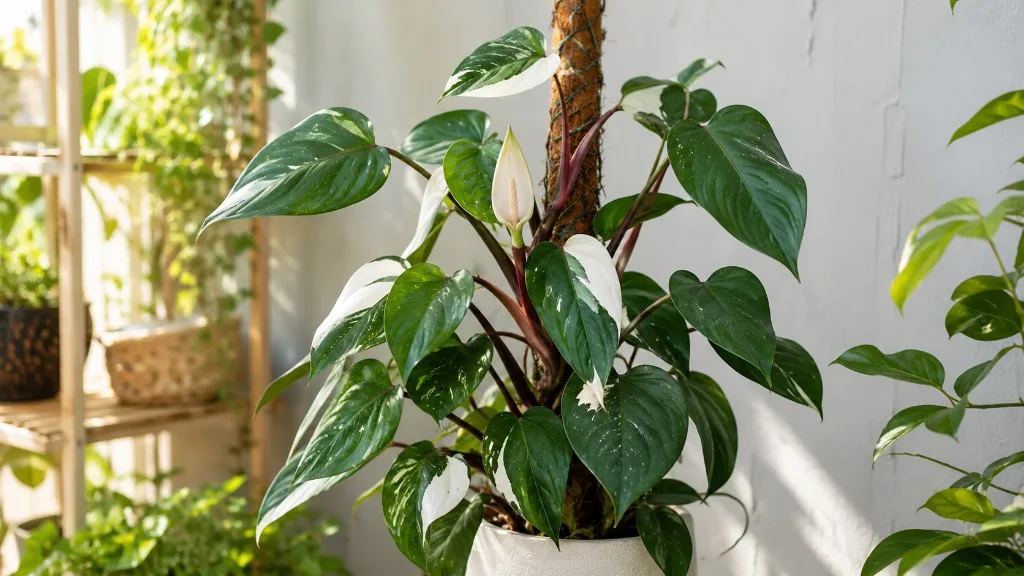
Philodendron White Knight is not a “set it on the shelf and forget it” philodendron. Philodendron erubescens ‘White Knight’ is a variegated climbing aroid with white patches on dark burgundy stems and fragile white leaf tissue that needs bright, filtered light - more than a dim north corner provides, but less harsh direct sun than a south windowsill delivers through summer glass. The practical mistake is judging by how bright the room looks instead of how much usable light reaches the leaves at the height where new growth opens.
White Knight sits in a narrow band: enough light to keep stem striping and balanced variegation, not so much that white sectors bleach or crisp. Heavily white leaves photosynthesize less than green tissue on the same parent species, so this cultivar often needs brighter indirect exposure than green P. erubescens while scorching faster than Pink Princess pink sectors when hot direct beams hit unacclimated foliage. Light also sets the throttle on watering and soil dry-down - a brighter White Knight drinks faster; a dim one stalls and risks root rot when watered on autopilot.
This guide covers how much light White Knight actually needs, the shadow test and foot-candle bands, a window-by-window placement matrix, direct-sun limits, low-light reversion, grow-light setup, safe acclimation, warning signs, and links to the White Knight care cluster.
Why White Knight Light Is Not “Whatever Looks Bright to You”
Human eyes adapt to indoor dimness. A living room that feels adequately lit to you may deliver under 100 foot-candles at a shelf three meters from a window - fine for a cast-iron plant, marginal for a white-variegated climber trying to hold contrast. Clemson HGIC notes that the interior of a well-lighted home is often less than 100 ft-c, while outdoor sun on a clear day can exceed 10,000 ft-c. Plants do not adapt their chlorophyll needs to your décor; they respond to photons at the leaf surface.
For White Knight, the stakes are higher than for solid-green heartleaf philodendron. Iowa State Extension states that philodendrons with brightly colored foliage prefer moderate to bright indirect light indoors, while low-light-tolerant types like Philodendron hederaceum can survive much dimmer placements. White Knight is a collector cultivar on the bright-foliage end of that spectrum - not because “more light creates more white,” but because green tissue must carry the plant when large leaf sectors cannot photosynthesize.
White Tissue and the Photosynthesis Deficit
White variegation on erubescens types is chimeral - patches of cells lack functional chloroplasts. Those white sectors contribute little or no photosynthetic energy. The remaining green tissue must produce enough carbohydrates to support roots, new leaves, and the metabolically expensive white portions. That is why White Knight grows slower than green erubescens climbers and why it needs a higher minimum light level than an all-green plant in the same window to avoid leggy growth or all-green reversion.
The goal is controlled brightness: strong enough that new leaves open with repeatable white patterning on the stem and blade, soft enough that white tissue does not bleach, brown, or feel hot at midday. The best long-term White Knight is not the whitest specimen in a photo - it is the one that keeps producing balanced new growth season after season.
How Much Light Philodendron White Knight Actually Needs
NC State lists Philodendron erubescens cultural light as dappled sunlight or partial shade - direct sun only part of the day, roughly 2–6 hours. Indoors, that translates to bright indirect light as the default: strong ambient brightness at the canopy without prolonged harsh beams on unfiltered south or west glass. SDSU Extension recommends bright light, diffused sunlight, or partial shade for philodendrons and warns that poor light reduces leaf and plant size, while too much light yellows leaves. SDSU also notes that variegated cultivars can handle a bit more indirect lighting than solid-green types - a useful clue that White Knight belongs on the brighter side of the philodendron range, not the dim hallway end.
For measurable indoor targets - heuristics, not laboratory requirements - aim for roughly 250–600 foot-candles (about 2,500–6,000 lux) at the top leaves for steady variegated growth. That aligns with Clemson’s medium light band (200–500 ft-c preferred for many foliage houseplants) and the upper portion of acceptable indoor brightness. Below ~150–200 ft-c, White Knight may survive but often loses stem striping, pushes smaller greener leaves, and stretches toward the glass. Above ~800–1,000 ft-c of direct or unfiltered exposure without acclimation, white sectors scorch before green tissue shows equivalent damage.
The Difference Between Surviving and Holding Variegation
A White Knight can look “fine” for months in marginal light while quietly reverting - new leaves emerge more green, stem white banding fades, and internodes stretch. That is not bad luck; it is the plant increasing photosynthetic area when energy input is insufficient. Conversely, a plant in borderline bright placement may hold variegation but grow so slowly that beginners assume it is stalled or underwatered.
Judge light by the newest leaf and the newest internode after any move. Old cosmetic damage on mature leaves does not tell you whether today’s placement works. Success looks like firm new blades, visible white patterning consistent with the stem, and reasonable internode length - not paper-white leaves that cannot sustain the next growth point.
Bright Indirect Light Explained (Shadow Test and Foot-Candle Bands)
“Bright indirect light” is accurate horticultural language and vague room advice at the same time. Translate it with two tools: a hand-shadow test at leaf height and, optionally, a light meter app reading in lux (divide lux by roughly 10 for a foot-candle estimate).
Bright indirect at White Knight leaf height: you can read comfortably without a lamp; a hand held between plant and window casts a soft but clearly defined shadow; leaves do not feel hot within an hour of peak sun. Medium indirect: readable, but shadow edges are fainter - acceptable for short periods or winter, risky as a year-round variegation strategy. Low light: no readable hand shadow at leaf height - survival mode for White Knight, not a display placement.
Clemson HGIC classifies indoor plants into low, medium, high, and very high light by foot-candles and notes that about 200 ft-c for 12 hours daily is necessary before foliage plants show much benefit from fertilization - a reminder that dim placements limit everything else you do for the plant.
The Hand-Shadow Field Test at Leaf Height
Perform the test where the top leaf actually sits, not at your eye level. Climbing White Knights on moss poles often have canopy leaves 30–60 cm above the pot - significantly brighter than the base if a shelf blocks lower stems. Hold your hand between the upper leaves and the window on a partly sunny day. Soft, sharp-edged shadow → bright indirect. Weak ghost shadow → add light or move closer. Harsh shadow with heat on the leaf back → filter or increase distance.
Re-test in late winter when sun angle drops. A placement that worked in June may fail in January on the same sill.
Best Window Placement for Philodendron White Knight
Window direction is a starting point, not the whole answer. Outdoor tree shade, overhangs, tinted glass, sheer curtains, and pot distance all change intensity. Still, compass orientation gives a reliable first guess in the northern hemisphere.
Place White Knight where it receives strong plant-facing brightness most of the day, not where the pot looks good in the room layout. Rotate the container a quarter turn every two to three weeks if growth leans toward the glass - see plant leaning if stems bend severely.
Worked example - rooted cutting vs established climber: A 10 cm cutting in a propagation cup belongs 30–45 cm back from an east pane or directly in gentle east morning sun once rooted, because small leaf area cannot tolerate the same heat load as a mature plant. A 60 cm moss-pole climber should have its top leaves in the bright indirect band - often 60–90 cm back from south glass with a sheer curtain, or 30–45 cm from an east window - while lower leaves may sit in moderate shade. That vertical gradient is normal; prioritize the newest growth point at the top.
East, North, South, and West Windows Compared
An east-facing window is the safest default for most White Knight growers. Morning sun tends to be bright but cooler than afternoon rays. 30–60 cm from an unobstructed east pane often delivers the bright indirect band where variegation holds without daily scorch scares. Gentle one to two hours of morning direct sun is acceptable on acclimated plants.
A north-facing window provides cool indirect light all day but often lands in the low to moderate range, especially in winter. White Knight may maintain here in summer at high latitudes but frequently reverts or stretches over time. Treat north as supplemental-grow-light territory if stem striping fades over two or three new leaves.
A south-facing window delivers the highest total daily light. Use sheer curtains or place the pot 90–150 cm back from the glass so leaves receive bright ambient light without baking. In summer, watch white patches for bleaching - pull back before brown necrotic spots form.
A west-facing window can work in spring and fall and becomes risky in midsummer when afternoon sun carries heat through the pane. West is viable with diffusion and distance; treat it like south with extra heat caution, not like east with bonus hours.
Distance From the Glass Matters
Direction labels fail when distance is wrong. A south window 1.5 m away on an open floor may deliver less usable light at the leaf than an east window 40 cm away.
Use distance as a dimmer switch: closer increases intensity and heat; farther softens direct sun but can drop below the variegation threshold. Seasonal adjustment beats permanent guessing - move closer in winter, slightly back in midsummer if leaf surfaces heat up. One 30 cm shift can matter more than switching exposures.
Can Philodendron White Knight Take Direct Sun?
Limited direct sun - yes, with conditions. NC State explicitly warns that direct sunlight should be avoided for erubescens indoors, which is conservative guidance for the species broadly. In practice, gentle morning direct sun through east glass - especially in spring and fall - is a tool many growers use after acclimation. What White Knight cannot tolerate is sudden unfiltered afternoon sun through south or west panes on a plant grown in a dim shop or propagation tent.
Problems start when intensity jumps faster than the plant adjusts. White tissue lacks chlorophyll to dissipate excess light energy as effectively as green sectors, so bleached patches, papery brown scorch, and sunken necrotic spots appear on white areas first. NC State also notes that leaf spot diseases worsen when water sits on foliage - another reason to avoid baking leaves under hot glass and overhead watering combined.
Treat direct sun as a graduated tool: add morning exposure in stages; remove it when white sectors show daily crisping during peak hours.
Low-Light Limits and Variegation Reversion
SDSU Extension states that poor light reduces leaf and plant size on philodendrons. For White Knight, low light does something more specific: it triggers reversion toward green growth because green cells outcompete white sectors when total photon capture is insufficient.
Low-light symptoms include smaller new leaves, longer internodes, fading stem white striping, solid green new blades for several cycles, and soil that stays wet too long because transpiration drops. If you see this pattern, see not enough light and leggy growth for cluster-specific recovery - but the fix starts with more bright indirect exposure, not fertilizer.
Recovery timeline: After moving from a dim shelf to a filtered east window, expect one to two new leaves before you can judge striping stability - often 4–8 weeks in active season, longer in winter. Do not repot, fertilize heavily, and move light all in the same week.
Warning Signs Your White Knight Has Too Much or Too Little Light
Use a two-week observation window after any placement change. Old scars are historical; new growth tells the story.
Too little light: stretched internodes; smaller paler new leaves; loss of stem white banding; mostly green new foliage; leaning toward the brightest source; soil wet for 10+ days after a modest drink; no new leaf for many months in warm seasons. Cross-check yellow leaves when low light pairs with overwatering.
Too much light or heat: bleached white patches turning papery brown; crisp scorch on sun-facing sectors while shaded green areas look fine; leaf curl during peak hours repeating daily; sudden damage within days of a window move. White tissue often fails before green tissue - that asymmetry is diagnostic. Brown tips from low humidity can look similar but usually lack hot-to-touch sun-facing patches and bleaching.
Decision shortcut: bleached + hot leaf surface → pull back and filter sun. Smaller + greener + stretched → increase bright indirect exposure. Firm growth but fading stem stripes → add light before pruning for variegation balance.
Using Grow Lights for Philodendron White Knight
When natural light is weak - north-only winter rooms, interior offices, shelves far from glass - a full-spectrum LED grow light is the reliable fix. Clemson HGIC notes that fluorescent or special incandescent grow lamps can supplement low indoor light, that sixteen hours on and eight hours off work for many houseplants, and that timers keep cycles consistent.
For White Knight, start with a full-spectrum white LED in the roughly 4000K–6500K range positioned 30–45 cm (12–18 inches) above the top leaves. Run 10–12 hours daily on a timer. If new growth pales or stretches toward the lamp, lower slightly or extend duration modestly. If white sectors crisp only under the bulb, raise the fixture or reduce hours - heat near the canopy matters as much as photon count.
Integrate grow lights with seasonal windows rather than treating them as winter-only. A mediocre east window plus a modest LED often outperforms either alone. When you add a lamp, recheck watering after two weeks - brighter total daily light increases dry-down speed.
How to Move or Acclimate White Knight Safely
Acclimation is mandatory when upgrading light. Move in stages over 7–14 days, not in one afternoon. Simple protocol: days 1–3, place in the target room but farther from the window than your goal; days 4–7, move halfway to final distance; days 8–14, settle at intended placement unless new leaves show stress.
Watch the newest leaf first. Slight temporary curl on the sun-facing side during peak hours can occur during acclimation on tough green tissue; bleaching, large brown patches, or softening white sectors mean you moved too fast - step back and hold one week before trying again.
Never stack stressors: avoid simultaneous Philodendron White Knight repotting guide, fertilizer, and major light jumps on a freshly rooted cutting. Settle light first; let one clean new leaf confirm success before other interventions. For propagation-light needs, see White Knight propagation.
Light, Watering, and Humidity - What Changes Together
Light is the throttle on White Knight metabolism even though watering gets blamed first. Brighter light increases photosynthesis and transpiration; dim light slows both. A watering rhythm that worked on a bright east sill will overwater the same plant after a move to a dim corner because the root zone stays saturated longer.
After increasing light, check moisture more often for the first month, but still follow top 3–5 cm dry-down before soaking. After decreasing light, extend dry intervals and skip fertilizer until new growth confirms the plant is still active. SDSU Extension links drooping leaves to both over- and underwatering - when light is low and soil wet, suspect root stress, not thirst.
White tissue is also physically fragile in dry air. Moderate humidity (55–70%) does not replace adequate light, but it reduces desiccation on white sectors that bright placement can otherwise dry out quickly. See low humidity if margins brown without scorch pattern.
Know Your Plant: Variegated Philodendron erubescens ‘White Knight’
Philodendron erubescens is a climbing tropical perennial in the arum family native to Colombia. Indoors the parent species typically reaches about 3 feet tall and 16 inches wide on a moss pole or trellis. White Knight is a collector cultivar selected for white variegation on dark stems - slower, more deliberate growth than green erubescens, with higher minimum light because of the photosynthesis deficit in white tissue.
Clemson HGIC notes that all parts of philodendrons are toxic if eaten, with calcium oxalate crystals causing mouth and GI irritation; NC State lists low-severity poison characteristics and contact dermatitis from sap on sensitive skin. Keep White Knight away from pets and children - ASPCA lists philodendron as toxic to cats and dogs. Contact a veterinarian promptly if ingestion is suspected.
When buying, check that the plant is rooted in real aroid mix, not dense propagation medium, and that the stem shows repeatable variegation banding - not a single lucky white leaf. Cosmetic browning on old white tissue is common; soft nodes are not.
How White Knight Light Differs From Pink Princess
Both are variegated P. erubescens climbers, but tissue behavior differs. Pink Princess variegation is often pink sectors on green blades; White Knight pushes white patches and stem striping on burgundy stems. White tissue generally scorches faster than pink under the same hot direct beam because both lack chlorophyll but white sectors may be thinner and more exposed on many specimens. Pink Princess is sometimes kept in slightly softer light to protect pink; White Knight often needs marginally brighter indirect exposure to hold stem contrast - but neither tolerates harsh unfiltered west summer sun without acclimation.
Use stem striping on new growth as your stability signal, not social-media whiteness. If several new leaves revert green, prune to a striped node only after you have fixed light - pruning in dim conditions selects for more green.
Conclusion
Philodendron White Knight light care comes down to one cultivar-specific idea: fragile white tissue needs bright, filtered exposure, not maximum sun and not dim survival corners. Aim for bright indirect light roughly in the 250–600 foot-candle range at the top leaves - validated with a hand-shadow test at canopy height - with an east window or filtered south/west placement as the default starting point.
Step light changes gradually over 7–14 days, read new leaves and stem striping rather than old scars, and link brighter placement to faster dry-down in your watering routine. When windows fall short, a full-spectrum LED at 30–45 cm for 10–12 hours closes the gap more reliably than hoping variegation holds on a dark shelf. The best White Knight is not the whitest photo - it is the plant that keeps opening firm, patterned new growth without scorch or slow reversion to green.
When to use this page vs other Philodendron White Knight guides
- Philodendron White Knight overview - Start here for whole-plant context before deep-diving this topic.
- Philodendron White Knight problems hub - Jump to symptom-specific fix guides when this care topic does not resolve the issue.
- Leggy Growth on Philodendron White Knight - Escalate here when light adjustments are not enough.
- Leaf Drop on Philodendron White Knight - Escalate here when light adjustments are not enough.
Related Philodendron White Knight guides
- Philodendron White Knight overview
- Philodendron White Knight watering
- Philodendron White Knight soil
- Philodendron White Knight propagation
- Philodendron White Knight fertilizer
- Philodendron White Knight repotting
- Leggy Growth on Philodendron White Knight
- Leaf Drop on Philodendron White Knight
- Philodendron White Knight problems