Philodendron White Knight Fertilizer: Feed Without Losing
Philodendron White Knight Fertilizer: Feed Without Losing Variegation
Philodendron White Knight Fertilizer: Feed Without Losing Variegation
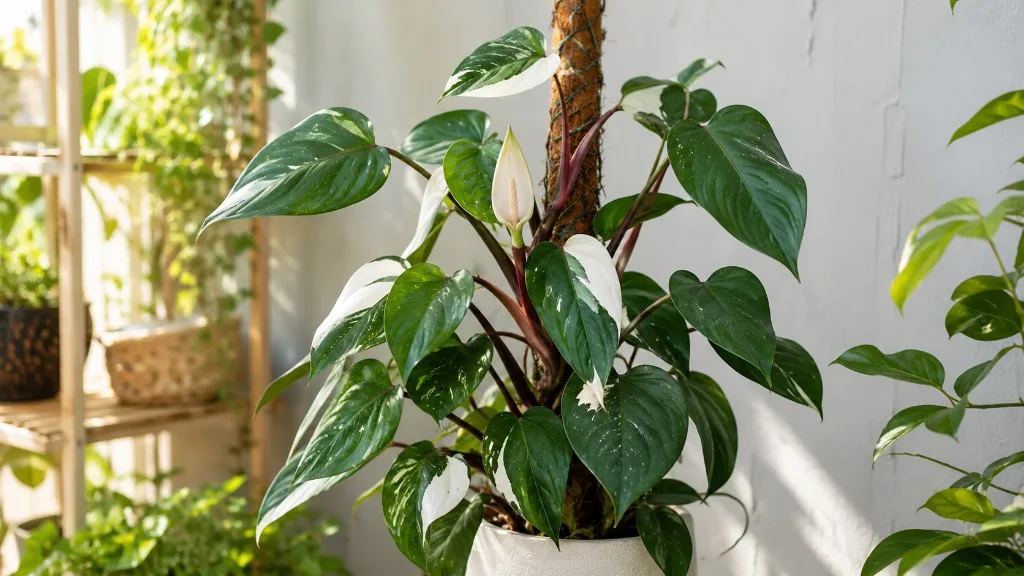
Philodendron White Knight fertilizer is not a generic philodendron feeding problem with a name swap. Philodendron erubescens ‘White Knight’ is a collector cultivar with white patches on dark burgundy stems and chlorophyll-deficient white leaf tissue that grows slower than green erubescens climbers because heavily variegated leaves produce less photosynthetic energy. Feed too aggressively - especially with nitrogen-heavy formulas - and you risk green reversion on new leaves, salt burn on fragile white sectors, and all-white leaves that cannot sustain the next growth point. Feed too little in bright, active growth and the plant stalls while you blame watering or light instead.
The workable goal is conservative, balanced nutrition during verified active growth - not maximum nitrogen for “fuller” foliage. SDSU Extension recommends a balanced fertilizer monthly for philodendrons during growth and reduced feeding in dormant winter months, but White Knight’s slow variegated rhythm often needs lighter cadence than the label implies for fast green climbers. This guide covers when to feed, what NPK to use, dilution math, seasonal tables, variegation-safe adjustments, flush recovery, and links across the White Knight care cluster.
If symptoms persist, see the Ants on Plant on Philodendron White Knight guide.
Why Fertilizer Matters for Variegated White Knight
Container-grown philodendrons cannot mine fresh nutrients indefinitely. UF/IFAS notes that plants in potting media must receive supplemental nutrients in liquid or granular form because substrates release water and minerals more freely than garden soil. Iowa State Extension advises light fertilization once or twice monthly during spring and summer active growth with a balanced all-purpose fertilizer.
For White Knight, fertilizer supports new leaf and root development when light and watering are already in range - it does not fix dim placement, soggy soil, or a stressed node on a fresh cutting. Because white sectors photosynthesize little, the green tissue on each leaf carries the energy budget. That makes White Knight more sensitive to salt buildup in small pots than a fast-growing green heartleaf philodendron in the same container size: fewer new leaves per month means less frequent nutrient uptake but the same salt input if you feed on a generic monthly autopilot.
Clemson HGIC also notes that at least 200 foot-candles for 12 hours daily is necessary before foliage plants show much benefit from fertilization - another reason to fix light before chasing nutrients.
White Knight Biology and Slow Growth
White Knight is a single cultivar of Philodendron erubescens - not a separate species. NC State describes erubescens as a climbing tropical aroid from Colombia that typically reaches about 3 ft tall indoors on a moss pole or trellis, with glossy heart-shaped leaves and purplish-red petioles. White Knight adds chimeral white variegation on stems and blades: patches of cells lack functional chloroplasts, so they contribute beauty but minimal photosynthetic output.
That biology drives three feeding consequences collectors care about:
Slower growth cadence. Heavily variegated White Knights push fewer leaves per season than green ‘Red Emerald’ or ‘Green Emerald’ types on the same parent species. A 6–8 week feeding interval is often safer than strict monthly feeding in a 10–15 cm pot with slow dry-down.
Green reversion under competitive pressure. UConn Extension explains that solid green shoots photosynthesize more efficiently and can overtake weaker variegated tissue if not corrected. Low light is the primary indoor trigger, but excess nitrogen also fuels vigorous green cell lines - peer-reviewed chimera work on variegated hosta shows whole-leaf greening after excess nitrogen fertilization. On White Knight, watch new leaves opening with less white banding after you increase feeding or switch to a high-N product.
All-white leaves are unsustainable. Leaves that are mostly or entirely white cannot support long-term growth alone. Conservative feeding avoids pushing the plant toward energy-deficient white foliage that aborts or browns at the next stress event. The best long-term specimen is not the whitest - it is the one that keeps producing balanced new growth season after season, matching LeafyPixels grower notes on this cultivar.
Quick-Reference Feeding Card
| Situation | What to do |
|---|---|
| Active growth (new leaves opening, bright indirect light) | Balanced liquid 10-10-10 or 20-20-20 at half label strength; every 4–6 weeks (monthly max) for established plants; every 6–8 weeks for slow growers in small pots |
| Moist-soil rule | Water with plain water first if top mix is dry; never feed dry roots |
| Monthly maintenance | One plain-water flush through drainage holes to limit salt buildup |
| Fall taper | Skip last 1–2 feeds as growth slows; pause by late autumn |
| Winter | No fertilizer unless grow lights sustain obvious active growth |
| After repot / propagation / stress | Withhold 4+ weeks (UF/IFAS recommends ~4 weeks after interior placement) |
| Salt crust or brown tips | Stop feeding; flush; wait 4–6 weeks before resuming |
| Variegation priority | Balanced NPK - avoid high-nitrogen “leaf boost” formulas |
When to Fertilize
Philodendron White Knight needs nutrients only during active growth when roots and leaves are visibly working - not on a calendar divorced from the plant’s state. SDSU Extension advises monthly balanced fertilizer during growth and reduced feeding in dormant winter months. Iowa State aligns with spring and summer as the primary window.
Spring and Summer Window
From early spring through late summer - when day length increases, temperatures stay in White Knight’s comfort band (roughly 18–29 °C / 65–85 °F per NC State cultural range), and new spears or leaves open regularly - feed at half strength on the schedule in the feeding card. Reconcile monthly vs. 6–8 weeks explicitly: use monthly for an established climber in a 15–20 cm pot with steady leaf output; stretch to every 6–8 weeks for a slow variegated plant in a 10–12 cm pot that produces one leaf at a time.
Worked example - 15 cm pot, active summer growth: Week 0: thorough plain-water soak. Week 1: top 3–5 cm dry; apply ½ tsp balanced 10-10-10 per gallon (half label) over moist mix. Week 4: plain-water flush equal to pot volume. Week 8: repeat half-strength feed if new growth continues. Week 10: notice white salt rim on clay pot → skip feed, flush twice over 48 hours, pause 4 weeks.
Fall Taper and Winter Pause
As growth slows in late summer and autumn, drop from monthly to every 6–8 weeks, then stop entirely by late autumn unless you run grow lights 10–12 hours daily and still see active leaves. Clemson HGIC states that during short winter days, many indoor plants enter a resting stage and should not receive fertilizer. Resume in early spring when new growth is obvious, not merely when the calendar flips - ramp back over 2–3 weeks at half strength rather than doubling the first dose.
Best Fertilizer Type and NPK
Balanced Formulas and Variegation Caution
Use a balanced water-soluble fertilizer - 10-10-10 or 20-20-20 - where nitrogen, phosphorus, and potassium are roughly equal. Clemson HGIC recommends balanced fertilizers such as 20-20-20 for foliage plants and notes that water-soluble forms diluted reduce burn risk compared with full-strength applications.
Do not reach for high-nitrogen “lush foliage” formulas on White Knight. Nitrogen drives chlorophyll and vegetative cell division - useful on solid-green production crops, but on a white-variegated chimera it can shift new leaves toward green and outcompete white sectors, especially combined with already-strong light. Balanced feeding supports roots and overall vigor without signaling the plant to maximize green tissue area.
Avoid slow-release pellets in small pots - release is uneven and hard to reverse if salts climb. Skip foliar feeding on White Knight; fragile white tissue stains and burns when fertilizer dries on the leaf surface, and philodendrons are not designed for leaf nutrient uptake the way some epiphytes are. Avoid fertilizer–pesticide combo products unless a label explicitly targets your pest and species.
Dilution Math and Feeding Frequency
Always dilute to half the label strength for indoor philodendrons unless the product is formulated specifically for houseplants at ready-to-use concentration. Iowa State describes light, frequent-balanced feeding rather than heavy doses.
Teaspoon-per-gallon example: If the label reads 1 teaspoon per gallon of 10-10-10 for outdoor containers, mix ½ teaspoon per gallon for White Knight. For a 6-inch (15 cm) pot holding roughly 3–4 cups of mix, you need about 1 cup (¼ quart) of solution - scale proportionally: ⅛ teaspoon fertilizer in 1 cup water, stirred well. Pour slowly until a little exits the drainage hole; empty the saucer within 30 minutes.
| Pot size (approx.) | Solution volume | Half-strength 10-10-10 (1 tsp/gal label) |
|---|---|---|
| 10 cm / 4 in | ~½ cup | Pinch (~1/16 tsp) in ½ cup water |
| 15 cm / 6 in | ~1 cup | ⅛ tsp in 1 cup water |
| 20 cm / 8 in | ~2 cups | ¼ tsp in 2 cups water |
Open pot vs. cache pot: White Knight in a nursery pot inside a decorative cache leaches poorly if the inner pot sits in drained water. Salts re-wick into the mix and show as white crust on the rim - common on slow growers fed monthly on autopilot. Prefer lifting the inner pot to drain or bottom-watering without stagnant reservoir.
Step-by-Step Feeding Protocol
Pre-Feed Checks
Before every feed, run this order:
- Season and growth: Is a new leaf or spear active? If the plant is winter-resting or recently repotted, skip.
- Soil moisture: Is the top 3–5 cm approaching dryness but not parched? If bone dry, plain-water first - SDSU and standard houseplant practice agree that fertilizer on dry roots causes burn.
- Salt check: White crust on soil or pot? Brown tips on newest leaf? Skip feed; flush instead.
- Stress check: Soft node, yellowing lower leaves, or post-repot within four weeks? No fertilizer until stable.
When checks pass, apply diluted solution at the soil line, keeping liquid off white leaf patches. Follow with plain-water flush every 4–6 weeks as maintenance - Nebraska Extension recommends periodic leaching every 4–6 months at twice the pot’s water volume; monthly lighter flushes are a conservative houseplant adaptation for small containers.
Signs of Healthy Feeding
Well-fed White Knight growth looks proportionate, not forced. Expect firm new blades with repeatable white patterning on stems consistent with prior nodes, sturdy burgundy petioles, and no sudden shift to all-green leaves after a feed change. Soil surface stays free of thick salt crust; the pot does not smell sour. Growth speed remains steady for this cultivar - slower than green erubescens, but not stalled for months in adequate light.
Pale new leaves can mean under-feeding, but rule out light and water first - the same symptom appears when a variegated plant is too dim and produces more chlorophyll. Fix placement before doubling fertilizer.
Over-Fertilizing and Variegation Stress
Fertilizer toxicity from soluble salts shows as brown or dead leaf tips and margins, reduced growth, lower leaf drop, wilting despite moist soil, and white crust on the medium surface - especially in bottom-watered cache setups. On White Knight, fragile white tissue browns before green sectors, so tip burn may appear patchy on variegated leaves rather than uniform.
Variegation-specific stress signals after heavy feeding:
- New leaves emerge greener with less white stem banding (possible nitrogen-driven reversion - compare against pruning and light history)
- All-white leaves produced in succession, then spear stall or leaf abort (energy deficit - reduce feeding and avoid stacking stress)
- Brown crisping on white patches while green areas stay intact (often salt or dry-soil feed burn, not sun alone)
Flush Protocol After Over-Feeding
When salt damage is suspected, stop all feeding immediately.
- Scrape visible white crust from the soil surface - no more than ¼ inch depth per Nebraska Extension leaching guidance.
- Flush at the sink: run room-temperature water slowly through the pot until it runs free from drainage holes. Use roughly twice the pot’s volume in total water, in several pours, so soil is not washed away from the crown.
- Repeat a lighter flush 24–48 hours later if tips still progress.
- Pause fertilizer 4–6 weeks until new growth looks stable - badly burned white sectors will not green back; judge recovery on the next one to two leaves.
UF/IFAS interior philodendron guidance notes that when soluble salts exceed 2.0 dS/m, do not fertilize; leaching with water helps reduce leaf necrosis risk. Severe cases in tiny pots may need repot into fresh chunky aroid mix without added fertilizer.
Repotting and Propagation Withholding
Do not fertilize newly repotted, freshly rooted, or recently propagated White Knight plants. UF/IFAS EP150 advises not re-potting or fertilizing for about four weeks after plants move indoors because additional stress is unnecessary. Fresh cuttings in propagation medium lack the root mass to use or tolerate salts - wait until roots circle the pot and new growth hardens.
After repot, let the plant re-establish dry-down rhythm in its new mix before the first half-strength feed. If you changed pot size, soil, and fertilizer in the same fortnight, you will not know which variable caused spear rot or green reversion.
Small-pot rule: A 10 cm White Knight in lean, chunky mix fed monthly at half strength often accumulates salts faster than a 20 cm green philodendron on the same schedule - when in doubt, extend interval to 6–8 weeks rather than increase dose.
Light, Water, and Pruning Connections
Fertilizer is the last lever, not the first. Bright light increases nutrient demand slightly; dim light reduces it - feeding a dark-corner White Knight builds salts it cannot use. Watering rhythm must stay evenly moist between soaks; chronic wetness plus fertilizer accelerates root decline. Pruning back all-green reverted stems redirects energy to variegated nodes - fertilizer will not restore white on a genetically green shoot.
For the full care picture, start with the White Knight overview. If new leaves stay mostly green despite conservative feeding, increase filtered light before nitrogen.
Common Mistakes
Feeding every watering with weak constant dose - salts accumulate faster in small pots than the plant uses them; use scheduled half-strength feeds and plain water between.
Chasing “fuller” leaves with high nitrogen - risks green reversion and unsustainable all-white growth on chimera cultivars; stay balanced.
Fertilizing dry soil after a missed watering - causes root tip burn that shows first on white leaf margins.
Ignoring salt crust because leaves “still look okay” - crust precedes tip necrosis and root dieback; flush preventively.
Stacking repot + feed + light move on a collector cutting - the soft node fails before you diagnose which stress killed it.
Winter feeding on autopilot because the room is warm - without grow lights and active leaves, nutrients sit in mix and burn roots come spring.
Conclusion
Philodendron White Knight rewards patient, balanced feeding tied to real growth, not calendar habit. Use half-strength balanced liquid fertilizer during spring and summer, flush salts monthly, pause in winter, and withhold after repot or propagation for at least four weeks. Protect white variegation by avoiding high-nitrogen pushes, watching new leaf color after every change, and pairing feeds with adequate light, correct watering, and well-draining soil. When salt crust or green reversion appears, reduce feeding before you increase it - on this cultivar, less is almost always safer than more.
Reviewed by LeafyPixels Review Board (2026-06-15).
When to use this page vs other Philodendron White Knight guides
- Philodendron White Knight overview - Start here for whole-plant context before deep-diving this topic.
- Philodendron White Knight problems hub - Jump to symptom-specific fix guides when this care topic does not resolve the issue.