Leggy Growth on Philodendron White Knight: Causes, Checks &
Quick answer
Leggy growth on Philodendron White Knight is etiolation-stretch toward light that widens internodes and fades white variegation. First step: move to bright indirect light within a few feet of an east or filtered west window, acclimate over 7–10 days, and tie the vine to a moss pole before pruning.
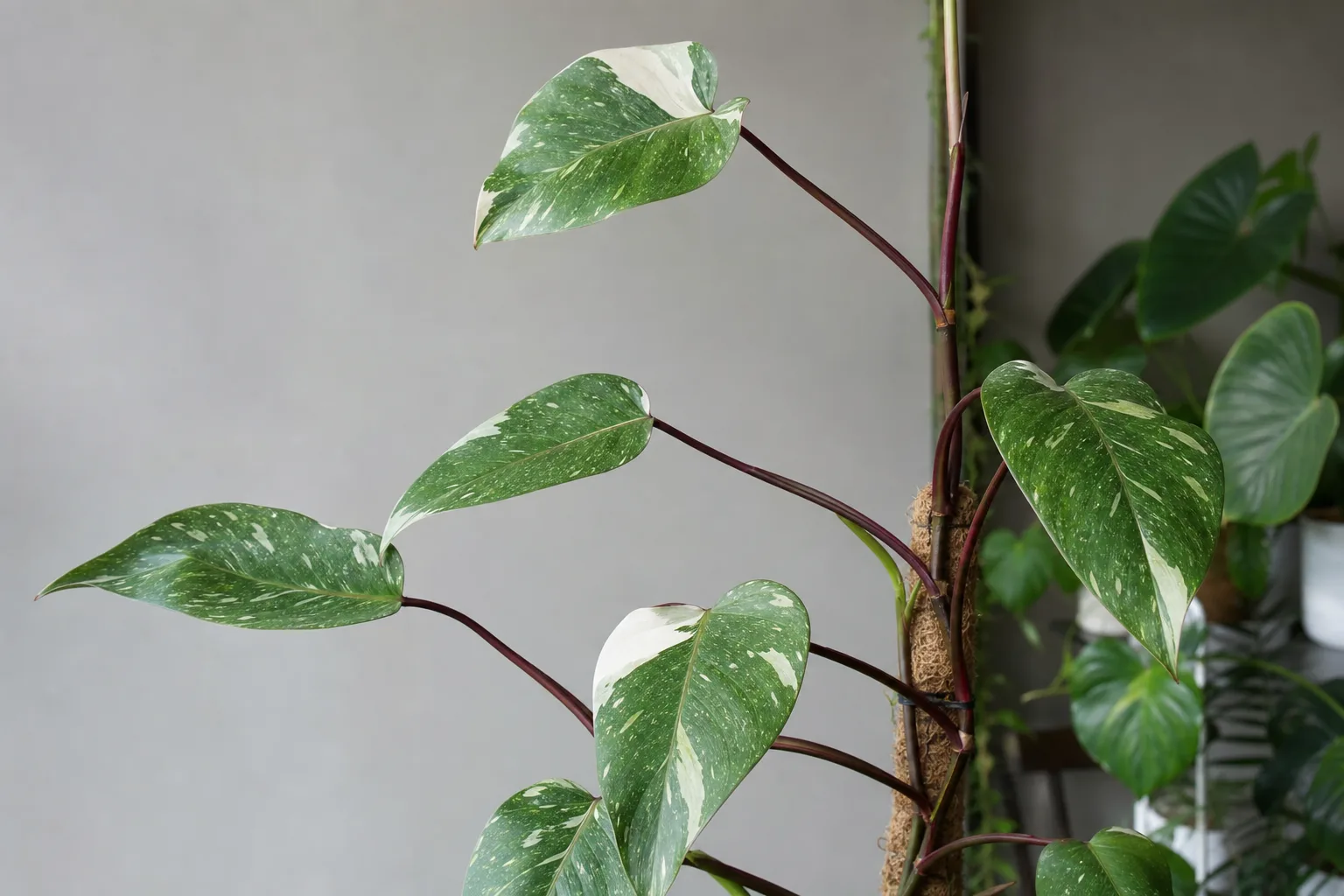
Leggy Growth on Philodendron White Knight: Causes, Checks & Fixes
This guide covers leggy growth on Philodendron White Knight. See also the general Leggy Growth guide, watering, and light pages for this plant.
Leggy Growth on Philodendron White Knight: Causes, Checks & Fixes
Quick answer
Leggy growth on Philodendron White Knight is etiolation-the vine stretching toward usable light at the cost of compact foliage and stable white variegation. On a burgundy-stemmed climber on a moss pole, that reads as long bare gaps between leaves, smaller mostly-green new spears, and stems leaning hard toward the brightest window. Insufficient light is the usual cause; over-fertilizing in shade and one-sided exposure make it worse.
First step: move the pot to bright indirect light where the top leaves receive several hours of indirect illumination daily, tie the vine to a moss pole or trellis, and acclimate over 7–10 days if it came from a dark corner. Do not jump straight to hot direct sun on white sections-they scorch easily. Do not repot or fertilize on day one.
White Knight is not a fast wall-covering vine even in good conditions; variegation slows energy production. Leggy stretch in dim rooms looks like growth but produces weak tissue that droops once leaves mature. Old stretched internodes never shorten-judge recovery by the next two or three leaves, not by old stem sections shrinking.
Page scope: This guide is the etiolation and internode-stretch deep dive for White Knight. For general low-light placement and variegation retention, see not enough light. For wiry fragile stems and wet-soil compounding, see thin stems. For uneven window lean without classic stretch, see plant leaning.
Leggy growth vs. not-enough-light vs. thin stems on White Knight
Three White Knight problem pages overlap because low light is often the root cause-but each URL answers a different keeper question:
| Your main worry | Best page | What you will find there |
|---|---|---|
| Long internodes, bare burgundy stem on the moss pole, etiolation recovery and pruning workflow | This page (leggy growth) | Stretch confirmation, acclimation, moss-pole support, prune-after-light sequence |
| Placement, variegation fade, grow-lamp specs, foot-candle bands | Not enough light | Canonical low-light diagnostic and window matrix |
| Wiry stems that bend under leaf weight, wet soil in dim corners | Thin stems | Stem girth, water-use slowdown, support failure |
| Whole vine tilts one way without long gaps yet | Plant leaning | Rotation and uneven exposure |
If symptoms span multiple columns, start with light at leaf level-then follow the column that matches your worst visible problem.
What leggy growth looks like on Philodendron White Knight
Healthy White Knight on a moss pole shows burgundy-purple stems, heart-shaped leaves with balanced green-and-white patterning, and alternating leaves spaced fairly close together along a supported climb. Leggy White Knight breaks that silhouette:
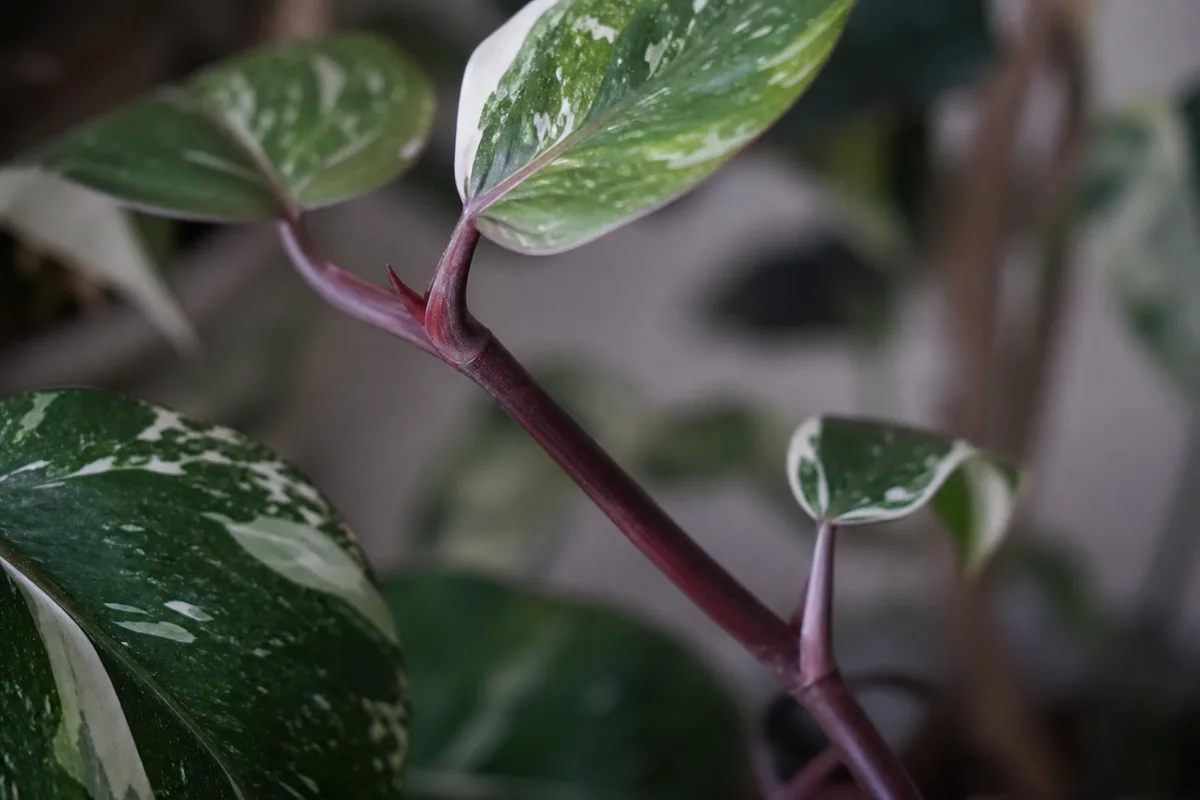
Leggy Growth symptoms on Philodendron White Knight - compare with healthy tissue on the same plant.
Long internodes and small new leaves
- Internodes noticeably longer than on earlier, compact growth on the same vine
- New leaves smaller or paler than mature ones lower on the pole
- Growth continues but looks sparse and weak despite watering correctly
Burgundy stem lean and bare moss-pole sections
- Stems arch or lean strongly toward the brightest spot
- Lower leaves drop, exposing long bare burgundy stem on the moss pole or trellis
- Aerial roots may reach for support while the vine flops sideways off the pole
White variegation fade on newest foliage
- New foliage mostly green with little white variegation compared to older leaves
- Each successive spear shows less white than the one before-a light-stress pattern, not random sport reversion
Leggy White Knight is often mistaken for healthy vigor because stems still elongate. Check leaf size and variegation on the newest leaf-that tells the truth. Compare against a solid-green philodendron in the same dim spot: if only White Knight stretches, variegation light demand is the difference.
Why Philodendron White Knight gets leggy growth
Insufficient light intensity
Philodendron erubescens is a natural climber that grows toward brighter canopy gaps. Indoors, far-from-window placement or north-only exposure without supplementation triggers long internodes and smaller leaves-a survival response called etiolation.
Variegation reversion in dim conditions
White leaf sections carry less chlorophyll than green tissue. In marginal light the plant prioritizes greener, larger-chlorophyll leaves and stretches toward the source. That is reversion coupled to stretch-not a separate disease. Many cycles of mostly-green growth may not fully reverse without selective pruning above nodes that still show white patterning.
Winter daylight drop
Short winter days worsen stretch even if summer placement was fine. The same window delivers fewer usable photons from late fall through early spring unless you move the plant closer or add supplemental lighting per our light guide.
Over-fertilizing in low light
Extra nitrogen without matching light pushes soft elongated stems because nutrients drive growth the light cannot support. Hold fertilizer until new compact leaves appear under better light.
One-sided exposure and crowding
One side stretches while the shaded side sheds leaves, leaving bare burgundy stem sections. Rotate weekly and supplement the weak side before assuming root failure.
Wet-soil compounding in dim corners
A dim White Knight uses water slowly, so mix stays wet longer. That does not cause etiolation directly but pairs stretch with yellow lower leaves and raises overwatering and root rot risk if you keep watering on a bright-room schedule. Fix light and dry-down together when soil stays heavy 10–14 days after watering.
How to confirm the cause
Work through these checks in order:
- Light meter or shadow test - At midday, hold your hand where the top leaves sit. A soft, defined shadow suggests moderate indirect light; a faint or absent shadow means too dim for variegated erubescens. Our light guide targets roughly 250–600 foot-candles at the top leaves for steady variegated growth.
- Newest leaf variegation - Compare the last three spears. If each new leaf is smaller and less white than the one before, light is the limiting factor.
- Internode spacing - Measure the gap between two recent leaves. Gaps noticeably longer than older sections on the same stem confirm ongoing stretch.
- Water and roots - Push your finger 3–5 cm into the mix. Firm roots and appropriate moisture rule out rot as the primary issue; legginess with wet soil is still usually light-first, but adjust watering when you brighten placement.
- Season - Winter stretch after a summer of compact growth points to daylight drop-supplement or move closer before pruning.
- Compare placement - If a green philodendron nearby is compact but White Knight stretches, variegation light demand is the difference.
- Support check - Note whether the vine has a moss pole. Trailing off a shelf without support often worsens sparse stretch even when light is fair.
If stretch, variegation loss, and slow dry-down cluster together, you have a confirmed light problem. Mushy bases in persistently wet soil need rot treatment first-not cosmetic pruning alone.
First fix for Philodendron White Knight
Move the plant to bright indirect light within a few feet of an east window or filtered west exposure, tie the vine to a moss pole or trellis, and acclimate over 7–10 days if it lived in a dark spot for months.
Good placement means several hours of indirect illumination on the top leaves-not just ambient room brightness. Avoid jumping straight to direct afternoon sun; white sections scorch easily. Wrap the stem loosely to a moist moss pole so aerial roots contact support; climbing on a moss pole or trellis encourages tighter growth than letting the vine flop sideways.
Do not fertilize heavily, repot, or prune heavily until new compact leaves appear under better light. Photons and support fix etiolation; fertilizer and pot size do not.
Step-by-step recovery
Relocate and acclimate (7–10 days)
Increase light gradually if the plant came from deep shade. Sudden harsh direct sun burns white patches. Each day, allow slightly brighter exposure or move a few inches closer to the window until the top leaves sit in bright filtered light.
Monitor new leaf variegation and internode length
Wait two to three weeks for a new leaf to unfurl. Check variegation and internode length against the leaf before it. Tighter spacing and restored white patterning mean the fix is working.
Prune to nodes with visible white variegation
Once the next one or two leaves prove tighter growth, cut leggy mostly-green sections just above a node that still shows white in the stem or petiole-see our pruning guide for node selection and clean shear technique. Philodendron is toxic to pets if chewed; wear gloves and wash hands after handling cut stems.
Resume light feeding after structure improves
After two weeks of improved leaves, feed lightly at half strength during active growth if the plant is otherwise healthy. Feeding a still-stressed White Knight in marginal light repeats the stretch cycle.
Adjust watering to match new light
Brighter exposure dries the pot faster. Check the top 3–5 cm of mix before each drink instead of following an old calendar from the dim corner-details in our watering guide.
Add supplemental light if windows are insufficient
In dark winter rooms, a full-spectrum grow lamp 30–45 cm above the top leaves for 10–12 hours daily on a timer can stabilize form when natural light is weak. Start moderate; raise the fixture if white sectors crisp under the bulb.
Recovery timeline
| Phase | What to expect |
|---|---|
| Days 1–10 | Acclimation-no instant visual change; avoid heavy prune or feed |
| Weeks 2–4 | Next one or two leaves should show tighter internodes and stronger white variegation if light is adequate |
| Months 2–3 | Vine silhouette looks fuller as compact new foliage replaces the stretched profile |
| Permanent | Old elongated internodes never shorten-prune bare sections once new growth proves the fix |
If four to six weeks pass with no improvement on new foliage, the spot is still too dim-move closer, verify grow-lamp intensity, or consult our light guide rather than reaching for fertilizer.
Worsening signs: continued stretch on every new leaf after four weeks in brighter light, yellowing lower leaves with persistently wet soil, or soft stem tissue at the soil line. Those point to overlapping water stress or advanced root issues-not light alone.
Lookalike symptoms
Not enough light without dramatic stretch yet - Fading white variegation and slow spears before long internodes dominate; same first fix, more placement detail on the not-enough-light page.
Thin stems - Wiry burgundy tissue that bends under leaf weight, often with soil that stays damp for weeks. Overlaps etiolation; read thin stems when girth and wet-soil compounding are the main worry.
Plant leaning - Uneven window exposure without long gaps yet; rotate and supplement the weak side per plant leaning.
Slow growth in winter - Short days can produce finer new tips; resume worrying if spring arrives and new growth stays spindly with adequate light.
Overwatering - Yellow lower leaves while soil stays wet. Low light and overwatering often appear together-fix light and dry-down together.
What not to do
- Do not assume fertilizer will fix stretch without adding light.
- Do not place immediately in hot direct sun to “force” variegation-acclimate or white tissue burns.
- Do not repot unless roots demand it-legginess is not a pot-size problem.
- Do not keep pruning repeatedly without fixing light; you will stall the plant and trigger more stretch.
- Do not mistake fast stem length for vigor-etiolation is weak tissue reaching for light.
- Do not water on the old schedule after a move to brighter light without checking soil moisture weekly.
Philodendron White Knight care cross-check
Leggy recovery sticks better when baseline culture supports new compact tissue:
| Factor | Leggy-growth check |
|---|---|
| Light | Top leaves in bright filtered band; shadow test at canopy height |
| Water | Top 3–5 cm dry before watering; faster dry-down after light increase |
| Mix | Chunky aroid mix-dense wet peat in dim corners worsens stall |
| Humidity | Moderate room humidity is fine; misting does not replace photons |
| Support | Moss pole or trellis with aerial roots contacting moist surface |
| Feed | Hold until two weeks of improved new leaves, then light half-strength feed |
See the White Knight overview for full culture context.
Prevention
Keep White Knight where bright filtered light reaches the leaves most of the day-not just where the pot photographs well. Supplement light in winter before stretch starts, rotate weekly on the moss pole, and prune early when internodes lengthen above a node with visible white variegation.
The best long-term plant is not the whitest one-it is the one that keeps growing with stable contrast without constant reversion cycles.
When to worry
Leggy growth is low to medium severity unless stems break, the plant stops leafing entirely, or mostly-green reversion has run for several cycles-restoring white variegation becomes harder though not always impossible with better light and selective pruning.
Escalate when yellow leaves stack up while soil stays wet, the base feels soft, or the vine snaps at a node onto cold glass-those combinations suggest rot or mechanical damage on top of light stress and may need root inspection before cosmetic fixes alone help.
Conclusion
Leggy growth on Philodendron White Knight means insufficient light driving etiolation and often variegation reversion on a climbing moss-pole vine. Confirm with long internodes, small new leaves, burgundy lean, and fading white on the newest spear; fix by moving to bright indirect light with 7–10 day acclimation, moss-pole support, and pruning to stronger variegated nodes only after new growth proves the correction. Old stretched stems stay long-compact new foliage is the recovery sign. For placement specs and lamp setup, see the light guide; for node cuts and reversion management, see the pruning guide.
When to use this page vs other Philodendron White Knight guides
- Philodendron White Knight watering guide - Use for routine moisture checks before assuming leggy growth is the main issue.
- Philodendron White Knight problems hub - Browse all 10 common issues on this species.
- Leaf Drop on Philodendron White Knight - Different entry point when symptoms overlap with leggy growth.
- Yellow Leaves on Philodendron White Knight - Different entry point when symptoms overlap with leggy growth.
- Plant Leaning on Philodendron White Knight - Different entry point when symptoms overlap with leggy growth.