Philodendron Selloum Care Guide: Thaumatophyllum
Thaumatophyllum bipinnatifidum
Philodendron Selloum needs bright to medium indirect light, watering every 7–10 days (top 5 cm dry), 50–60 % humidity, and a large pot. Toxic to pets. Plan for its eventual large size.
Philodendron Selloum Care Guide: Thaumatophyllum bipinnatifidum
Start with wateringThe most common care mistake for Philodendron SelloumWatering guide →Philodendron Selloum care essentials
Light
bright indirect light, medium indirect light
Water
Every 7–10 days in summer - allow top 5 cm to dry. Every 14–21 days in winter. Large leaf mass uses water quickly in warm conditions.
Soil
Chunky aroid mix: potting mix + 25 % perlite + 25 % orchid bark + 10 % worm castings. Large pots with multiple drainage holes.
Humidity
50–60%
Temperature
18–29°C (65–84°F)
Fertilizer
Feed lightly during active growth. Use monthly during spring and summer.
About Philodendron Selloum
Philodendron Selloum has a upright growth habit.
| Detail | Information |
|---|---|
| Growth habit | Upright |
| Scientific name | Thaumatophyllum bipinnatifidum |
Philodendron Selloum Care Guide: Thaumatophyllum bipinnatifidum
Walk into a nursery looking for a big tropical foliage plant and you will probably find something labeled Philodendron selloum, tree philodendron, split-leaf philodendron, or Philodendron Hope. The tag may or may not mention that the plant is no longer classified as a Philodendron at all. What you are buying is a self-heading shrub with massive deeply lobed leaves, a thick stem that develops with age, and a real appetite for space. This guide covers the current name, the care that matches how the plant actually grows indoors, and the mistakes that matter most on a plant this size.
By the end you should know whether Philodendron Selloum overview fits your home, how to place it for light and humidity, how to water a large root ball without rotting it, what soil and pot size make the routine forgiving, how to propagate it, why pets and toddlers need to stay away, and how to read yellow leaves and brown tips without guessing.
What Philodendron Selloum Actually Is
Philodendron selloum is the common name most people still use, but the currently accepted scientific name is Thaumatophyllum bipinnatifidum (Schott ex Endl.) Sakur., Calazans & Mayo, published in PhytoKeys in 2018 when DNA work moved several large non-climbing “tree philodendrons” out of Philodendron and into the resurrected genus Thaumatophyllum. Missouri Botanical Garden still lists the plant under Philodendron bipinnatifidum with Thaumatophyllum bipinnatifidum as a synonym, which reflects how slowly trade labels catch up. For care purposes, every name on the tag - selloum, bipinnatifidum, Hope, lacy tree philodendron, horsehead philodendron - points to the same species.
The plant is a broadleaf evergreen shrub in the Araceae family, native to tropical and subtropical South America. GRIN-Global and the Flora of the Southeastern United States both place its native range in southeastern Brazil, Paraguay, northeastern Argentina, and possibly Bolivia. In habitat it is not a vine. Missouri Botanical Garden describes Philodendron bipinnatifidum as a large, non-climbing, semi-woody shrub with huge glossy leaves rising on long petioles from a rosette-like crown. North Carolina Extension notes that outdoors in warm climates it can become decumbent with age, sending down aerial roots from the trunk while the crown keeps producing new leaves.
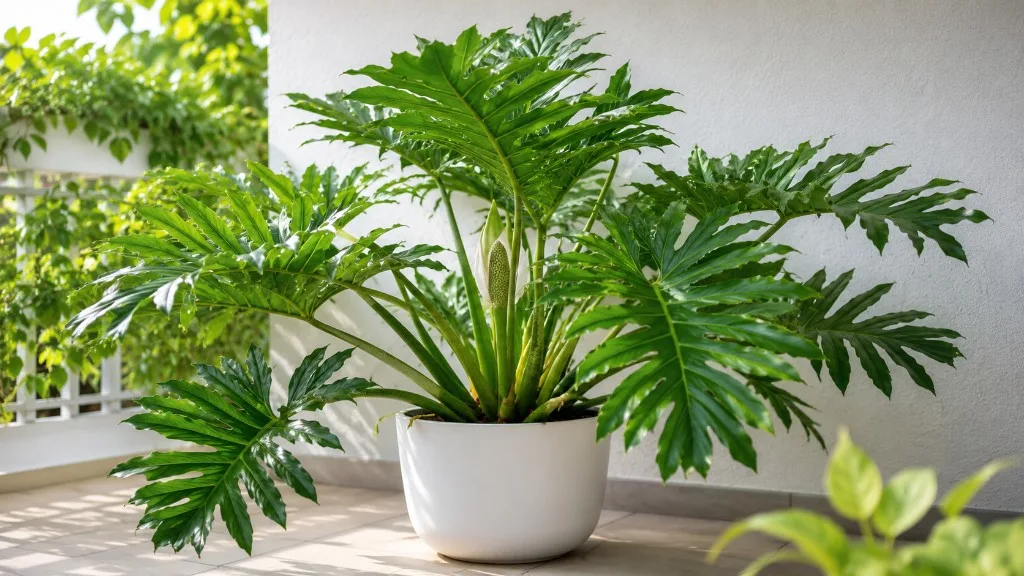
The leaves are the reason people buy it. They are deeply dissected (pinnatifid), glossy, dark green, and leathery, with wavy margins. Missouri Botanical Garden puts mature leaf length at up to 3 feet (about 1 meter) on long smooth petioles. The specific epithet bipinnatifidum refers to lobes that are themselves further divided on mature foliage - the “split” look that gets it confused with Monstera deliciosa, which is a different genus entirely. Tree philodendron leaves are deeply lobed but not perforated with fenestrations the way Monstera leaves are, and the plant does not climb by default.
Indoors, the plant rarely flowers. When it does in warm outdoor conditions, NC Extension describes tiny apetalous flowers on an upright spadix enclosed by a purplish spathe. Do not expect blooms on a living-room specimen; you are growing it for foliage architecture, not for an inflorescence.
One more identification note matters because it drives search confusion: “Split-leaf philodendron” is also used for Monstera deliciosa, which Missouri Botanical Garden explicitly says is not a philodendron despite the common name. If your plant climbs, develops holes and splits in solid leaf tissue, and wants a moss pole, it is probably Monstera. If it forms a trunk-like stem and produces large lobed leaves from a central crown without climbing, you are in the right guide.
Self-Heading Growth vs Climbing Philodendrons
Most houseplant philodendrons people know - heartleaf, Brasil, micans, burle marx - are climbers or scramblers that want support, produce longer internodes, and stay manageable in smaller pots when their vining growth is trimmed or wrapped. Thaumatophyllum bipinnatifidum is self-heading, which means it grows upward and outward from a central crown, building its own structure rather than attaching to a tree or moss pole.
That growth habit changes the care calculus in three practical ways. First, you do not need a moss pole unless you simply want to lift drooping petioles for aesthetics; the plant will not die without support the way a Monstera adansonii might sprawl and look leggy. Second, the root ball and leaf mass scale together, so a “small” selloum in a 10-inch pot still dries differently than a pothos in the same pot - the large leaves transpire more water in warm bright conditions, and the chunky stem stores less moisture than you might expect from the plant’s size. Third, the plant has a floor plan, literally. NC Extension lists available planting space outdoors at 6–24 feet, and even indoors a mature specimen commonly reaches 4–10 feet tall and 6–10 feet wide according to NC Extension and multiple cultivation references. You are not buying a tabletop plant that happens to have big leaves; you are buying a shrub that will eventually behave like furniture.
How the Trunk and Aerial Roots Form Over Time
Young nursery plants look like a rosette of huge leaves on short petioles. As the plant ages, the lower petioles fall away and the remaining stem thickens, giving the “tree philodendron” silhouette. NC Extension notes that in native habitats plants can develop a trunk-like stem to 6 inches in diameter and mature to 15 feet with aerial roots absorbing water and nutrients. Indoors you will see a scaled-down version: a stout stem, sometimes with adventitious aerial roots near the base or along the trunk if humidity is high.
Those aerial roots are normal, not a cry for help. You can guide them into the pot to supplement the root system or trim them for appearance if they become unruly, but cutting them does not harm a healthy plant when done cleanly. What you should not do is let aerial roots sit in a saucer of standing water for days - that invites rot at the stem base, especially if light is weak and airflow is poor.
Before You Buy: What to Check at the Nursery
A tree philodendron is an investment in space and pot weight. Before you buy, look past the dramatic leaves and inspect the basics. New growth should be firm and green, not pale and floppy. Leaf undersides and stem axils should be clean, without stippling, webbing, or cottony clusters that suggest spider mites or mealybugs. Soil should smell neutral, not sour or musty - a sour smell in the nursery pot is an early warning of chronic overwatering and compromised roots.
Pick the smallest plant that fits your patience. A 6-inch starter will grow quickly in good conditions, and you get years to learn its drying rhythm before Philodendron Selloum repotting guide into something you need a dolly to move. If you buy a large specimen for instant impact, ask whether it was recently shipped or repotted; both events add stress, and the first month should be boring care, not a full overhaul.
Be realistic about placement. NC Extension warns that tree philodendron may become too large for smaller homes. Measure ceiling height and the width of the spot you have in mind, including how far leaves will extend sideways. A plant that touches a cold window in winter or blocks an HVAC return will underperform no matter how perfect your watering is.
First Month After Bringing It Home
Do not repot on day one unless the mix is clearly failing - sour smell, roots black and mushy, or an active pest infestation you can see without disturbing the whole root ball. Instead, quarantine the plant for two to three weeks if you have other plants, set it in its long-term bright spot, and learn how fast the pot dries at roughly the same time each day. Water when the top layer is dry, not on the schedule the nursery used in a greenhouse.
Watch for transit stress: a yellow lower leaf on arrival is common and not automatically a crisis. A pattern of multiple yellow leaves, soft stems, or soil that stays wet for a week is a crisis, and the fix is light and root environment, not fertilizer. If problems appear, change one variable at a time - usually light or watering - rather than repotting, pruning, and feeding in the same weekend.
Light: Bright to Medium Indirect
Tree philodendron is an understory plant that wants bright to medium indirect light for most of the day. Missouri Botanical Garden recommends part shade outdoors and notes that full direct sun scorches leaves. NC Extension lists dappled sunlight and partial shade (2–6 hours of direct sun) as acceptable outdoor conditions. Indoors, translate that to a spot within a few feet of an east-facing window, or a north-facing window if you are in a bright climate, or several feet back from a south- or west-facing window filtered by a sheer curtain.
The plant tolerates lower light better than many tropicals, which is why it survives in offices and dim corners - but tolerance is not preference. NC Extension is explicit: low light and over-watering produce smaller leaves with fewer or no lobes. Leggy petioles, thin leaf tissue, and muted splitting mean the plant wants more brightness, not more fertilizer. Rotate the pot a quarter turn every week or two so the crown does not lean permanently toward the window.
Direct sun indoors shows up as bleached patches, brown scorched areas, or curled leaf margins, usually on the side facing the glass. Move the plant back, filter the window, or shift it to morning sun only. Acclimate gradually if you move it from a low-light shop corner to a bright room; sudden jumps in light stress leaves that formed under weaker conditions.
If natural light is limited, a full-spectrum LED grow light 12–18 inches above the crown for 10–12 hours daily will keep growth compact. Tree philodendron is not a low-light specialty plant like a ZZ, but it is less fussy than a Calathea - a useful middle ground for large-room displays.
Watering: Let the Top Layer Dry, Then Soak
Watering a large aroid is less about the calendar and more about how fast that specific pot dries in your home. The practical rule: let the top 5 cm (about 2 inches) of mix dry, then water thoroughly until a small amount runs from the drainage holes, and empty the saucer within 30 minutes so the bottom of the root ball is never sitting in runoff. In many homes that works out to roughly every 7–10 days in warm active growth and every 14–21 days in cooler, slower months, but the finger test overrides any schedule.
Missouri Botanical Garden describes the species as needing consistent and regular moisture and being intolerant of drought, which sounds like “keep it wet” until you read the same sources warning about root rot in overly moist soils. The reconciliation is simple: moist root zone, aerated mix, dry surface between waterings. The plant hates bone-dry shock - a fully desiccated root ball on a large leaf mass produces widespread droop and crisping - but it hates stale anaerobic soil more.
Use room-temperature water. NC Extension notes the plant does not tolerate salt buildup and recommends flushing soil regularly, allowing rain to rinse outdoor plants, or using distilled water where tap water is hard. Salt and fluoride damage show up as brown leaf tips and margins on otherwise healthy tissue; if you see that pattern on multiple leaves, flush the pot with plain water until runoff is clear and consider filtered or rainwater for a few months.
Reading Soil Moisture on a Large Root Ball
Large pots lie to beginners. The surface can look dry while the center stays damp, or feel dry while the bottom is waterlogged. Use a finger to the second knuckle, a bamboo chopstick left in the mix for ten minutes, or a moisture meter near the root ball - not only at the edge. Lift the pot when you can; a freshly watered container is noticeably heavier than one ready for water.
In winter, stretch intervals. Growth slows, transpiration drops, and the same volume of mix holds water longer. A tree philodendron pushed with summer-frequency watering in a dim December room is a common path to yellow leaves and soft stems. Resume your shorter interval only when new growth is clearly active and the pot is drying at the old rate.
Humidity and Temperature Indoors
Native rainforest understory conditions are moderate to high humidity, and tree philodendron looks best around 50–60% relative humidity. It tolerates typical heated-home levels in the 40% range better than many finicky aroids, but long stretches below 30% invite brown leaf edges and spider mites, especially in winter.
Raise humidity with a humidifier nearby, a pebble tray under the pot (pot above the water line), or grouping plants to share transpiration. Misting is optional and brief; it does not replace ambient humidity and wet foliage in stagnant corners can encourage fungal spotting. Airflow matters - NC Extension and practical indoor experience both point to stagnant damp conditions as a setup for leaf problems. A ceiling fan on low or occasional open-window ventilation in mild weather helps.
Temperature comfort aligns with normal indoor living: roughly 65–84°F (18–29°C) during the day. Missouri Botanical Garden recommends indoor winter temperatures above 60°F and summer daytime temperatures above 70°F for container plants. NC Extension suggests moving outdoor pots inside when temperatures drop below 60°F. Avoid cold drafts from single-pane windows, hot air blasting from heating vents, and sudden moves between rooms with very different conditions. Sustained exposure below 50°F (10°C) stalls growth and damages foliage.
Soil and Pot Choice for a Large Aroid
Tree philodendron wants moist, fertile, well-drained soil high in organic matter - Missouri Botanical Garden’s outdoor description applies indoors too, with extra emphasis on drainage. A chunky aroid mix keeps oxygen around roots in a large container: potting mix plus about 25% perlite, 25% orchid bark, and 10% worm castings is a solid starting recipe. The bark and perlite prevent the center of a big root ball from staying soggy; the castings add gentle organic matter without turning the pot into a peat brick.
Avoid straight peat-heavy bagged mix in a 12-inch pot unless you amend it heavily. Compacted mix is the silent killer on large philodendrons: the top looks fine, the bottom stays wet, and the first symptom is mysterious yellowing while you swear you “only water once a week.”
Drainage holes are non-negotiable. For a heavy plant, choose a sturdy plastic or fiberglass pot with multiple holes, or terracotta if you tend to overwater and can handle the extra dry-out speed. Decorative cachepots are fine if the inner pot lifts out for watering. Go up one pot size at a time on repot - an oversized new home holds water the root system cannot use and is the most common post-repot rot scenario.
Soil pH is generally acidic to neutral; most amended indoor mixes land near 6.0–7.0 without adjustment. pH only becomes a troubleshooting variable after you have ruled out watering and light.
Fertilizer Schedule and Strength
Tree philodendron is not a heavy feeder, but active plants in bright light benefit from modest nutrition during spring and summer. A balanced liquid fertilizer at half strength, applied monthly to already-moist soil, matches Missouri Botanical Garden’s “medium water” maintenance level and typical aroid practice. Slow-release granules incorporated lightly at repotting are an alternative if you prefer fewer applications.
Never fertilize a dry, stressed, or newly repotted plant. Salts on dry roots burn fine root hairs; unused fertilizer in a dormant plant accumulates and shows up as crispy leaf margins and white crust on the mix surface. Pause feeding in late fall and winter unless you are running grow lights and seeing continuous new leaves. If salt buildup is suspected, flush the pot with plain water before the next feeding cycle.
Yellow leaves from genuine nitrogen deficiency are uncommon in fresh mix but possible in a plant that has lived in the same depleted substrate for years without repot or feed. Confirm deficiency only after checking moisture and light; fertilizer is support, not a substitute for roots that can breathe.
Repotting a Plant That Outgrows the Room
Plan to repot every 1–2 years while the plant is actively growing, or when watering becomes unpredictable - either the pot dries in a day or stays wet for two weeks when it never used to. The best timing is early spring as new growth starts, giving a full season to recover. Late fall repots in a dim room are harder on the plant.
Repotting a large selloum is a two-person job in many homes. Water the day before, tip the pot on its side, and slide the root ball out without yanking the stem. Loosen only the outer 10–20% of roots if they are circling; cut black mushy roots with clean pruners. Set the plant at the same depth in fresh chunky mix, firm lightly, water once, and then water sparingly for the first week while cut surfaces callus.
Signs the Root Ball Needs More Space
Watch for roots circling the surface or exiting drainage holes, water running straight through without soaking in, soil that decomposes and smells earthy-sour, or top-heavy plants that tip easily. Any one of these is enough reason to repot even if the calendar says otherwise. If the plant is already at the maximum size you can house, you can refresh the top third of mix and root-prune lightly instead of moving to a larger diameter - advanced, but viable for experienced growers who accept slower growth.
Propagation by Division and Stem Cuttings
Home propagation works best on healthy, stable plants. The two reliable methods are division at repotting and stem cuttings with nodes.
Division is the easiest when the plant has multiple crowns or basal offsets in one pot - common on larger nursery specimens. During repot, identify natural separations where each section has its own stems and roots, cut between them with a sterile knife, and pot each division separately. Keep humidity steady and light bright but indirect until new growth resumes.
Stem cuttings work when you have a section of trunk with visible nodes and preferably aerial roots. Cut below a node with clean shears, let the cut callus for a few hours, then root in moist chunky aroid mix or water changed weekly. A node is mandatory; a leaf alone without node tissue will not produce a new plant. Bottom heat around 75°F (24°C) speeds rooting but is optional.
Do not propagate from a plant fighting root rot, mites, or chronic yellowing unless you are explicitly trying to salvage clean tissue. Cuttings inherit the parent’s problems and fail at higher rates when the parent is weak.
Toxicity to Pets and People
Tree philodendron is toxic to cats, dogs, and horses per the ASPCA, which lists Philodendron selloum under both “Lacy Tree Philodendron” and “Tree Philodendron” entries. The toxic principle is insoluble calcium oxalate crystals - microscopic needle-like raphides that penetrate oral tissues when chewed. Pet Poison Helpline notes the same mechanism for tree philodendron and related Araceae.
Clinical signs in pets include oral irritation, pain and swelling of mouth, tongue, and lips, excessive drooling, vomiting (not in horses per ASPCA), and difficulty swallowing. Most cases are painful but self-limiting, but very rarely swelling can affect the upper airway and make breathing difficult. Human exposure from sap during pruning can cause skin irritation; ingestion causes oral and GI irritation.
This is not a plant for floor pots in pet households, low shelves with toddlers, or anywhere curious animals browse foliage. Treat it as a display plant out of reach.
What to Do If a Pet Chews the Plant
Remove any remaining plant material from the mouth if you can do so safely, rinse the mouth with water, and call your veterinarian or the ASPCA Animal Poison Control at (888) 426-4435 (a consultation fee may apply). Do not induce vomiting unless a veterinary professional specifically instructs you to. Watch for persistent drooling, refusal to eat, swelling, or breathing difficulty and treat those as urgent. For skin contact, wash the area with soap and water.
Common Problems and Practical Fixes
Most selloum problems are environmental. The diagnostic order that saves time on a big plant: check soil moisture and root health, then light, then pests, then water quality and salt buildup.
Yellow leaves. A single yellow lower leaf is often normal senescence - old leaves retire as the trunk builds. Widespread yellowing with wet mix and soft stems is overwatering and probable root rot; unpot, trim mushy roots, repot in fresh airy mix, and adjust light so the pot dries predictably. Yellowing with dry mix and limp petioles is underwatering or root loss from past overwatering. Uniform pale yellow on new growth in good light may mean nutrition issues after years without repot. Stippled yellow with webbing is spider mites.
Brown tips and edges. Usually low humidity, salt or fluoride buildup, or inconsistent watering. Flush the pot, adjust humidity toward 50%+, and keep the drying rhythm stable. Trim brown tips for cosmetics only after conditions improve.
Root rot. Smells sour, roots black and mushy, plant wilts in wet soil. Unpot immediately, cut away rotten tissue, repot in fresh mix, withhold water briefly, then resume cautious watering in brighter indirect light. Severe rot on a large old plant may not be salvageable; prevention is easier.
Spider mites. Dry winter air is the trigger. Look for fine webbing, stippling, and dusty-looking leaf surfaces. Shower the foliage to dislodge mites, raise humidity, and treat with insecticidal soap or horticultural oil per label, testing a small area first because large tender leaves can be sensitive.
Mealybugs and scale. Cottony clusters in leaf axils or hard bumps on petioles and stems. Manual removal with 70% isopropyl alcohol on a swab plus repeated soap treatments works if you catch them early. Quarantine during treatment.
Small leaves with weak lobes. Almost always too little light and sometimes chronic overwatering in that low light. Fix placement first; do not chase leaf size with fertilizer.
Size, Pruning, and Living With a Statement Plant
Outdoors in frost-free climates (USDA zones 9–11 per NC Extension and Missouri Botanical Garden), tree philodendron can reach 10–15 feet tall and wide. Indoors, expect a large shrub, commonly cited at 4–10 feet in both height and spread depending on pot size, light, and age. Leaves on a well-grown indoor plant can still exceed 2–3 feet in length - measure your space honestly.
Pruning is mostly aesthetic and size control. Cut unwanted petioles at the base of the stem with clean sharp tools; wear gloves because sap can irritate skin. Removing a few of the oldest leaves opens light to the crown and is normal maintenance. Avoid stripping the plant bare in one session; take no more than 20–30% of foliage at a time so photosynthesis can recover.
Dust large leaves monthly with a damp cloth - NC Extension and Missouri Botanical Garden both imply glossy foliage stays healthier when clean. Dust blocks light on a plant already pushed for photons in indoor conditions.
If the plant outgrows the room, options are propagate and downsize, donate to a bright office or atrium, or move outdoors for frost-free summers while keeping a plan for cool nights below 60°F. What does not work is pretending a 6-foot shrub will stay cute in a corner with no light - it will slowly decline until watering feels impossible.
Conclusion
Philodendron selloum - Thaumatophyllum bipinnatifidum in current taxonomy - is one of the most dramatic foliage plants you can grow indoors if you respect what it is: a self-heading tropical shrub, not a vining philodendron and not a Monstera. Give it bright to medium indirect light, water when the top 5 cm of mix dries, keep humidity near 50–60%, plant it in chunky well-drained aroid mix, feed lightly in the active season, and plan for real size before you buy.
The routine is straightforward once the pot dries on a predictable rhythm. The hard parts are space, weight, and pet safety - calcium oxalate crystals make this a poor choice where dogs, cats, or toddlers can reach the leaves. If you can place it out of reach, give it room to grow, and resist the urge to overwater in low light, a tree philodendron becomes a long-lived architectural centerpiece. If your home is small, pet-filled, or dim, a smaller philodendron or a pet-safe alternative is the more honest fit.
When to use this page vs other Philodendron Selloum guides
- Philodendron Selloum overview - Canonical hub for this species - care topics and problems branch from here.
- Philodendron Selloum problems - Symptom-first path when you already know something is wrong.
Related Philodendron Selloum guides
- Philodendron Selloum watering
- Philodendron Selloum light
- Philodendron Selloum soil
- Philodendron Selloum propagation
- Philodendron Selloum fertilizer
- Philodendron Selloum repotting
- Philodendron Selloum pruning
- Brown Tips on Philodendron Selloum
- Root Rot on Philodendron Selloum
- Spider Mites on Philodendron Selloum
- Yellow Leaves on Philodendron Selloum
- Philodendron Selloum problems
How to care for Philodendron Selloum?
How much light does Philodendron Selloum need?
bright indirect light, medium indirect light
- bright indirect light, medium indirect light - bright indirect light, medium indirect light.
When should you water Philodendron Selloum?
Every 7–10 days in summer - allow top 5 cm to dry. Every 14–21 days in winter. Large leaf mass uses water quickly in warm conditions.
- Check top 2 inches - Every 7–10 days in summer - allow top 5 cm to dry.
- Drain excess water - Large leaf mass uses water quickly in warm conditions.
What soil works best for Philodendron Selloum?
Chunky aroid mix: potting mix + 25 % perlite + 25 % orchid bark + 10 % worm castings. Large pots with multiple drainage holes.
- Well-draining mix - Large pots with multiple drainage holes.
Grower notes for Philodendron Selloum
What matters most with Philodendron Selloum
Philodendron Selloum is easiest to understand by its growth habit. Climbers need support for larger leaves, self-heading types need stable root moisture, and delicate velvet forms punish stale air faster than basic green philodendrons. In practice, the care checkpoint is simple: bright indirect light, medium indirect light. Pair that with chunky aroid mix: potting mix + 25 % perlite + 25 % orchid bark + 10 % worm castings. Large pots with multiple drainage holes, and avoid changing water, pot size, and placement all at once.
Best placement in a real home
Philodendron Selloum belongs where bright indirect light, medium indirect light is realistic for most of the day, not only where the pot looks good. Every 7–10 days in summer - allow top 5 cm to dry. Every 14–21 days in winter. Large leaf mass uses water quickly in warm conditions. If the pot stays wet longer than expected, move the plant into better light or reassess the mix before watering again. Humidity target: 50–60%. Temperature comfort zone: 18–29°C (65–84°F).
Before you buy this plant
Choose Philodendron Selloum with firm new growth, clean leaf undersides, and soil that does not smell sour or feel compacted. Be cautious if you see yellow-leaves, sticky residue, collapsed crowns, or a pot that is wet in poor light. Cosmetic old-leaf damage is less worrying than weak roots or active pests.
First month after bringing it home
Do not repot Philodendron Selloum on day one unless the mix is failing or pests are obvious. Quarantine it, learn how fast the pot dries, and keep care boring while it adjusts. Watch especially for yellow-leaves, brown-tips, and root-rot. If problems appear, correct the condition first rather than stacking fertilizer, repotting, and pruning together.
Safety note for Philodendron Selloum
Philodendron Selloum is not a plant to keep within reach of pets or children. Treat it as an inaccessible display plant. Use gloves if sap or plant tissue is irritating, and pick a pet-safe alternative for floor pots or low shelves.
How to tell Philodendron Selloum is settling in
If you plan to multiply it later, common methods include Division and Stem cuttings. If brown-tips shows up early, inspect light, watering, and roots before assuming the plant is permanently weak.
Is it pet safe?
Philodendron Selloum is toxic to cats and dogs.
Contains calcium oxalate crystals. All parts are toxic to pets and humans if ingested-causes oral and GI irritation.
Watering Philodendron Selloum
Every 7–10 days in summer - allow top 5 cm to dry. Every 14–21 days in winter. Large leaf mass uses water quickly in warm conditions.
Soil & potting for Philodendron Selloum
Chunky aroid mix: potting mix + 25 % perlite + 25 % orchid bark + 10 % worm castings. Large pots with multiple drainage holes.
Humidity & temperature for Philodendron Selloum
Philodendron Selloum prefers 50–60%, though normal home humidity is usually fine. Keep temperatures around 18–29°C (65–84°F).
| Detail | Information |
|---|---|
| Humidity | 50–60% - normal home humidity is fine. |
| Ideal temperature | 18–29°C (65–84°F) |
Fertilizer & pruning for Philodendron Selloum
Use feed lightly during active growth. Use monthly during spring and summer. for Philodendron Selloum.
| Detail | Information |
|---|---|
| Fertilizer type | Feed lightly during active growth. Use monthly during spring and summer. |
Common problems on Philodendron Selloum
Brown Tips
MediumLikely cause: Low humidity from dry indoor air
Quick fix: Increase humidity to 50%+; large leaf surface transpires heavily
Full fix guide →Root Rot
HighLikely cause: Dense soil or winter overwatering
Quick fix: Repot in chunky aroid mix; correct winter watering
Full fix guide →Spider Mites
MediumLikely cause: Dry indoor heating on large leaf surface
Quick fix: Rinse leaves; apply neem oil; increase humidity
Full fix guide →Yellow Leaves
MediumLikely cause: Overwatering in winter when growth slows
Quick fix: Reduce watering in winter; allow top 5 cm to dry
Full fix guide →