Philodendron Selloum Fertilizer: When, How & Mistakes
Philodendron Selloum Fertilizer: When, How & Mistakes
Philodendron Selloum Fertilizer: When, How & Mistakes
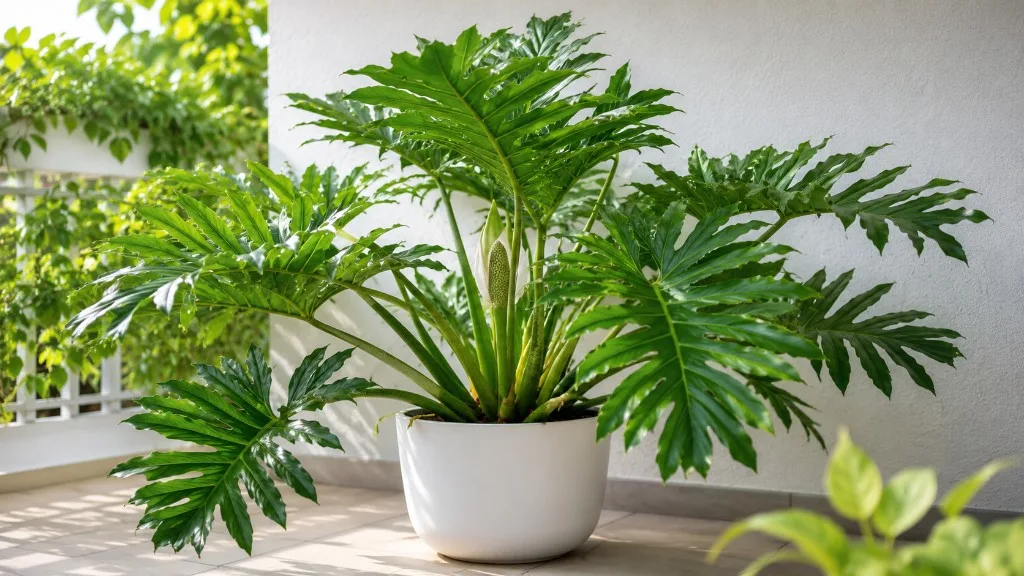
Philodendron Selloum fertilizer for a floor specimen is not the same problem as feeding a compact Birkin on a shelf. The plant most nurseries still label Philodendron selloum is Thaumatophyllum bipinnatifidum - a self-heading shrub that can reach 4 to 10 feet tall and 6 to 10 feet wide indoors, with individual leaves spanning 2 to 3 feet on mature crowns. That scale changes everything about feeding: a large lobed leaf surface photosynthesizes heavily in bright light, a heavy root mass in a 10- to 14-inch pot holds more salt between flushes, and fertilizer burn scars tissue you cannot replace quickly. The practical goal is conservative balanced liquid fertilizer at half the label strength, applied every four to six weeks from mid-spring through early fall while the crown is pushing new lobed leaves, with a monthly salt leach on large containers and a full winter pause unless strong grow lights keep the plant in active growth.
Feed too aggressively - full label strength, slow-release pellets in an undersized pot, or monthly doses through a dim winter - and selloum shows it on mature foliage: crisp brown margins on deeply lobed blades, a white or yellow salt crust across a wide soil surface, and stunted new leaves with shallow lobing that looks like a light problem but traces to a stressed root zone. Feed too little in bright filtered light and the crown may stay alive while new architecture degrades - smaller blades, longer petioles, pale interveinal yellowing. Fertilizer cannot fix dim placement or soggy mix, but once light and watering are in range, a steady half-strength schedule supports the leaf mass Philodendron Selloum overview is grown for.
This guide covers why large self-heading selloum draws more nutrients than trailing philodendrons, when to feed and when to pause, a month-by-month schedule with light-adjusted frequency bands, NPK and slow-release rules sized to floor pots, step-by-step application, burn versus deficiency on lobed leaves, repot and large-pot mistakes, salt-flush recovery, and how feeding couples to the rest of the Selloum care cluster. For shared philodendron mechanics across cultivars, see the genus fertilizer guide.
Why Selloum Needs Feeding - Large Self-Heading Shrub Biology
Selloum is a broadleaf evergreen self-heading shrub in its native South American habitats and behaves like a floor-scale foliage plant indoors - not a vining philodendron you can underfeed indefinitely in a small pot. Missouri Botanical Garden describes it as an upright, self-heading shrub that reclines with age and may send aerial roots from the trunk when given support. NC State notes mature indoor specimens commonly reach 4 to 10 feet tall and 6 to 10 feet wide, with deeply pinnatifid leaves whose lobes can extend halfway or more into the blade. That architecture means a single mature crown maintains a large photosynthetic surface area year-round, continuously building cellulose, chlorophyll, and root tissue when conditions support growth.
Crown Mass, Lobed Leaf Area, and Nutrient Draw
A selloum in bright filtered light - the band NC State lists as preferring high light with tolerance for lower levels - metabolizes faster than the same plant parked in a dim corner. More light drives more transpiration and more new leaf production at the crown, which pulls nitrogen for chlorophyll, potassium for water regulation, and trace elements for enzyme function. Iowa State Extension groups tree or split-leaf philodendron among non-climbing self-heading types that can get quite large and recommends fertilizing lightly once or twice a month during active spring and summer growth with a balanced all-purpose fertilizer (Iowa State Extension - growing philodendrons at home). “Lightly” is the operative word for a species that does not tolerate salt buildup in the root zone - a common failure mode on heavy floor pots where evaporation concentrates minerals across a wide soil surface.
Editorial observation (2025–2026): Two floor selloums fed on the same half-strength 10-10-10 schedule - one 5 feet from a filtered south window, one in a north-facing dining alcove - showed different outcomes after one growing season. The bright specimen pushed three full-sized lobed leaves with firm petioles and deep green tissue; the dim plant produced two smaller blades with shallower lobes and longer petioles despite identical fertilizer timing. The lesson is not “feed the dim plant more.” It is: match frequency to actual growth and light, and fix placement before increasing dose.
Thaumatophyllum bipinnatifidum Taxonomy Note
Search results and nursery tags still say Philodendron selloum or Philodendron bipinnatifidum, but the current accepted name is Thaumatophyllum bipinnatifidum. Care advice under any of those names applies to the same plant. Taxonomy does not change the feeding principle: large aroid shrub, moderate feeder, salt-sensitive roots, active-season liquid feeding.
When to Fertilize: Active Growth vs Winter Rest
Timing follows crown metabolism, not a wall calendar. Feed when selloum is actively unfurling new lobed leaves at the self-heading crown and pause when growth stalls - even if old foliage still looks impressive on a 6-foot specimen.
Nebraska Extension is explicit: do not fertilize dormant plants because unused nutrients accumulate as harmful salts (Nebraska Extension - houseplant fertilization). Active growth signals include new leaf spears emerging, aerial root tips lengthening on the trunk in warm months, and soil drying on your normal watering rhythm rather than staying cold and soggy for weeks.
Spring and Summer Feeding Window
Start feeding when you see fresh crown growth in mid-spring - usually March through April in temperate climates, earlier in consistently warm rooms. Continue every four to six weeks through early fall (roughly May through September) while new lobed leaves keep appearing. Fast-growing specimens in bright filtered light with warm roots often sit at the four-week end; established plants in moderate light or fresh chunky aroid mix with worm castings may need only six-week intervals.
Always apply to moist soil the day after a regular watering - never to dry roots on a plant this large, where fertilizer contact can burn fine root hairs before dilution spreads through the mix.
Fall Taper and Winter Pause
Taper in early fall as days shorten. Give a final half-strength feed in September if the crown still pushes leaves, then stop entirely from late fall through winter - roughly November through February for most indoor setups without strong supplemental light. Oregon State Extension links winter tip burn and weak spring growth to soluble salt accumulation and recommends periodic leaching every four to six months (Oregon State Extension - soluble salts).
Grow-light exception: If selloum sits under 12+ hours of strong full-spectrum LED daily and keeps producing new crown leaves through winter, you may feed once every eight to ten weeks at half strength - still conservative. If growth is flat, skip feed and flush salts instead.
Month-by-Month Feeding Schedule
Use this table as a framework, then adjust by crown output and light band (next section). All feeds assume half-strength balanced liquid on moist soil.
| Month (temperate climate) | Crown activity | Feeding guidance |
|---|---|---|
| January–February | Minimal new growth indoors | No fertilizer; optional salt leach if crust visible |
| March–April | Spring wake-up, first new lobes | Start half-strength liquid when new growth visible; every 6 weeks if slow |
| May–August | Peak foliage production | Every 4–6 weeks; bright-light plants on 4-week end |
| September | Slowing slightly | Every 6–8 weeks or one final light feed |
| October | Wind-down | Taper off; leach if feeding through summer |
| November–December | Low growth indoors | No fertilizer unless strong grow lights + active new leaves |
Pair the schedule with monthly plain-water leaching on floor pots 10 inches and larger - see step-by-step below. Nebraska Extension recommends leaching every four to six months as standard practice, using twice the pot’s water volume (Nebraska Extension - houseplant fertilization). On heavy selloum specimens fed all summer, a quarterly flush is safer than waiting for visible crust.
Best Fertilizer Type and NPK for Selloum
The best selloum fertilizer for most homes is a complete water-soluble houseplant formula with roughly equal nitrogen, phosphorus, and potassium plus micronutrients including iron and magnesium. Large lobed leaves need nitrogen for chlorophyll, modest phosphorus for root function, and potassium for stomatal regulation and stress tolerance. Pale new growth on an otherwise well-watered plant in good light sometimes traces to iron or magnesium deficiency rather than nitrogen hunger - another reason to use a complete blend, not a single-nutrient hack.
Balanced Liquid at Half Strength
A 10-10-10 or 20-20-20 water-soluble fertilizer diluted to half the label’s recommended strength is the default across extension guidance for philodendrons (Iowa State Extension - growing philodendrons at home). Illinois Extension notes that applying half of label strength on a regular schedule reduces burn risk on container plants (Illinois Extension - houseplant fertilization). Liquid formulas win for control - you know the dose applied to a 12-inch floor pot, you can skip a month without leftover pellets releasing in the mix, and you can stop immediately if salt crust appears.
Skip high-phosphorus bloom boosters (9-58-8 and similar). Selloum is grown for foliage, not flowers indoors; excess phosphorus does not deepen lobing and can add unnecessary salts.
Slow-Release Rules for Large Repots Only
Slow-release granules belong at repot time in large containers - not as a default in small pots. Mixed into fresh aroid soil during a spring repot into a pot 2 inches larger, a half-rate slow-release product can feed for several months without monthly liquids. In an undersized pot where roots already fill 80% of the volume, pellet release is unpredictable - hot rooms accelerate dump, uneven moisture creates hot spots, and salts concentrate where evaporation is highest. If you repotted a floor selloum this season with slow-release in the mix, skip liquid feed for six months unless new growth looks pale despite good light and watering.
Never combine full-rate slow-release plus monthly liquid on the same plant - the most common path to permanent tip burn on mature lobed leaves.
Step-by-Step: How to Feed Selloum Safely
- Check the crown first. Confirm new lobed growth is active and the plant is not drought-stressed, wilted, or within four weeks of a major repot (repotting guide).
- Water the day before. Moisten the full root ball with plain water so fertilizer disperses without root tip burn.
- Mix half strength. Measure liquid fertilizer at 50% of label dose into your watering can - for a 10-inch pot, scale to the volume that moistens the root zone without flooding the saucer repeatedly.
- Apply evenly. Pour slowly across the soil surface, not over the crown or leaf axils. Avoid foliar feeding on large glossy blades - runoff into the crown can cause tissue damage and adds little nutrition compared to root uptake.
- Let drain once. Discard saucer runoff so salts do not wick back.
- Log the date. Floor specimens blur together; a phone note prevents accidental double-feeding.
- Leach monthly on large pots. Once between fertilizer feeds, run plain water equal to twice the pot volume through the mix in the bathtub or patio, in repeated pours, to wash accumulated salts (Nebraska Extension - houseplant fertilization).
Adjust Frequency by Light Level
NC State lists tree philodendron as preferring high light - not optional brightness for best form. Fertilizer frequency should track that reality.
Bright Filtered Light (NC State High-Light Band)
Placement: Within 2 to 6 feet of east glass, or 4 to 6 feet back from filtered south or west windows - matching the light guide bands.
Feeding: Every four to five weeks from spring through early fall at half strength, plus monthly leach on pots 10 inches and up.
Success signal: New lobed leaves match recent crown size, petioles stay relatively short, deep green color without interveinal yellowing on the newest blade.
Dim Corner Survival Band
Placement: North rooms, interior corners far from windows, or blocked by furniture where the crown receives mostly ambient bounce light.
Feeding: Every six to eight weeks at half strength at most - or skip liquid feed entirely if new leaves show smaller blades with fewer lobes, the pattern NC State associates with low light combined with overwatering. Fertilizer cannot substitute for photons; it often worsens salt stress when the plant is already metabolically slow.
Rule: If new growth is pale or small, improve light first, then resume feeding at the wider interval.
Signs Feeding Is Working vs Burn or Deficiency
Healthy feeding response on selloum looks like this: deep green lobed new leaves at the crown, firm upright petioles, steady but not explosive size gain on blades relative to recent crown output, and a soil surface free of thick white crust. Old lower leaves naturally age and yellow individually - that is not deficiency if the crown stays strong.
Over-fertilizing shows sudden brown crisping at lobe tips, marginal burn spreading along lobes (not just one old leaf), white or yellow salt crust on 30% or more of the soil surface, leaf drop from the crown shortly after feeding, and weak spring growth after a winter of unnecessary doses. Cross-check brown tips and yellow leaves pages when symptoms overlap watering or light stress.
Under-fertilizing or nutrient imbalance can produce interveinal yellowing on new growth while veins stay green (possible iron/magnesium issue in exhausted mix), overall pale green new blades in bright light with correct watering, or slow crown output over months despite good placement. Rule out light and water before assuming hunger - but after two seasons in the same depleted soil, a conservative feed schedule helps.
Salt Burn on Large Lobed Leaves
On selloum, fertilizer burn often appears as crisp brown patches at lobe tips and sinuses on newly unfurled or recently mature blades - tissue that will not green back. Unlike small heartleaf philodendron leaves you can trim and forget, a burned 2-foot lobed leaf is a permanent eyesore until the plant eventually sheds it years later. That is why half strength, winter pause, and periodic leaching matter more on selloum than on compact tabletop aroids.
Oregon State Extension notes that as salt concentration rises, roots struggle to take up water even from moist soil, producing tip burn, wilting, and root dieback (Oregon State Extension - soluble salts). On a large selloum, the visual cue is often multiple lobes browning simultaneously after a heavy feed - not a single aged lower leaf.
Selloum-Specific Mistakes to Avoid
Feeding immediately after repotting a large floor plant. Fresh roots need four to six weeks to settle before fertilizer. Slow-release mixed at repot is enough; liquid feed on top causes crown drop on heavy specimens.
Slow-release pellets in a pot-bound 8-inch container. Pellets release into a root mat with little buffering soil - salts spike, crust forms, lobed tips burn. Repot first, or use liquid only at half strength.
Foliar feeding large glossy blades. Nutrient uptake is root-driven on selloum; foliar sprays leave residue, risk crown rot where liquid pools, and do not solve soil depletion in a 14-inch pot.
Monthly full-strength doses because the plant is big. Size increases water need, not fertilizer concentration. Scale frequency slightly in bright light, not dose.
Ignoring salt crust on a wide soil surface. A crust across a 12-inch pot means evaporation concentrated minerals - scrape the top quarter inch if crusty, then leach with twice pot volume plain water before the next feed.
Feeding through winter in a dim room because leaves are still green. Foliage persists; metabolism does not. Nebraska Extension warns dormant feeding causes harmful salt buildup (Nebraska Extension - houseplant fertilization).
Recovery After Over-Fertilizing
- Stop all fertilizer immediately - including slow-release if you can remove the top inch of pellet-heavy mix safely.
- Scrape visible salt crust from the soil surface (up to one-quarter inch).
- Leach thoroughly. In a tub or outdoors, pour plain water in repeated batches totaling twice the pot’s volume until runoff runs clear (Nebraska Extension - houseplant fertilization). For a 12-inch floor pot holding roughly 3 gallons of mix, plan 6 gallons total poured in stages - not one fast flood that channels through side gaps.
- Pause feeding four to six weeks - a home-climate heuristic, not a species-specific lab interval. Watch the next crown leaf for firm green tissue without new tip burn.
- Resume at half strength only after one clean new lobed leaf unfurls. Badly burned mature blades will not heal - prune only if fully dead and unsightly.
- Escalate if crown wilts despite moist soil after flush: inspect roots for rot, reduce watering, and consider repotting into fresh chunky mix before feeding again.
Recovery on a large root mass typically takes one to two new leaf cycles - often 8 to 16 weeks in bright light, longer in dim conditions. Patience beats a second corrective feed.
How Fertilizer Fits With Light, Water, and Soil
Fertilizer is the last layer, not the foundation. Selloum in bright filtered light with a chunky aroid mix that dries on a predictable watering rhythm uses nutrients efficiently - roots breathe, new lobed leaves build steadily, and salts flush on schedule. The same fertilizer dose in a dim corner with peat-heavy soggy mix accumulates salts because roots absorb slowly and evaporation concentrates minerals at the surface.
Water before feed is non-negotiable on large specimens. Repot on a separate calendar from feeding jumps - stacking stress events causes crown drop on self-heading shrubs. When basics are right, conservative feeding supports the statement foliage selloum is grown for; when basics are wrong, feeding accelerates decline.
Pet and Child Safety Note
Philodendron Selloum contains insoluble calcium oxalate crystals that irritate mouths and digestive tracts if chewed. Fertilizer does not make the plant safe - it adds chemical salts to soil children and pets should never access. Keep floor specimens out of reach, store liquid fertilizer locked away, and contact your veterinarian if ingestion occurs. For inaccessible display placement, see the overview safety notes.
Conclusion
Philodendron Selloum fertilizer success on a floor specimen comes down to half-strength balanced liquid every four to six weeks during active crown growth, monthly or quarterly salt leaching on large pots, and a winter pause unless grow lights keep new lobed leaves coming. Let the next unfurling crown leaf be your feed-readiness signal - firm green lobes with deep sinuses mean the schedule works; crisp tips and crust mean pull back, flush, and wait. Match frequency to light, never feed a stressed or freshly repotted plant, and treat slow-release as a large-repot-only tool. When in doubt, skip a month rather than double the dose - selloum keeps its massive foliage far longer than it forgives a salt-burned root zone.
When to use this page vs other Philodendron Selloum guides
- Philodendron Selloum overview - Start here for whole-plant context before deep-diving this topic.
- Philodendron Selloum problems hub - Jump to symptom-specific fix guides when this care topic does not resolve the issue.