Brown Tips on Philodendron Selloum: Causes, Checks & Fixes
Quick answer
Brown tips on Philodendron Selloum are usually caused by low humidity from dry indoor air-the large leaf surface transpires heavily and tips dry first. First step: raise humidity to 50% or higher with a humidifier near the plant and keep it away from heating vents.
Brown Tips on Philodendron Selloum: Causes, Checks & Fixes
This guide covers brown tips on Philodendron Selloum. See also the general Brown Tips guide, watering, and light pages for this plant.
Brown Tips on Philodendron Selloum: Causes, Checks & Fixes
Quick answer
Brown tips on Philodendron Selloum are usually caused by low humidity from dry indoor air-the large leaf surface transpires heavily and tips dry first. First step: raise humidity to 50% or higher with a humidifier near the plant and keep it away from heating vents.
Philodendron Selloum (Thaumatophyllum bipinnatifidum) is a self-heading tree philodendron with deeply dissected evergreen leaves up to three feet long. That huge leaf area moves a lot of water through transpiration. When indoor air is dry-common in winter heating or summer AC-the farthest point from the roots, the leaf tip, desiccates first. Iowa State Extension lists low humidity as the most likely cause of brown leaf tips on houseplants, and Selloum’s leaf mass makes it show that pattern faster than smaller philodendrons.
Why Philodendron Selloum gets brown tips
Dry indoor air is the primary trigger on Philodendron Selloum overview. Selloum evolved in tropical to subtropical South America where humidity stays high. Indoors, relative humidity often drops to 30–40% or lower when furnaces or air conditioners run. Clemson HGIC notes that philodendrons tolerate low household humidity but grow best with more moisture in the air-Selloum’s size pushes that gap into visible tip burn sooner than a heartleaf philodendron in the same room.
Large leaf surface area amplifies the problem. Each mature Selloum leaf is a broad transpiration panel on a long petiole. Water must travel from roots through thick stems and stalks to reach the farthest lobe tips. When the air pulls moisture from leaves faster than roots replace it, tips crisp before the rest of the leaf shows stress. SDSU Extension links browning leaf tips to humidity needs around 50% for philodendrons-matching the 50–60% target that suits this plant in home care.
Placement near vents, radiators, and drafty windows compounds dry air. A Selloum that looked fine in summer may develop tip burn within weeks of heating season because localized humidity near the foliage crashes even when a room average seems acceptable. Spider mites also thrive in dry indoor heating on large-leaf plants; confirm you are not treating pest stippling as simple tip burn.
What brown tips look like on Philodendron Selloum
Early damage is easy to dismiss as normal aging until you see the pattern repeat on new leaves. Watch for these signs together:
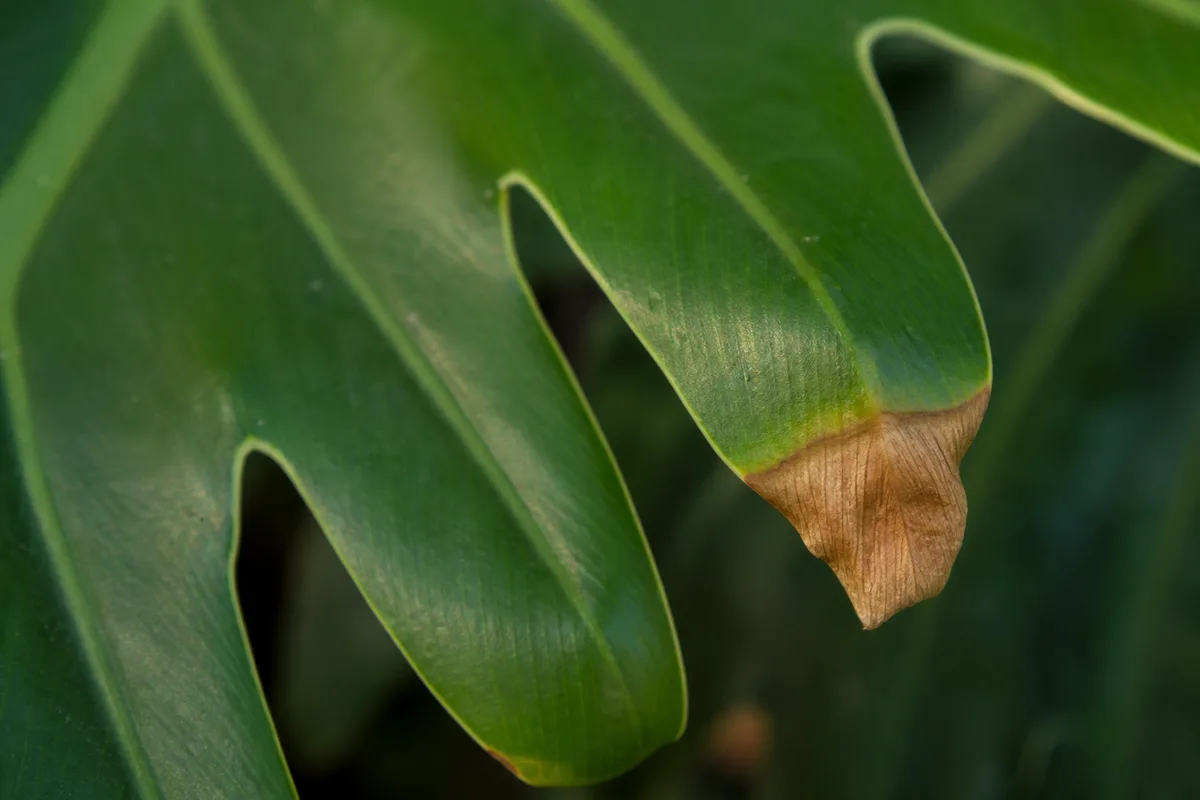
Brown Tips symptoms on Philodendron Selloum - compare with healthy tissue on the same plant.
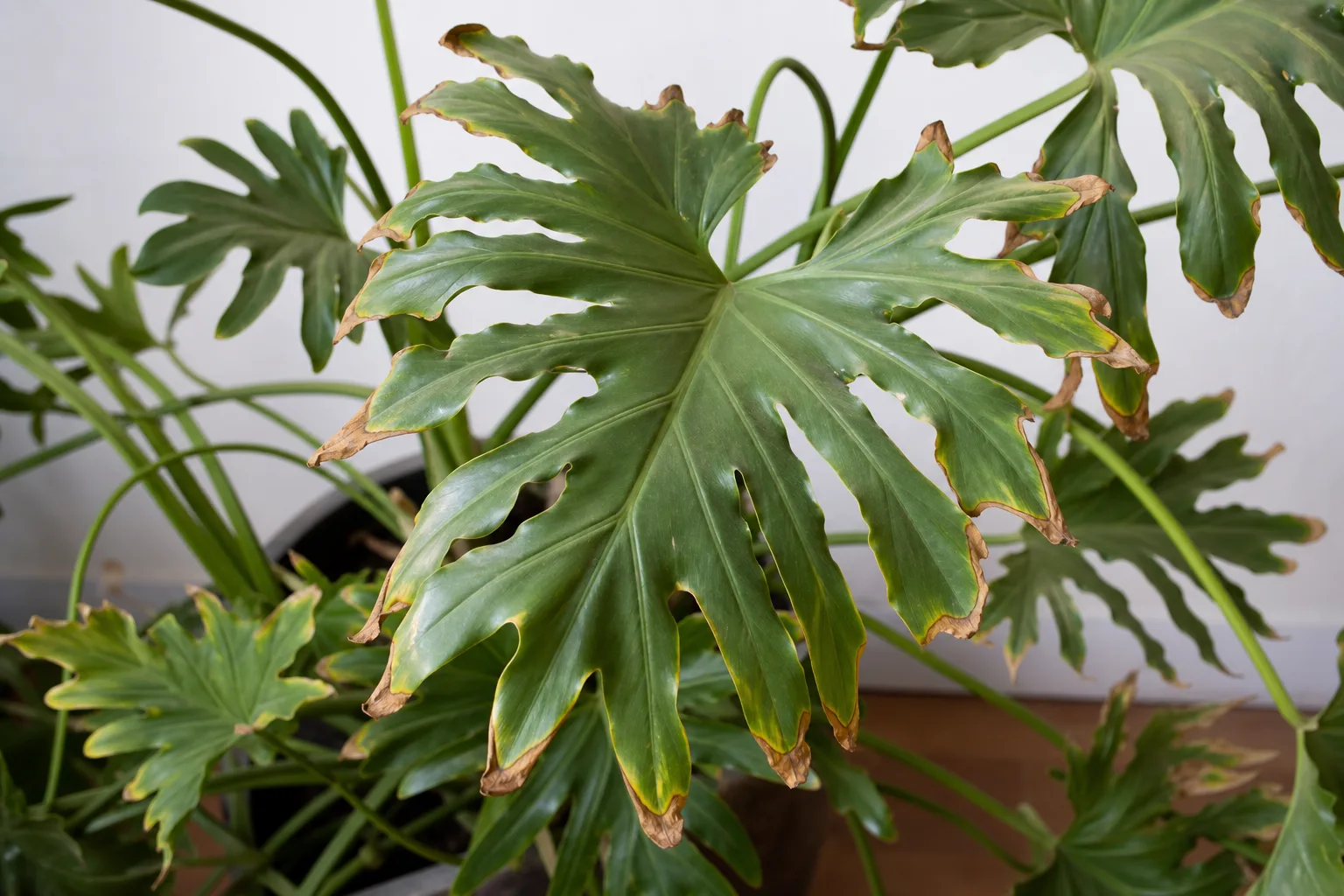
- Leaf tips turn tan to dark brown, dry, and papery while the rest of the leaf stays glossy green
- Browning starts at the extreme tip and may creep a few millimeters down lobed margins-not from the petiole upward
- Newest leaves unfurl with minor tip necrosis or slow, crinkled expansion in very dry air
- Lower, oldest leaves show tip burn on edges that face vents or windows
- No soft, wet, spreading lesions-tip burn is desiccation, not bacterial rot
- Fine stippling or webbing on undersides suggests spider mites instead of humidity alone
On Selloum, tip burn often appears on the most exposed outer leaves of the rosette first. Because leaves are deeply lobed, damage may look like several small brown points along a wavy margin rather than one central tip-still the same hydraulic-end-of-leaf mechanism.
How to confirm the cause
Do not treat every brown edge as humidity stress. Use this inspection order:
- Hygrometer at leaf level - Place a digital hygrometer within 30 cm of the foliage, not on the opposite side of the room. Below 45% strongly supports low humidity; 50–60% makes humidity a less likely sole cause.
- Airflow and heat sources - Note vents, radiators, fireplace proximity, and frequently opened exterior doors within 2 m of the plant.
- Pot weight and soil moisture - Push your finger 5 cm into the mix. Selloum should be watered when this layer dries in summer; plants need consistent moisture and are intolerant of drought, so bone-dry soil plus tip burn points to underwatering layered on dry air.
- Salt crust check - White mineral rings on the soil surface suggest fertilizer or hard-water buildup, which Iowa State Extension lists as a separate cause of brown leaf tips.
- New growth trend - Are the last two leaves worse, better, or unchanged? Worsening tips on fresh leaves while humidity stays low confirms the environmental diagnosis.
Lookalike symptoms to rule out
Underwatering makes the pot feel light, soil pulls away from the sides, and leaves may droop before tips crisp; humidity may still be adequate. Overwatering and root stress often yellow whole leaves from the base up with wet, heavy soil-different from isolated dry tips on green foliage. Fertilizer burn from excess salts may brown tips with crusty soil and sometimes curled leaf edges; Clemson HGIC notes too much fertilizer can brown and curl tips. Fluoride or hard tap water builds over months and affects sensitive species; Selloum is less fluoride-sensitive than dracaena, but switching water helps when humidity is already correct yet tips keep browning. Normal old-leaf aging affects one or two lowest leaves slowly while new growth stays clean.
First fix for Philodendron Selloum
Raise humidity to 50% or higher near the plant-the fastest correction for dry-air tip burn on this species.
Practical steps:
- Run a cool-mist or evaporative humidifier within 1–2 m of the plant; target 50–60% at leaf height
- Move the pot away from heating vents, AC blowers, and drafty windows
- Group tropical plants to share a slightly more humid microclimate, but do not crowd so tightly that airflow stalls
- Avoid relying on misting alone-Iowa State Extension recommends humidifier, pebble tray, or grouping for meaningful humidity gains; misting lifts moisture briefly on leaves this large
Make one change at a time. Do not repot, flush soil, increase fertilizer, and move rooms on the same day-you need to see whether humidity correction stops new damage within one to two leaf cycles.
Step-by-step recovery
After humidity improves:
- Leave existing brown tips in place for one week to confirm no new spread, or trim them following the natural leaf curve with clean scissors.
- Resume watering when the top 5 cm of mix is dry-roughly every 7–10 days in warm active growth and every 14–21 days in winter for a mature potted Selloum.
- If white salt crust is present, flush the pot with clean water at two to three times pot volume once, then wait two weeks before fertilizing again.
- Wipe large leaf surfaces monthly with a damp cloth to remove dust that can slow healthy gas exchange.
- Watch the next unfurling leaf. Clean margins mean the fix worked; repeated tip burn with humidity above 50% sends you back to Philodendron Selloum watering guide and salt checks.
Recovery timeline
Mild tip burn from a dry winter week often stabilizes within two to four weeks once humidity holds above 50%. The next one or two new leaves tell the story-existing brown tissue will not revert to green. Moderate cases with several affected leaves may need six to eight weeks and a full growing season before the canopy looks uniformly clean from a distance.
If humidity is corrected but tips keep browning on every new leaf, inspect roots on the next watering cycle: root crowding or chronic underwatering can limit water delivery to massive leaves even in humid air.
What not to do
- Do not increase fertilizer to “green up” browned tips-excess salts worsen edge burn.
- Do not cut deep into healthy green tissue when trimming; leave a thin brown margin.
- Do not place Selloum directly in hot dry air from a floor vent to “give it more light.”
- Do not assume misting twice daily replaces a humidifier for a plant with three-foot leaves.
- Do not overwater because tips look dry; soggy roots impair delivery to leaf margins and mimic drought at the tips.
- Do not ignore spider mites when tips brown alongside stippling in very dry rooms.
Philodendron Selloum care cross-check
Tip burn is often a humidity problem, but recovery sticks only when the rest of the routine matches this species. Selloum wants bright to medium indirect light-avoid direct sun that can scorch leaves. Use chunky aroid mix with perlite and bark in a large pot with drainage holes. Water when the top 5 cm dries, not on a fixed calendar. Keep daytime temperatures roughly 18–29°C (65–84°F). Remember the plant is toxic to pets and humans if ingested-keep it on an elevated stand away from cats and dogs while you adjust humidity.
How to prevent brown tips next time
Run a humidifier from the first cold snap through heating season rather than waiting for visible tip burn. Monitor with a hygrometer at leaf level, not across the room. Flush soil every four to six weeks during active growth if you use tap water or fertilizer regularly. Repot before roots circle tightly in a pot so large leaves stay hydrated between waterings. During routine care, glance at newest leaf tips weekly-early tan spots are cheaper to fix than margin burn across the whole rosette.
When to worry
Escalate beyond simple humidity adjustment if:
- Browning moves from tips to entire margins on most new leaves within two weeks
- Leaves go limp, yellow widely, or stop unfurling despite wet soil-possible root rot on Philodendron Selloum
- Fine webbing, stippling, or sticky residue appears on leaf undersides
- Tip burn spreads rapidly after you moved the plant to direct sun
- Multiple leaves collapse at the petiole base while soil smells sour
Isolated crispy tips on a few outer leaves with firm stems, stable roots, and humidity now above 50% is a medium-severity cosmetic issue with a good outlook.
Conclusion
Brown tips on Philodendron Selloum usually mean the air is too dry for a plant with massive transpiring leaves-not that the plant is dying. Confirm with a hygrometer below 45%, dry crispy tips on otherwise green foliage, and no root rot signs. Fix by raising humidity to 50% or higher with a humidifier and better placement away from vents. Judge success on new leaves, not old brown edges. Align watering, light, and soil with Selloum’s needs so the humidity fix holds through the next heating season.
When to use this page vs other Philodendron Selloum guides
- Philodendron Selloum watering guide - Use for routine moisture checks before assuming brown tips is the main issue.
- Philodendron Selloum problems hub - Browse all 4 common issues on this species.
- Yellow Leaves on Philodendron Selloum - Different entry point when symptoms overlap with brown tips.