Overwatering on Echeveria: Causes, Checks & Fixes
Quick answer
Overwatering on Echeveria means the root zone stays wet too long for a drought-adapted rosette succulent. First step: stop watering until the mix is dry two inches down and the pot feels noticeably lighter. If lower leaves turn mushy or the stem base softens, unpot and inspect roots-trim rot, callus 3–7 days, and repot into dry gritty mix or behead the firm rosette above rot.
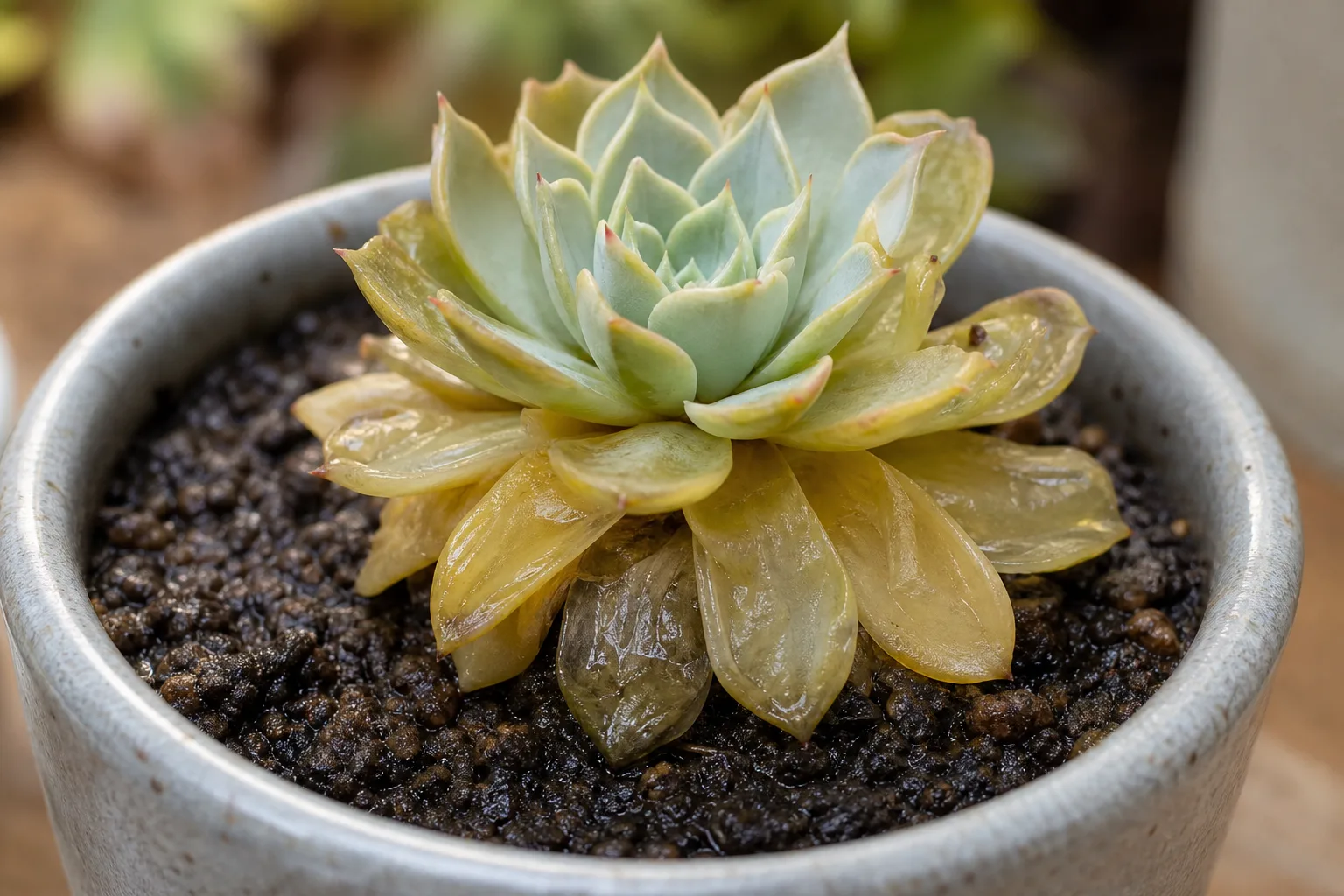
Overwatering on Echeveria: Causes, Checks & Fixes
This guide covers overwatering on Echeveria. See also the general Overwatering guide, watering, and light pages for this plant.
Overwatering on Echeveria: Causes, Checks & Fixes
Quick answer
Overwatering on Echeveria is what happens when a drought-adapted rosette succulent sits in wet mix too long. Echeveria stores water in thick overlapping leaves and expects a full soak followed by a full dry-down-not constant moisture. When soil stays saturated, roots lose oxygen, decay, and stop moving water upward. The rosette then shows damage that started underground: soft translucent lower leaves, a sour smell, and eventually stem-base collapse-the most fatal mistake on tight rosette forms.
First step: stop watering today. Do not fertilize, mist, or repot into fresh wet mix on day one. Let the mix dry completely at least two inches down while you check pot weight, drainage holes, and whether the stem base is still firm. If leaves keep turning mushy after the pot dries, unpot and inspect roots. Mild cases recover with dry-down alone; advanced rot needs trim, callus, and dry repot-or beheading if rot climbs the stem.
For the full soak-and-dry rhythm that prevents this problem, see the Echeveria watering guide. If roots are already brown and slimy, escalate to root rot rescue.
Why Echeveria gets overwatered
Echeveria evolved in semi-arid highlands where rainfall arrives in bursts separated by long dry spells. Indoors, overwatering appears when care mimics constant moisture instead of that wet-dry cycle where soil fully wets then dries completely before the next drink. More echeverias die from too much water than from too little.
Calendar watering, oversized pots, and heavy mix
Calendar watering is the leading trigger. A schedule that felt right every ten days in summer becomes a slow drowning by December when growth slows and soil stays damp for weeks. Succulents cannot be watered on a set schedule because pot size, soil type, light, and season all change dry-down speed.
Heavy peat-based potting soil compounds the problem. Typical potting soil retains too much water, risking root rot. Echeveria needs fast-draining gritty mix so water moves through rather than pooling around roots.
Oversized pots create a hidden trap. Extra soil volume stays wet long after a properly sized container would have dried-functionally identical to overwatering even when each drink feels modest.
Winter slowdown and dim-room extended wet cycles
Echeveria enters semi-dormancy in winter with cooler, drier rest and sharply reduced water demand. Continuing summer frequency through short cool days is the most common winter overwatering mistake on indoor collections.
Low light pairs badly with wet soil. In dim corners the plant uses less water, so the same volume sits longer-especially in glazed pots on shelves away from windows. Weak growth plus frequent watering rot the stem at soil level even when roots looked fine a week earlier. If stretch is also present, read not enough light on Echeveria alongside this page.
Rosette geometry traps moisture too. Overlapping leaves form a cup that holds droplets when top watering hits the center or bottom watering leaves the pot in a tray too long. Water pooled at the crown in a cool room evaporates slowly and invites stem rot at the soil line-the fatal endpoint on tight forms like Echeveria elegans.
What overwatering looks like on Echeveria
On rosette succulents, overwatering rarely announces itself with generic houseplant yellowing alone. Watch for this progression:
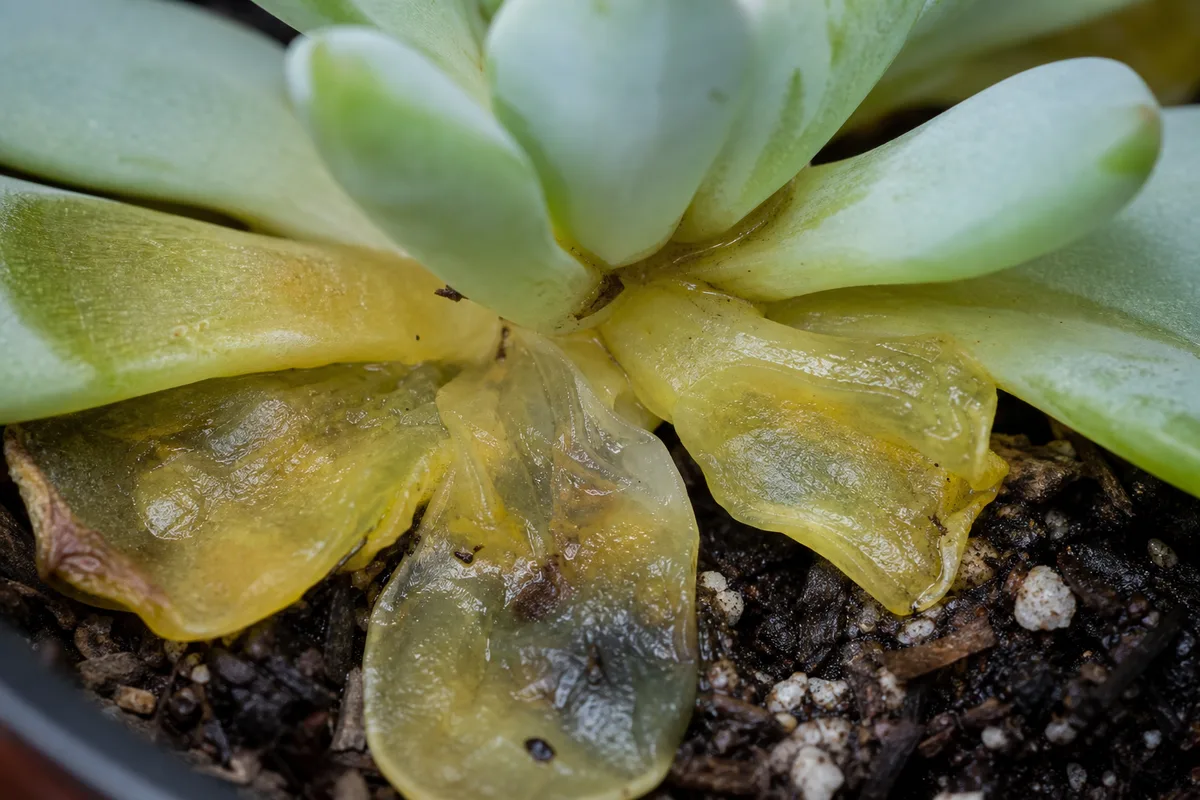
Overwatering symptoms on Echeveria - compare with healthy tissue on the same plant.
- Soft, mushy, or translucent lower leaves - healthy echeveria leaves are firm and opaque; overwatered succulents develop soft and mushy leaves and stems as waterlogged cells turn glassy and squash easily between fingers
- Yellow-green or blackening at the leaf base - colour change starts on oldest leaves where they meet the stem; tissue feels wet and may detach with light pressure
- A heavy pot that stays heavy for weeks - saturated mix does not lose weight
- A sour or musty smell from the pot - anaerobic decomposition in waterlogged mix; soil that has been too long without oxygen usually smells sour or rotten
- Stem-base softness - dark mushy patch at soil line creeping upward means rot has passed the roots
- Crown collapse - the center rosette feels wet, brown, or unstable; this threatens the only growing point and is more urgent than soggy soil alone
- Fungus gnats at the pot rim - larvae need consistently moist organic mix; gnats are a moisture alarm, not a leaf pest
Early overwatering can mimic thirst because the plant wilts when roots fail-symptoms are often confused for underwatering and more water is added-but the pot is heavy and mix is cool and damp at depth, not light and bone dry.
Lookalikes: underwatering vs. root rot
| Signal | Overwatering (early triage) | Underwatering | Advanced rot (see root rot page) |
|---|---|---|---|
| Pot weight | Heavy for days after last drink | Noticeably light | Heavy for weeks; may not dry |
| Leaf texture | Firm leaves; soil wet too long | Wrinkled but firm | Soft, translucent, mushy at base |
| Soil smell | Neutral unless stagnant | Neutral | Sour or musty |
| Roots on inspection | Pale and firm (if checked) | Pale and firm; may be sparse | Brown, black, slimy |
| First fix | Pause watering; improve drainage | Deep soak when fully dry | Stop water; trim; callus; dry repot or behead |
If soil is dry two inches down, the pot is light, and leaves are wrinkled but firm, suspect underwatering instead. If soil is wet and roots are already brown and slimy, treat as root rot-this page covers early wet-soil triage before that point.
How to confirm the cause
Work through these checks in order before Echeveria repotting guide into new mix:
- Pot weight test - Lift the pot right after a thorough watering once to learn what “wet” feels like, then lift it daily. A heavy pot that never lightens over one to two weeks confirms chronic saturation.
- Depth moisture check - Push a finger or wooden skewer two inches into the mix. If it comes out cool, damp, or with soil clinging, the plant is not ready for another drink-even if the surface looks pale. A dry surface is not always a sign of water need.
- Leaf texture at the base - Pinch the lowest leaf gently. Mushy and translucent fits overwatering; wrinkled but firm fits drought.
- Smell test - Sour or rotten odor from drainage holes suggests anaerobic rot already underway.
- Stem-base firmness - Press the stem just above soil line with a clean finger. Soft, wet tissue means escalate beyond dry-down alone.
- Light and season cross-check - Dim winter rooms extend dry-down; if the plant also stretches, pair watering correction with brighter placement per not enough light.
If the mix dries fully, the pot lightens, and new leaves stay firm within two weeks, overwatering was mild. If mushy leaves spread while soil stays damp, unpot and inspect roots the same day.
First fix for Echeveria
Stop watering until the mix is completely dry at least two inches down and the pot feels noticeably lighter.
That single pause is the correct first response for early overwatering-not fertilizer, not a bigger pot, not another “small drink” to perk limp leaves. Place the pot where it receives several hours of bright direct sun daily if it was in a dim corner; stronger light speeds evaporation and helps the plant use stored leaf water. Empty saucers and cachepots so the root zone is not re-wetted from below.
Mild cases: dry-down and drainage check
When roots are still firm and the stem base is solid:
- Confirm drainage holes are open-not blocked by roots, pebbles, or a mesh pad holding water.
- Wait for full dry-down; in active summer growth that may take 10–14 days; in winter it can take three to four weeks.
- Resume only with soak-and-dry per the watering guide-deep drink when dry throughout, then full drain.
- Remove any lower leaves that turned mushy and detach cleanly; do not pull firm tissue.
Advanced cases: trim rot, behead, callus, reroot
When unpotting reveals brown, black, or slimy roots-or the stem base is soft:
- Knock the plant out gently and brush away wet soil. Do not rinse roots under a tap; that spreads pathogens.
- Trim to clean tissue with a sterile blade or scissors until only firm white or tan roots and stem remain.
- Callus cuts 3–7 days in dry, shaded, airy conditions before touching mix. Skipping callus invites fresh rot.
- Repot into dry gritty mix in a clean pot only 1–2 inches wider than the root mass. Hold the first drink 5–7 days after repotting.
- Behead if rot climbed the stem - Cut the rosette off above the mush line while the head is still firm. Callus the cut, then set it on dry succulent mix to reroot. Discard mushy stem and roots. For step-by-step salvage when rot is confirmed, see root rot on Echeveria.
If the crown is wet, brown, or collapses when touched, the growing point is likely gone-propagate any firm leaves rather than waiting for recovery.
Recovery timeline
Mild overwatering often stabilizes within one to two weeks once soil oxygen returns and the pot dries. Lower leaves that turned translucent usually do not re-firm; judge success by new growth at the rosette center staying compact and firm, not by old damaged leaves plumping up.
After trim-and-repot or beheading, expect callus formation in 3–7 days and first root nubs in two to four weeks under bright light and dry mix. The rosette may look unchanged for weeks while roots rebuild-that is normal. Recovery is measured by stable new growth, not instant leaf repair.
Escalate if mush spreads to the crown, soil smells sour after a full dry-down attempt, or the rosette head wobbles on a soft stalk.
What not to do
Do not fertilize a waterlogged plant-fertilizer cannot fix suffocated roots and may burn stressed tissue.
Do not repot into an even larger pot “to help drying.” Extra soil volume holds moisture longer and worsens the problem.
Do not water because leaves look limp without checking pot weight and soil moisture at depth. Limp leaves on a heavy wet pot mean damaged roots, not thirst.
Do not pour water into the rosette center. Keep drinks on the mix around the inner pot edge per the watering guide.
Do not assume bottom watering prevents overwatering. It helps keep the crown dry during normal care, but leaving the pot in a tray for hours recreates saturated conditions.
How to prevent overwatering next time
Prevention on Echeveria is the same rhythm that keeps the whole genus healthy: soak-and-dry, fast mix, right-sized pot, and enough light that the plant actually uses water.
Water only when the compost starts to feel dry at depth-not on a calendar. The RHS describes echeveria as drought-tolerant and warns to never leave plants sitting in water. Push a skewer two inches down; if it comes out clean and dry, water deeply until runoff, drain fully, and empty saucers within 30 minutes.
Use gritty succulent mix-roughly one part organic matter to two parts mineral amendments like perlite and coarse sand-and a pot with drainage holes sized to the root ball, not the dream size of the rosette. Unglazed terracotta speeds dry-down for beginners.
Give bright light with several hours of direct sun so transpiration matches your watering rhythm. Cut winter frequency sharply when growth slows.
For species context on rosette water storage and native dry-season biology, see the Echeveria overview.
When to worry
Treat as urgent when the crown feels wet or unstable, the stem base turns dark and mushy, or lower leaves detach at a touch while soil stays saturated. Crown involvement threatens the only growing point-behead above clean tissue the same day if the head is still firm.
Also act when soil smells sour after you have stopped watering for two weeks in warm bright conditions-that suggests active rot, not slow dry-down. Mild heaviness right after a single overwatering event is not an emergency if drainage is good and the stem base is solid.
Conclusion
Overwatering on Echeveria is almost always a rhythm problem: wet soil too long for a plant built to store water in its leaves and survive dry gaps. Stop watering first, confirm with pot weight and a two-inch soil check, and dry the mix completely before the next soak. Mild cases recover when drainage and light improve; advanced mush at the stem base needs the same trim, callus, and reroot path as root rot-or a clean beheading while firm tissue remains. Align daily care with soak-and-dry in the watering guide and you prevent most of this before it starts.
When to use this page vs other Echeveria guides
- Echeveria watering guide - Use for routine moisture checks before assuming overwatering is the main issue.
- Echeveria problems hub - Browse all 16 common issues on this species.
- Root Rot on Echeveria - Different entry point when symptoms overlap with overwatering.
- Yellow Leaves on Echeveria - Different entry point when symptoms overlap with overwatering.
- Wilting on Echeveria - Different entry point when symptoms overlap with overwatering.