Fungus Gnats on Echeveria: Causes, Checks & Fixes
Quick answer
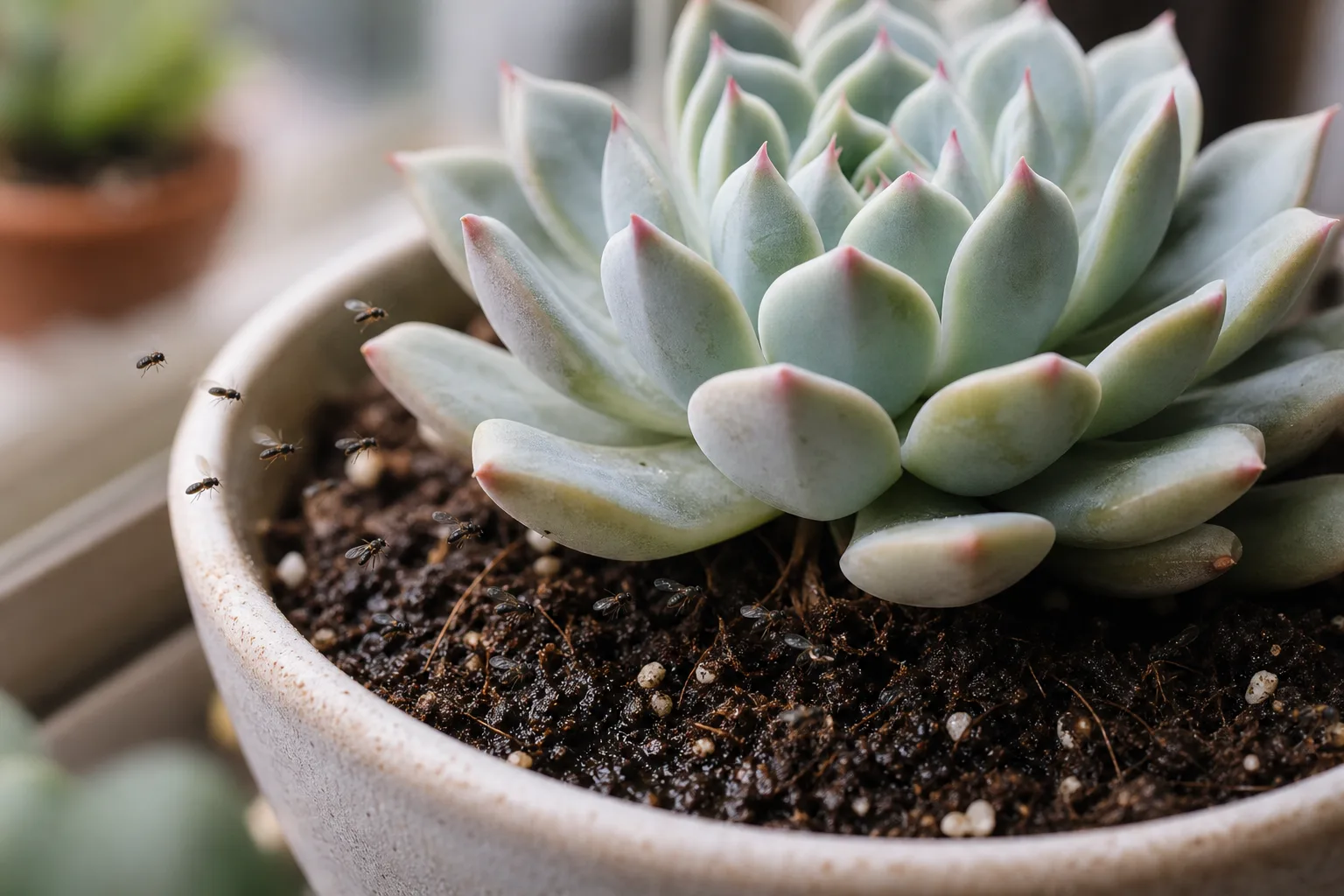
Fungus gnats on Echeveria mean the succulent mix surface stays wet too long-adults hover near the rosette base and larvae feed in the damp top layer. First step: stop watering until the full root zone dries, and set a yellow sticky trap at the pot rim.
Fungus Gnats on Echeveria: Causes, Checks & Fixes
This guide covers fungus gnats on Echeveria. See also the general Fungus Gnats guide, watering, and light pages for this plant.
Fungus Gnats on Echeveria: Causes, Checks & Fixes
Quick answer
Fungus gnats on Echeveria (Echeveria spp.) almost always mean the potting mix stays wet too long-especially the surface layer where adults lay eggs. Fungus gnats thrive in moist conditions, and echeveria is a drought-adapted rosette succulent built for a full soak followed by a complete dry-down-not a constantly damp top inch. Tiny dark flies hover near the rosette base when you water. Larvae live in damp organic mix, feeding on fungi and fine succulent roots.
First step: stop watering until the full root zone is dry, and place a yellow sticky trap at the pot rim. Gnats on a succulent are a moisture alarm, not a leaf pest. Spraying waxy rosette leaves will not reach larvae in soil. For dry-down rhythm, see our Echeveria watering guide.
Scope note: This page covers fungus gnat flies and larvae in wet succulent mix-the early moisture signal before roots fail. If lower leaves are already mushy on saturated soil, pair this guide with overwatering on Echeveria for wet-soil triage or root rot when roots are brown and slimy.
Why Echeveria gets fungus gnats
Fungus gnats need moist organic soil to reproduce. Females lay eggs in cracks of growing media, and larvae concentrate in the top two to three inches where they feed on fungi, algae, and decaying organic matter-and occasionally chew fine roots and root hairs.
Echeveria invites gnats when treated like a leafy tropical:
Overwatering and light frequent sprinkles. Clemson notes succulents need well-drained soil and infrequent watering-roots rot in heavy wet mix. The same conditions sustain gnat larvae.
Dense peat without grit. Standard potting soil holds surface moisture for days. Echeveria needs gritty succulent mix that dries fast throughout. Typical potting soil retains too much water, risking root rot and gnat nurseries in the surface layer.
Oversized pots. Large wet soil volume around a small rosette root ball is a gnat nursery-the center stays damp long after a properly sized pot would have dried.
Low light winter slowdown. Cool dim rooms evaporate slowly. Summer watering rhythm overwaters in January when echeveria growth slows and water demand drops.
“Succulent-safe” moist schedules. Keeping soil slightly damp at all times-advice meant for ferns-destroys echeveria roots and breeds gnats.
New introductions. Infested nursery pots spread adults to every succulent on the shelf.
Gnats do not live on waxy rosette leaves. They mean the soil environment is wrong-and on echeveria, chronic wetness leads to overwatering and root rot if ignored.
What fungus gnats look like on Echeveria
Adult flies:
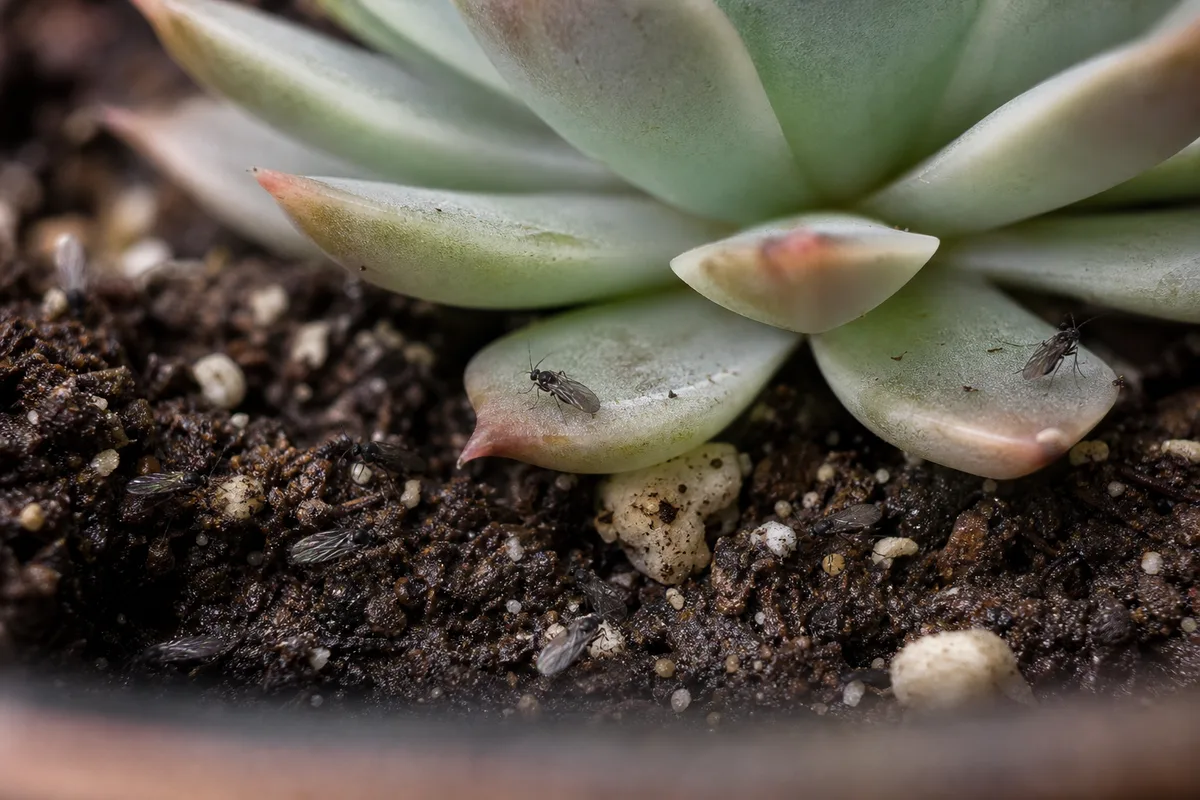
Fungus Gnats symptoms on Echeveria - compare with healthy tissue on the same plant.
- Tiny dark mosquito-like insects about 1/16 to 1/8 inch long near soil surface and pot rim
- Rise when you water the rosette pot or bump the bench
- Rest on bench, window, or lower leaf tips-not feeding on waxy blades
- Adults do not damage plants or bite people-their presence is primarily a nuisance and a moisture signal
Larval stage:
- Translucent worms with shiny black heads in top inch of wet mix
- Visible on potato slice test or when scraping surface
- Algae film on constantly wet soil
Echeveria stress overlap:
- Lower leaves mushy or translucent on wet mix = overwatering, not gnat bites on leaves
- Firm shriveled leaves on dry mix = drought-opposite problem
Visual check: Adults cluster at the pot rim and soil line beside a firm echeveria rosette-not on the leaf surface. Photo reference: tiny dark flies on yellow sticky trap placed flush with gritty mix at pot edge; potato slice on wet surface with translucent larvae visible on underside after 48 hours.
Potato-slice larval test - step by step
The potato slice is the fastest home confirmation when you are unsure whether flies are fungus gnats or a stray kitchen pest:
- Choose a suspect pot - one where adults rise when you water or where the surface stays cool and damp for many days.
- Cut a raw potato chunk about one inch thick. Use the cut face, not the peel alone. UC IPM recommends raw potato chunks placed cut-side down in pots to monitor and trap larvae away from roots.
- Press the cut face lightly into the wet surface beside the rosette stem-not against the crown where moisture invites rot.
- Wait 48 hours in normal room conditions. Oklahoma State Extension suggests checking slices after three to four days for maggot-like larvae.
- Lift the slice carefully. Translucent worms with dark heads on the underside confirm fungus gnat larvae in that pot. No worms on a dry lightweight pot points away from gnats-check underwatering instead.
- Dispose of infested slices in sealed trash and replace with a fresh piece if you are still monitoring during recovery. Do not compost slices from infested indoor pots.
Springtails are harmless jumpers in damp mix-they bounce when disturbed and do not produce mosquito-like adults at the window. Fungus gnat larvae stay on the potato and develop into flying adults from the same pot.
How to confirm fungus gnats
Work through these checks in order:
- Flight test - Flies rise from soil when disturbed, not from rosette center.
- Surface moisture - Top layer stays cool and damp many days; pot heavy when echeveria should be dry.
- Potato slice test - Larvae on underside after overnight to 48-hour press into wet surface.
- Rosette firmness - Firm leaves with few flies = early moisture drift. Mushy lower leaves on sour wet mix = escalate toward overwatering-gnats alone do not mush tissue overnight.
- Neighbor pots - Check all succulents on same tray; gnats spread across a collection when multiple pots hold damp surface mix.
First fix for Echeveria
Let the full root zone dry completely. Set a yellow sticky trap at the pot rim.
Stop light sprinkles and calendar watering. Allow the surface of container soil to dry between waterings-on echeveria that means the entire root zone, not just the top half-inch. Resume only with thorough soak when mix is dry throughout-per watering guide.
After dry-down begins:
- Yellow sticky traps at soil level catch egg-laying adults
- Improve airflow around pot rim
- If larvae persist after two weeks of dry surface: BTI drench to top layer per label; repeat every five to seven days for two to three cycles because BTI does not kill eggs or adults
Do not mist rosettes for gnats-wet crowns invite rot on echeveria. Do not use caterpillar Bt (kurstaki); fungus gnat control requires Bacillus thuringiensis israelensis (Bti).
Step-by-step recovery
- Week 1: Full dry-down; sticky traps at soil line; no watering
- Week 2: Trap counts drop; fresh potato slice monitors larvae
- Week 3: BTI drench if adults still emerge on dry surface; confirm no sour smell
- Week 4+: Resume succulent watering rhythm-soak then full dry
- Ongoing: Quarantine new plants two weeks; gritty mix per soil guide
Recovery success: fewer flies, no larvae on fresh potato slice, firm plump rosette leaves after next proper soak.
Lookalike symptoms
| What you see | Likely cause | This page or sibling |
|---|---|---|
| Flies at soil only | Fungus gnats | Start here |
| Webbing in rosette | Spider mites (rare on succulents) | Spider mites |
| White cotton in axils | Mealybugs | Mealybugs |
| Mushy translucent leaves on heavy wet pot | Overwatering | Overwatering - wet-soil triage |
| Brown slimy roots on unpot | Root rot | Root rot - trim and salvage |
| Wrinkled firm leaves on light dry pot | Underwatering | Underwatering |
| White fuzz on damp soil surface | Mold on soil | Mold on soil |
Mistakes to avoid
- Keeping soil “slightly moist” for echeveria
- Echeveria repotting guide into more peat without perlite or pumice
- Spraying rosette leaves instead of fixing soil moisture
- One trap without correcting watering
- Ignoring gnats because rosette still looks cute-larvae damage roots first
- Hydrogen peroxide drenches as a solo fix while keeping mix soggy
- Pouring water into the rosette center to “flush” gnats
Echeveria care cross-check during treatment
While correcting gnats, align the rest of care with what rosette succulents need:
| Factor | Gnat-friendly mistake | Echeveria target |
|---|---|---|
| Water timing | Calendar watering in dim winter room | Full root-zone dry-down before next soak |
| Saucers | Standing water after watering | Empty within 30 minutes |
| Mix | Dense peat without mineral grit | Gritty fast-draining blend per soil guide |
| Pot size | Oversized nursery pot holding wet center | Sized to root mass; one size up at repot only |
| Light | Dim shelf slowing water use | Bright direct sun per light guide |
| Crown care | Misting rosette leaves for “humidity” | Keep water off tight rosette centers |
For sibling moisture and pest pages in this cluster, see Related Echeveria problems below.
How to prevent fungus gnats next time
- Full root-zone dry-down between soaks
- Gritty fast-draining succulent mix
- Pot sized to rosette-not oversized
- Bright light per light guide for predictable dry cycles
- Empty saucers within 30 minutes
- Quarantine new succulents two weeks with a trap at soil level
Healthy prevention is the same rhythm that keeps echeveria compact: soak-and-dry in mineral-heavy mix, never a moist-soil schedule meant for tropical foliage plants.
When to worry
Escalate when gnats persist after four weeks of corrected watering, soil smells sour, lower rosette leaves go mushy on wet mix, or roots feel slimy on inspection.
Scope differentiation:
- This page (gnats): Flies at soil line, damp surface, firm rosette, no sour smell-dry-down plus traps and optional BTI.
- Overwatering: Heavy wet pot, soft translucent lower leaves, calendar watering in winter-stop water and confirm two-inch dry-down before next soak.
- Root rot: Brown slimy roots, soft stem base, crown collapse-same-week unpot, trim to firm tissue, callus, and dry repot or behead.
If decline continues after dry-down, BTI drenches, and drainage correction, contact your local cooperative extension office before you water again.
Escalation summary: which path to take
Use this fork after surface moisture, pot weight, stem firmness, and trap trend checks:
- Dry-down only - Few adults when watering, firm stem base, surface damp but no sour smell, firm lower leaves. Stop watering until full root zone dries; one sticky trap; recheck traps in 10–14 days.
- Dry-down plus BTI - Traps fill weekly, larvae confirmed on potato slice, stem still firm. Dry surface first, then two to three Bti drenches five to seven days apart while keeping mix dry between drinks.
- Escalate to overwatering triage - Mushy lower leaves on heavy wet pot without slimy roots yet. Follow overwatering dry-down and drainage checks this week.
- Escalate to root rot - Soft stem base, sour saturated mix, brown slimy roots on unpot. Follow root rot trim-and-salvage protocol the same day.
- Collection protocol - Gnats on one echeveria in a shared succulent shelf. Isolate the affected pot, dry every neighbor pot completely, and trap each container for two to three weeks.
Permanent cosmetic note: Lower leaves that turned mushy from chronic wet soil will not re-firm. Judge success by falling trap counts, a mix that dries throughout between soaks, and firm new center growth-not by old damaged foliage.
Related Echeveria problems
- Echeveria overview - species care hub: light, water, soil, dormancy
- Watering - soak-and-dry rhythm and skewer checks
- Overwatering - wet-soil signs when gnats are a moisture alarm
- Root rot - mushy roots and same-week unpot escalation
- Mold on soil - surface fungi on persistently damp mix
- Underwatering - wrinkled firm leaves on light dry pots
- Spider mites - stippling on rosette leaves, usually on drier mix
- Soil - gritty succulent mix ratios
This URL is the fungus-gnat and wet-surface hub for the Echeveria cluster. Sibling pages go deeper on one cause; start here when tiny flies rise from a damp succulent pot beside a firm rosette.
FAQs
Are fungus gnats dangerous to Echeveria?
Adults are mostly a nuisance, but larvae in constantly wet succulent mix chew fine roots and invite the same overwatering conditions that cause rot. A few gnats with firm rosettes and proper dry-down are manageable; sour soil, mushy lower leaves, and heavy larval counts mean treat as urgent moisture failure.
How can I confirm fungus gnats on Echeveria?
Confirm small dark flies rising when you water or bump the pot, plus larvae in the top inch of soggy mix-not insects on the waxy rosette leaves. A potato slice pressed into wet surface soil for 48 hours with translucent worms underneath points to fungus gnats, not harmless soil springtails.
Why do I have gnats if I barely water my Echeveria?
Light frequent sprinkles, dense peat in the mix, oversized pots, low light slowing dry-down, and winter calendar watering can keep the surface wet even when you think you are conservative. Echeveria needs full dry-down between soaks-damp surface alone breeds gnats.
Can I use BTI on Echeveria?
Yes. Bacillus thuringiensis israelensis drenches target fungus gnat larvae in the top soil layer without harming the rosette. Pair BTI with corrected dry-down watering-larvae return if the mix stays constantly moist.
How do I prevent fungus gnats on Echeveria next time?
Water only when the full root zone is dry per the watering guide, use gritty succulent mix with fast drainage, empty saucers after every drink, and quarantine new plants. Never keep echeveria on a moist-soil schedule meant for tropical foliage plants.
When to use this page vs other Echeveria guides
- Echeveria watering guide - Use for routine moisture checks before assuming fungus gnats is the main issue.
- Echeveria problems hub - Browse all 16 common issues on this species.
- Overwatering on Echeveria - Different entry point when symptoms overlap with fungus gnats.
- Mold on Soil on Echeveria - Different entry point when symptoms overlap with fungus gnats.
- Root Rot on Echeveria - Different entry point when symptoms overlap with fungus gnats.