Echeveria Soil: Gritty Mix, Pumice Ratios & Drainage
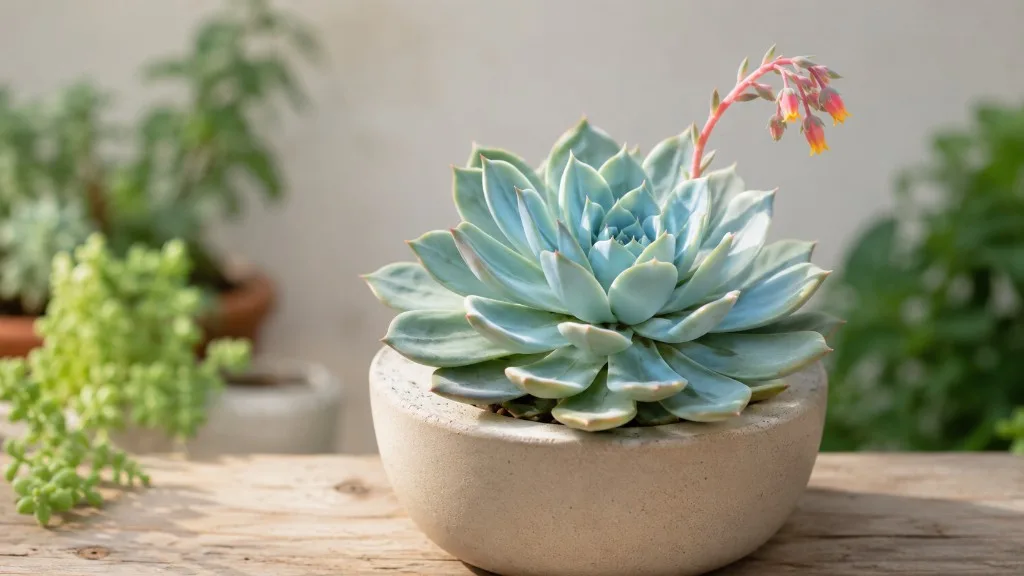
Echeveria Soil: Gritty Mix, Pumice Ratios & Drainage
Echeveria Soil: Gritty Mix, Pumice Ratios & Drainage
Author: sai-ananth · Reviewed by: LeafyPixels Review Board · Updated: 2026-06-15
Echeveria Soil: Gritty Mix, Pumice Ratios & Drainage
Echeveria spp. (Crassulaceae) stores water in thick rosette leaves, which means its roots evolved for brief drinks followed by long dry spells - not for sitting in damp compost. The echeveria soil mix you choose controls how fast water leaves the root zone, how much air reaches roots between waterings, and whether a thorough soak from the watering guide is safe or a slow rot event. Get the mix wrong and even careful watering becomes a gamble. Get it right and echeveria becomes one of the most forgiving succulents on a sunny windowsill. This page covers recipes, pumice ratios, pot pairing, and the one-minute drainage check that tells you whether your setup actually works in your room.
Why Fast-Draining Soil Matters for Echeveria
Echeveria soil must drain quickly enough that the root zone dries within a few days after a full watering, not linger damp for a week or more. Standard indoor potting compost is engineered to hold moisture for moisture-loving foliage plants - ferns, calatheas, peace lilies. That design is exactly what kills echeveria. When organic matter stays wet around succulent roots, oxygen gets pushed out of pore spaces, anaerobic conditions develop, and root tissue begins to break down before you see obvious leaf symptoms. Iowa State Extension describes the correct rhythm as a wet-dry cycle: thoroughly wet the entire root ball, let excess water drain away, then allow the soil to dry completely before watering again.
The RHS recommends planting echeveria in peat-free cactus compost - gritty and sharply draining - in a pot with plenty of drainage holes, watering only when the compost approaches dryness. That guidance sounds simple, but many bagged “cactus mixes” sold at garden centers still contain enough fine peat or compost to compact and retain moisture over time. Treating soil as a fixed product label rather than a system you adjust to your pot and room is where most growers go wrong. Your job is to build or amend a mix that matches how fast your specific container dries in your specific room, not to find one magic bag off the shelf.
root rot on Echeveria is the headline failure - see the root rot problem guide if symptoms are already advanced - but slow-draining soil causes quieter problems too. Mix that stays damp too long encourages soft translucent leaves, etiolation-prone growth in low light, and a crown that sits wet at the soil line. Fast drainage does not mean zero moisture retention. It means predictable dry-down: water in, water out, air back in. That cycle is what echeveria roots expect from the rocky, mineral-rich slopes where the genus evolved.
What Echeveria Roots Need in a Container
Container growing changes every variable echeveria faces in the wild. In habitat, roots spread through open mineral soil where water drains instantly downslope and the plant’s stored leaf moisture carries it through dry intervals. In a pot, the same volume of water has nowhere to go except down through a single drainage hole, and container walls create a capillary boundary that slows evaporation from the sides. That is why echeveria soil mix in a pot must be grittier than what works for the same plant in a raised outdoor bed in a dry climate.
Semi-Arid Origins and Drainage Physics
Echeveria belongs to Crassulaceae, a family of leaf succulents native to semi-arid highland regions of Mexico and Central America. Those environments share a pattern: thin, rocky soil with high mineral content, sharp drainage, and rainfall that arrives in bursts rather than steady drizzle. Roots in that context are shallow and spreading, designed to grab moisture quickly and then endure drought. They are not built for deep, constantly moist substrate.
When you replicate that indoors, the goal is not to recreate desert sand - echeveria still needs a small organic fraction to anchor roots and hold trace nutrients - but to recreate the drainage physics. Mineral particles create permanent air channels that do not collapse when the mix dries. Organic matter provides structure early on but decomposes and compacts over 12 to 24 months, which is why refresh timing matters as much as the initial recipe. For full species context, start with the echeveria overview.
Air Pores and the Dry-Down Rule
Healthy echeveria roots need oxygen as much as they need periodic moisture. After you water thoroughly, pore spaces in a good gritty mix fill with water briefly, then drain and refill with air as the mix dries. In a peat-heavy mix, those pores collapse as organic material breaks down, and the root zone becomes a dense, airless block that holds moisture at the center even when the surface looks dry.
Drainage speed - how many days until the mix is dry an inch or two down - is the metric that matters, not whether the label says “cactus.” As a home-climate heuristic (not a universal law), after a full watering in a 10 cm terracotta pot on a bright windowsill, the mix should feel dry to the touch within roughly three to five days in summer and seven to ten days in winter. Your room may run faster or slower; track pot weight for two full cycles rather than copying these numbers blindly. If the mix stays damp longer, add more inorganic grit, reduce pot size, improve light per the light guide, or adjust airflow - often a combination.
Worked scenario (home observation, 2025): Echeveria ‘Lola’ in a 10 cm terracotta pot with unamended bagged cactus mix stayed heavy 9–10 days after each summer watering on a south-facing sill. Repotted into 50% peat-free compost + 50% pumice in the same pot, dry-down dropped to roughly 4 days, and lower-leaf softness stopped within two weeks once watering frequency matched the new dry-down. Your timeline will differ - use the one-minute drainage check below to calibrate.
Quick-Reference Recipe Card
Use this card before you blend. All ratios are by volume (scoops or cups), not weight.
| Recipe | Blend | Best for |
|---|---|---|
| Default | 50% potting compost + 30% coarse perlite + 20% horticultural grit | Average indoor conditions, bright windowsill |
| Humid / heavy hand | 50% compost + 50% pumice | Humid rooms, plastic pots, frequent waterers |
| Max drainage | 40% compost + 60% pumice or perlite | History of rot, dim corners, oversized pots |
Squeeze test target: a damp handful crumbles when you open your fist - not a tight ball, not dust.
CORRECT CROWN PLACEMENT          BURIED CROWN (rot risk)
┌─────────────────────┐          ┌─────────────────────┐
│    ╱╲  rosette      │          │    ╱╲               │
│   ╱  ╲              │          │  ▓▓╱  ╲▓▓ leaves    │
│───soil line─────────│          │───soil piled high───│
│ ○ ○ grit  ○  ░░     │          │ ▓▓ wet against base │
└─────────────────────┘          └─────────────────────┘
 soil at base of lowest leaves    moisture trapped in crown
Best Soil Mix for Echeveria
The best soil for echeveria is a gritty, fast-draining succulent mix that balances a modest organic base with a high proportion of coarse inorganic amendments. A reliable default that works for most indoor growers: 50% standard potting compost, 30% coarse perlite, and 20% horticultural grit (or coarse sand), consistent with RHS cactus and succulent guidance. That ratio delivers enough structure for roots to anchor while ensuring water moves through the profile rather than pooling around the crown.
This is a starting point, not a law. Growers in humid climates or those who tend to water generously should push the inorganic fraction higher - toward 60% grit, pumice, or perlite combined. Growers in very dry homes with strong light may find a 50/50 blend of potting mix and pumice ideal, because pumice holds a little moisture in its pores and releases it gradually rather than drying the roots overnight.
The Core Gritty Succulent Formula
Break the default mix into what each fraction does:
- 50% potting compost - Provides root anchoring, trace nutrients, and a slight moisture buffer. Choose plain, unfertilized mix without water-retention crystals or heavy wetting agents.
- 30% coarse perlite - Lightweight volcanic glass that creates air pockets and prevents compaction. Use horticultural-grade perlite with particles roughly 4–8 mm, not fine seed-starting dust.
- 20% grit or coarse sand - Adds weight, improves drainage pathways, and separates organic particles so they do not fuse into a solid block. Horticultural grit, poultry grit (granite, not oyster shell), or coarse builder’s sand works. Never use beach sand (salt) or fine play sand (cements the mix).
For a single 15 cm pot, that translates roughly to two cups compost, one and a quarter cups perlite, and three-quarters cup grit - enough to fill the pot with a 1 cm headroom below the rim for watering. Mix dry in a bucket until texture looks uniform before filling the pot.
Pumice vs Perlite: Ratios That Actually Work
Both pumice and perlite improve aeration, but they behave differently in a pot over months of watering - and that difference matters for echeveria rosettes that cannot tolerate wet crowns.
Perlite is lightweight, inexpensive, and widely available. It creates excellent air pockets when fresh. The downsides: it tends to float toward the surface during repeated soak-and-dry cycles, leaving the lower root zone with less aeration than the top; and it gradually crushes into fine powder, reducing long-term benefit. For a beginner on a budget, perlite at 30% of the mix still works well if you refresh the soil every 12 to 18 months.
Pumice is heavier, more durable, and porous. It absorbs water into microscopic reservoirs and releases it slowly as the surrounding mix dries - a behavior Debra Lee Baldwin documents as particularly suited to potted succulents. Baldwin recommends a simple half-and-half blend of bagged potting soil and pumice for containers, or two parts inorganic grit to one part organic material for rot-prone plants. Pumice does not float, does not blow away, and depending on mine source may contribute trace minerals. The trade-off is cost and availability: pumice costs more and is harder to find locally, though online succulent suppliers and some feed stores stock it (look for products labeled pumice or “Dry Stall” - not “Stall Dry,” which is a different product).
Practical ratio guidance:
| Situation | Recommended blend |
|---|---|
| Default indoor mix | 50% compost + 30% perlite + 20% grit |
| Pumice-forward (humid climate) | 50% compost + 50% pumice |
| Maximum drainage (overwatering on Echeveria tendency) | 40% compost + 60% pumice or perlite |
| Store-bought cactus mix amendment | 2 parts cactus mix + 1 part pumice |
| Very dry, bright windowsill | 50% compost + 50% pumice (Baldwin half-and-half) |
Substitute pumice for perlite at a 1:1 volume ratio in any recipe above. A common split for growers who want both: 20% perlite + 20% pumice + 20% grit with 40% compost.
DIY Echeveria Soil Recipes
Blending your own echeveria potting mix takes ten minutes and gives you control that no bagged product can match. Two recipes cover most situations.
Store-Bought Cactus Mix and Custom Blends
Beginner amend path: Mix 2 parts commercial cactus/succulent soil with 1 part pumice or coarse perlite by volume. Read the label first: if peat moss or compost is the first ingredient and you see no perlite, pumice, or sand listed, treat it as regular potting soil and amend aggressively - Iowa State Extension suggests roughly one-third organic to two-thirds mineral material for sharp-draining succulent mixes. Stir until mineral particles are evenly distributed. If the amended mix still clumps when squeezed, add another half-part pumice until a handful crumbles apart when you open your fist.
Custom scratch blend for bright windowsills: 40% potting compost + 35% pumice + 25% horticultural grit. The higher pumice fraction compensates for indoor humidity and slower evaporation compared to outdoor succulent gardens. The grit adds weight so top-heavy rosettes like Echeveria ‘Black Prince’ do not tip in lightweight plastic pots.
For very humid rooms or heavy waterers, shift to 30% compost + 50% pumice + 20% grit. Some experienced growers use 100% pumice or 100% perlite for propagation and specimen plants, but that demands precise watering and regular dilute feeding per the fertilizer guide because there is almost no nutrient-holding organic matter. That approach is advanced, not a starting recommendation.
Inorganic Grit and Organic Base: What Each Does
Understanding components helps you adjust ratios without guessing. The inorganic fraction - pumice, perlite, grit, coarse sand, crushed granite, lava rock - creates permanent structure. These particles do not decompose. They hold open air channels, increase drainage velocity, and add weight so pots stay upright. Particle size ideally falls around 6 mm (¼ inch) for a true gritty-mix approach; smaller particles still help but pack tighter over time.
The organic fraction - compost, coco coir, pine bark fines, peat - provides cation exchange capacity, root anchoring, and a modest moisture buffer. Echeveria needs some organic matter, but only as a minority ingredient. When organic content exceeds roughly 50% of the mix, drainage slows to levels that stress succulent roots in containers.
Can you use regular potting soil for echeveria? Only if you amend it heavily. Straight peat-based potting compost retains too much moisture and compacts within months. If regular potting soil is all you have, blend it 1:1 with pumice or perlite at minimum, and preferably 1:2 (one part soil, two parts mineral amendment) for safer drainage. Never add water-retention crystals or moisture-control additives to an echeveria mix.
Coco coir is a workable organic substitute for peat in DIY blends - it rewets more easily than peat and is more sustainable - but it still holds moisture, so keep the coir fraction at or below 30% of the total mix and pair it with generous pumice or grit. Orchid bark is not a standard echeveria ingredient; it breaks down faster than grit and holds more moisture than most rosette succulents need indoors. If you experiment with bark, keep it under 15% of the blend and monitor dry-down closely.
Container Drainage and Pot Selection
Soil and pot work as a single system. The best echeveria soil mix in a container without drainage holes will still kill the plant, and an oversized plastic pot with one small hole at the bottom will defeat a gritty mix by holding a reservoir of wet soil the roots cannot escape.
Drainage Holes and the Gravel-Layer Myth
Yes - echeveria needs a drainage hole. Every pot used for long-term echeveria care should have at least one hole roughly 6 mm or larger in the bottom so water exits freely after a thorough soak. Iowa State Extension is explicit: succulents do not tolerate staying wet, and a “drainage layer” of coarse gravel at the bottom is not a suitable replacement for a drainage hole. The RHS houseplant growing guide recommends open, well-drained compost throughout the pot rather than drainage layers that can hold a perched water table. Fill the entire pot with your gritty mix from bottom to top. If you worry about soil washing out, cover the hole with a small piece of mesh or a pottery shard - not a thick gravel layer.
Decorative cachepots - outer pots with no holes - are fine only if the inner grow pot drains and you remove it to water, or if you empty every drop of runoff within minutes. Leaving an echeveria sitting in a cachepot full of water is one of the fastest paths to crown rot.
Pot Size, Depth, and Material for Rosette Echeveria
Pot size: Choose a container only 2.5–5 cm (1–2 inches) wider in diameter than the root ball - not the rosette spread. Echeveria has a shallow, spreading root habit and does not need deep pots. A 7 cm rosette in a 10 cm pot is appropriate; the same plant in a 20 cm bowl is a rot risk unless you use an extremely mineral-heavy mix and water with discipline. Iowa State Extension notes that succulents thrive in small or shallow containers because the smaller soil volume dries more quickly.
Pot depth: Shallow is better than deep. A pot that is wider than it is tall suits rosette echeveria well. Deep pots concentrate moisture at the bottom where fine roots sit farthest from light and airflow.
Pot material and expected dry-down (home-climate heuristics):
| Material | Dry-down tendency | Best for |
|---|---|---|
| Unglazed terracotta | Fastest | Humid rooms, beginners, heavy waterers |
| Glazed ceramic | Moderate | Dry, bright rooms with gritty mix |
| Plastic | Slowest | Dry homes only; verify dry-down every cycle |
Always empty the saucer after watering. A plant sitting in its own runoff is effectively in a pot without drainage.
Soil pH, Minerals, and Long-Term Mix Breakdown
Echeveria prefers a slightly acidic to neutral substrate, with a target pH of 6.0 to 7.0 per RHS echeveria guidance. Most quality potting composts and cactus mixes fall within or near this range without adjustment. Hobbyist pH tweaking is rarely necessary unless you know your tap water is extremely alkaline and you see chronic nutrient deficiency symptoms despite appropriate feeding.
Mineral buildup on the soil surface - white crust from hard water or fertilizer salts - signals that the mix is retaining salts rather than flushing them. Flush the pot with plain water until it runs freely from the drainage hole two or three times, or refresh the mix entirely at the next repot. Echeveria leaves can show tip burn from fluoride in tap water in sensitive species; using filtered or rainwater for flushing and watering reduces that stress, though it is a water quality issue as much as a soil issue.
Every organic-based mix breaks down. Over 12 to 24 months, compost and coir decompose, particle size shrinks, and the profile compacts. Drainage that was excellent on day one becomes sluggish by year two even if you never changed your watering. That degradation is normal and is the main reason scheduled refresh matters more for echeveria than for many foliage houseplants.
When to Refresh Echeveria Soil and Read Failure Signs
Refresh echeveria soil when any of these conditions appear: the mix compacts and water runs down the sides without absorbing; drainage has slowed noticeably compared to when the plant was first potted; a sour or stagnant smell comes from the root zone; roots circle densely at the drainage hole; or the plant dries out unevenly (wet center, dry edges). For most indoor echeveria, that timeline falls between every 12 and 24 months, depending on mix quality, watering frequency, and pot material.
Repot during active growth - spring through early summer - when the plant can recover quickly. Choose a pot one size up at most, keep the crown at soil level, and wait five to seven days before the first watering so damaged root tissue can callus. Full step-by-step repot workflow, tool list, and post-repot care live on the echeveria repotting guide - this page covers soil choice only, not the procedural walkthrough.
Your mix sends signals before the plant collapses:
- Water sits on the surface for minutes instead of soaking in - compaction or hydrophobic peat.
- The pot stays heavy days after watering while the surface looks dry - poor drainage or perched moisture; roots at the bottom may be anaerobic.
- Lower leaves turn yellow, translucent, and mushy - classic overwatering, often rooted in slow-draining soil even if watering frequency seemed reasonable.
- White fuzzy mold on the soil surface - persistent moisture and poor airflow; grittier mix and less organic matter help.
Run a one-minute drainage check after repotting or when diagnosing problems: water thoroughly until runoff flows from the hole. Water should not pool on top for more than a few seconds. Pick up the pot - it should feel substantially heavier immediately, then noticeably lighter within your summer dry-down heuristic window. If weight barely changes after a week, correct mix or pot setup before you adjust watering.
Common Echeveria Soil Mistakes to Avoid
Using unamended bagged cactus mix. Many commercial mixes drain adequately for a season, then compact. Always check ingredients and amend with pumice or perlite if the bag feels heavy or peat-dominant.
Oversizing the pot. More soil volume means longer wet time. Match pot to root ball, not leaf spread.
Adding gravel at the bottom. Creates a wet zone above the gravel layer. Use uniform gritty mix throughout.
Using fine sand instead of coarse grit. Fine sand fills pore spaces and cementifies the mix. Coarse horticultural grit (2–4 mm) separates particles; fine sand binds them.
Burying the crown. Soil piled against the base of the rosette holds moisture against leaves that never evolved to tolerate it. Keep the soil line at the base of the lowest healthy leaves - see the crown diagram in the recipe card above.
Watering immediately after repotting. Fresh cuts on roots plus wet fresh mix equals rot. Wait five to seven days unless you are doing a bare-root rescue on already-rotten tissue.
Ignoring the cachepot. Runoff trapped in a decorative outer pot is the same as no drainage hole.
Never refreshing the mix. Even perfect soil degrades. A two-year-old echeveria in original compost is living on borrowed time.
Chasing pH with additives before fixing drainage. pH matters less than structure. A well-draining mix at pH 7.2 outperforms a peat-heavy mix at pH 6.0 every time.
For propagation in pure mineral media, see the propagation guide - leaf pullings and offsets have different substrate demands than established rosettes in long-term pots.
Conclusion
Echeveria soil succeeds when it mimics rocky highland drainage physics - fast entry, fast exit, plenty of air between drinks - not when it mimics the rich, moisture-holding compost that keeps tropical houseplants happy. Start with the quick-reference default (50/30/20) or shift to 50/50 compost-and-pumice if your room runs humid. Pair that mix with a shallow pot one size larger than the root ball, a mandatory drainage hole, and terracotta where moisture lingers. Run the one-minute drainage check after every repot. Keep the crown at the soil line, not buried. When leaves stay firm, new growth stays compact, and pot weight drops predictably between waterings, your soil system is working - and echeveria rewards that setup with years of low-maintenance color on the windowsill.
When to use this page vs other Echeveria guides
- Echeveria overview - Start here for whole-plant context before deep-diving this topic.
- Echeveria problems hub - Jump to symptom-specific fix guides when this care topic does not resolve the issue.
- Root Rot on Echeveria - Escalate here when soil adjustments are not enough.
- Mold on Soil on Echeveria - Escalate here when soil adjustments are not enough.