Echeveria Light Needs: Direct Sun, Grow Lights & Etiolation
Echeveria Light Needs: Direct Sun, Grow Lights & Etiolation
Echeveria Light Needs: Direct Sun, Grow Lights & Etiolation
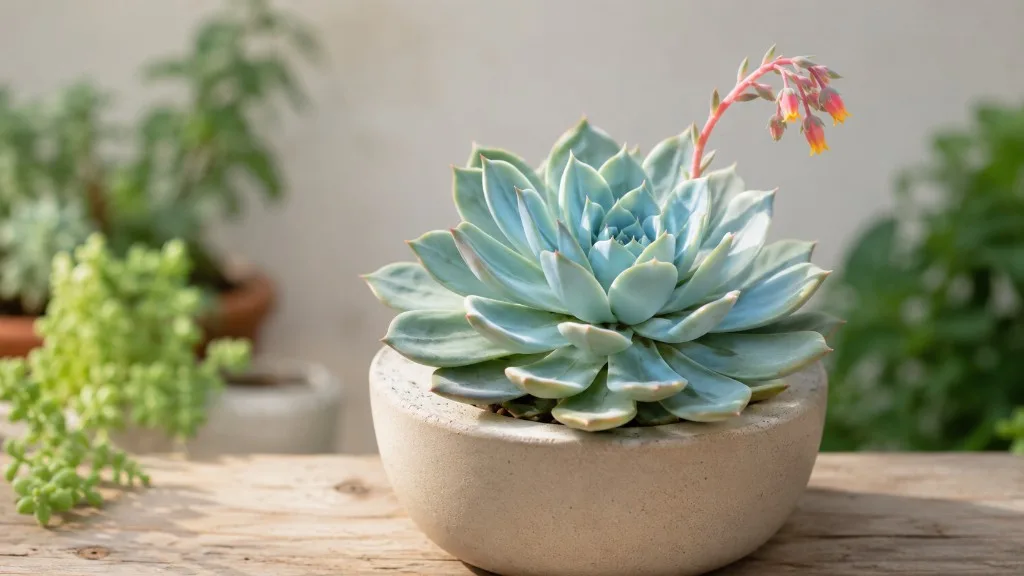
Echeveria is sold as a low-maintenance windowsill succulent, which is half true. It is drought-tolerant and forgiving of missed waterings - but it is not forgiving of dim rooms. These rosette succulents evolved on sun-exposed rocky slopes and semi-arid highlands in Mexico and Central America, where light is intense, day length is long, and there is no forest canopy to soften the beam. Indoors, that biology translates into a simple rule: Echeveria needs bright light with several hours of direct sun to keep its signature tight rosette. Give it “houseplant bright” - the kind of spot where a pothos looks fine - and within weeks you will see etiolation: a stretched stem, wide gaps between leaves, and a pale green plant reaching toward the window like it is trying to escape the room.
The practical indoor band is bright direct to bright indirect light, with the pot close enough to the glass that leaves receive real photons, not just ambient room brightness. A south or east window often works; a north window or a shelf across the room usually does not, at least not long-term without a full-spectrum grow light. The RHS Plant Guide notes that echeveria enjoy bright but indirect light indoors, with east-facing windows offering gentler morning sun and south-facing exposures supporting compact growth when unobstructed - especially in winter when sun angle and intensity drop.
This guide covers the decisions that keep rosettes compact: how much light Echeveria actually needs, direct sun vs bright indirect indoors, window placement, etiolation signs and fixes, grow light setup, stress color vs unhealthy fade, and safe acclimation when you move a plant brighter or outdoors for summer.
How Much Light Echeveria Actually Needs
Echeveria is a high-light succulent, not a shade-tolerant foliage plant. In cultivation, most species and hybrids perform best with roughly six to eight hours of strong light daily, including some direct sun when acclimated. That is not six hours of “the room feels bright to human eyes.” It means the rosette itself sits in a high-flux zone - typically within 6 to 12 inches (15 to 30 cm) of an unobstructed window or under a grow light delivering meaningful intensity at leaf level.
Outdoors in partial sun, Echeveria often thrives with dappled or morning direct light and bright ambient exposure the rest of the day. Indoors, glass cuts intensity and filters UV, so the same plant usually needs the brightest window you can offer or supplemental lighting. The RHS cacti and succulents growing guide classifies echeveria among succulents that want full sun to partial sun in outdoor settings - a signal that indoor “bright indirect only, never direct” advice is too conservative for long-term rosette health, even if it prevents beginner scorch in week one.
Light quantity also interacts with watering and rot risk. A bright, correctly lit Echeveria uses water on a predictable rhythm and keeps leaves firm. A dim Echeveria grows slowly, stays wet longer in the same mix, and becomes structurally weak - which makes overwatering on Echeveria injuries more likely even when your calendar says you waited long enough. Treat light as the throttle for the whole care system.
The Short Answer for Busy Growers
If you only remember four rules, use these. Placement target: brightest window available - south or east first, west with caution, north only with a grow light. Distance: pot within 6 to 12 inches of the glass, not on a distant shelf. Daily total: aim for six or more hours of strong light, including one to four hours of gentle direct sun on acclimated plants; extend with 12 to 14 hours under a full-spectrum LED when windows fail in winter. Read new growth: compact, firm, correctly spaced leaves mean the light works; stretching, pale green, downward-tilting outer leaves mean increase brightness before changing water or soil. Acclimate every jump: move brighter over 7 to 14 days, not in one afternoon.
Give any new placement 10 to 14 days before declaring failure. Old stretched leaves do not un-stretch; only new leaves tell you whether the current light is enough.
Why Echeveria Needs More Light Than Most Houseplants
Human vision is a terrible light meter for succulents. A room that feels adequately lit to you may deliver a fraction of outdoor photon flux at the leaf surface. Indoor light through glass is substantially weaker than outdoor sun - which explains why Echeveria that looked perfect on a nursery bench can etiolate on an indoor coffee table that seemed “near the window,” as the RHS emphasizes bright placement for compact rosettes.
Echeveria stores water in thick leaves and slows metabolism when stressed, so it can survive low light longer than a fern or calathea. Survival is not the goal. Without enough light, the plant abandons compact rosette architecture and enters shade-escape morphology - longer internodes, smaller new leaves, weaker stem tissue, and reduced pigment investment. That is etiolation. It is reversible only in the sense that new growth can be compact after you fix light; the old stretched section remains stretched unless you remove it.
Native Highlands and the Compact Rosette Shape
Wild Echeveria spp. grow in open, rocky habitats with strong UV exposure and sharp day-night temperature swings. The tight rosette is not decorative accident; it is a light-harvesting and water-conservation structure that minimizes exposed surface area while maximizing photosynthetic tissue orientation toward the sky. High light keeps internodes short. Low light triggers elongation because the plant is literally searching for a brighter patch.
Many Echeveria also produce farina - the powdery epicuticular wax on leaves such as Echeveria ‘Lola’ or Echeveria lilacina - which acts as UV and moisture protection. Farina develops best under strong light. In dim conditions, farina may thin and leaves look shinier and greener, not because the plant is “happier,” but because it is prioritizing basic photosynthesis over protective coating. Stress anthocyanin pigments - pink, red, or purple leaf margins and blush - similarly require adequate light flux to express; a colorful cultivar like ‘Perle von Nürnberg’ or ‘Black Prince’ often looks flat green in a dim office until you increase brightness.
Direct Sun vs Bright Indirect Light Indoors
Bright indirect light means strong ambient illumination without prolonged harsh rays on the leaf surface - think a few feet back from a sunny window or direct sun filtered through a sheer curtain. Direct sun means unfiltered or lightly filtered rays hit the rosette for part of the day. Echeveria uses both indoors, but the balance depends on acclimation state, window direction, season, and cultivar.
For many growers, the winning indoor formula is bright indirect light most of the day plus direct morning sun - especially through east glass. That pattern delivers intensity without the leaf-cooking combination of hot afternoon west or south glass in summer. South windows in winter often behave like a gift for Echeveria; the same south window in midsummer may need diffusion or a slight pull-back from the pane.
Direct sun is not optional luxury for most Echeveria long-term. It is how you keep leaf spacing tight and stem thickness adequate. Pure bright indirect can work if the indirect is genuinely bright - close to a large unobstructed window - but the common failure mode is assuming indirect is enough when the plant is actually receiving moderate shade at leaf level.
When Direct Sun Produces the Best Rosettes
Direct sun helps most when it is gentle, consistent, and acclimated:
- East windows provide cool morning direct rays that firm up leaves and deepen stress color without the thermal spike of late afternoon.
- South windows in fall, winter, and early spring (northern hemisphere) often deliver ideal direct-sun hours at manageable leaf temperatures.
- Acclimated nursery or outdoor-season plants that already formed leaves under strong light tolerate more direct exposure than a plant grown under shade cloth and shipped to a dim apartment.
Under adequate direct sun, new leaves emerge closely stacked, the rosette stays flat or slightly cupped, and many cultivars show stronger marginal color. Outer leaves may tilt slightly upward or inward - normal posture - rather than splaying downward.
Watch for positive stress signals vs damage: a pink or red rim on ‘Black Prince’ after brighter exposure often means healthy pigment response; a bleached white patch on the same leaf means too much, too fast.
When Indirect Light Is the Safer Indoor Default
Bright indirect becomes the safer default when direct sun would outpace the plant’s current defenses:
- Newly purchased shade-grown plants with soft, wide-spaced leaves and thin farina.
- Farina-heavy species where scrubbing or burning the wax coat permanently marks leaves.
- West-facing summer glass that turns into a magnifier after 2 p.m.
- Recently repotted or root-disturbed plants that are slightly stressed and cannot afford simultaneous light shock.
In those cases, start with strong indirect close to glass, then add 30 to 60 minutes of early direct sun every few days while inspecting the newest leaves. Indirect is a ramp, not a permanent destination for most Echeveria - unless your cultivar consistently scorches in your climate even when acclimated, which happens on some very pale or variegated hybrids.
Best Window Placement for Echeveria Indoors
Compass labels are starting guesses. A “south window” blocked by a porch roof may lose to an open east window. What matters is measured brightness at the rosette, which you proxy with new growth quality and, optionally, a phone-compatible PAR meter.
Rotate the pot a quarter turn every few days if growth leans hard toward the glass. Echeveria does not need even 360-degree symmetry for health, but one-sided etiolation on single-window setups is common when rotation stops.
South, East, West, and North Exposures Compared
A south-facing window (northern hemisphere) delivers the strongest winter sun and is often the best year-round Echeveria anchor if the pot sits close to the pane. In summer, watch for one-sided bleaching on leaves touching hot glass. A sheer curtain or 6 to 12 inches of pull-back from the window during heat waves prevents scorch while preserving brightness.
An east-facing window is the most forgiving premium placement. Morning direct sun is bright but cooler than afternoon rays. Many Echeveria that scorch on west windows thrive east, especially farina-coated types and colorful hybrids that need intensity without midday heat load.
A west-facing window supplies strong afternoon direct sun - high reward, high scorch risk. Use west when east and south are unavailable, prefer filtered late-day light, and acclimate slowly. West is often where beginners lose a plant in one sunny afternoon after a dim shelf stint.
A north-facing window rarely sustains compact Echeveria without supplementation except in very bright high-latitude summer rooms. North can keep a plant alive and slowly growing, but expect etiolation, color fade, and wet-soil risk over months. Treat north as grow-light territory if you want display-quality rosettes.
How Close the Pot Should Sit to the Glass
Light falls off fast with distance. A rosette on the sill receives dramatically more flux than the same plant on a table three feet away that still “faces” the window. Practical rule: keep the top of the rosette within 6 to 12 inches (15 to 30 cm) of the glass on the brightest suitable window. In winter, closer often helps; in summer heat, slightly farther with diffusion may be safer than leaf contact with glass.
Hanging planters and deep window sills can mislead you - the room looks sunny while the plant canopy sits in a shadow pocket. Lower the pot or raise the plant surface until direct sky view from the rosette’s perspective improves. If you cannot sit closer without heat damage, add a grow light rather than accepting middle-room brightness.
Etiolation: What Stretching Looks Like and Why It Happens
Etiolation is the plant’s response to chronic insufficient light: internode elongation - visible stretching between leaves along the stem - combined with paler, thinner new growth and often downward splay of outer leaves as the rosette loses structural tightness. It is not a disease and not a watering problem first, though dim plants do stay wet longer. It is a light deficit signal.
Etiolation happens gradually, which is why beginners normalize it. Week one after a move to a dim shelf, the plant looks fine - old compact leaves hide the problem. By week four, the rosette sits on a miniature palm-tree stem and new leaves look smaller and greener than when you bought it. At that point the plant is not ” adapting”; it is re-architecting for shade escape.
Severely etiolated Echeveria is also sunburn-prone if you jump it to harsh direct outdoor sun without acclimation, because the elongated stem and weak leaf tissue cannot handle sudden flux. Fix light in steps.
Early Warning Signs of Too Little Light
Catch etiolation early by watching new leaves only:
- Increasing space between leaf pairs on the newest part of the stem - the gap that should be millimeters becomes centimeters.
- Smaller new leaves compared to older ones at the rosette center when the plant should be in active growth.
- Uniform pale green on a cultivar that should show blue, purple, or pink tones - especially on ‘Perle von Nürnberg’, ‘Black Prince’, or blue farina types.
- Downward tilt of outer leaves and a flattening rosette profile as the plant presents more surface area toward the light source.
- Directional lean toward the window or lamp that worsens weekly even after rotation.
- Slow dry-down in the same pot and mix that dried quickly in summer - often coupled to dim winter light, not “mysterious root death.”
If two or more signs appear together over 10 to 14 days, increase light before tweaking fertilizer or Echeveria repotting guide.
Fixing a Stretched Echeveria Without Starting Over
Mild etiolation - slightly longer stem, still mostly compact top - often resolves by moving brighter and waiting for two to three rounds of new leaf pairs under better light. The old stretched section remains, but the rosette crown can look normal again.
Moderate etiolation with a bare stem below a healthy top rosette responds well to beheading: cut the rosette head with a clean knife, let the cut callus two to five days, then re-root in fast-draining mix under bright light. The stub often pushes pups from the old stem. This is standard succulent practice and preferable to pretending the stem will compress back down - it will not.
Severe etiolation - long weak stem, tiny pale leaves, top-heavy flop - is harder to salvage aesthetically. Increase light immediately to stop worsening, behead if the top is still healthy, and propagate leaf cuttings from firm leaves as backup. Honest limit: a plant that etiolated for many months in a dark corner may never become a show specimen without reconstruction.
Grow Lights When Natural Light Falls Short
When windows cannot deliver enough daily flux - north exposures, winter at mid and high latitudes, office desks, interior rooms - a full-spectrum LED grow light is the most reliable fix. Echeveria responds well to artificial light if intensity at leaf level is high enough. Budget “plant bulbs” that look bright to humans often deliver under 100 µmol/m²/s PPFD at typical hanging distances, which is too weak to prevent stretching for rosette succulents; When supplementing window light, aim for bright full-spectrum LED output strong enough that new leaves stay compact - if stretching continues after two weeks, increase intensity or photoperiod rather than guessing a fixed lux number, following the RHS principle of matching light to active growth.
You do not need laboratory gear to start. Use new growth as feedback: if stretching continues after two weeks, lower the fixture or add hours; if leaves bleach, raise it.
Fixture Height, Hours, and Spectrum for Rosette Succulents
A workable starting setup for indoor Echeveria:
- Fixture type: horticultural full-spectrum white LED (roughly 5000 to 6500 K), not a standard room bulb optimized for lumens.
- Distance: 6 to 12 inches (15 to 30 cm) above the top of the rosette for many small LED panels and clip lights; wider or higher-watt fixtures may need 10 to 16 inches to avoid hot spots. Low-wattage clip lamps often must stay closer than large panels.
- Photoperiod: 12 to 14 hours daily on a timer during active growth seasons; succulents still need 8 to 10 hours of darkness for normal metabolism - do not run lights 24/7.
- Combination strategy: window plus lamp often beats either alone in winter, reducing lean and evening out cloudy weeks.
Adjust one variable at a time. If new leaves still etiolate after 14 days, lower the fixture 2 inches or add one hour to the timer - not both simultaneously. If bleached spots or crispy tips appear only under the lamp, raise the fixture 2 to 3 inches or reduce hours slightly. Heat buildup on enclosed shelves matters even with LEDs; if leaves feel hot to the touch at midday, increase airflow or distance.
For overwintered plants you plan to move outdoors in spring, use grow lights to hold compact form, not to force unnatural summer-speed growth in December. Transition outside with the same 7 to 14 day acclimation you would use for any light increase.
Stress Colors, Farina, and Faded Green Growth
Echeveria color is light-dependent chemistry, not a static paint job. Anthocyanin pigments produce red, purple, and pink stress tones on margins and leaf faces when light flux and sometimes temperature swings cross cultivar-specific thresholds. Farina produces powder-blue or silvery surfaces on species like Echeveria lilacina. Both require adequate light to express fully.
A colorful Echeveria turning uniform dull green in a dim room is usually a light problem, not a fertilizer deficiency. Feeding a shade-stretched plant does not restore compact form or pigment; increasing brightness does, within genetic limits.
Distinguish healthy stress color from damage:
- Healthy stress: gradual pink/red/purple deepening on edges after brighter acclimated exposure; farina thickening slightly; rosette remains firm and tightly stacked.
- Unhealthy fade or damage: sudden white bleached patches, tan crispy spots, translucent scorched zones, or limp leaves after a move - those are excess light or heat, not Instagram-worthy stress.
Variegated or pale Echeveria hybrids scorch faster than dark thick-leaved types because lighter tissue lacks pigment shielding. Give them bright indirect plus gentle morning direct, not unfiltered west summer blast.
Acclimating Echeveria to Brighter Light Safely
Every leaf is a record of the light in which it formed. Soft shade-grown tissue cannot jump to outdoor noon sun in one step. Acclimation - gradual exposure increase over 7 to 14 days - lets new leaves build tolerance while you watch for scorch on existing ones.
Basic acclimation protocol:
- Start at the current acceptable brightness for three to five days after any move or purchase quarantine.
- Add 30 to 60 minutes of direct sun (or move 6 inches closer to the window) every two to three days if new leaves look clean.
- Pause or step back if bleaching, crisp brown patches, or sudden leaf collapse appears - resume only after one week of stable new growth.
- Change only light during acclimation; do not simultaneously repot, heavy-water, or fertilize.
For indoor-to-outdoor summer moves, begin when overnight lows stay above roughly 50°F (10°C). Place the pot in full shade or bright indirect outdoors for several days, then shift into morning direct sun, then into the target patio spot. The RHS recommends bringing plants indoors well before the first frost after summer outdoors; use at least one week of gradual transition before full outdoor exposure, with protection during the hottest midday hours for specimens grown indoors most of the year.
Reverse acclimation matters too: bringing an outdoor summer plant straight to a hot south windowsill in autumn can scorch. Step through bright indirect indoors first, then closer to glass over a week.
Warning Signs Your Echeveria Has the Wrong Light
Echeveria reports problems on new tissue first. Old scorched or stretched leaves never revert; read the youngest leaves and the next leaf pair after any change. Make one adjustment, then wait 10 to 14 days before also changing water, fertilizer, or pot size - overlapping stressors make diagnosis guesswork.
Too little light - etiolation and fade:
- Visible stem stretching with widening gaps between leaves.
- Smaller, paler new leaves; cultivar color lost to plain green.
- Outer leaves splaying downward; rosette looks flat or floppy, not crisp.
- Persistent lean toward the window despite rotation.
- Slow growth and slow soil dry-down in warm months.
Fixes: move closer to glass, shift to south or east, remove obstructions, add or lower a grow light, extend photoperiod on a timer, behead and re-root if stem length is extreme.
Too much light - scorch and bleach:
- White or tan crispy patches on sun-facing leaf surfaces, especially after a sudden move.
- Brown dried tips or translucent scald spots on farina-coated leaves where wax was damaged.
- Sudden leaf drop or collapse after relocation to harsh direct sun without acclimation.
- Downward curling during peak hours combined with leaf temperature hot to the touch on window glass contact.
Fixes: pull back from glass, add sheer diffusion, shift to east or filtered light, acclimate more slowly, avoid dark pots on blazing surfaces that cook roots while leaves bleach.
Conclusion
Echeveria light needs are not negotiable if you want the plant you saw on the tag. These succulents demand bright light with direct sun when acclimated - six or more strong hours daily, with the rosette close to the window or under a full-spectrum LED that actually delivers usable intensity at leaf level. East and south windows are the usual winners indoors; north and middle-room shelves require supplementation. Etiolation - stretching, pale green growth, wide leaf spacing - means increase brightness, not fertilizer. Scorch and bleach mean step back and acclimate more slowly.
Read new leaves, not memory of the old compact rosette. Move light in 7 to 14 day steps, pair brighter light with adjusted watering, and use beheading when moderate stretch already happened. Get the light band right and Echeveria becomes one of the most rewarding indoor succulents - compact, colorful, and structurally sound. Miss it and even perfect drainage produces a leggy green stranger that no amount of careful watering will turn back into a tight rosette.
When to use this page vs other Echeveria guides
- Echeveria overview - Start here for whole-plant context before deep-diving this topic.
- Echeveria problems hub - Jump to symptom-specific fix guides when this care topic does not resolve the issue.
- Not Enough Light on Echeveria - Escalate here when light adjustments are not enough.
- Leggy Growth on Echeveria - Escalate here when light adjustments are not enough.
Related Echeveria guides
- Echeveria overview
- Echeveria watering
- Echeveria soil
- Echeveria propagation
- Echeveria fertilizer
- Echeveria repotting
- Not Enough Light on Echeveria
- Leggy Growth on Echeveria
- Echeveria problems
Related tool
Try the Plant Problem Diagnosis Tool with echeveria pre-selected to estimate needs for your setup.