Not Enough Light on Echeveria: Causes, Checks & Fixes
Quick answer
Echeveria needs bright light with several hours of direct sun daily. When light is too weak, rosettes stretch upward (etiolation), lean toward windows, and lose compact form. First step: move the pot to your brightest south- or west-facing window and watch whether new leaves stay tight within two weeks.
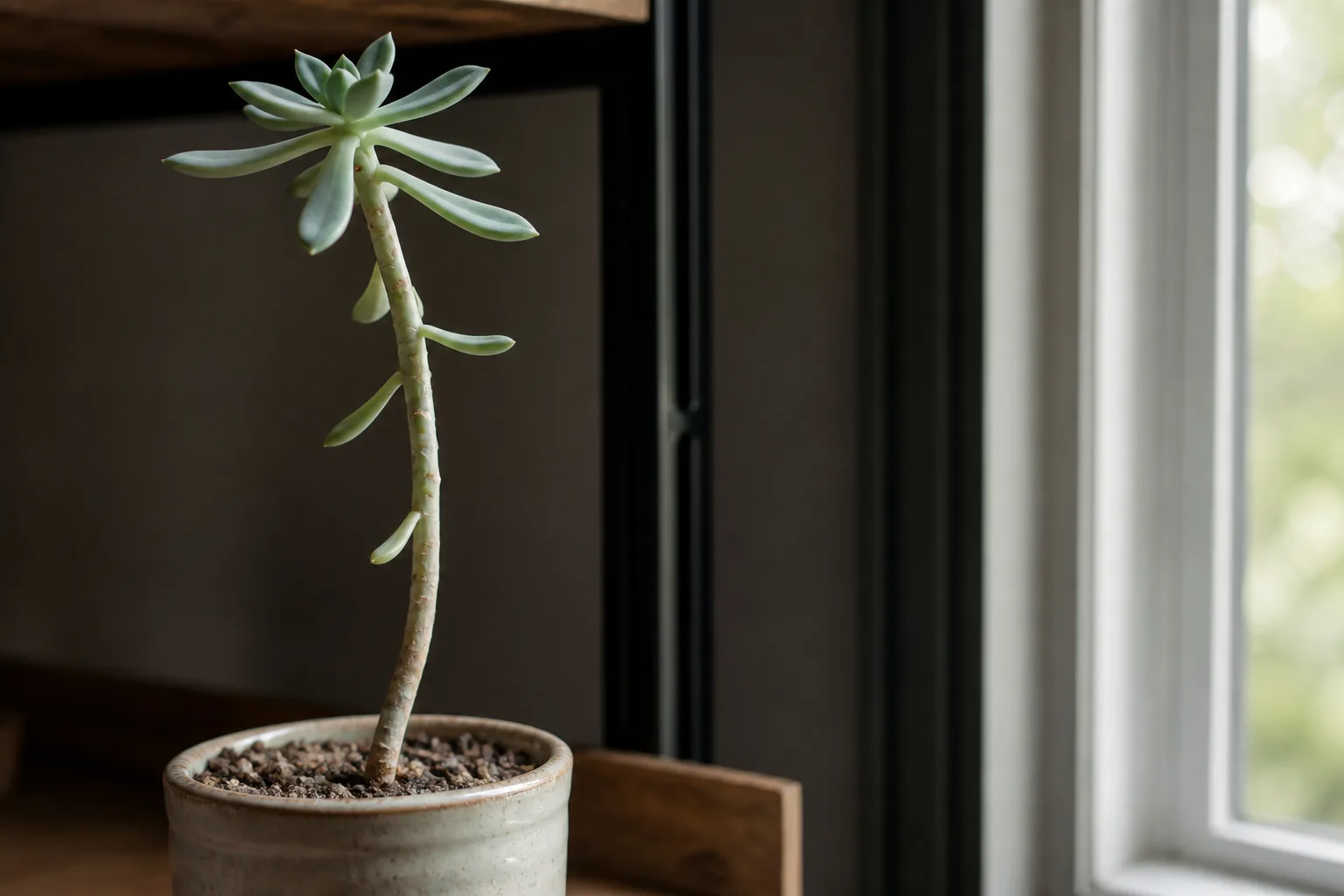
Not Enough Light on Echeveria: Causes, Checks & Fixes
This guide covers not enough light on Echeveria. See also the general Not Enough Light guide, watering, and light pages for this plant.
Not Enough Light on Echeveria: Causes, Checks & Fixes
Quick answer
Echeveria is built for semi-arid highland sun. Its tight rosette is the whole point of growing it-and that shape collapses quickly when photosynthesis cannot keep up. In weak indoor light the plant etiolates: it stretches toward the window, leaves space out along a lengthening stem, and new foliage stays pale or dull green.
First step: move the pot to the brightest location you can offer-typically a south- or west-facing window where leaves receive several hours of direct sun daily. Do not repot, fertilize, or soak the plant on day one. Watch new leaf spacing for about two weeks before any secondary fixes like beheading.
Why Echeveria runs out of light
Echeveria evolved in bright, dry highland conditions in Mexico and Central America. It stores water in thick leaves and expects strong light to drive compact growth. Without enough photons, the plant cannot maintain the tight rosette collectors prize-it literally reaches for energy.
Indoors, the mismatch is extreme. A rosette that looked perfect under greenhouse benches often lands on a coffee table, bathroom shelf, or north window where usable light drops with every foot from glass. What feels “bright” to human eyes may still be low light for a succulent that wants direct sun for much of the day.
Distance and season both matter. Light intensity falls sharply as you move away from windows. Winter shortens daylight even at the same sill, so an acceptable October spot may trigger stretch by January. Overhangs, tinted glass, sheer curtains left closed, and neighbouring buildings all steal the hours Echeveria needs.
Low light also slows the plant’s water use. Soil stays wet longer in dim corners, which pairs poorly with Echeveria’s soak-and-dry rhythm. The same Echeveria watering guide that worked in summer sun becomes excessive in a dark room-and wet cool mix plus weak growth is how stem rot starts at the rosette base.
What not enough light looks like on Echeveria
On rosette succulents, insufficient light shows in structure before colour alone:
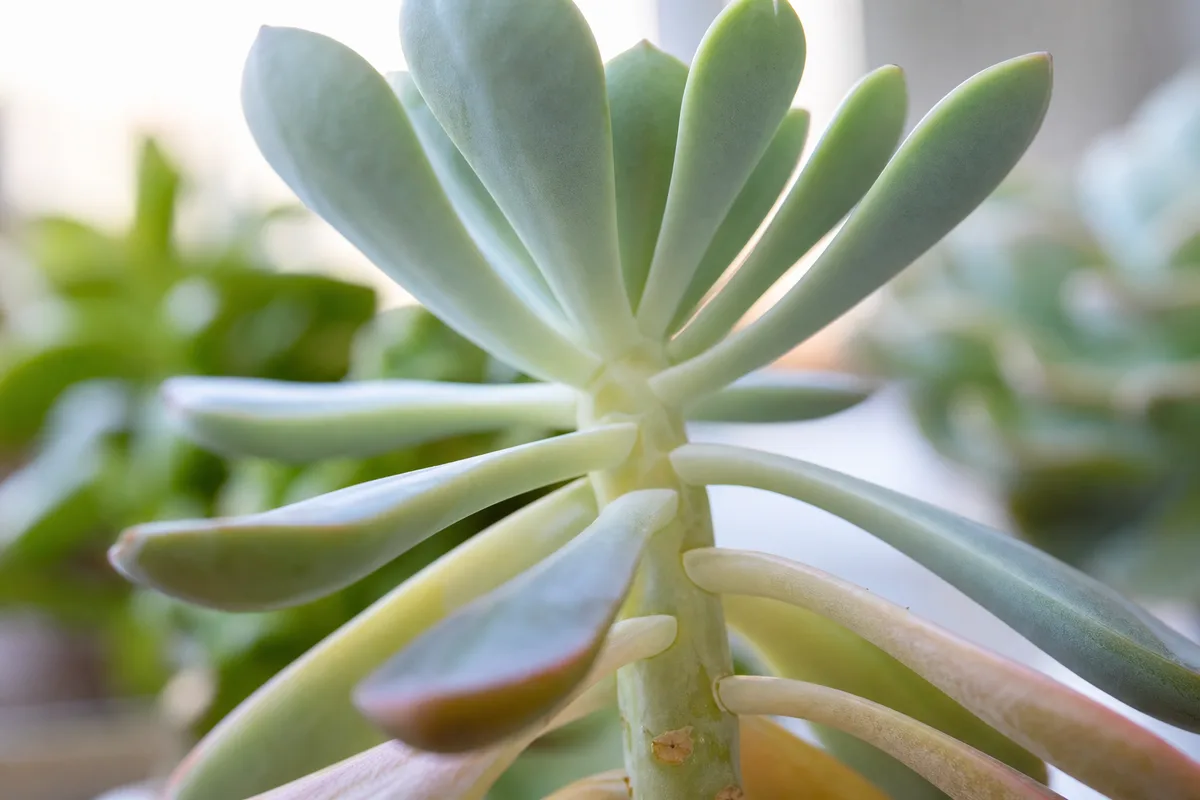
Visible internode stretch between spaced-out pale rosette leaves - classic etiolation when Echeveria lacks bright direct light indoors.
- Etiolation-the rosette rises on a lengthening stem with visible gaps between leaf pairs; leggy, lighter stems are a classic insufficient-light signal on succulents
- Leaning or one-sided growth toward the brightest window or lamp
- Flattened, loose rosette instead of a tight cup shape
- Smaller, thinner new leaves compared with older compact foliage
- Pale or washed-out green; stress colours (pink, red, purple edges) fade when light is weak
- Slow or stalled growth through spring and summer
- No flower stalk even when the plant otherwise looks healthy
- Lower leaves dropping eventually as the plant reallocates energy upward
Early etiolation can be subtle-slightly wider spacing on the newest leaves. Left uncorrected, Echeveria can turn into a “palm tree” shape: a small rosette on top of a bare, bendable stalk. That pattern is classic low light on rosette succulents, not random bad luck.
Echeveria in weak light also dries slowly. The pot stays heavy for days after watering because transpiration is limited. If you see stretch and soil that will not dry, treat light and watering together-not light alone.
How to confirm the cause
Work through these checks before changing fertilizer, Echeveria repotting guide, or watering heavily:
- Window audit - Identify direction and distance. South- or west-facing windows are the strongest indoor sites for succulents; glass within about two feet is strongest indoors. North windows rarely keep Echeveria compact without grow lights.
- Shadow test at midday - Hold your hand between the plant and the window. A sharp, dark shadow suggests usable direct or bright light. A faint or absent shadow means the spot is too dim for a sun-loving rosette succulent.
- New growth comparison - Mark where the newest leaf pair sits today. After two weeks in a brighter spot, spacing between new leaves should tighten. If the stem keeps lengthening, light is still insufficient-or the move was too small to matter.
- Leaf texture cross-check - Firm, plump leaves with stretch point to light. Soft, translucent lower leaves that mash easily between fingers point to overwatering on Echeveria or rot, especially if soil smells sour.
- Pot weight and moisture - Lift the pot. Chronic heaviness with stretch in a dim room suggests slow evaporation; cut watering frequency when you improve light. A very light pot with wrinkled outer leaves fits underwatering on Echeveria better than etiolation alone.
- Pest scan - Mealybugs hide in leaf axils and can weaken rosettes, but they leave white waxy residue-not the uniform internode stretch of etiolation.
If the plant already sits in several hours of direct sun and still looks weak, look elsewhere: root rot on Echeveria from wet mix, mealybugs, or recent repot shock.
First fix for Echeveria
Move the pot to the brightest appropriate window and leave it there for two weeks before any other intervention.
Place it on a south- or west-facing sill where leaves receive at least four hours of bright, direct light daily-the baseline Missouri Botanical Garden cites for cacti and succulents indoors. An east window can work for mild climates or summer months but may fall short through winter. If the only upgrade is from a dark interior to intense all-day sun, increase exposure gradually over one to two weeks so leaves do not scorch.
Do not repot on day one. Do not fertilize a stretched plant hoping to “push” compact growth-fertilizer cannot replace light. Do not water heavily because the rosette looks sad; check soil first. Do not behead until new growth in brighter light proves the diagnosis, unless the stem is already too weak to support the head.
Step-by-step recovery
After the initial move:
- Rotate the pot a quarter turn every few days so all sides receive light and the rosette stops leaning permanently one direction.
- Add supplemental lighting if windows are weak - Full-spectrum LED or fluorescent fixtures six to twelve inches above the rosette for twelve to sixteen hours daily can preserve compact form through winter; Maryland Extension recommends no more than about sixteen hours of total daily light when combining natural and artificial sources. Use a timer so duration stays consistent.
- Adjust watering downward in dim-to-bright transition only if soil was staying wet for many days; in stronger light near a sunny window, check more often because evaporation increases.
- Behead severely etiolated rosettes after light improves - Once new growth at the tip looks tight, cut the rosette off with a clean blade, let the cut callus several days, then place it on dry succulent mix to reroot. The bare stem often produces offsets; lower leaves can be propagated separately.
- Remove only dead or rotted tissue - Trim soft, translucent leaves at the base if rot is present; do not strip healthy leaves hoping to fix stretch.
- Clean windows seasonally - Grime and screens cut usable light more than owners expect, especially before winter stretch begins.
If the plant never compacts after four weeks in genuinely brighter conditions, verify roots are firm and white-not brown and mushy from chronic wet soil in the old dim spot.
Recovery timeline
Expect tighter leaf spacing on new growth within two to three weeks of truly brighter placement. Colour intensity may return on fresh leaves over a similar window once chlorophyll production catches up.
Old stretched stem tissue never shortens-the same plant in brighter light grows compact new leaves, but existing elongated stems do not revert. Success means a compact new rosette at the tip-or a cleanly rerooted beheaded rosette-not a magically shrinking stalk. Flower stalks, if they appear at all, follow once light and seasonal growth align; do not expect bloom from a long-term shelf plant in deep shade.
Lookalike symptoms to rule out
Overwatering and stem rot show soft, translucent lower leaves, sour soil, and a collapsing rosette base while mix stays damp. Common when Echeveria lives in a dim corner on a summer watering schedule. Fix drainage and dry the mix before assuming light alone.
Underwatering wrinkles and thins outer leaves while the rosette center stays firm. The pot feels very light. Stretching is not the primary sign.
Mealybugs leave white cottony patches in leaf axils and sticky residue. They weaken growth but do not create the classic long naked stem of etiolation.
Sunburn bleaches or browns patches on leaves facing intense unacclimated sun. That is too much light intensity too fast-not too little. Diffuse or shift exposure rather than moving back into deep shade.
Normal offset growth at the base of a healthy compact mother rosette is not etiolation. Offsets should stay small and tight; the main stem stretching upward is the low-light signal.
Mistakes to avoid
Do not keep Echeveria as permanent décor on a bookshelf, bathroom counter, or north room without grow lights. It may stay green briefly, then stretch beyond recognition.
Do not blast a plant from a dark corner into midsummer all-day sun in one move. Move plants to direct light gradually so leaves do not scorch; sunburn scars tissue permanently.
Do not increase watering because the rosette looks weak-check light and soil moisture first.
Do not assume fertilizer fixes pale stretch. Without adequate light, feeding can produce soft, elongated growth.
Do not wait until the stem is pencil-thin and floppy before moving the plant. Early correction saves beheading.
Do not confuse etiolation with “reaching for water.” Wrinkled dry leaves mean thirst; long stems with firm plump leaves mean light.
Echeveria care cross-check
Light and watering move together on this succulent. In strong sun the pot dries predictably and the soak-and-dry method works. In weak light the same volume of water sits longer, which is why dim placement plus frequent watering rot the stem at soil level-the fatal pattern on Echeveria.
Temperature matters alongside light. Echeveria grows best around 18–29°C during active seasons and rests cooler in winter with minimal water. A bright but cold windowsill can slow growth; a warm dim shelf stretches faster while soil stays wet.
Humidity is rarely the limiter indoors-Echeveria prefers low humidity under about 40%. Do not mist leaves hoping to compensate for low light; wet foliage in dim corners invites fungal problems without fixing stretch.
How to prevent low-light stress next time
Buy or place Echeveria only where several hours of direct sun is realistic through the year, not just in summer.
Treat the brightest sill as the default home after quarantine-not the spot that fits the room layout.
Install grow lights before winter etiolation begins if your window weakens from October onward. Twelve to sixteen hours of supplemental full-spectrum light preserves rosette form when natural days shorten.
Rotate pots weekly and clean glass seasonally.
Group Echeveria with other high-light succulents under the same fixture so you notice stretch early across the collection.
Research cultivar expectations. Some Echeveria hybrids tolerate Echeveria light guide better than others, but none thrive as permanent low-light plants.
When to worry
Treat as urgent when the rosette collapses in a dark room with wet, sour-smelling soil-unpot and inspect for stem rot immediately while improving light and drying the mix.
Also act when etiolation is so advanced the rosette head wobbles on a thin stalk; behead and reroot before it snaps. Mild early stretch is cosmetic, not an emergency.
Replace or propagate when roots fail after months in corrected light-firm new rosette growth on a rerooted cutting is often faster than saving a rotted base.
Conclusion
Echeveria tells you plainly when light is wrong: the rosette stretches, leans, and loses the compact shape that defines the genus. Move to the brightest suitable window first, confirm with tighter new leaf spacing, then adjust water and consider beheading if old stretch cannot be tolerated. Old elongated stems never shrink back, but proper sun-or honest grow-light supplementation-restores the tight, colourful rosettes Echeveria overview was meant to grow.
When to use this page vs other Echeveria guides
- Echeveria watering guide - Use for routine moisture checks before assuming not enough light is the main issue.
- Echeveria problems hub - Browse all 16 common issues on this species.
- Leggy Growth on Echeveria - Different entry point when symptoms overlap with not enough light.
- Slow Growth on Echeveria - Different entry point when symptoms overlap with not enough light.
- Yellow Leaves on Echeveria - Different entry point when symptoms overlap with not enough light.