Mealybugs on Echeveria: Causes, Checks & Fixes
Quick answer
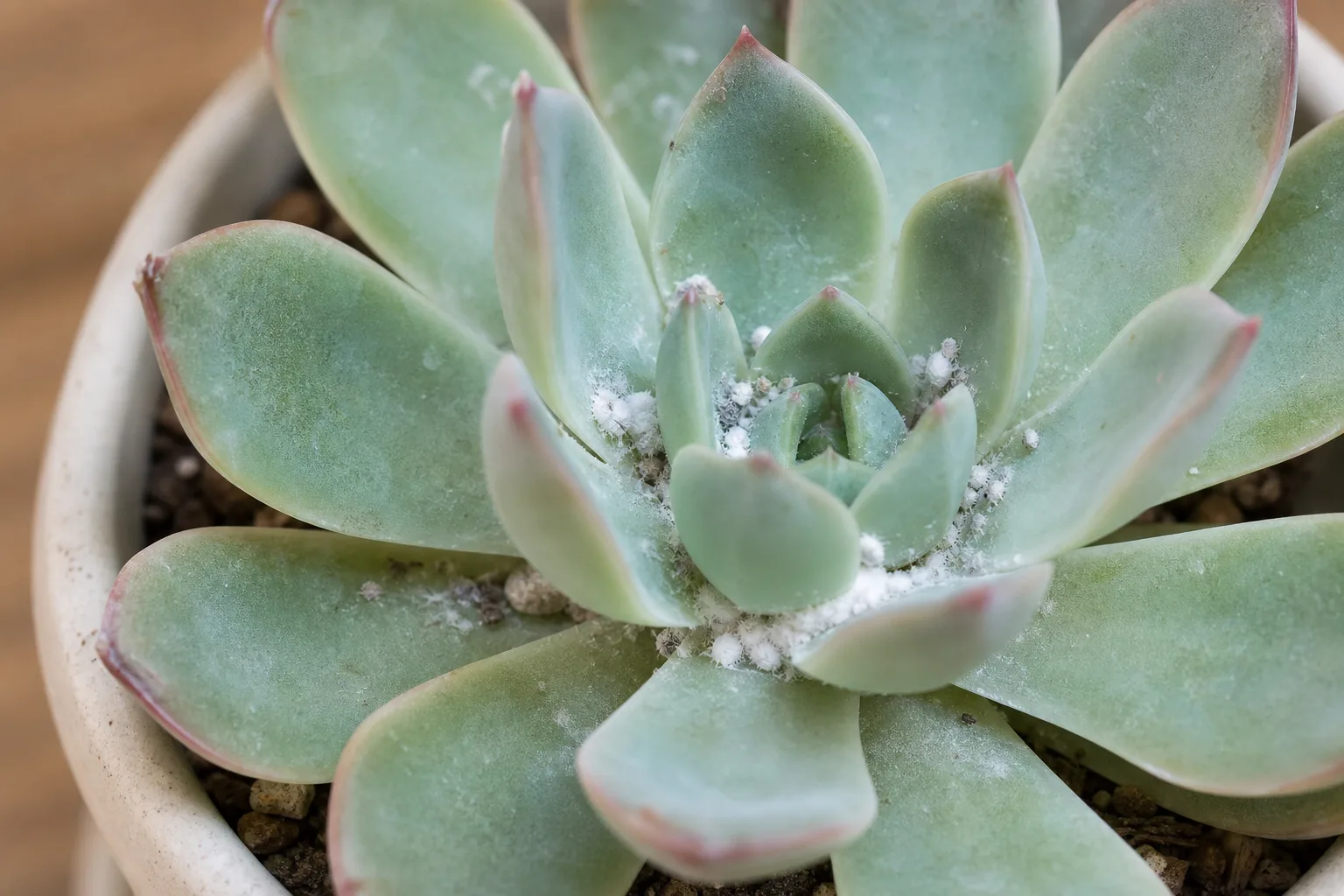
Mealybugs on Echeveria cluster in tight rosette axils, offset bases, and stem joints where leaves overlap. First step: isolate the plant, inspect from below with a hand lens, and dab visible insects with 70% isopropyl alcohol on a cotton swab-patch-test one leaf first on farina-coated cultivars.
Mealybugs on Echeveria: Causes, Checks & Fixes
This guide covers mealybugs on Echeveria. See also the general Mealybugs guide, watering, and light pages for this plant.
Mealybugs on Echeveria: Causes, Checks & Fixes
Quick answer
Mealybugs on Echeveria are small, wax-covered sap feeders that tuck into the sheltered joints this rosette succulent creates-overlapping leaf axils, offset bases, and the crown center where casual top-down watering never reaches. They rarely kill a firm, well-rooted rosette overnight, but they weaken new growth, coat leaves in sticky honeydew, and spread to neighboring succulents within days if left unchecked.
First step: isolate the plant and inspect the rosette from below with a hand lens. Mealybugs hide under overlapping leaves long before you notice white wax from above. Once you confirm live insects, dab each cluster with 70% isopropyl alcohol on a cotton swab or fine brush. On farina-coated blue-gray cultivars, patch-test one outer leaf first-alcohol permanently removes that powdery bloom on the treated area.
What mealybugs look like on Echeveria
Adult mealybugs are soft-bodied insects covered with white, powdery or cottony wax, usually about 3/16 inch long. They gather in colonies rather than scattered singles. On Echeveria, look in these locations:
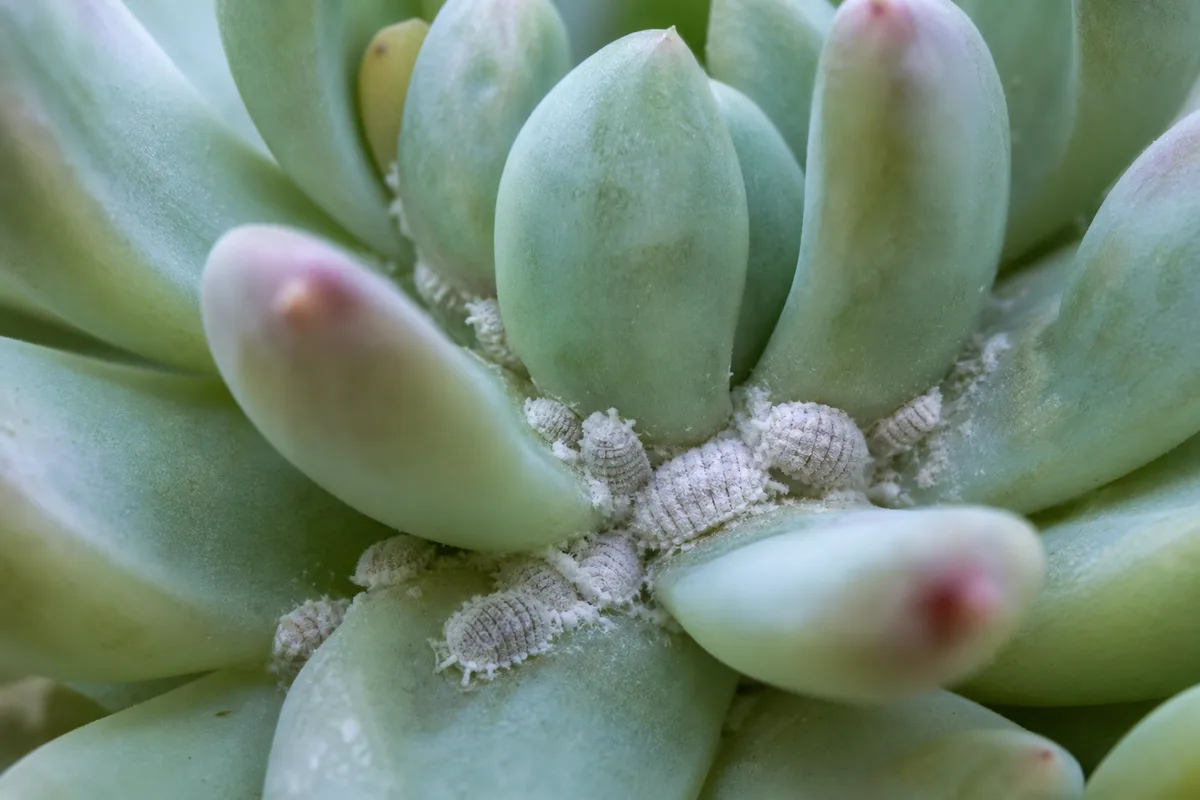
Mealybugs symptoms on Echeveria - compare with healthy tissue on the same plant.
- Rosette axils - where each thick leaf meets the stem, especially in the overlapping layers of a mature rosette
- Crown center - the tightest point where new leaves emerge; wax clusters here are easy to miss from above
- Offset bases - narrow joints where pups attach to the mother plant
- Stem joints and lower leaf undersides - especially on stacked or branching cultivars
- Pot drainage holes and soil surface - a sign of root mealybugs (Rhizoecus spp.) in gritty succulent mix
Supporting signs include white cottony egg sacs, shiny honeydew on leaf surfaces or the pot rim, ants climbing stems to harvest that honeydew, and sooty mold-a black fungal coating that grows on sticky residue, not in the leaf tissue itself. Heavy feeding can yellow or curl outer leaves and slow new center growth. You may also see pale cast skins after nymphs molt.
Older, firm outer leaves on a mature rosette are less attractive to mealybugs than soft new tissue at the center or on fresh offsets. If wax clusters concentrate in axils and joints while outer leaves stay plump, that pattern fits mealybug feeding rather than rot or sunburn.
Why Echeveria gets mealybugs
Echeveria is not uniquely prone among houseplants, but its rosette architecture creates ideal hiding spots. Overlapping leaves shade mealybug colonies from casual inspection until honeydew drips onto lower leaves or the pot edge. Fuzzy-leaved species like E. pulvinata and E. setosa add another layer of camouflage-natural leaf hairs can mask early wax clusters until populations grow.
Introduction routes are straightforward:
- New nursery plants brought home without quarantine
- Outdoor summer placement where mealybugs colonize patio or garden plants and hitchhike indoors in fall
- Nearby infested succulents in a crowded tray or shelf display
- Ant-assisted spread - ants protect mealybug colonies and move crawlers between pots in multi-plant setups
Stressed Echeveria attracts pests faster than a firm, well-lit rosette. Leggy plants in too little light produce soft, stretched growth that mealybugs prefer. Over-fertilizing with high-nitrogen feed during active growth pushes lush shoots that are easier to pierce-mealybugs thrive on tender new growth. Chronically wet soil does not cause mealybugs directly, but root stress slows recovery after feeding damage.
Expect more mealybug pressure during spring and summer active growth when Echeveria produces fresh leaves and offsets. Winter-dormant rosettes in cool, dry conditions grow slowly, but indoor heating keeps colonies active year-round on houseplants.
How to confirm the cause
Work through these checks in order:
- Location on the plant - White cottony clusters in leaf axils, crown center, or offset joints strongly suggest mealybugs. Fixed brown bumps that do not move point to scale instead.
- Crush test - Touch a cluster with a cotton swab. Mealybugs smear pink or reddish when crushed; natural farina wipes off dry and white without a color smear.
- Movement check - Young crawlers may shift slowly when disturbed. Scale insects stay fixed; farina and water spots do not move at all.
- Honeydew and ants - Sticky residue that returns within a day after wiping, plus ant activity, confirms sap feeders. Mineral dust on farina-coated leaves wipes off dry and does not attract ants.
- Magnified inspection - A 10× hand lens reveals segmented bodies and waxy filaments on mealybugs. Aphids are pear-shaped without wax coating; spider mites are nearly microscopic and come with fine webbing on stressed, dry plants.
- Root-mealy screen - White wax at drainage holes or on roots when you lift the plant from its pot suggests soil-dwelling mealybugs-common in fast-draining succulent mix where grit hides insects below the surface.
- Whole-collection scan - Check pots within two feet. Mealybugs spread to other rosette succulents, kalanchoes, and soft-stemmed plants quickly.
If you find white residue but no insects or honeydew, reconsider natural farina on blue-gray cultivars or leaf fuzz on E. pulvinata before treating.
First fix for Echeveria
Isolate the plant and dab visible mealybugs with 70% isopropyl alcohol on a cotton swab or fine brush.
Move the pot away from other plants immediately-if pests are detected, isolate the plant from others. Tilt the rosette and work from below, hitting axils, offset joints, crown center, and any wax clusters on stems. Dab mealybugs directly with a cotton swab dipped in alcohol; treated insects turn light brown. Avoid soaking the entire rosette on the first pass-target insects, not every leaf surface.
Patch-test one outer leaf first if the plant has a powdery farina coating (E. lilacina, E. peacockii, E. ‘Lola’). Alcohol removes that bloom permanently on treated areas. Wait 24 hours and check for leaf burn before treating the full plant.
Keep the plant in bright indirect light out of hot direct sun after treatment. Echeveria leaves burn more easily when alcohol residue sits on wet or sun-stressed tissue.
Do not apply insecticidal soap or spray alcohol broadly in the same session unless the infestation is severe and you have already isolated the plant. Confirm live mealybugs remain after the first dab pass before adding chemicals.
Step-by-step recovery
After the initial alcohol dabs, continue in this order based on severity:
Light infestation (few visible clusters)
- Repeat alcohol dabs every five to seven days for three to four weeks. Consistency matters more than a single heavy treatment-repeat weekly until the infestation is gone.
- Inspect from below each pass - new crawlers settle in axils you cleared last week.
- Wipe honeydew from lower leaves with a dry cloth so sooty mold does not block light to growing points.
Moderate infestation (multiple axils, one rosette)
- Continue weekly alcohol dabs on all visible insects and egg sacs.
- Supplement with insecticidal soap if colonies persist - use a product labeled for houseplants, spray until insects are wet, and cover leaf axils and stem joints. Repeat every four to seven days for two to three cycles to catch newly hatched crawlers. Spray in early morning or evening, not in hot midday sun.
- Let the rosette dry completely the same day - do not leave liquid pooled in the crown after any spray treatment. Follow soak-and-dry watering once foliage is dry.
- Wash off sooty mold - once insects are gone, wipe honeydew and black mold from leaves with a damp cloth. The mold itself does not require fungicide.
Heavy infestation (wax throughout rosette, multiple plants, or root mealybugs)
- Treat all affected pots on the same weekly schedule so reinfestation does not bounce between neighbors.
- For root mealybugs, unpot, rinse grit from roots, inspect for white wax clusters, and repot into fresh fast-draining succulent mix. Discard heavily infested soil rather than composting indoors.
- If contact methods fail after three full treatment cycles, a systemic houseplant insecticide watered into the root zone may reduce crawler numbers-products containing imidacloprid are labeled for some houseplant mealybug situations. Use only on non-edible ornamentals, follow label directions exactly, and avoid on plants accessible to pets or children. Systemics are less reliable against mealybugs than against many other sap feeders.
- Discard rosettes with mushy stem bases or wax throughout the crown that resists three weeks of consistent treatment-propagate clean offsets from the base if any pups look insect-free.
For collections with repeated outbreaks, inspect every Echeveria in the tray and treat all affected pots together.
Recovery timeline
Within one week of the first thorough alcohol pass, live mealybug counts should drop sharply if you are reaching hidden axils and offset joints.
Three to four weeks of consistent weekly treatment usually clears moderate infestations. Watch for clean new center leaves-that is the best sign the rosette is recovering.
Old damaged leaves may stay slightly yellow or curled until they are replaced by normal growth. Do not expect cosmetic recovery on leaves that were heavily fed upon.
Farina-coated leaves treated with alcohol will show permanent shiny patches where the bloom was removed-new leaves emerge with normal coating.
Worsening signs include fresh wax clusters appearing daily after three treatment cycles, ants spreading between multiple pots, center leaves collapsing while the stem base stays firm-last case may mean rot coinciding with pests and needs separate soil inspection-or root mealybugs reappearing at drainage holes after Echeveria repotting guide.
Lookalike symptoms
| What you see | Likely cause | How to tell apart |
|---|---|---|
| White cottony clumps in leaf axils | Mealybugs | Smears pink when crushed; sticky honeydew nearby |
| Even powdery blue-gray coating on leaf surface | Natural farina | Dry to the touch; no clustering in axils; no honeydew |
| Fixed white or brown bumps on stems | Scale insects | Immobile when touched; no wax filaments |
| Pear-shaped green insects on new growth | Aphids | No waxy coating; often on flower stalks and soft center leaves |
| Fine stippling and webbing | Spider mites | Nearly microscopic; thrives in hot dry air, not tight axils |
| Dense white hairs on leaf surface | Natural fuzz (E. pulvinata, E. setosa) | Hairs fixed to leaf; no honeydew or pink smear |
What not to do
Do not leave the plant in a crowded tray while treating-mealybug crawlers and ants spread to neighbors within days.
Avoid spraying 90% or higher alcohol on Echeveria-it evaporates too quickly and can burn leaf tissue. Stick with 70% for contact kills.
Do not soak the entire farina-coated rosette in alcohol without a patch test; you will permanently strip the powdery bloom across treated leaves.
Skip leaving water or soap pooled in the rosette crown after rinsing or spraying-rot risk rises when the center stays wet in low airflow.
Avoid high-nitrogen fertilizer during an active infestation; soft new growth feeds the next generation of mealybugs.
Do not assume one alcohol session solved it-crawlers hatch over several weeks and resettle in axils you already cleared.
Avoid treating with soap or alcohol on sun-stressed plants in hot direct light-succulent leaves burn more easily when pores are coated and temperatures are high.
Do not compost infested prunings or soil indoors where crawlers can reinfest clean pots.
Echeveria care cross-check
Mealybug recovery goes faster when baseline care is stable:
- Light - bright light with several hours of direct sun keeps growth compact; weak light produces soft stretched tissue pests prefer
- Water - soak-and-dry only when soil is bone dry; never let the pot sit wet after any liquid treatment
- Soil - fast-draining succulent mix; soggy peat holds moisture against the stem base and hides root mealybugs
- Airflow - space pots so rosettes dry quickly after any water or spray contact
- Season - expect more mealybug pressure during spring and summer growth; reduce scouting frequency in winter when Echeveria is nearly dormant
How to prevent mealybugs next time
Quarantine new plants and outdoor-return pots for two weeks before placing them beside other succulents-quarantine and monitor newly purchased plants during that window. Inspect rosette axils, offset bases, and drainage holes during that period.
Scout weekly during active growth, tilting rosettes to view overlapping leaf layers from below. One axil checked early prevents a tray-wide outbreak later.
Keep Echeveria firm and well-lit rather than overfed. Dilute fertilizer to quarter strength once or twice in spring and summer, and skip feed entirely on stressed plants.
When moving plants outdoors for summer, inspect them before bringing them back indoors in fall-mealybugs are common on outdoor succulent collections.
If ants appear on pot rims, find the honeydew source below before the ant trail establishes a long-term mealybug nursery on your Echeveria.
For full species context, see the Echeveria overview.
When to worry
Most single-rosette mealybug problems are manageable with isolation, alcohol dabs, and three to four weeks of follow-up. Escalate when:
- Multiple plants in a collection show live wax clusters at the same time
- Root mealybugs appear at drainage holes or on exposed roots after unpotting
- Sooty mold covers most of the rosette and blocks light to growing points
- Center growth stops while sticky residue and wax clusters remain after three full treatment cycles
- Ants farm honeydew across an entire succulent tray-you must treat every infested pot on the same schedule
A heavily wax-coated rosette with a firm stem base can still be saved by treating axils and letting clean offsets take over. Discard only when the stem is mushy at soil level-that is rot, not mealybug damage alone. When in doubt, propagate insect-free offsets into fresh mix and discard the heavily infested mother rosette rather than fighting chronic reinfestation for months.
When to use this page vs other Echeveria guides
- Echeveria watering guide - Use for routine moisture checks before assuming mealybugs is the main issue.
- Echeveria problems hub - Browse all 16 common issues on this species.
- Yellow Leaves on Echeveria - Different entry point when symptoms overlap with mealybugs.
- Slow Growth on Echeveria - Different entry point when symptoms overlap with mealybugs.
- Spider Mites on Echeveria - Different entry point when symptoms overlap with mealybugs.