Drooping Leaves on Echeveria: Causes, Checks & Fixes
Quick answer
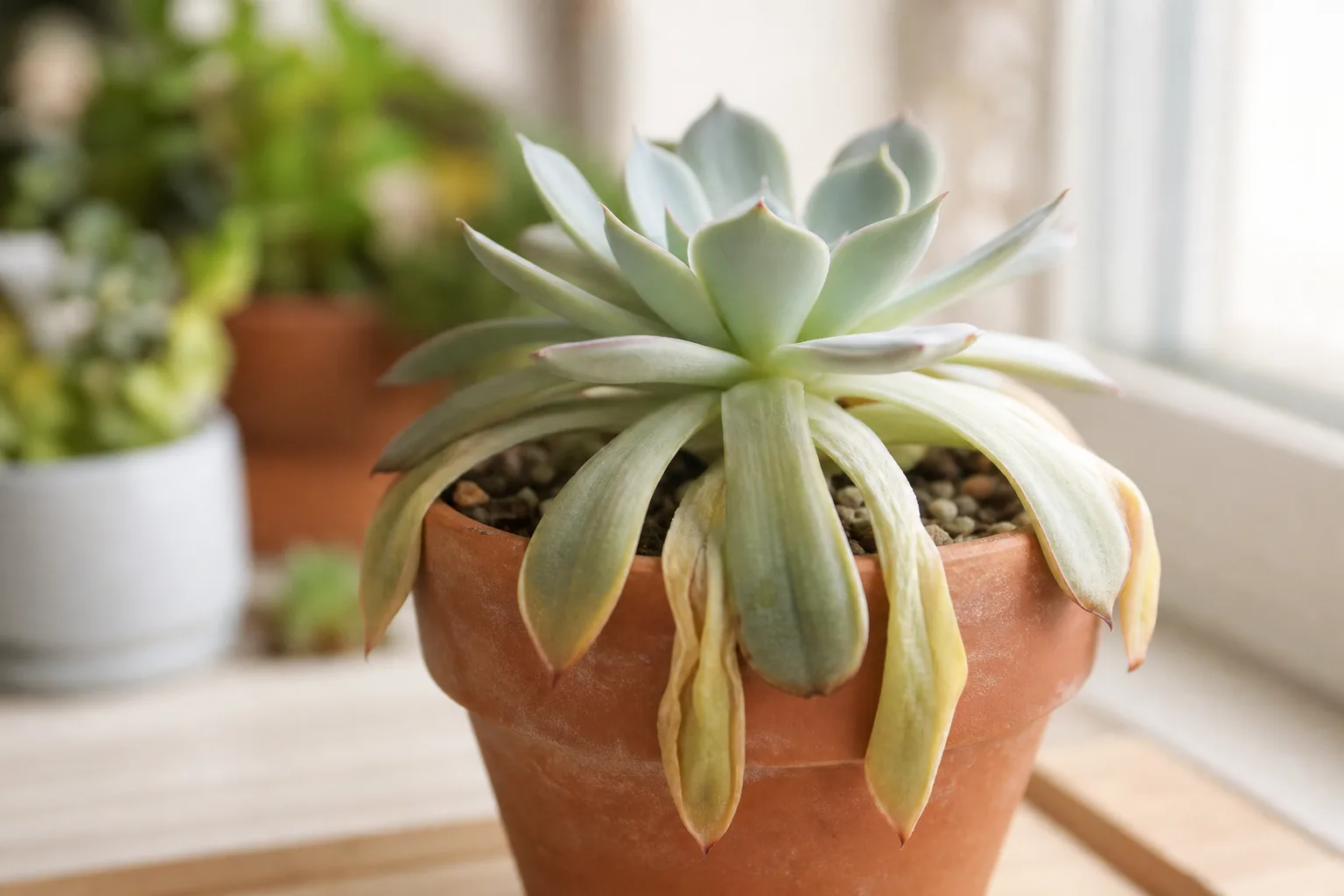
Drooping Echeveria leaves usually mean the rosette is reaching for light, sitting on wet roots, or running dry-not a single watering mistake. First step: note whether leaves stay plump while angling down (often etiolation or low light) or feel soft and mushy on heavy wet mix (overwatering). Lift the pot and probe the mix two inches deep before you change anything.
Drooping Leaves on Echeveria: Causes, Checks & Fixes
This guide covers drooping leaves on Echeveria. See also the general Drooping Leaves guide, watering, and light pages for this plant.
Drooping Leaves on Echeveria: Causes, Checks & Fixes
Quick answer
On Echeveria (Echeveria spp.), drooping leaves describe foliage that angles downward, flattens off the rosette plane, or splay outward-often while the plant still looks alive and sometimes while leaves stay plump. That posture is different from wilting, where leaves lose turgor and feel deflated. Drooping on this Crassulaceae rosette succulent most often traces to etiolation from low light, lower-leaf collapse on wet roots, drought shrivel, or normal aging of bottom leaves-four paths that need opposite fixes.
First step: compare leaf texture with pot weight and light history before you water. Long visible stem with plump leaves leaning toward a window → suspect etiolation; move to brighter light, do not soak. Mushy translucent lower leaves on heavy wet mix → stop watering and check crown firmness. Wrinkled firm leaves on a feather-light dry pot → deep soak-and-dry. One or two papery brown bottom leaves while the center stays tight → likely senescence, not crisis.
Echeveria stores water in thickened leaves evolved for semi-arid Mexican highlands. The rosette architecture means stress often shows on lower leaves first during rot, while upper leaves tilt down when the stem stretches for photons. Misreading stretch as thirst is a common way owners water a plant that only needed a south-facing sill.
What drooping looks like on an Echeveria rosette
Healthy echeveria holds leaves in a tight cup-angled slightly upward or outward but not floppy. Drooping changes that silhouette. The pattern tells you which branch to follow.
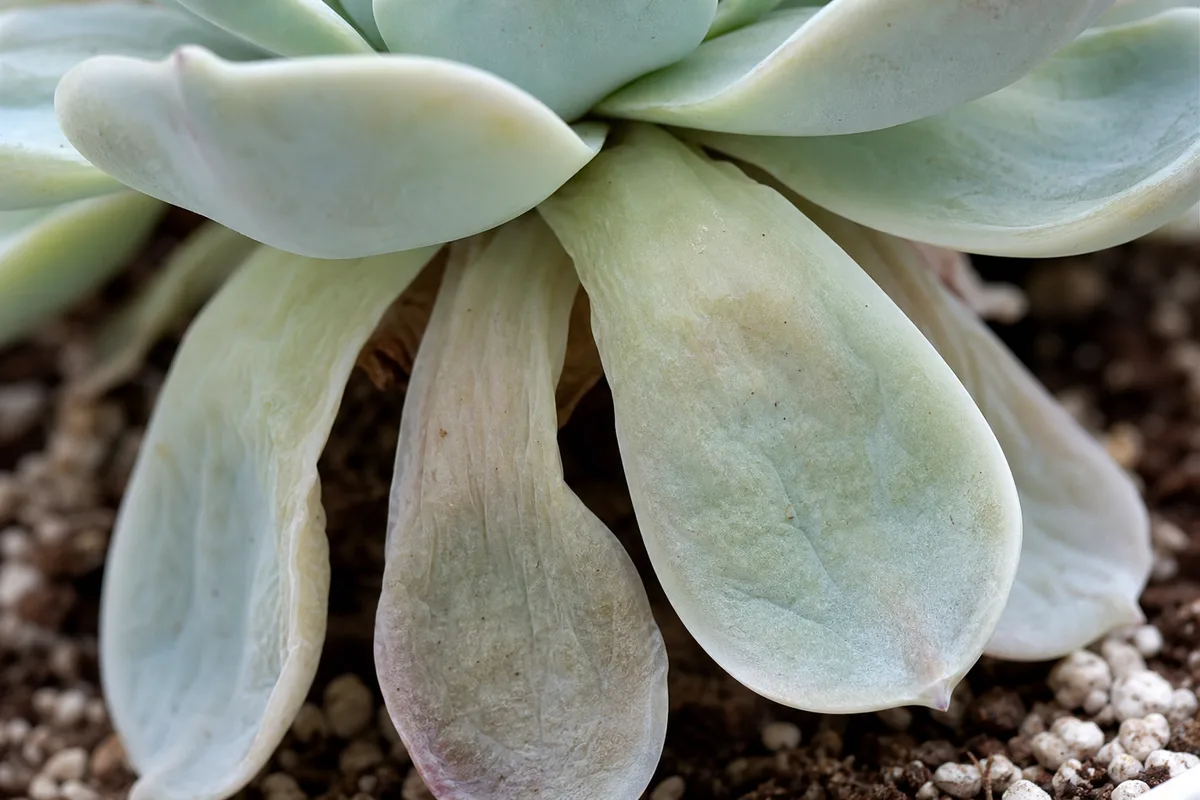
Drooping Leaves symptoms on Echeveria - compare with healthy tissue on the same plant.
Etiolation droop (low light / stretch):
- Visible stem between leaf pairs; rosette rises on a lengthening stalk
- Upper and outer leaves angle downward or flatten while staying relatively firm and plump
- Plant leans toward the brightest window or lamp
- New leaves smaller, paler, or more widely spaced than older compact growth
- Mix may be dry because dim corners slow water use-do not assume thirst from droop alone
- Classic “floppy echeveria” on a shelf far from glass
Wet-root droop (overwatering / early rot):
- Lower rosette leaves splay outward and downward first
- Leaves turn soft, translucent, or yellow at the base while mix stays damp
- Pot feels heavy and cool days after watering; surface may look dry while depth stays wet
- Sour smell, fungus gnats, or algae on persistently moist gritty mix
- Crown may still feel firm in early stages; softness at the stem base is urgent
Dry-pot droop (underwatering):
- Leaves angle down and look thin or wrinkled-turgor loss overlaps with posture here
- Pot is light; skewer two inches deep emerges clean and dry
- Outer leaves shrivel before the center; tissue stays firm, not mushy
- Often follows a bright window summer stretch or winter heat that dried a small pot fast
Low-light flattening without much stretch yet:
- Rosette loosens and opens flat like a plate instead of a bowl
- Leaves still plump but lose the tight stacked look
- Common on a north window or desk several feet from glass
- Often pairs with slow drying and accidental overwatering if you kept a summer schedule
Normal lower-leaf senescence:
- One or two bottom leaves dry, brown, and hang while center growth stays compact
- No spreading mush; pot weight matches your usual soak-and-dry rhythm
- Not pathological-remove dried leaves when they detach easily
If the whole rosette is deflated and limp-not just angled-see wilting on Echeveria for turgor-focused diagnosis. If the stem is dramatically long with spaced leaves, also read not enough light.
Why Echeveria leaves droop
Echeveria is built for bright, dry conditions. When light, water, or roots fall out of balance, the rosette changes shape before it dies outright.
Etiolation is the plant reaching for usable light. In weak indoor exposure, internodes lengthen, leaf spacing widens, and the rosette head tilts or droops on a bendable stem. Watering more does not shorten the stem; only brighter light produces compact new growth. Dim rooms also slow transpiration, so the same watering rhythm keeps soil wet longer-inviting lower-leaf rot that adds a second droop pattern on top of stretch.
Overwatering and root decline let lower leaves lose structural support first. Saturated gritty mix drives out oxygen; fine succulent roots fail and lower leaves splay on mushy tissue even while upper leaves still look upright briefly. Overwatering can rot the stem at soil level and collapse the rosette. Heavy peat mix, cachepots without drainage, and oversized pots all keep the root zone wet after the surface looks acceptable.
Underwatering drains the leaf water tanks until outer leaves cannot hold their normal angle. The rosette looks collapsed and downward-pointing, but texture is wrinkled and dry-not translucent. Bright summer windows and small terracotta pots dry fastest.
Repot shock can loosen leaf posture for one to three weeks after transplanting while roots re-establish-even on correct moisture. Crown firmness and recent history narrow this quickly.
Cultivar habit matters at the margin. Some echeveria hybrids hold looser leaves naturally. Compare the current plant to how it looked in the same spot three months ago; sudden change is diagnostic, gradual looseness on an otherwise healthy rosette may be normal form.
Drooping vs. wilting vs. stretching
These terms overlap in search results but point to different fixes on rosette succulents.
| Symptom | What you see | Leaf feel | Usual first fix |
|---|---|---|---|
| Drooping | Leaves angle down or splay; rosette opens flat | Often still plump in etiolation; mushy if wet rot | Match light or moisture branch |
| Wilting | Deflated, limp, collapsed turgor | Thin, soft, or wrinkled | Pot weight + depth moisture |
| Stretching | Long stem, wide leaf spacing, lean toward light | Firm; pale new growth | Brighter light; behead later if needed |
Rule of thumb: plump leaves on a long stem in a dim room → light, not water. Mushy lower leaves on wet mix → dry and inspect roots, not another soak. Wrinkled firm leaves on light dry pot → soak-and-dry.
How to confirm the cause
Work through these checks in order-posture without moisture data misleads on echeveria.
- Light and stem length - Measure against memory or a photo. New internodes longer than a few millimeters, visible naked stem, or lean toward glass → etiolation likely. Compact stem with sudden lower-leaf splay → water or rot likely.
- Pot weight - Lift the container. Feather-light with wrinkled drooping leaves fits drought. Heavy and cool with splaying lower leaves fits saturation.
- Soil moisture at two inches - Insert a dry finger or wooden skewer two inches into the mix. Clean dry skewer on a light pot confirms underwatering. Damp clinging skewer with mushy lower leaves confirms chronic wetness-not surface dryness alone.
- Leaf texture by layer - Press outer lower leaves. Mushy and translucent → overwatering. Firm but wrinkled → drought. Firm and plump but angled down on a long stem → low light.
- Crown firmness - Pinch the stem at the rosette base. Soft darkening on wet soil is urgent rot-see root rot. Firm crown with dry soil points to thirst or stretch, not crown failure.
- New growth direction - Tight pale center leaves emerging close together after a brighter move confirms light was limiting. Continued wide spacing means exposure is still too weak.
- Recent history - Echeveria repotting guide within two weeks, a move from greenhouse shade to a dim shelf, a rainy outdoor spell, or a missed watering on a hot sill narrows cause in one pass.
Confirmed etiolation: long stem, plump angled leaves, lean toward window, dry or normal moisture, firm crown. Confirmed overwatering droop: heavy pot, damp depth, soft lower leaves, possible sour smell. Confirmed drought droop: light pot, dry depth, wrinkled firm leaves.
First fix for Echeveria
Decide whether the droop is a light problem or a water problem before you touch the watering can.
- If the stem has lengthened and leaves stay plump while leaning toward a window: Move the pot to your brightest location-typically south- or west-facing glass with several hours of direct sun after gradual acclimation. Do not soak on day one. Watch new leaf spacing for two weeks; tighter center growth proves the fix.
- If lower leaves are mushy and the pot is heavy: Stop watering immediately. Empty saucers, improve airflow, and unpot if the crown softens or the mix smells sour. Full wet-soil protocol: overwatering on Echeveria.
- If leaves are wrinkled, firm, and the pot is light with dry mix two inches down: Water deeply until drainage runs free, then empty the saucer within 30 minutes. Wait until the root zone is substantially dry before the next drink-see underwatering and the watering guide.
Make one correction, then wait several days before stacking repotting, beheading, and fertilizer.
Step-by-step recovery by cause
Etiolation / low-light droop
- Move to brighter light with gradual increase in direct sun over one to two weeks.
- Hold watering steady using soak-and-dry-do not compensate for dim rooms with extra water.
- Rotate the pot a quarter turn weekly so new growth stays even.
- Once new center leaves emerge tight and short-stemmed, optionally behead above healthy tissue, callus, and reroot-or remove stretched lower leaves for propagation. Old stretched tissue will not compress back.
Wet-root droop
- Stop watering. Wick excess moisture with paper towels under drainage holes if needed.
- If roots are mushy on inspection, trim decay, callus severe cuts, and repot into gritty succulent mix sized to remaining roots.
- Remove lower leaves that stay soft; they will not re-stand.
- Withhold fertilizer until firm new center growth appears-usually two to four weeks.
Dry-pot droop
- One deep soak until water runs from holes; discard all runoff.
- For hydrophobic dry cores, water once, wait 30 minutes, water again, then drain fully.
- Resume soak-and-dry only when a skewer two inches deep emerges clean and dry-not on a calendar.
Repot-shock droop
- Keep Echeveria light guide-not harsh midday sun on healing roots.
- Wait five to seven days after repotting before the first light watering unless mix was bone dry at planting.
- Expect posture to normalize within one to three weeks if crown stays firm.
Recovery timeline
Etiolation: New compact leaves may appear within two to three weeks after adequate light; old angled leaves remain until you prune or behead. Full aesthetic recovery often means rerooting the tight head, not waiting for stretch to shrink.
Overwatering droop: Lower mushy leaves rarely stand up again-one to three weeks to judge crown stability and new center growth. Severe rot with beheading may need four to six weeks for rerooting.
Underwatering droop: Outer leaves often lift within 24 to 48 hours after a proper soak on healthy roots; badly shriveled leaves may stay slightly angled but should plump.
Senescence: Remove dried bottom leaves anytime; no recovery timeline needed.
Cause comparison table
| Cause | Leaf look | Pot / soil | Crown | First action |
|---|---|---|---|---|
| Etiolation | Plump, angled down; long stem | Often dry or normal | Firm | Brighter light |
| Overwatering | Soft translucent lower splay | Heavy, wet at depth | Firm early; soft = urgent | Stop water; inspect roots |
| Underwatering | Wrinkled, thin, drooped | Light, dry 2 in. down | Firm | Deep soak-and-dry |
| Senescence | One or two brown papery lowers | Normal for your routine | Firm | Remove dry leaves |
What not to do
Do not water an etiolated stretched rosette because the head flops-low light is the limiter, and extra moisture in dim corners worsens rot risk. Do not leave a drooping echeveria in a dark corner hoping it will stiffen. Do not pour more water onto mushy lower leaves when the pot is already heavy. Do not fertilize a stressed rosette before you know roots are healthy. Do not behead and repot on the same day you moved light and watered-stack one intervention at a time. Do not mist the rosette crown; trapped moisture in tight leaf axils invites fungal problems on a plant that does not need humidity sprays.
How to prevent drooping leaves next time
Place echeveria where at least six hours of bright light daily is realistic-including some direct sun after acclimation-not where the pot looks best on an interior shelf. Water only when the root zone is substantially dry using soak-and-dry; surface dryness alone is insufficient for this genus. Use fast-draining mix and pots with holes; empty saucers within 30 minutes. Inspect lower leaves weekly during watering-catch stretch before the stem bends, and catch wet-soil splay before mush reaches the crown. Reduce water in cool winter rest when growth slows. Full baseline: Echeveria overview.
When to worry
Act immediately if the crown feels soft on wet soil, blackening spreads from the stem base, or lower translucent leaves detach with a touch-those signs mean advancing crown rot, not posture alone. A long etiolated stem that suddenly collapses on wet mix in a dim room is also urgent; stretch plus chronic moisture is a common rot setup.
You can observe longer if only outer leaves angle down on a firm crown, you have identified clear etiolation, and you have already moved to brighter light-improvement shows as tighter new center leaves within two to three weeks. One papery brown bottom leaf on an otherwise compact rosette is normal aging.
Related Echeveria problems
- Wilting - deflated turgor and limp collapse, not just angled leaves
- Not enough light - etiolation, stretch, and compact recovery after brighter placement
- Overwatering - wet-pot lower-leaf mush and drainage fixes
- Underwatering - dry-pot shrivel and soak-and-dry recovery
- Root rot - soft crown, trimming, and re-rooting
- Echeveria overview - full care hub
Conclusion
Drooping Echeveria leaves are a posture clue, not an automatic command to water. Long stems with plump angled foliage ask for light. Mushy lower splay on heavy wet mix asks for drying and root inspection. Wrinkled firm leaves on a light pot ask for soak-and-dry. Read texture, pot weight, and stem length together, fix one variable, and judge recovery by new tight center growth-not by whether old angled leaves ever stand perfectly upright again.
When to use this page vs other Echeveria guides
- Echeveria watering guide - Use for routine moisture checks before assuming drooping leaves is the main issue.
- Echeveria problems hub - Browse all 16 common issues on this species.
- Underwatering on Echeveria - Different entry point when symptoms overlap with drooping leaves.
- Overwatering on Echeveria - Different entry point when symptoms overlap with drooping leaves.
- Root Rot on Echeveria - Different entry point when symptoms overlap with drooping leaves.