Powdery Mildew on African Violet: Causes, Checks & Fixes
Quick answer
Powdery mildew on African Violet shows as white dusty patches on velvet leaves that return after wiping. First step: isolate the plant, pinch off coated leaves without wetting foliage, and improve airflow-never rinse or mist fuzzy leaves.
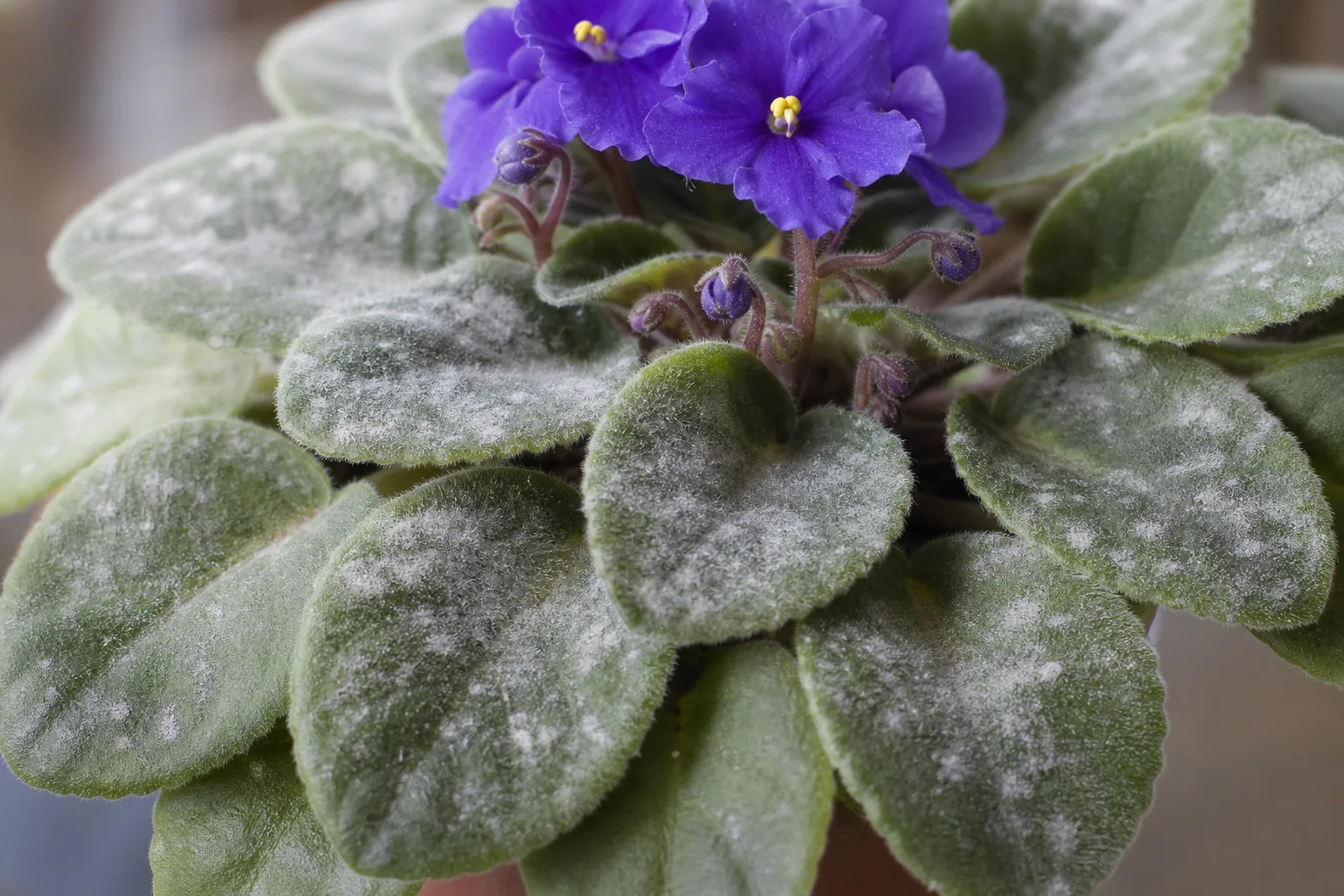
Powdery Mildew on African Violet: Causes, Checks & Fixes
This guide covers powdery mildew on African Violet. See also the general Powdery Mildew guide, watering, and light pages for this plant.
Powdery Mildew on African Violet: Causes, Checks & Fixes
Quick answer
Powdery mildew on African Violet (Saintpaulia spp.) shows as white or gray dusty patches on velvet leaves-not rinseable dust. The white material on African violet foliage is probably powdery mildew, a fungal disease common on indoor plants. First step: isolate the plant, pinch off coated leaves with dry hands, and improve airflow. Do not rinse, mist, or overhead-water fuzzy foliage to wash mildew off; wet velvet spreads spores and invites crown rot.
African violets belong to the Saintpaulia genus and the gesneriad (Gesneriaceae) family and grow as tight rosettes with hairy leaves that trap moisture. That velvet surface makes them prone to foliar fungus when winter heating raises room humidity but air stays still around crowded shelves. The fix is cultural first-spacing, fans, dry leaves-because chemical sprays can burn fuzzy tissue if applied carelessly.
Why African Violet gets powdery mildew
Powdery mildew is a fungal disease common on indoor plants, and African violets, begonias, ivy, jade, and kalanchoe are susceptible to powdery mildew indoors. Outbreaks on houseplants typically occur in winter or early spring when relative humidity climbs but windows stay closed and air circulation drops.
High relative humidities and poor air circulation favor powdery mildew development on houseplants. On a violet collection, that microclimate shows up as:
- Crowded gesneriad shelves - Saintpaulia, streptocarpus, and episcia pressed together share stagnant humid air.
- Winter windowsill culture - Heating dries the room air globally but creates a humid boundary layer between glass and plant crowns.
- Overhead watering or misting - Wet velvet leaves stay damp for hours; the fungus does not need standing water to colonize fuzzy surfaces.
- Low light corners - Dim placement slows leaf drying after any splash from wick reservoirs or neighbor watering.
- Fresh succulent growth - High-nitrogen feeding pushes soft new leaves that mildew colonizes quickly.
Unlike succulents that prefer dry air, African violets enjoy moderate humidity-but only with gentle air movement. Still, humid air around a dense rosette is the classic trigger collectors see after bringing home a show plant or grouping pots for bloom season.
What powdery mildew looks like on African Violet
Early signs are discrete white or gray powdery spots on the upper surface of velvet leaves, sometimes starting on outer or lower leaves where airflow is weakest. Powdery mildew starts as a dusty white to gray coating over leaf surfaces, stems, buds, or flowers. Spots expand and merge into a continuous mat that can cover most of a leaf.
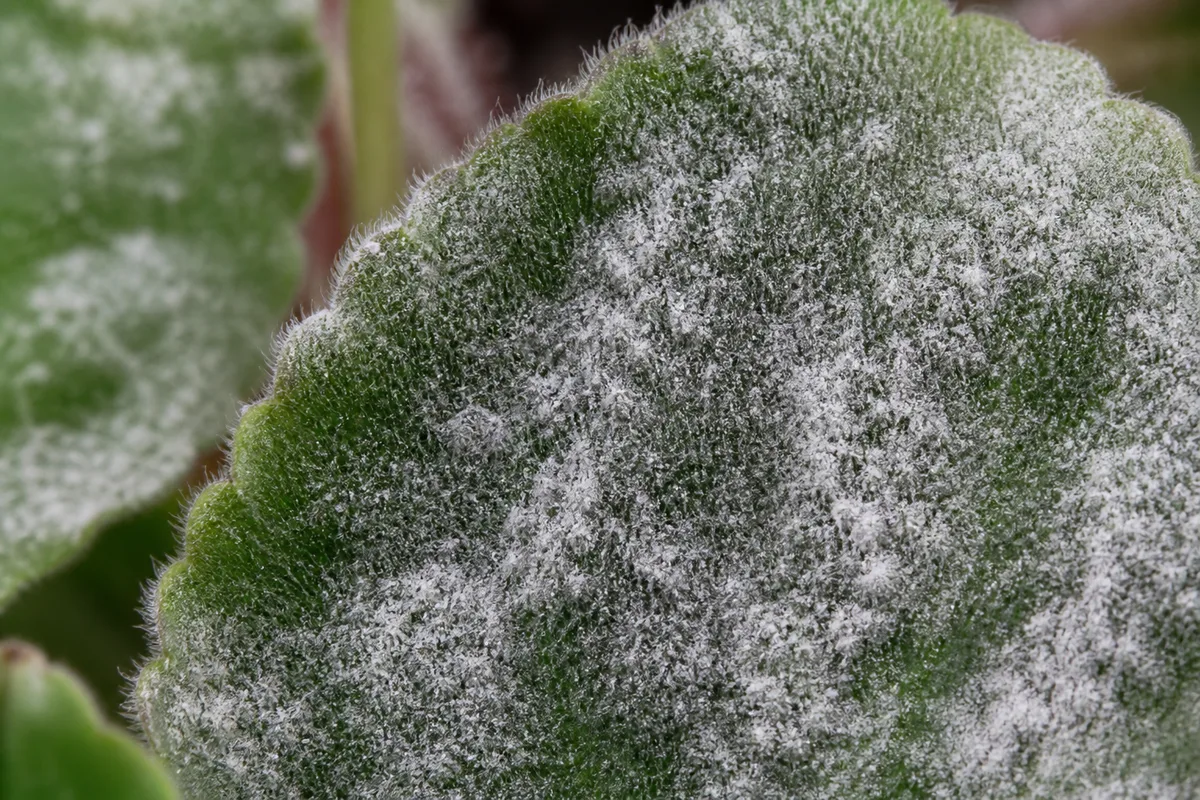
Powdery Mildew symptoms on African Violet - compare with healthy tissue on the same plant.
On African violets specifically, watch for:
- Uniform surface dust on leaf tops-not cottony clumps tucked in crevices (that pattern fits mealybugs).
- Coating on open blooms and bud clusters during active flowering-mildew can distort petals and abort buds.
- Spread to neighboring leaves within days in the same humid zone.
- Slightly faded or stunted new center growth when infection reaches the crown.
Affected leaves may look dull before the white mat is obvious. Severely coated tissue eventually browns and dies. The crown should stay firm-soft, mushy center tissue with sour soil points to crown rot or root rot, not mildew alone.
Confirm mildew vs. dust, minerals, and mealybugs
Work through these checks before treating. A numbered routine catches most misdiagnoses on velvet foliage:
- Wipe test - Gently rub a coated leaf with a dry finger. Mildew can be partially removed by rubbing the leaves as a dusty smear that returns within days. Hard-water minerals brush off cleanly and do not spread. Mealybug wax comes off in waxy threads with insects visible underneath.
- Spread pattern - Mildew enlarges and jumps to adjacent leaves and nearby gesneriads. Static white marks in one spot that never grow suggest splash or dust.
- Location - Mildew coats broad leaf surfaces and petals. Mealybugs cluster in leaf axils, under spent bloom stems, and along pot rims.
- Humidity history - Did winter heating season start, did you group plants for a show, or did someone mist the collection? Spreading white dust after those events strongly suggests mildew.
- Neighbor audit - Check begonias, streptocarpus, and other shelf mates. Matching patches across unrelated species in the same stagnant zone confirm environmental fungus.
- Bottom-watering check - Lift the pot during your normal watering routine. If wick or saucer water splashes crown leaves regularly, mineral rings can mimic mildew on upper leaves only.
Symptom lookalike comparison
| What you see | Spreads? | Wipe test | Likely cause |
|---|---|---|---|
| Soft white powder on leaf tops and petals | Yes, within days | Smears; returns | Powdery mildew |
| White cottony clumps in leaf axils | Slow, localized | Waxy threads; insects underneath | Mealybugs |
| Stiff white rings where droplets dried | No | Brushes off fully | Hard-water minerals |
| Gray household dust on outer leaves only | No | Clean cloth removes all | Dust |
| Bumpy pale spots with webbing underneath | Irregular patches | No uniform powder | Spider mites |
| Water-soaked blisters on leaf undersides | No powder | N/A | Edema from overwatering on African Violet |
If multiple plants on the same shelf show matching surface dust after a humid stagnant week, environmental fungus is the likely cause-not a one-off fertilizer issue.
First fix for African Violet
Isolate the plant and pinch off infected leaves and flowers with dry hands or clean, sharp scissors. Bag discarded tissue and throw it in the trash-not the compost pile indoors. This single step stops spore load before you change the room environment.
After removal:
- Space the pot at least six inches from neighbors so air moves between rosettes.
- Run a small fan on low for two to three hours daily near the collection-not directly blasting one crown.
- Switch to bottom-watering through a saucer or wick so velvet leaves stay dry. See the watering guide for technique.
- Hold fertilizer until new center growth looks clean for two weeks. High-nitrogen feeding pushes succulent tissue mildew loves.
Do not repot, mist, shower, or spray anything the same day you remove leaves. Stack one correction at a time so you can read the plant’s response.
Why rinsing and misting fail on velvet foliage
African violet leaves are covered in fine hairs that hold water against the surface. Rinsing coated leaves spreads spores to the crown and neighboring plants while keeping velvet damp for hours-the opposite of what you need. Do not mist plants and avoid wetting the leaves when watering; misting for “humidity” during an outbreak feeds the fungus and can trigger fungus gnats on wet soil surfaces. Bottom-watering is the safe default for this species.
Fungicide escalation when cultural fixes fail
Wait five to seven days after isolation, tissue removal, and airflow correction. Inspect new center leaves. If white dust appears on fresh growth despite dry foliage and good spacing, escalate to a labeled fungicide:
- Potassium bicarbonate products (such as those labeled for powdery mildew on ornamentals) effectively eradicate powdery mildew fungi. Several less toxic fungicides are available, including potassium bicarbonate, though products containing it can injure powdery mildew infected plants-use with caution and not on advanced disease.
- Neem oil labeled for indoor ornamentals is another option many growers use between bicarbonate applications.
Fuzzy-leaf test-patch protocol:
- Mix and apply per label directions only.
- Spray two lower leaves and wait 48 hours under your normal grow lights.
- Watch for pale spots, curling, or petal burn before treating the full rosette.
- Keep spray off the crown center and open blooms unless you accept cosmetic petal spotting.
- Repeat only at label intervals-over-spraying velvet foliage causes more damage than mildew alone.
Read every label for indoor houseplant use. When cultural controls fail across a large collection, contact your local extension office or an African Violet Society chapter for region-specific product guidance.
What not to do the same day
Do not mist leaves, overhead-water from a watering can, crowd the plant back onto a shelf, fertilize, or repot while spores are still active. Do not compost removed leaves indoors where spores can drift back to the collection.
Step-by-step recovery
- Isolate the affected violet from other gesneriads until active spread stops.
- Pinch off heavily coated leaves and distorted blooms; sterilize scissors with rubbing alcohol between cuts and between plants.
- Increase spacing and add gentle fan airflow at room level.
- Bottom-water only; empty saucers after each drink so humidity does not rise from standing water.
- Inspect the rosette center every three to four days during bottom-watering-early mildew on crown leaves needs immediate removal.
- If new growth powders over within one week despite dry leaves, apply a test-patch fungicide as described above.
- Resume mild feeding only after two weeks of clean new leaves.
Recovery timeline and bloom expectations
New powder formation should halt within one to two weeks once infected tissue is removed and leaves stay dry with improved airflow. Clean new center leaves emerging ten to fourteen days later confirm recovery. Old coated foliage that was not removed will not green up again-expect a thinner rosette until fresh rows fill in.
Open blooms that carried mildew often brown at the edges and should be removed rather than saved. Bud clusters may abort during active infection; do not judge flowering failure until two weeks of clean new growth pass. Mini and trailer cultivars with tight crowns sometimes need more aggressive leaf removal because inner leaves dry slowly-check those forms weekly during winter.
Lookalike symptoms on African Violet
Mealybugs - White cottony masses in leaf axils and under spent bloom stems with sticky honeydew. Individual insects visible with a hand lens. See the mealybugs guide for treatment.
Hard-water mineral deposits - Stiff white crust where droplets dried on leaf edges; does not spread and wipes off completely.
Household dust - Outer leaves only; uniform removal with a dry soft brush; no progression over a week.
Spider mites - Fine stippling and webbing on undersides in dry air, not talcum-like surface powder. See spider mites.
Edema - Water-soaked blisters on leaf undersides from overwatering or cold wet soil-not a fungal coating on top.
White spots hub overlap - The white spots page covers several pale-mark causes; mildew is the one that spreads as surface powder in humid stagnant air.
What not to do
Do not mist African violets when white dust is present-moisture feeds the fungus and wets velvet for hours. Do not overhead-water from a shower or watering can. Do not leave removed powdered leaves on the soil surface where splash can spread spores. Do not apply nitrogen fertilizer to a stressed rosette; hold feeding until new growth is stable.
Do not assume every white mark is mildew-confirm with the wipe test and spread pattern before spraying chemicals on fuzzy leaves.
How to prevent powdery mildew on African Violet
Keep plants in well-ventilated areas and do not overcrowd. Space gesneriads so air moves between rosettes, especially during winter heating season on windowsills. Bottom-water following the watering guide and avoid wetting the leaves when watering.
Integrate a weekly shelf inspection into your watering routine: scan upper leaf surfaces and open blooms before refilling wick reservoirs. Quarantine new plants and show entries for two weeks before placing them near your collection. Run a small fan on low a few hours daily when humidity stays above fifty percent in a closed room.
Reduce nitrogen fertilizer during humid months if your violets push very soft leaves. Match light to species needs via the light guide-dim corners slow drying after any accidental splash.
Related problems to watch on the same shelf: thrips and fungus gnats often signal over-wet culture, which pairs with mildew-favorable humidity.
When to escalate
Treat as urgent if white coating reaches most of the rosette within a week, center crown leaves powder over despite dry culture, buds abort repeatedly during peak bloom season, or multiple gesneriads on one shelf show matching spread. Those patterns suggest you need collection-wide spacing, fan airflow, and possibly labeled fungicide-not leaf pinching alone.
Slow, stable white dust on two or three outer leaves with clean center growth is lower urgency. Correct airflow and bottom-watering first and reassess before chemical treatment.
Contact your county extension office or a local African Violet Society if outbreaks return every winter despite cultural changes-chronic indoor mildew sometimes needs professional identification of the fungal species and region-appropriate product labels.
Conclusion
Powdery mildew on African Violet is white surface dust on velvet leaves in humid, stagnant air-not a problem you rinse away. Confirm with a wipe test and spread pattern, isolate and remove coated tissue dry, improve spacing and airflow, and judge recovery by clean new center growth. When cultural fixes fail within two weeks, escalate to a test-patch fungicide safe for fuzzy foliage rather than showering the rosette.
For year-round culture that keeps leaves dry and air moving, start with the African violet overview and watering guide.
When to use this page vs other African Violet guides
- African Violet watering guide - Use for routine moisture checks before assuming powdery mildew is the main issue.
- African Violet problems hub - Browse all 52 common issues on this species.
- White Spots on African Violet - Different entry point when symptoms overlap with powdery mildew.
- Leaf Drop on African Violet - Different entry point when symptoms overlap with powdery mildew.