Pebble Tray Alternatives: Better Ways to Raise Humidity
Compare alternatives to pebble trays, including humidifiers, grouping plants, room placement and realistic humidity fixes.
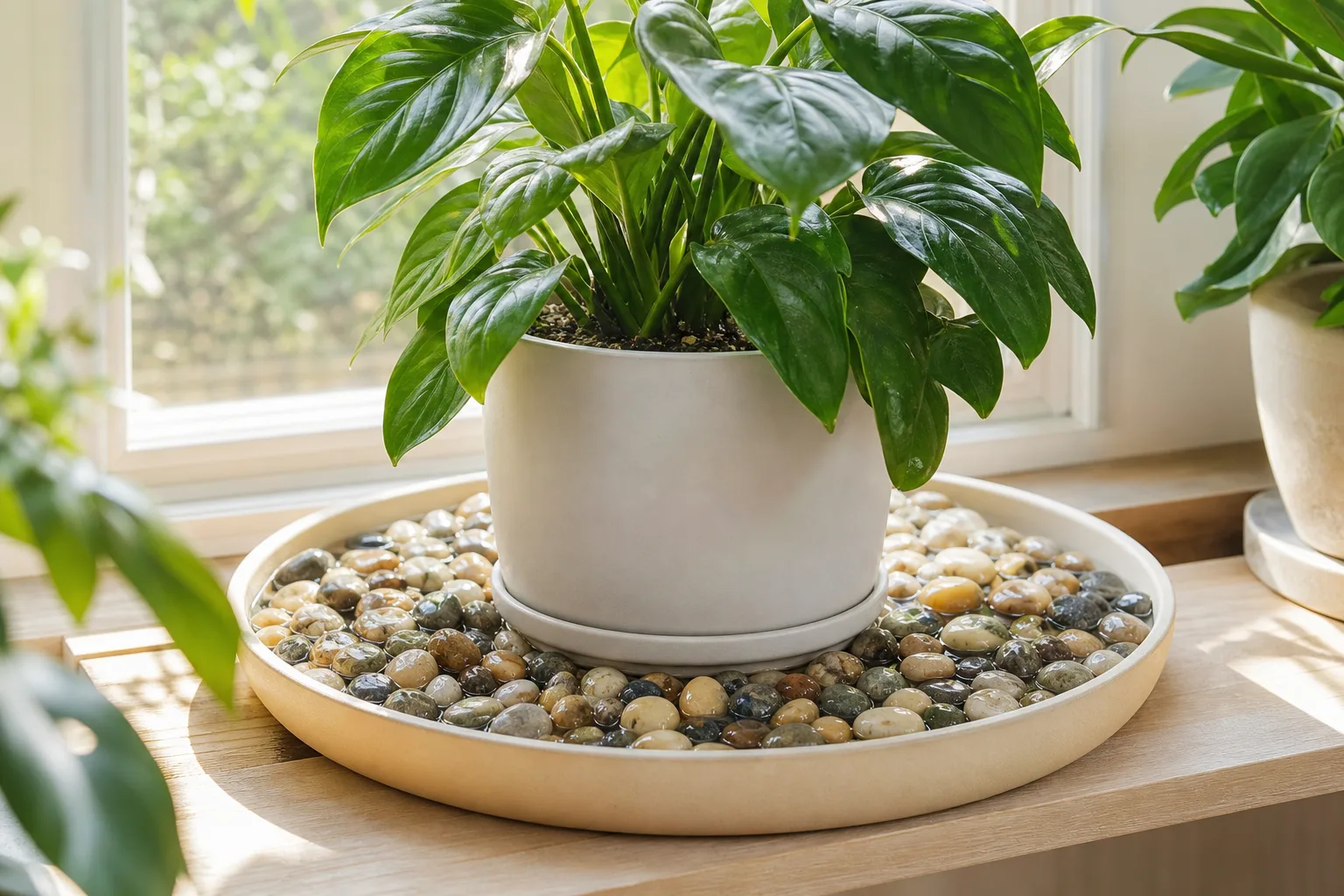
Quick Answer: Pick Your Alternative Using This Matrix
If a pebble tray is not doing enough, the fix depends on two variables: how many plants need help and how dry the room actually is. A tray creates a small local bump. A humidifier changes the air in a zone. Grouping, enclosures, and humid rooms sit in between. This page is the alternatives decision guide for the pebble-tray cluster — not a tray setup tutorial. For tray basics, see pebble trays for plants. For a full humidifier comparison, see pebble tray vs humidifier.
| Method | Best for | Strength | Main drawback |
|---|---|---|---|
| Humidifier | Several plants or a dry room corner | Most reliable, measurable | Cleaning and monitoring |
| Grouping plants | 3–12 similar tropicals on one shelf | Free, passive microclimate | Mild effect only |
| Terrarium / cabinet / cloche | Small humidity-loving plants | Strong localized humidity | Ventilation and disease risk |
| Naturally humid room | Bathroom or kitchen with usable light | Uses existing moisture | Light often limits placement |
| Moss pole / damp support | Climbing aroids | Helps aerial roots locally | Not a room-wide fix |
Use the matrix below once you know your baseline room RH from a hygrometer. Measure at leaf height, not over wet stones.
| Room baseline RH | 1 sensitive plant | 5–10 plants on one shelf | 20+ plants or whole corner |
|---|---|---|---|
| Mildly low (35–45%) | Broad tray may suffice; try grouping first | Grouping + tray under cluster | Humidifier optional; grouping often enough |
| Moderately dry (25–35%) | Terrarium/cloche or humidifier | Grouping + humidifier on low | Humidifier primary tool |
| Severely dry (below 25%) | Enclosure or humidifier — tray alone rarely enough | Humidifier + grouping | Humidifier required; monitor EPA home limits |
How to Read the Decision Matrix
Start with measurement, not method shopping. University of New Hampshire Extension recommends a portable humidifier and sensor for dry winter rooms, but also lists grouping, trays, and glass enclosures as layered options. (University of New Hampshire Extension) The matrix above translates that guidance into scale: one plant in a 40% room needs a different tool than six calatheas in a 22% heated living room.
If symptoms persist after your chosen method, check whether the problem is really air moisture or roots, salts, light, or vents. Iowa State Extension notes brown leaf tips from low humidity can look like other stressors. (Iowa State Extension) Fix placement and measure RH before buying another gadget.
Decision Flowchart: One Plant, Shelf, or Whole Room
flowchart TD
  A[Measure RH at leaf height] --> B{Below 25%?}
  B -->|Yes| C{One plant or many?}
  B -->|No| D{35-45% mild gap?}
  C -->|One small plant| E[Enclosure or humidifier]
  C -->|Shelf cluster| F[Humidifier + grouping]
  C -->|Whole room| G[Zone humidifier required]
  D -->|One plant| H[Grouping or broad tray]
  D -->|Shelf cluster| I[Grouping + shared tray]
  D -->|Many plants| J[Humidifier if symptoms persist]
Why Pebble Trays Often Fall Short
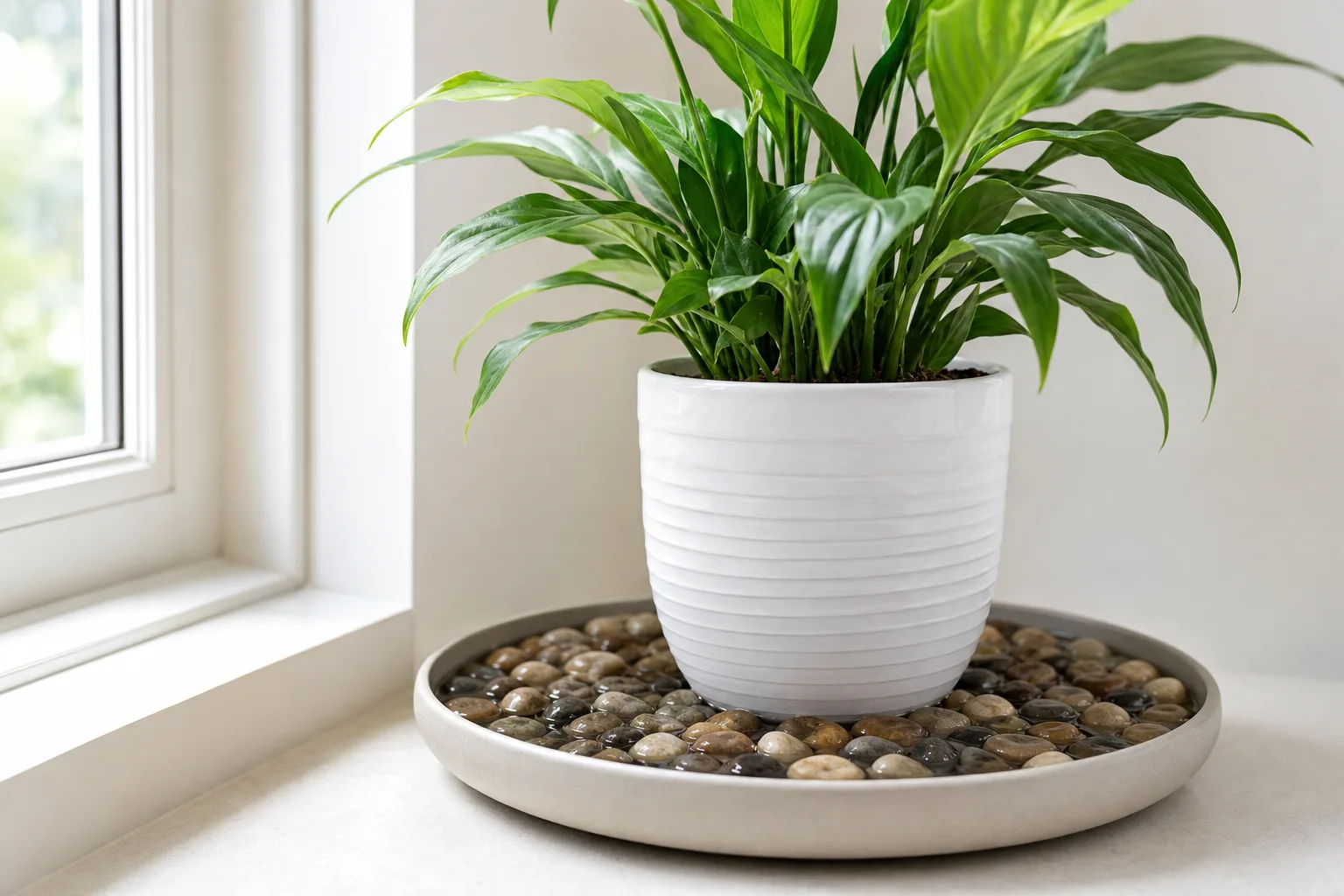
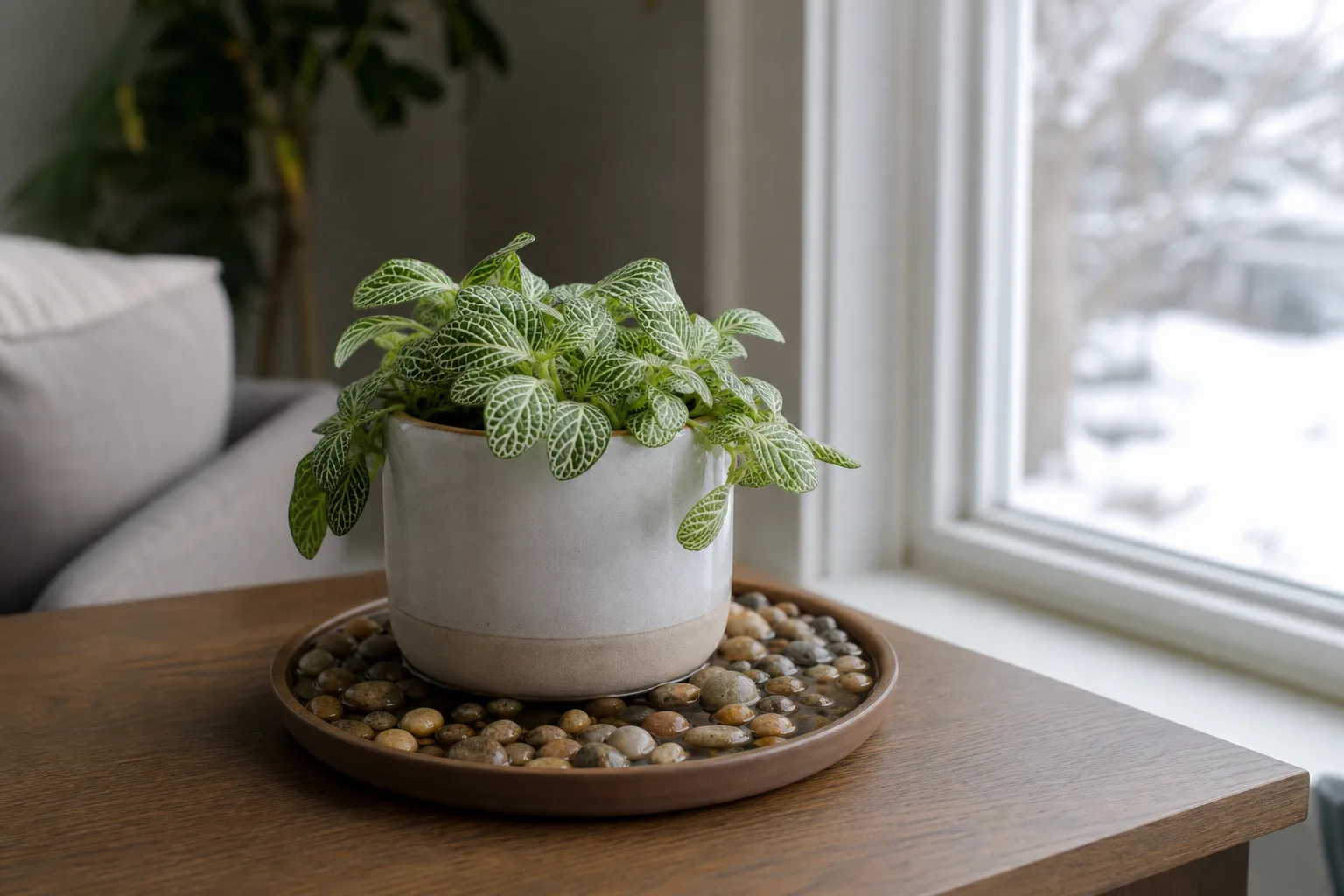
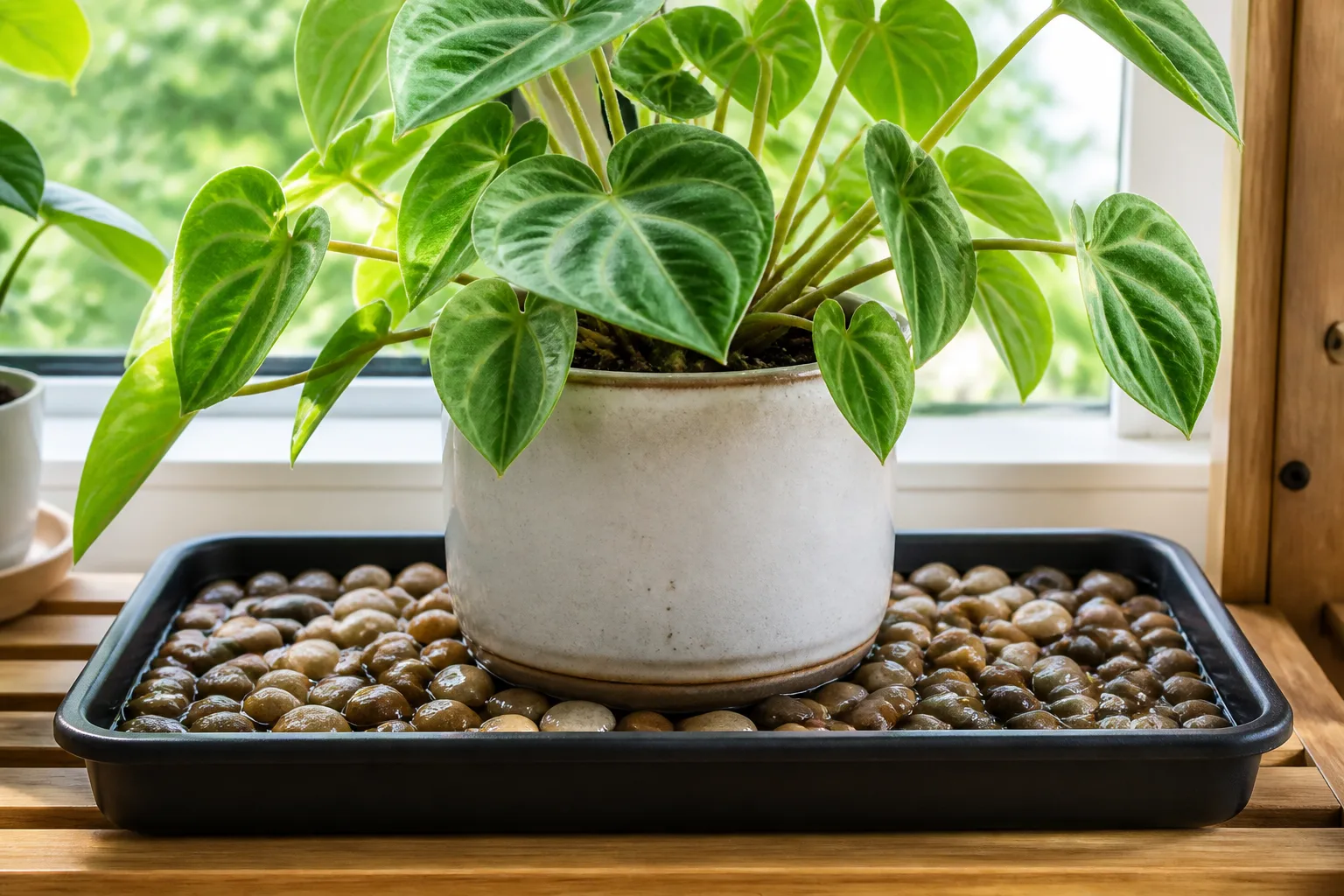
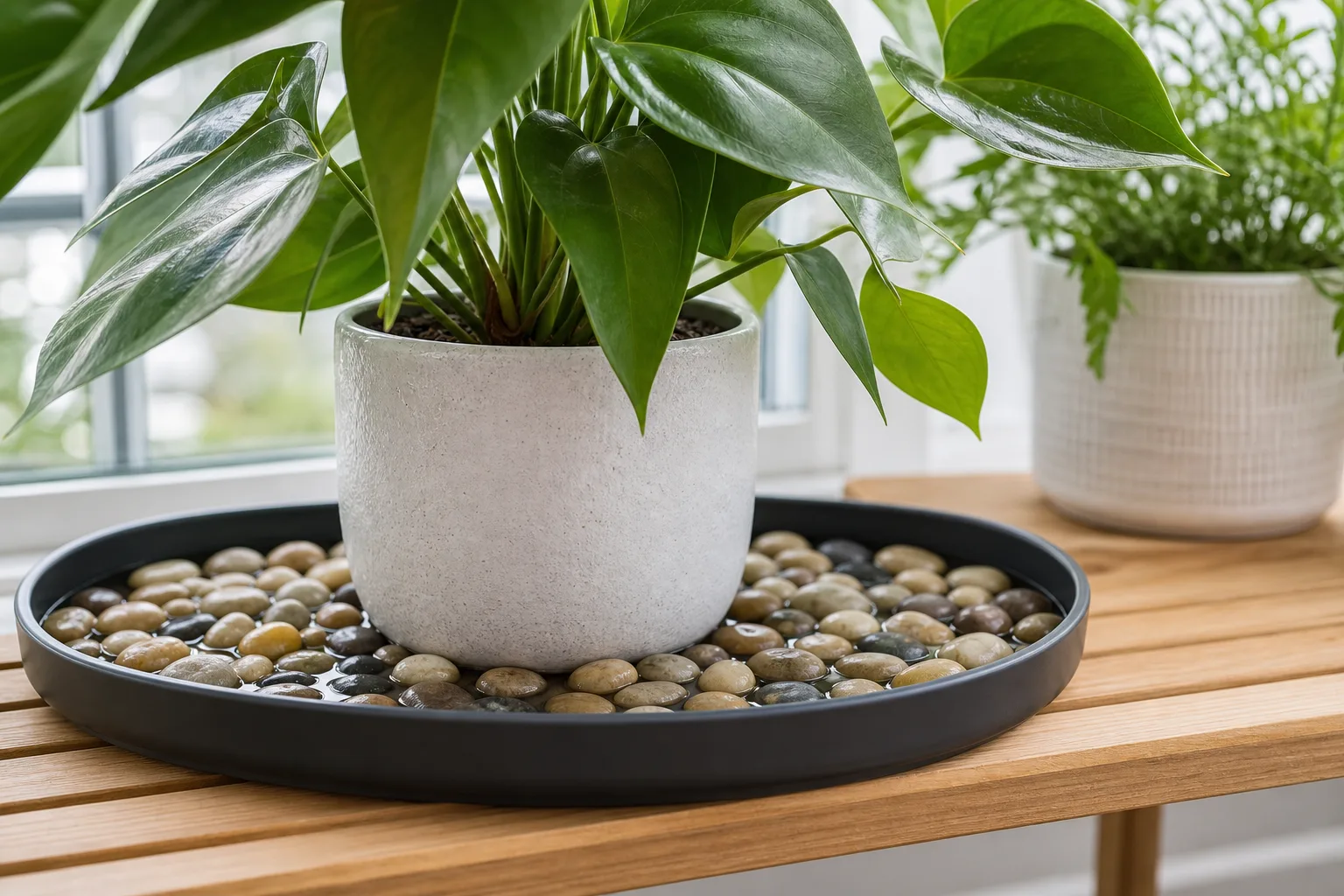
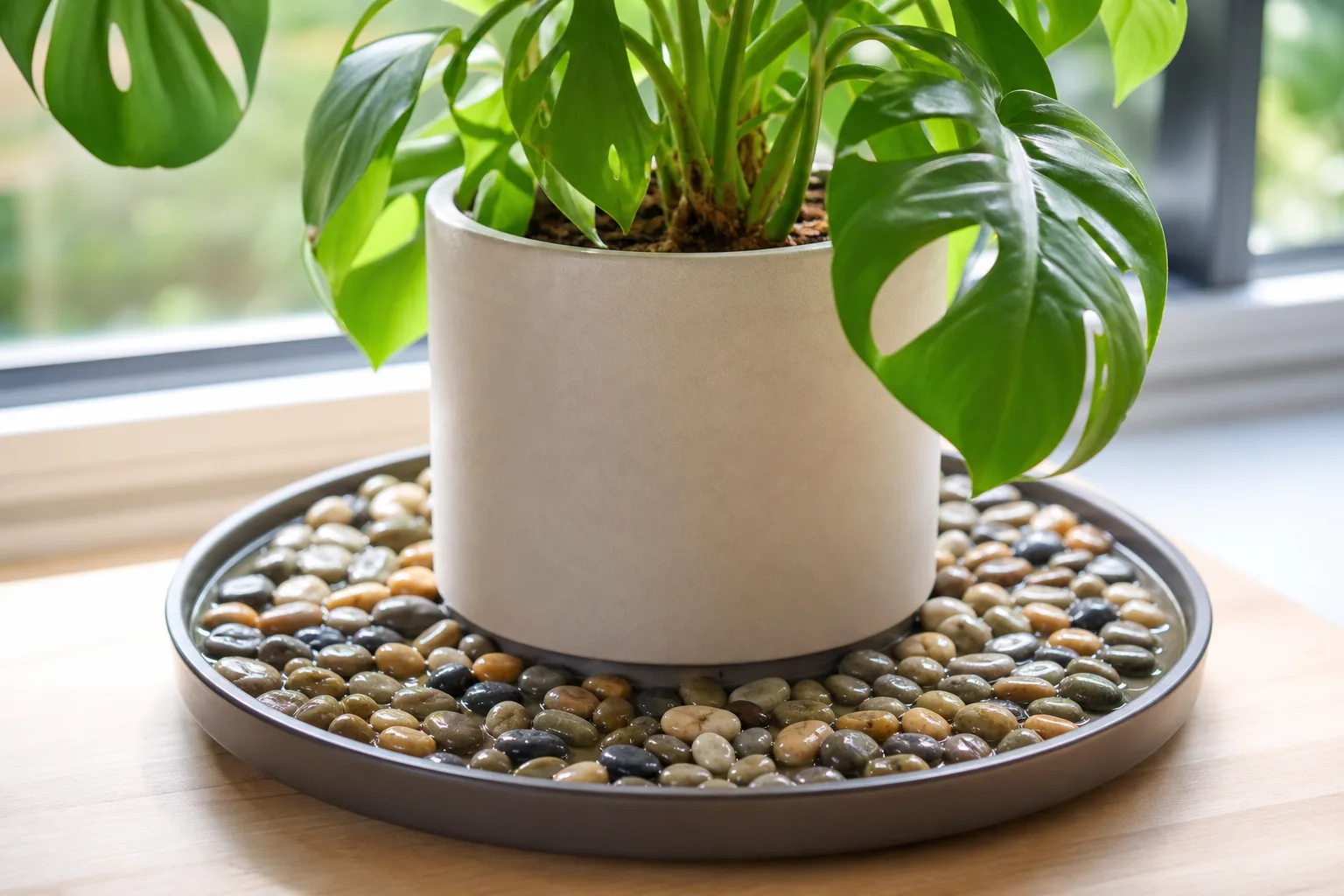
Pebble trays work by evaporation from a shallow water reservoir under the pot. Virginia Cooperative Extension and Washington State University Extension both describe gravel or pebble trays as ways to raise RH near containers — not across a whole room. (Virginia Cooperative Extension Gardener Handbook) (Washington State University Extension) That local effect is real but small, especially when heating vents, tall canopies, or wide open floor plans pull dry air through the space.
People get frustrated for two predictable reasons. First, they expect a tray to rescue a humidity-demanding plant in desert-level winter air. Second, they increase pot watering when leaves crisp, which can rot roots while foliage still suffers from dry air. Treat humidity as its own variable. The houseplant humidity guide covers target ranges and seasonal shifts if you need broader context than this alternatives picker.
What Humidity-Loving Houseplants Actually Need
Relative humidity is water vapor as a percentage of what the air could hold at that temperature. Warm air holds more vapor than cold air, which is why forced-air heating in winter drops indoor RH so sharply.
A Practical Relative Humidity Range
For many common houseplants, 40% to 60% RH is a workable indoor band. University of New Hampshire Extension places most houseplants in that range, with thin-leaved tropicals often wanting more. (University of New Hampshire Extension) The EPA recommends keeping homes between 30% and 50%, ideally not pushing whole-room humidity too high because of mold and condensation risk. (US EPA) Your plant target and your home-health ceiling can differ — that is why local strategies (grouping, enclosures, a humidifier near the shelf) often beat trying to tropicalize an entire house.
Plants That Usually Need More Than Average Air
The RHS lists species such as Stromanthe, Calathea, and other humidity-sensitive foliage as candidates for 60% RH or higher. (RHS) Ferns, prayer plants, anthuriums, and many orchids show brown margins, papery tips, curling, or bud drop when air stays too dry — especially near heat sources. Succulents and cacti are the opposite case: they tolerate, and often prefer, drier air.
Signs that point toward low humidity include edge browning that worsens in winter, new leaves smaller or thinner than older ones, and crisping that returns after you fix watering. For a humidity-sensitive classic, see the Calathea care guide and the low-humidity problem page for Calathea.
When Each Alternative Fails
Every method has a ceiling. Scan this table before you blame the plant.
| Method | Common failure scenario | What to do instead |
|---|---|---|
| Pebble tray | Tall plant, wide room, vent nearby | Grouping, humidifier, or relocation |
| Grouping | Plants spread across a room or one drafty window | Move cluster; add humidifier |
| Terrarium | Large plant, desert species, or no vent schedule | Open setup or humidifier |
| Humid room | Bathroom too dark; kitchen grease/heat swings | Humidifier near bright shelf |
| Moss pole | Whole room below 30% RH | Room-level humidifier first |
| Humidifier | Never cleaned; RH above 55% with condensation | EPA cleaning routine; lower output |
If you fix the failure mode and RH still will not move, revisit watering, root health, fertilizer salts, and pest stress before escalating again.
Editorial Comparison: What Each Method Changed in One Room
Numbers beat folklore. In a LeafyPixels winter editorial check (14 × 12 ft forced-air heated room, ThermoPro TP50 digital hygrometer at leaf height, windows closed, vent cycling normally), we recorded the following 48-hour snapshots with a mid-size ultrasonic portable humidifier on low, placed 4 ft from the plant zone. These are one-room observations — not universal performance claims — but they show why method choice matters.
| Method tested | RH at leaf height | Notes |
|---|---|---|
| Room baseline (no tray) | 21% | Typical dry winter reading on TP50 |
| Single broad pebble tray | 25% (+4 pts) | Modest local lift only |
| Five grouped tropicals, no tray | 26% (+5 pts) | Cluster center slightly higher than room |
| Five grouped + shared pebble tray | 28% (+7 pts) | Layering helps; still not room-wide |
| Closed 12-inch terrarium | 68% inside | Strong enclosure effect; vented 30 min daily |
| Portable ultrasonic humidifier (low, 4 ft away) | 42% in plant zone | See pebble tray vs humidifier for sizing and maintenance detail |
The pattern matches extension guidance: trays and grouping nudge the immediate zone; enclosures hold moisture in a small air volume; humidifiers move the largest measurable change in an open area. For tray-specific math and diagnostic logic, read indoor humidity and pebble trays.
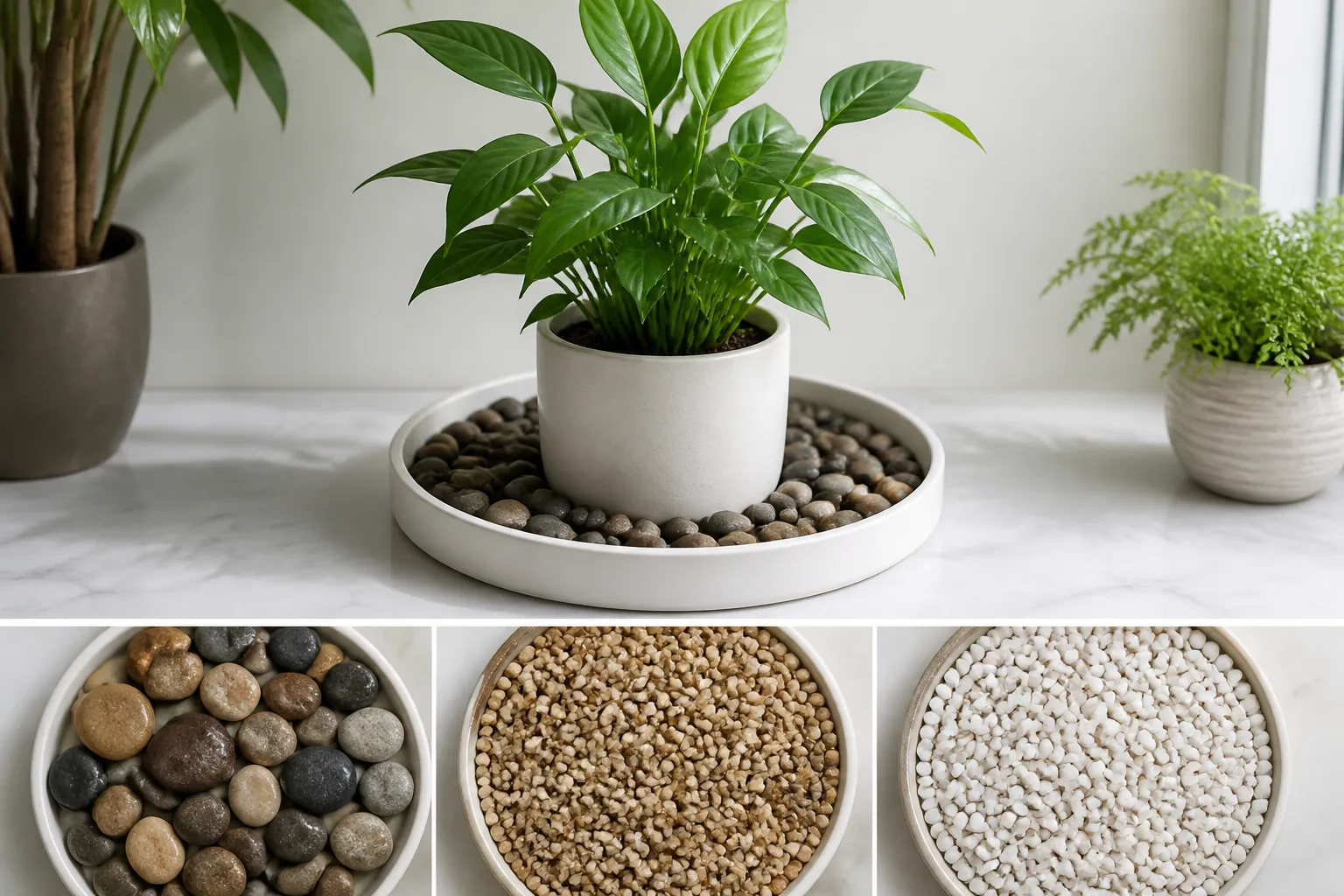
LeafyPixels editorial setup: ThermoPro TP50 at leaf height in a 14 × 12 ft forced-air heated room, January 2026. Readings illustrate relative method strength in one home — your numbers will differ.
Humidifiers: Most Reliable Upgrade
When the matrix points to humidifier, that is usually the right call for multiple plants, moderately or severely dry rooms, or canopies too high above a tray. University of New Hampshire Extension identifies a portable humidifier near plants, paired with monitoring, as the option with the most benefit in dry indoor conditions. (University of New Hampshire Extension) This page stops at the decision — sizing, distilled water, EPA cleaning schedules, and side-by-side tray math live on pebble tray vs humidifier.
Placement, Cleaning, and When to Choose One
Place the unit close enough to influence the plant zone but not so close that leaves stay wet from direct mist contact. Run toward the lowest setting that hits your target, and stop if condensation forms on windows or walls. The EPA advises emptying portable humidifier tanks daily, using low-mineral water, and cleaning every third day to limit scale and microorganisms. (US EPA) The CDC recommends distilled or boiled-and-cooled water to reduce germ growth. (CDC)
Choose a humidifier when repeated hygrometer readings stay far below your plant target, when several sensitive plants share one shelf, or when trays and grouping produced negligible change in the editorial test above. Skip it as the first move when one compact plant already sits in acceptable RH and only needs better placement.
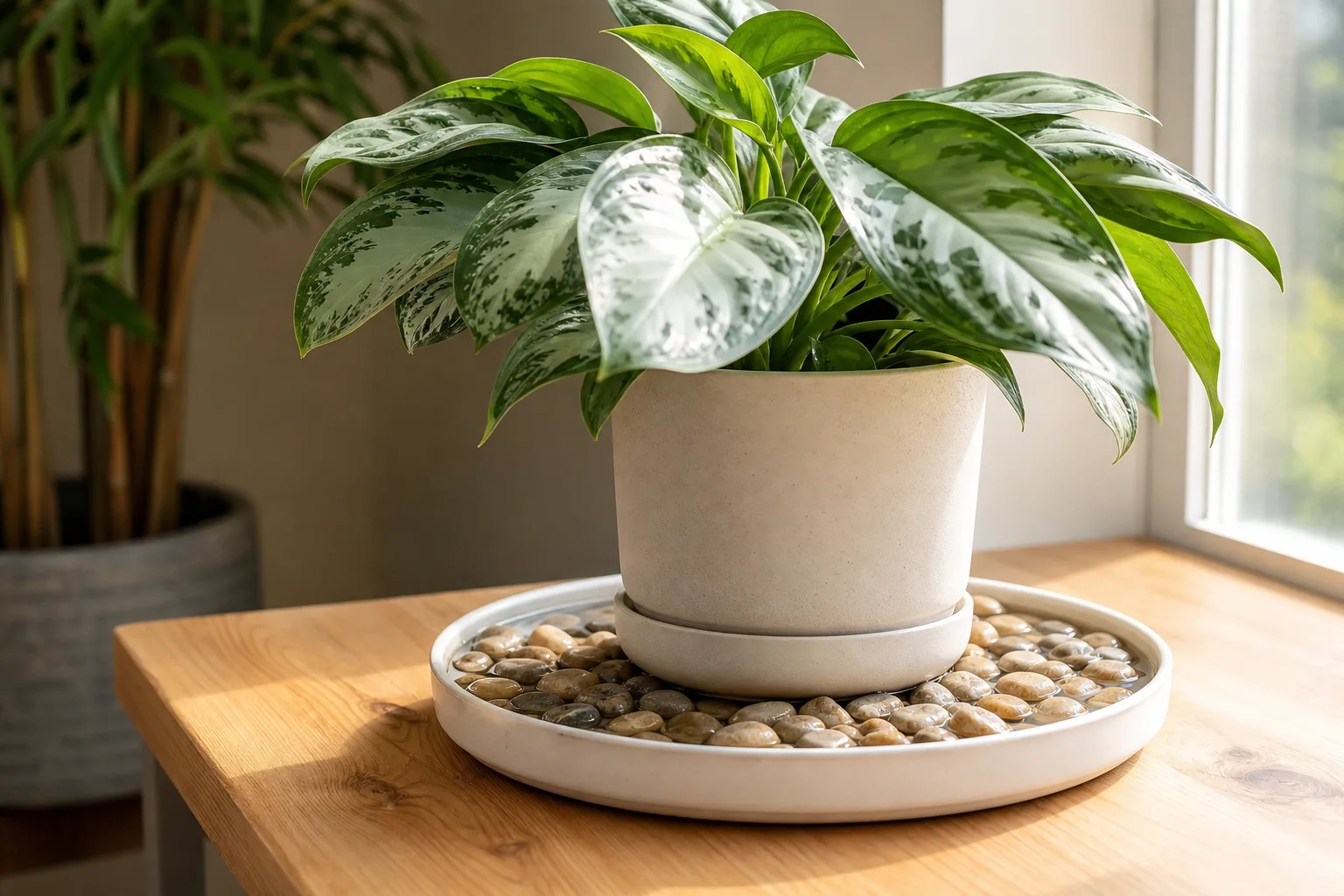
Portable ultrasonic unit on low, 4 ft from the shelf — the setup used in the editorial comparison table above.
Grouping Plants: Microclimate Setup
Grouping uses transpiration — moisture released from leaves and evaporation from soil surfaces — to create a shared pocket of slightly higher RH. Washington State University Extension lists grouping close together as a standard humidity-raising tactic alongside gravel trays. (Washington State University Extension) Nebraska Extension describes the result as a small pocket of slightly higher humidity rather than a whole-room shift.
This is the best free upgrade when you already own several tropicals with similar needs. It pairs well with a shared tray under the cluster but does not replace a humidifier in a severely dry room.
Three-Step Grouping Layout
Materials: hygrometer, stable shelf or bench, optional shared pebble tray, plants with matched light and water needs.
- Cluster by need and light. Place humidity-loving plants within 6–12 inches of each other on one surface that receives the same light level. Do not mix succulents with calatheas in the same humidity stack.
- Clear vents and drafts. Move the group at least 3–4 feet from heating vents, radiators, and drafty windows. Dry moving air defeats the microclimate faster than transpiration builds it.
- Measure at the cluster center. After 24 hours, read RH at leaf height between the pots. If the bump is under 3–5 points and plants still crisp, escalate to a humidifier or enclosure per the matrix.
Leave enough space for air to move. Leaves should touch neighbors occasionally, not form a solid wall of wet foliage — stagnant damp clusters invite fungal issues.
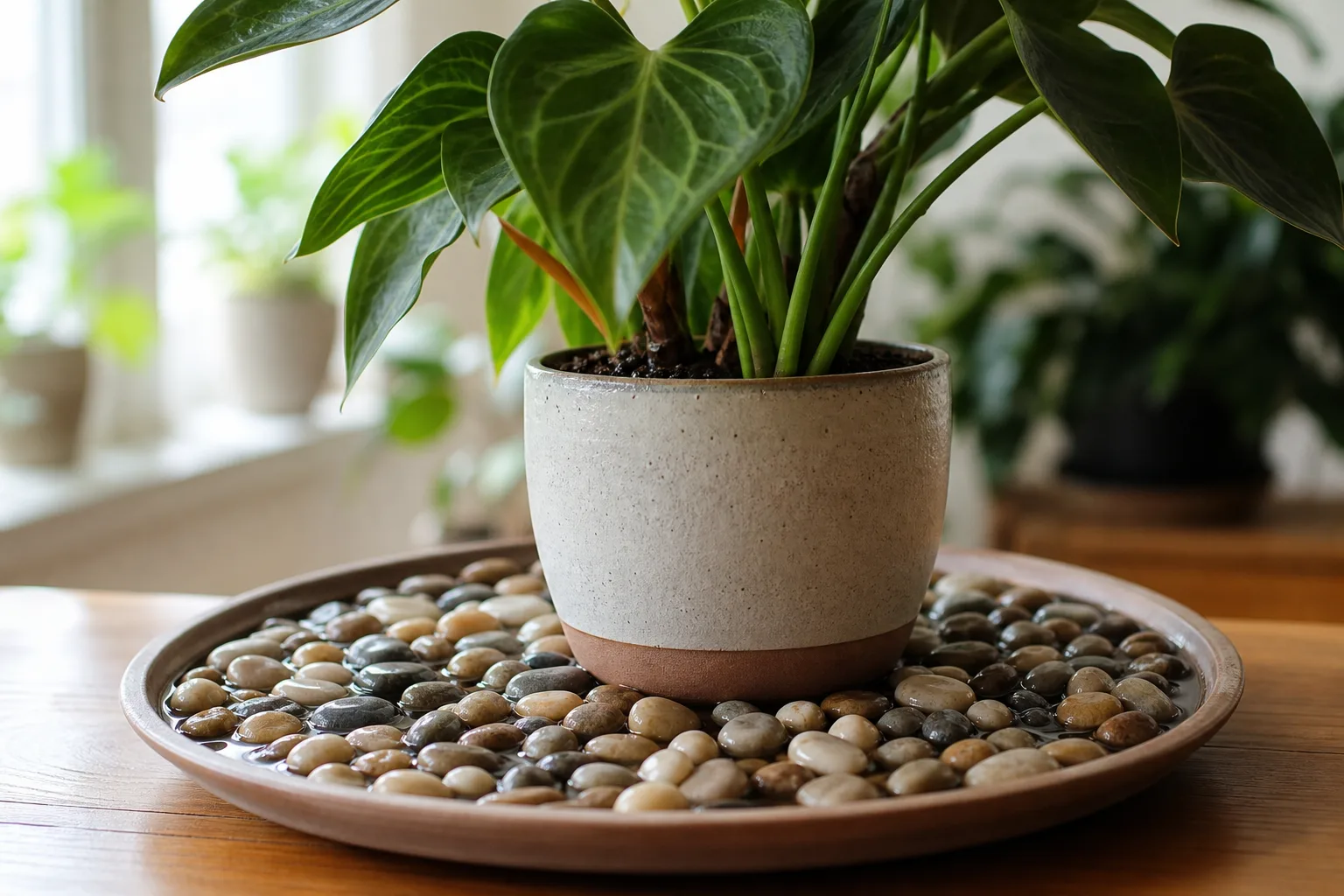
Six humidity-loving tropicals clustered 6–12 inches apart on one shelf; RH was measured at the cluster center 24 hours after rearrangement.
Terrariums, Cabinets, and Cloches
Enclosed glass holds humidity far better than open-room methods. Missouri Extension notes closed terrariums retain the most humidity but carry greater disease risk if moisture and stale air build unchecked. (MU Extension) Oklahoma State Extension similarly warns that excess condensation signals a need to vent. (Oklahoma State Extension)
Use enclosures for small humidity lovers — fittonias, tiny ferns, mosses, miniature begonias — not for large monsteras or desert plants.
Minimal Closed-Terrarium Build
Materials: clear glass container with lid, 1–2 inches coarse gravel or pebbles, thin charcoal layer, peat-free terrarium mix, small humidity-tolerant plants, mister, chopstick or skewer.
- Drainage base. Add gravel, then a thin charcoal layer, then moist (not soggy) terrarium mix sloped slightly away from glass walls.
- Plant and water lightly. Aim water at the soil, not foliage. Let leaves dry before sealing.
- Seal and observe. Fine mist on glass is normal; running streams of condensation mean vent the lid 30–60 minutes daily until balance returns.
Iowa State Extension’s terrarium care guide recommends venting when walls coat heavily and avoiding direct sun that turns glass containers into ovens. (Iowa State Extension)
Ventilation and Disease Prevention
High humidity without airflow trades crisp tips for rot. Match the enclosure to the plant, vent on schedule, and remove dead leaves promptly. If mold appears on soil or glass, open the container, remove affected tissue, and reduce watering before resealing.
Daily venting prevents excess condensation; running streams on glass mean the enclosure needs more airflow before resealing.
Naturally Humid Rooms
Bathrooms, kitchens, and laundry areas often run more humid than living rooms because of showers, cooking, and appliances. University of Arizona Cooperative Extension lists these rooms among spaces that can suit sensitive houseplants when conditions align. (University of Arizona Cooperative Extension)
Humidity alone does not grow plants. Before you relocate a calathea to the shower window, confirm:
| Check | Pass? | Why it matters |
|---|---|---|
| Bright indirect light for 6+ hours | Yes / No | Many bathrooms are too dim |
| Stable temperature (no cold window draft) | Yes / No | Cold + damp invites disease |
| Room RH higher than living area on hygrometer | Yes / No | Confirms the move is worth it |
| Plant not directly under vent or fan | Yes / No | Dry airflow negates humidity |
When light is adequate, moving a struggling plant to a naturally humid room can outperform a tray in a dry living room — at zero cost.
Moss Poles and Localized Moisture
Climbing aroids — philodendrons, monsteras, pothos on poles — often benefit from damp moss supports that keep aerial roots and new growth in a moister micro-zone. Missouri Botanical Garden’s indoor plant guidance treats humidity trays and localized moisture as support tactics for tropical foliage, distinct from whole-room humidification. (Missouri Botanical Garden)
A lightly moist moss pole can encourage stronger attachment and larger leaves on some climbers. Re-moisten the moss when the top layer feels dry to the touch — typically every 3–5 days in average indoor air, or more often when heating runs constantly. It does not replace a humidifier when the room sits at 20% RH. Think of it as targeted support layered on top of a room strategy that already meets baseline needs. For Monstera-specific humidity context, see Monstera humidity needs.
Weak Fixes and Common Mistakes
Casual misting is the most overrated substitute. Virginia Cooperative Extension states misting is of doubtful effectiveness for meaningful humidity change unless repeated frequently through the day — and timed so foliage dries before night to reduce disease risk. (Virginia Cooperative Extension Gardener Handbook) Misting wets leaves temporarily; it does not hold RH elevated for hours.
Other mistakes that keep humidity lovers unhappy:
- Watering more when the real issue is dry air — roots stay wet while tips crisp.
- Treating all houseplants as rainforest species — succulents and many common tropicals tolerate average homes.
- Ignoring vents and radiators — no tray outruns a heating duct.
- Guessing instead of measuring — a $10 hygrometer saves months of trial and error.
- Chasing high RH without a home limit — keep whole-room humidity within EPA guidance while using local boosts for sensitive plants.
Conclusion
Match your pebble tray alternative to plant count, measured room dryness, and species sensitivity — then measure again after 24 hours. When the room stays stubbornly dry or many plants share one shelf, escalate to a humidifier; when the gap is mild, grouping or a shared tray may be enough. Stop asking whether a substitute looks clever. Ask whether it is powerful enough for the plant in front of you.
Related Guides
- Pebble tray vs humidifier — sizing, EPA maintenance, distilled water, and full side-by-side comparison
- Indoor humidity and pebble trays — tray math, hygrometer placement, and measured local RH
- Pebble trays for plants — when trays still make sense and how to set them up
- Houseplant humidity guide — broader target ranges and seasonal humidity shifts
- Calathea care guide — species deep dive for a high-humidity classic
- How to water indoor plants the right way — separate watering problems from air-moisture problems