Best Potting Mix for Indoor Plants: Soil Ingredients That Work
Learn what makes a good indoor plant soil mix, including drainage, aeration, moisture retention and plant-specific tweaks.
The Short Answer
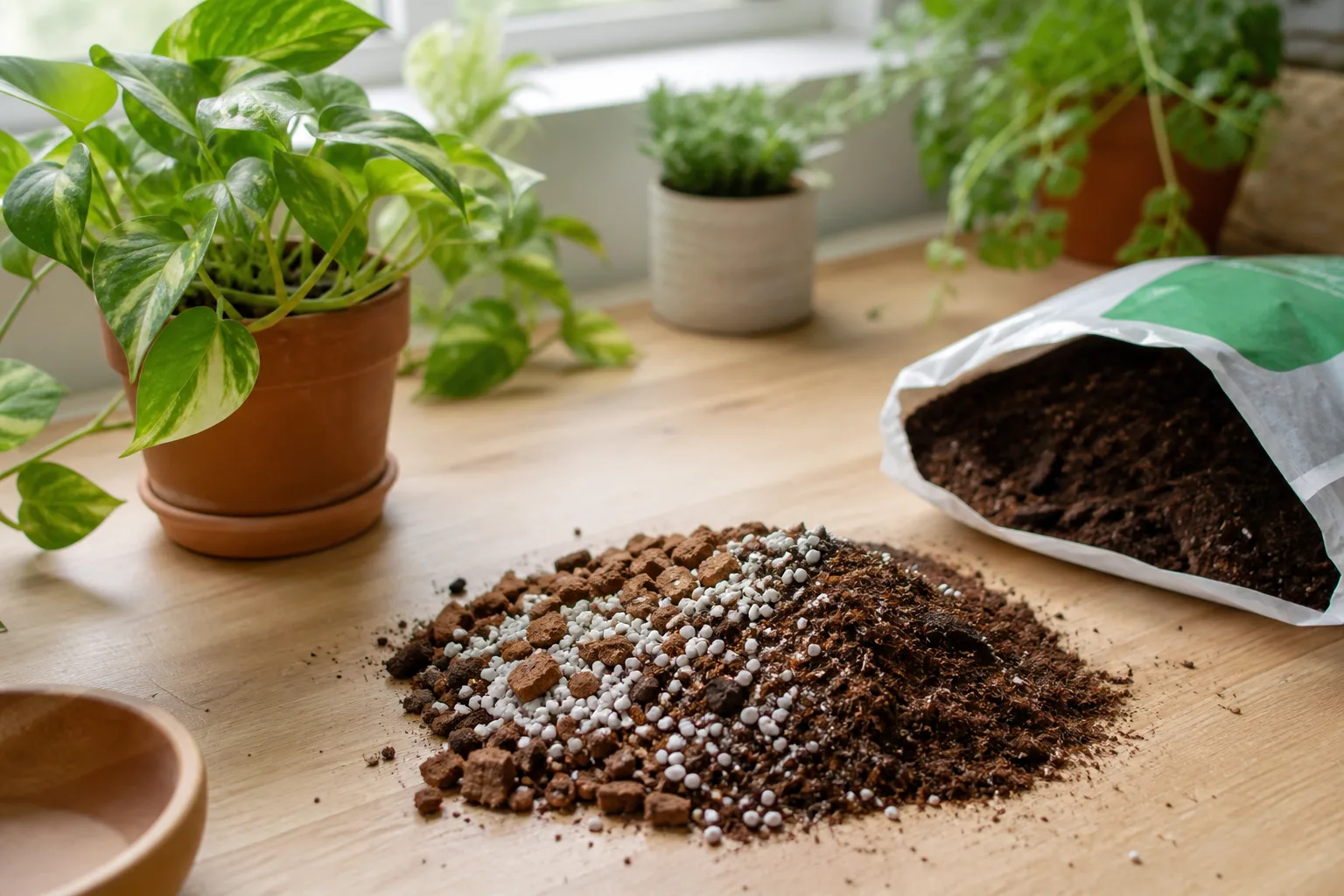
The best potting mix for indoor plants is light, airy, moisture-retentive, and fast enough to drain before roots sit in stagnant water. For most common houseplants, a strong starting blend is 2 parts high-quality indoor potting mix or coco coir-based mix, 1 part perlite or pumice, and 1 part fine orchid bark. This gives roots moisture, oxygen, and structure, which is the real goal. A mix that only “holds water” is not enough; indoor plants need a medium that can hold some water while still leaving air spaces around the roots.
There is no single perfect mix for every indoor plant. A fern and a cactus should not live in the same medium. A Monstera deliciosa usually wants a chunkier mix than a peace lily. A snake plant usually does better in a faster-draining, grittier mix than a calathea. The right choice depends on the plant’s root type, your home’s light level, the pot’s drainage, and your watering habits.
University and horticultural guidance consistently points to the same core principle: container media must balance aeration, drainage, water retention, and nutrient-holding capacity. The University of Maryland Extension says potting medium for indoor plants should be porous enough for aeration and drainage while still holding water and nutrients. It also warns that products labeled “potting soil” can be too dense unless amended with perlite or vermiculite. (University of Maryland Extension)
That is why the best practical answer is not “buy any indoor plant soil.” A basic bagged mix may work for forgiving plants, but it often needs adjustment. If your plants are yellowing, wilting in wet soil, developing fungus gnats, or drying out strangely fast, the issue may not be your watering alone. The potting mix may be holding too much water, collapsing too quickly, or failing to provide enough oxygen around the roots.
What Indoor Plant Roots Need from Potting Mix
Indoor plant roots do three jobs that matter here: they absorb water, absorb dissolved nutrients, and exchange gases. The part many beginners miss is gas exchange. Roots need oxygen. When a mix stays dense and wet for too long, water fills the spaces where air should be. That creates the perfect setup for weak roots, stalled growth, and root rot.
A good potting mix is not the same thing as outdoor soil. Outdoor garden soil behaves differently because it sits in the ground, drains into a wider soil profile, and supports a broad ecosystem. In a pot, the root zone is trapped in a small container. The mix has to perform all the work: it must support roots, drain excess water, hold enough moisture between waterings, and avoid turning into a compact brick.
Clemson Cooperative Extension notes that many indoor gardeners use peat-lite mixes, often based on peat moss with perlite or vermiculite, while coco coir has become a popular alternative to peat. It also notes that soilless media are lightweight, sterile, and easy to handle, with some mixes including slow-release fertilizer that feeds plants for a few months. (Home & Garden Information Center) This matters because most indoor plant problems start when the growing medium is wrong for the plant or the environment.
Think of potting mix as root architecture. The plant above the soil can only perform as well as the root environment below it. Glossy leaves, strong stems, and steady new growth depend on roots that are neither suffocating in mud nor drying out every few hours. The best mix gives the plant a stable root zone while still letting you water normally.
Air Pockets for Healthy Roots
Aeration is the amount of air space inside the potting mix. This is why ingredients like perlite, pumice, coarse bark, and horticultural grit are so useful. They create physical gaps that keep the mix from becoming dense. Those gaps allow oxygen to reach the roots and let excess water move through the container.
Poor aeration is one reason indoor plants can look thirsty even when the soil is wet. When roots are damaged by soggy, oxygen-poor conditions, they cannot absorb water properly. The leaves may wilt, and a beginner may respond by watering again, making the problem worse. This is the classic overwatering trap.
The University of Wisconsin-Madison Division of Extension explains that root rot prevention starts with proper repotting, drainage holes, and a pasteurized commercial potting mix rather than garden soil. It also warns against putting rocks or gravel at the bottom of pots because that can inhibit drainage instead of improving it. (Wisconsin Horticulture)
For most indoor plants, aeration should be visible when you touch the mix. It should feel loose, not sticky or heavy. When dry, it should not shrink into a hard block. When watered, it should absorb moisture but still let water escape from the drainage holes within a reasonable time.
Moisture Retention Without Sogginess
A good indoor plant mix should not drain like a basket of stones. Roots need access to water long enough to use it. The problem is not moisture itself; the problem is stagnant moisture without air. This is why the best potting mix combines water-holding materials with drainage and aeration materials.
Coco coir and peat moss both hold moisture well. Vermiculite holds more water than perlite and can be useful for moisture-loving plants, though it is not ideal for plants that hate wet feet. Fine bark and compost can also hold moisture, but too much fine organic material can make a mix dense over time. The key is balance.
Your home changes the answer. A plant in bright indirect light near a warm window will use water faster than the same plant in a dim corner. A terracotta pot dries faster than glazed ceramic or plastic. A small pot dries faster than a large pot. A plant in active growth uses more water than a plant resting in winter. The “best” mix must fit the actual growing conditions, not just the plant label.
If your soil stays wet for more than a week after watering, the mix is probably too dense, the pot is too large, the room is too dim, or the plant is not using much water. Often it is a combination. Adding perlite, pumice, or bark can help, but it will not fix a pot with no drainage holes or a plant placed in light that is too low for healthy growth.
Structure That Does Not Collapse
Potting mix structure matters over months, not just on repotting day. Some mixes feel fluffy when new but collapse after repeated watering. Once the small particles settle, the lower part of the pot can become wet, dense, and poorly aerated. This is common in cheap mixes with too much fine compost, peat dust, or poorly processed organic material.
A stable indoor plant mix contains particles of different sizes. Fine material holds some moisture. Medium particles support roots. Coarse particles create air channels. Bark, pumice, perlite, and coarse coir chips are valuable because they resist compaction better than very fine organic matter.
The Royal Horticultural Society explains that bark is commonly used for orchids and is also useful in mixes because it adds air, improves drainage, and can lower pH. Its houseplant growing media guidance also describes how different ingredients can be combined for different plant needs, including chunkier blends for plants such as Monstera and Philodendron. (RHS)
This is why a plant may decline six months after repotting even if the mix seemed fine at first. The medium may have broken down. Watering may have washed fine particles downward. Fertilizer salts may have built up. Roots may have filled the container. A good potting mix buys you time, but it does not stay perfect forever.
The Core Ingredients in a Good Indoor Plant Potting Mix
The easiest way to understand potting mix is to group ingredients by function. Every ingredient should earn its place. Some hold water. Some create air. Some add nutrients. Some improve structure. Problems begin when a mix has too much of one function and not enough of another.
A typical indoor plant mix uses a base material, an aeration material, and a small nutrient component. For many houseplants, this works better than using straight compost, straight coco coir, or straight cactus mix. Pure moisture-holding material can stay too wet. Pure gritty material can dry too fast and hold too little nutrition. Pure compost can compact and invite fungus gnats if kept wet indoors.
The best mix is also clean. Indoor containers are not the place for random garden soil, unfinished compost, or unknown outdoor dirt. These can introduce pests, weed seeds, pathogens, and drainage problems. A pasteurized commercial mix or a carefully built DIY blend gives you more control.
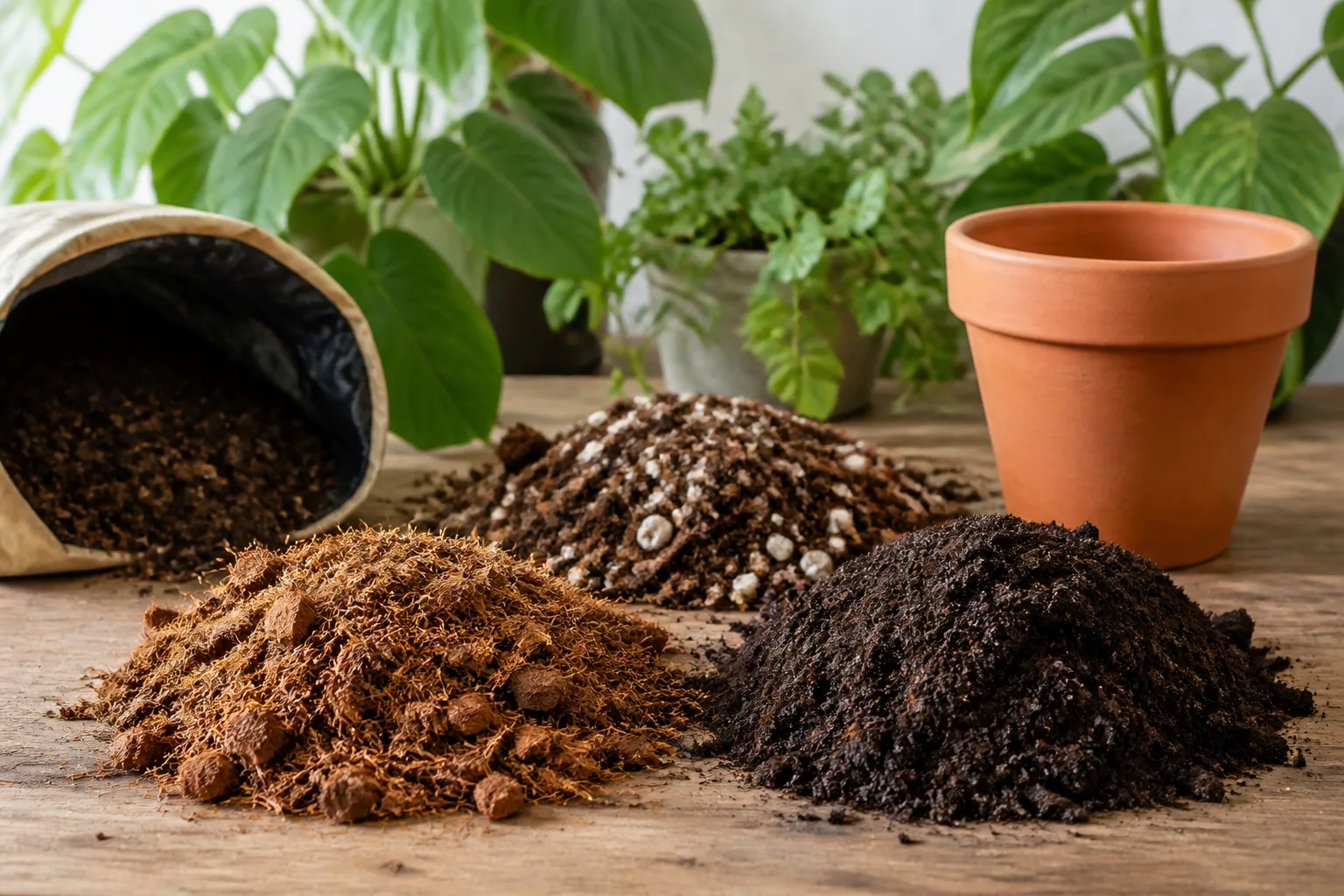
When reading a bag label, look for ingredients such as coco coir, peat moss, bark, perlite, pumice, composted bark, and controlled-release fertilizer. Be cautious with vague labels that say only “soil,” “humus,” or “organic matter” without explaining texture or drainage. Indoor plants usually need a container medium, not heavy earth.
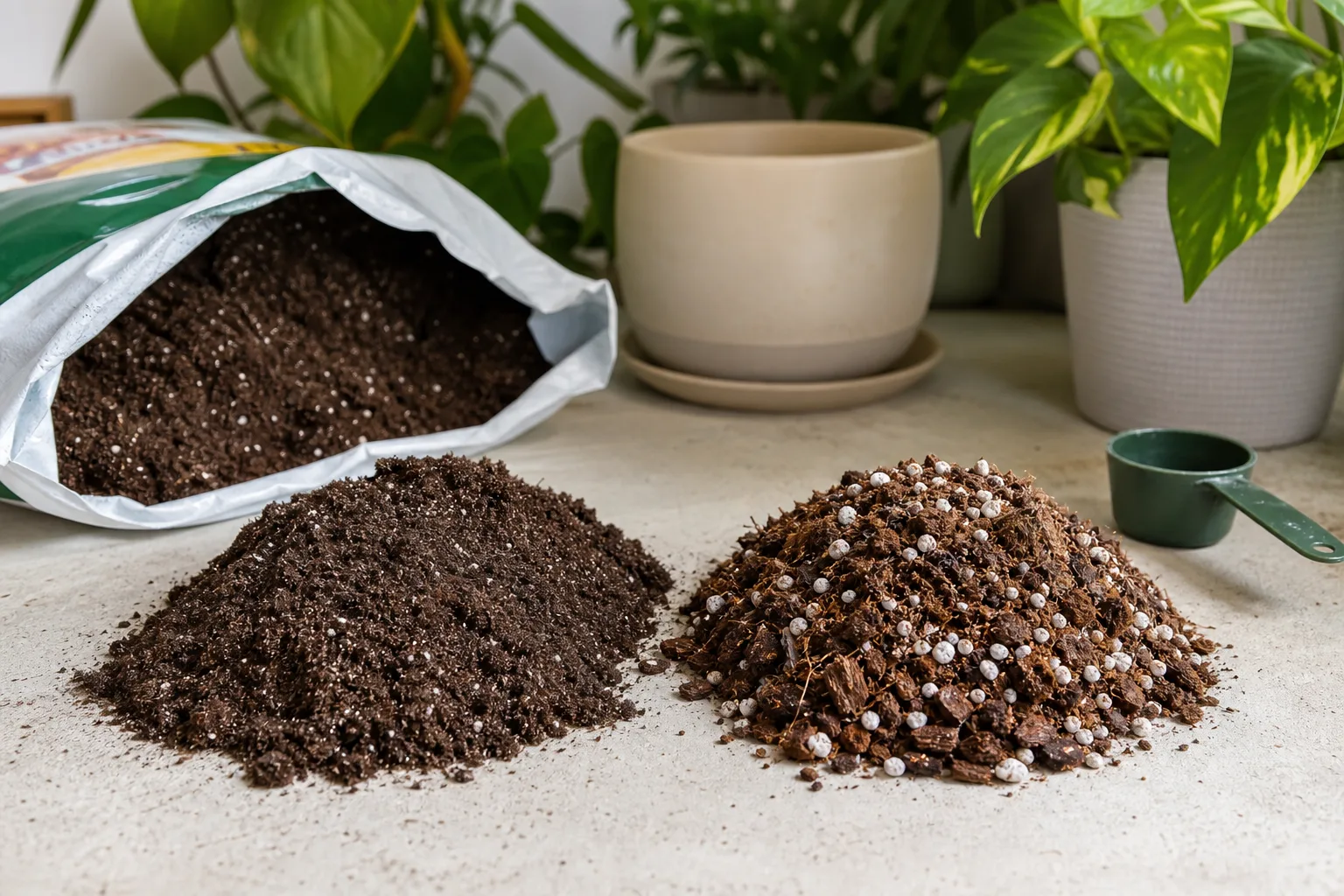
Editorial note: In a side-by-side test, an unamended bagged “indoor potting mix” held water in a 6-inch test pot for roughly 90 minutes before the top inch felt dry again, while the same base amended with 30% perlite drained visibly faster and passed a simple squeeze test—moist but crumbly, not a sticky clump. Your home humidity and pot material will change the timing, but the texture difference is immediate and worth learning by hand.
Base Material: Coco Coir or Peat Moss
The base of many indoor plant mixes is either coco coir or peat moss. Both hold moisture and help keep the mix light. Peat moss has been used for decades because it is consistent, acidic, and excellent at water retention. Coco coir, made from coconut husk fiber, is widely used as a peat alternative and often re-wets more easily after drying.
The choice is not purely technical. It also has an environmental side. IUCN reports that peat soils contain more than 600 gigatonnes of carbon, representing up to 44% of all soil carbon, and exceeding the carbon stored in all other vegetation types, including forests. (IUCN) UNEP has also highlighted that drained peatlands release large amounts of greenhouse gases. (UNEP - UN Environment Programme) For readers trying to reduce peat use, a peat-free or reduced-peat mix based on coir, bark, wood fiber, and composted materials is a reasonable direction.
Coco coir is not perfect. Some coir products can contain salts if poorly washed, and coir holds calcium and magnesium differently than peat. Good commercial mixes account for this, but very cheap compressed coir bricks may need rinsing and buffering depending on quality. For everyday indoor gardeners, buying a reputable coir-based houseplant mix is easier than building from raw coir alone.
Peat-based mixes can still perform well for many indoor plants, especially when amended with perlite or bark. The practical decision is this: choose a base that holds moisture but does not become dense, and avoid using it alone. Whether the base is peat or coir, it needs structure and aeration ingredients to become a good indoor plant potting mix.
Aeration Materials: Perlite, Pumice, and Bark
Perlite is the white, lightweight material commonly seen in potting mixes. It improves aeration and drainage without adding much weight. It is useful for nearly all indoor plant mixes, especially if your bagged soil feels heavy or stays wet too long. The downside is that it can float to the surface over time and crush more easily than pumice.
Pumice is heavier and more durable. It improves drainage and aeration while adding weight, which helps stabilize top-heavy plants such as larger snake plants, fiddle-leaf figs, or mature aroids. It is often more expensive than perlite, but it holds structure well and does not float as much.
Orchid bark or pine bark adds chunkiness. It is especially helpful for aroids and epiphytic plants that naturally grow with roots exposed to air pockets around tree bark, leaf litter, or loose organic debris. Bark also helps prevent the mix from becoming too uniform and compact. For fine-rooted plants, use smaller bark. For large-rooted aroids, medium bark works well.
The University of New Hampshire Extension explains that good potting mixes often contain an organic component such as peat moss, compost, or bark, plus materials such as vermiculite or perlite to manage moisture and structure. It also stresses that knowing what is in the mix helps determine whether it matches the plants being grown. (Extension | University of New Hampshire) That is the core skill: stop thinking in brand names only and start thinking in functions.
Nutrient Materials: Compost, Worm Castings, and Fertilizer
Potting mix is not just a physical support system. It also needs to provide or hold nutrients. Many commercial mixes include starter fertilizer or slow-release fertilizer that feeds plants for a limited period. Clemson notes that high-quality soilless mixes often contain slow-release fertilizers that supply plant needs for a few months, though they may be low in trace elements. (Home & Garden Information Center)
Compost and worm castings can improve nutrient content and microbial activity, but they should be used carefully indoors. Too much compost can make the mix heavy, wet, and attractive to fungus gnats. A small amount is useful; a large amount can create problems. For most indoor plants, 10% to 20% worm castings or finished compost is enough if you are making a DIY mix. If you add compost from outdoor sources, pasteurize or buy a sterilized product—UF/IFAS recommends pasteurized media for container plants to reduce pathogen risk. (Solutions For Your Life)
Fertilizer is not a substitute for good structure. A plant sitting in dense, wet soil will not become healthy because you add more nutrients. In fact, fertilizing a stressed plant can worsen root stress. Build the right physical mix first, then feed lightly during active growth using guidance from our fertilizing indoor plants guide.
If you use a fresh commercial potting mix, do not assume you need to fertilize immediately. Many mixes already contain nutrients. Check the label. If the mix feeds for two or three months, wait before adding liquid fertilizer. Overfeeding can cause salt buildup, burned roots, and weak growth, especially in low-light indoor conditions.
Best Potting Mix by Indoor Plant Type
The most useful way to choose potting mix is by plant type. Plants with thick, drought-tolerant roots need a different medium from plants with fine roots that dislike drying out. Plants that climb trees in nature often like chunkier mixes. Plants adapted to dry conditions usually need faster drainage. Moisture-loving plants need water retention but still need air.
This does not mean you need twenty bags of soil. Most indoor gardeners can manage with three building blocks: a quality indoor plant mix, an aeration material such as perlite or pumice, and orchid bark. Add a cactus mix or coarse sand if you grow many succulents. Add sphagnum moss only for specific plants or propagation uses, not as a universal houseplant solution.
The recipes below are starting points. Your conditions matter. If you underwater, you may prefer slightly more moisture retention. If you overwater, use more pumice, perlite, or bark. If your home is humid and low-light, go chunkier and faster-draining. If your home is hot, bright, and dry, the same plant may need a slightly more moisture-retentive mix.
Everyday Foliage Plants
Everyday foliage plants include pothos, peace lily, spider plant, Chinese evergreen, dracaena, dieffenbachia, and many common tropical houseplants. These plants usually do well in a balanced indoor potting mix that holds moderate moisture but does not stay soggy. A good formula is 2 parts indoor potting mix, 1 part perlite or pumice, and ½ to 1 part fine bark.
This mix is forgiving because it has enough moisture retention for normal watering routines while giving roots more air than a dense bagged mix. If your home is dry or you forget to water, use slightly less bark and more base mix. If your plants often stay wet, increase perlite or pumice.
Peace lilies and Chinese evergreens can tolerate more moisture than snake plants, but they still dislike stagnant soil. Yellowing lower leaves, a sour smell, and soil that remains wet too long are signs the mix may be too dense. Do not respond by adding more fertilizer. Check the roots and the mix first.
For these plants, a standard “indoor plant mix” can be enough if it contains perlite and feels loose. But many commercial mixes benefit from an extra handful or two of perlite. This simple amendment often makes the difference between soil that stays wet and soil that breathes.
Aroids Like Monstera, Pothos, and Philodendron
Aroids such as Monstera deliciosa, Philodendron, Anthurium, and many pothos varieties usually appreciate a chunkier mix. Their roots often like oxygen-rich pockets and do not perform well in dense, fine soil. A strong aroid blend is 2 parts indoor potting mix or coco coir base, 1 part orchid bark, 1 part perlite or pumice, and a small amount of worm castings.
This kind of mix mimics the loose organic debris many aroids encounter in nature. It lets larger roots push through the medium while preventing the pot from becoming waterlogged. Chunky bark also helps reduce compaction over time, which is important for plants that may stay in the same pot for a year or more. For Monstera-specific ratios and bark sizing, see our dedicated Monstera soil mix guide.
If your Monstera grows slowly, produces small leaves, or has yellowing leaves while the soil stays damp, the mix may be too fine. Repotting into a chunkier blend can help, but do it carefully. Remove only loose old soil; do not aggressively strip healthy roots unless the plant has rot or the old medium is severely compacted.
Succulents, Cacti, Snake Plants, and ZZ Plants
Succulents, cacti, snake plants, and ZZ plants need a faster-draining mix because they store water in leaves, stems, rhizomes, or roots. Their biggest indoor risk is usually not underwatering. It is staying wet in low-light rooms, oversized pots, or dense soil.
A practical indoor blend is 1 part cactus/succulent mix, 1 part pumice or perlite, and ½ part coarse bark or gritty material. If your store-bought cactus mix still looks like regular potting soil with a little sand, amend it heavily. Many cactus mixes are not gritty enough for indoor conditions, especially in humid rooms or plastic pots. For full care context, see Indoor Succulent Care.
Snake plants and ZZ plants are often sold as “low-maintenance,” but that does not mean they can survive wet soil forever. Their thick underground structures can rot when surrounded by stagnant moisture. Use a pot with drainage holes, avoid oversized containers, and let the mix dry significantly before watering again.
For cacti and true succulents, drainage must be fast, but the mix should still hold a little water long enough for roots to absorb it. Pure sand is not ideal because it can compact. A better gritty mix uses pumice, perlite, coarse sand, fine bark, and a small amount of organic base. The goal is not desert dust; it is an airy container medium that dries predictably.
Ferns, Calatheas, and Moisture-Loving Plants
Ferns, calatheas, marantas, and similar moisture-loving plants need a different balance. They dislike drying out completely, but they also suffer in dense soggy soil. Their ideal mix is moisture-retentive and airy at the same time. A useful blend is 2 parts coco coir or fine indoor mix, 1 part perlite, ½ part fine bark, and a small amount of worm castings.
Vermiculite can help moisture-loving plants because it holds water, but use it carefully. Too much can keep the mix wet for too long, especially in low light. Fine bark and perlite help keep oxygen in the root zone while the coir or peat base holds moisture.
Calatheas are especially sensitive to inconsistent moisture. If the mix dries into a hard block, water may run around the edges instead of soaking the root ball. If the mix stays wet, roots decline. A slightly moisture-retentive but loose mix is usually better than a very chunky aroid mix or a dense all-purpose mix.
Humidity and water quality may also affect these plants, but potting mix is still foundational. Crispy edges do not always mean the soil is too dry; they can come from low humidity, mineral buildup, or inconsistent watering. Before changing the mix, check whether the root ball is drying evenly or staying wet at the bottom.
Orchids and Epiphytic Plants
Many orchids, especially Phalaenopsis orchids, are epiphytes. Their roots are adapted to cling to trees and experience strong airflow. They should not be potted like ordinary foliage plants. For most Phalaenopsis orchids, a bark-based orchid mix is safer than standard indoor potting mix.
Orchid bark provides large air spaces and drains quickly. Some orchids are grown in sphagnum moss, which holds more water, but moss requires careful watering because it can stay wet inside even when the surface looks dry. If you are a beginner, bark is often easier to manage because it makes overwatering less likely.
Other epiphytic plants, such as some anthuriums, hoyas, bromeliads, and jungle cacti, may also benefit from barkier mixes. However, they are not identical. A Christmas cactus may need more moisture retention than a Phalaenopsis orchid. A Hoya may prefer a chunky but not bone-dry medium. Always adjust by plant behavior, not just category.
Store-Bought vs DIY Indoor Plant Potting Mix
Store-bought potting mix is convenient and often the best choice for beginners. It is consistent, widely available, and usually cleaner than homemade mixes made from random outdoor materials. A good commercial indoor mix can work well for many common plants, especially if you add extra perlite, pumice, or bark to match the plant.
DIY mix gives you more control. You can make a chunkier blend for aroids, a grittier blend for succulents, or a moisture-retentive blend for ferns. It also lets you avoid peat if that matters to you. The downside is that buying multiple ingredients costs more upfront and requires storage space.
| Option | Best For | Strength | Limitation |
|---|---|---|---|
| Store-bought indoor mix | Beginners and common foliage plants | Easy and consistent | May be too dense without amendments |
| Store-bought cactus mix | Succulents and snake plants | Drains faster than regular mix | Often still needs pumice or perlite indoors |
| Store-bought orchid mix | Orchids and some epiphytes | Excellent airflow | Too chunky for ordinary foliage plants |
| DIY mix | Plant collectors and problem-solvers | Most control | Requires ingredient quality and correct ratios |
| Peat-free mix | Sustainability-focused growers | Reduces peat use | Quality varies by brand and formulation |
The best middle path is simple: buy a good indoor potting mix and amend it. For most homes, adding 25% to 40% aeration material improves performance. This is especially useful if you tend to overwater, use plastic pots, or grow plants in medium to low light.
Reading bag labels: Look for “potting mix” or “container mix,” not “garden soil” or “topsoil.” A useful label lists perlite, bark, or pumice by name. If the first ingredients are only peat and compost with no aeration material listed, plan to add perlite before repotting. “Cactus mix” on the label does not guarantee grit indoors—squeeze the dry mix; if it forms a tight ball, treat it like regular potting soil and amend heavily.
Be careful with cheap “all-purpose compost” or “garden soil” sold for outdoor use. It may be too heavy for indoor containers. It may also contain more fine organic matter than indoor roots can tolerate in a closed pot. A bargain bag can become expensive if it leads to root rot, fungus gnats, or repeated repotting.
Simple DIY Potting Mix Recipes
For a reliable all-purpose indoor plant mix, use 2 parts coco coir or quality indoor potting mix, 1 part perlite or pumice, and 1 part fine orchid bark. Add a small amount of worm castings if the base mix has no nutrients.
For aroids, use 2 parts coco coir or indoor mix, 1 part medium orchid bark, 1 part pumice or perlite, and ½ part worm castings. For succulents, snake plants, ZZ plants, and cacti, use 1 part cactus mix, 1 part pumice or perlite, and ½ part coarse sand or fine bark. For ferns and calatheas, use 2 parts coco coir or fine indoor mix, 1 part perlite, ½ part fine bark, and a light handful of worm castings.
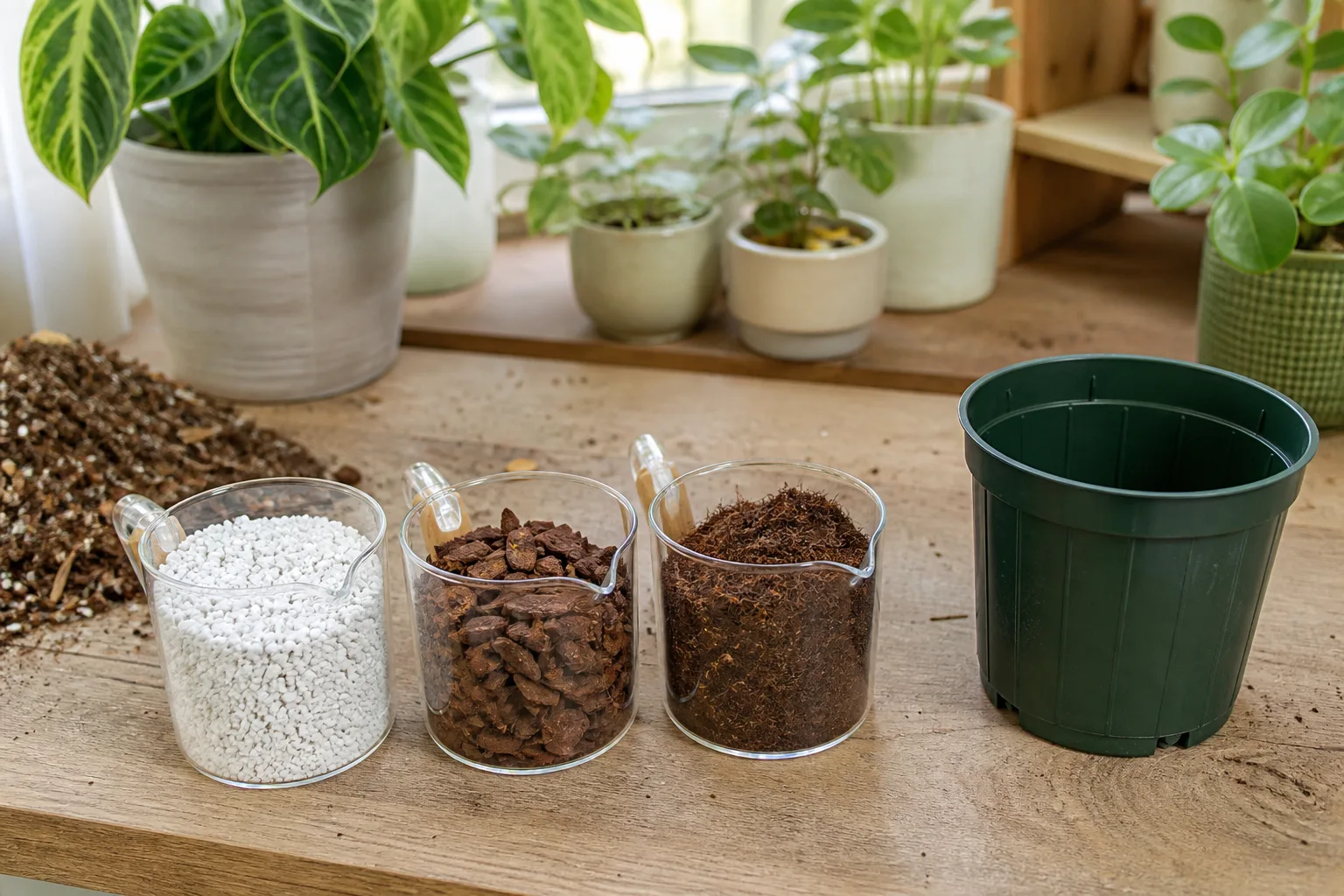
Single 6-inch pot batch (cup measurements): For one standard 6-inch nursery pot repot using the all-purpose 2:1:1 recipe above, measure roughly 2 cups base mix, 1 cup perlite or pumice, and 1 cup fine bark, plus 2–3 tablespoons worm castings if needed. You may not use every cup—leave room for the root ball—but this gives a workable batch without mixing a full bucket. Scale proportionally for larger pots.
The University of Florida IFAS Extension recommends starting with recipes and testing small batches before experimenting further. Its example recipes include foliage plant mixes using peat with perlite and coarse sand, or peat with pine bark and coarse sand, and separate formulas for succulents and bromeliads. (Solutions For Your Life) That “test small first” advice is important. Do not repot your entire collection into a new mix before seeing how it behaves in your home.
Common Potting Mix Mistakes That Damage Indoor Plants
The biggest mistake is using garden soil indoors. Garden soil is often too dense for containers, and it may introduce pests or pathogens. In a pot, it can compact, drain poorly, and suffocate roots. Wisconsin Extension specifically recommends pasteurized commercial potting mix rather than garden soil for houseplants, partly because garden soils can contain root rot fungi. (Wisconsin Horticulture)
The second mistake is adding gravel, rocks, or broken pottery at the bottom of a pot to “improve drainage.” This advice is common, but it is misleading. University of Illinois Extension explains that gravel at the bottom creates a perched water table effect, where water gathers in the soil above the gravel instead of immediately draining away. (Illinois Extension) If you want better drainage, use a pot with drainage holes and a better-draining mix.
The third mistake is using a pot without drainage holes and trying to compensate with careful watering. It can work for expert growers in specific situations, but it is risky for most indoor plants. Water can collect unseen at the bottom, while the top inch looks dry. This is how a plant can rot while the owner thinks it needs water.
The fourth mistake is assuming “organic” means better in any amount. Compost, worm castings, and rich organic ingredients can be useful, but too much can hold excess water and attract fungus gnats. Indoor plants are usually not heavy-feeding vegetables. They need a stable root environment more than a rich, wet medium.
The fifth mistake is using the same mix for every plant. A cactus in fern mix may rot. A fern in cactus mix may dry too quickly. An orchid in standard potting soil may suffocate. A Monstera in dense peat-heavy mix may survive but grow poorly. Matching the mix to the plant type prevents many problems before they start.
The sixth mistake is ignoring old potting mix. Over time, organic components break down, roots fill the pot, and the mix loses air space. If water suddenly runs straight through the pot or sits on the surface, the structure may be failing. If the plant has not been repotted in years and growth has slowed, refreshing the mix may help more than fertilizing. Top-dressing with fresh mix can buy time on a healthy plant, but a full refresh—or at least replacing the outer third of the root ball—is usually better when the medium has collapsed or smells sour.
What to Do Next
Once you have chosen or mixed the right medium, the next step is putting it to use correctly:
- Repot at the right time — active spring or early summer growth is usually safest; see Repotting Houseplants for step-by-step timing and technique.
- Match watering to the new mix — a chunkier blend dries faster; adjust using How to Water Indoor Plants the Right Way.
- Open the species hub — Monstera, pothos, calathea, snake plant, and ZZ plant each have dedicated soil and care pages under
/plants/{slug}/. - Plan fertilizer after repotting — many fresh mixes already contain starter nutrients; see Fertilizing Indoor Plants before feeding heavily.
- Watch for root-rot symptoms — yellow leaves, sour smell, and persistent wet soil mean check roots and mix, not just water less once.
Related Guides
- Repotting Houseplants — when and how to move plants into fresh mix
- How to Do Monstera Soil Mix — chunkier aroid ratios in depth
- How to Water Indoor Plants the Right Way — match watering to mix drainage
- Indoor Succulent Care — gritty mixes for drought-tolerant plants
- Fertilizing Indoor Plants: Complete Care Guide — feeding after repotting
Conclusion
Use this checklist before your next repot:
- Match mix to plant type — chunkier for aroids, grittier for succulents and snake plants, moisture-retentive but airy for calatheas and ferns, bark-based for orchids.
- Amend dense bagged mix — add 25–40% perlite, pumice, or bark unless the label already lists strong aeration ingredients.
- Test texture by hand — moist mix should crumble, not clump; dry mix should not form a hard brick.
- Use drainage holes — never rely on gravel layers or careful watering alone in sealed pots.
- Refresh every 1–2 years — or sooner if the mix smells sour, drains poorly, or the plant stalls despite good light and water.
Roots need oxygen as much as they need water. Good potting mix makes watering predictable and keeps indoor plants out of the dense-soil trap that causes most beginner root problems.