Yellow Leaves on Zebra Plant: Causes, Checks & Fixes
Quick answer
Yellow leaves on Aphelandra squarrosa usually mean root-zone stress-overwatering, poor drainage, or underwatering during active growth-not normal aging alone. First step: check whether the top inch of soil is wet or dry, then correct watering before you repot or fertilize.
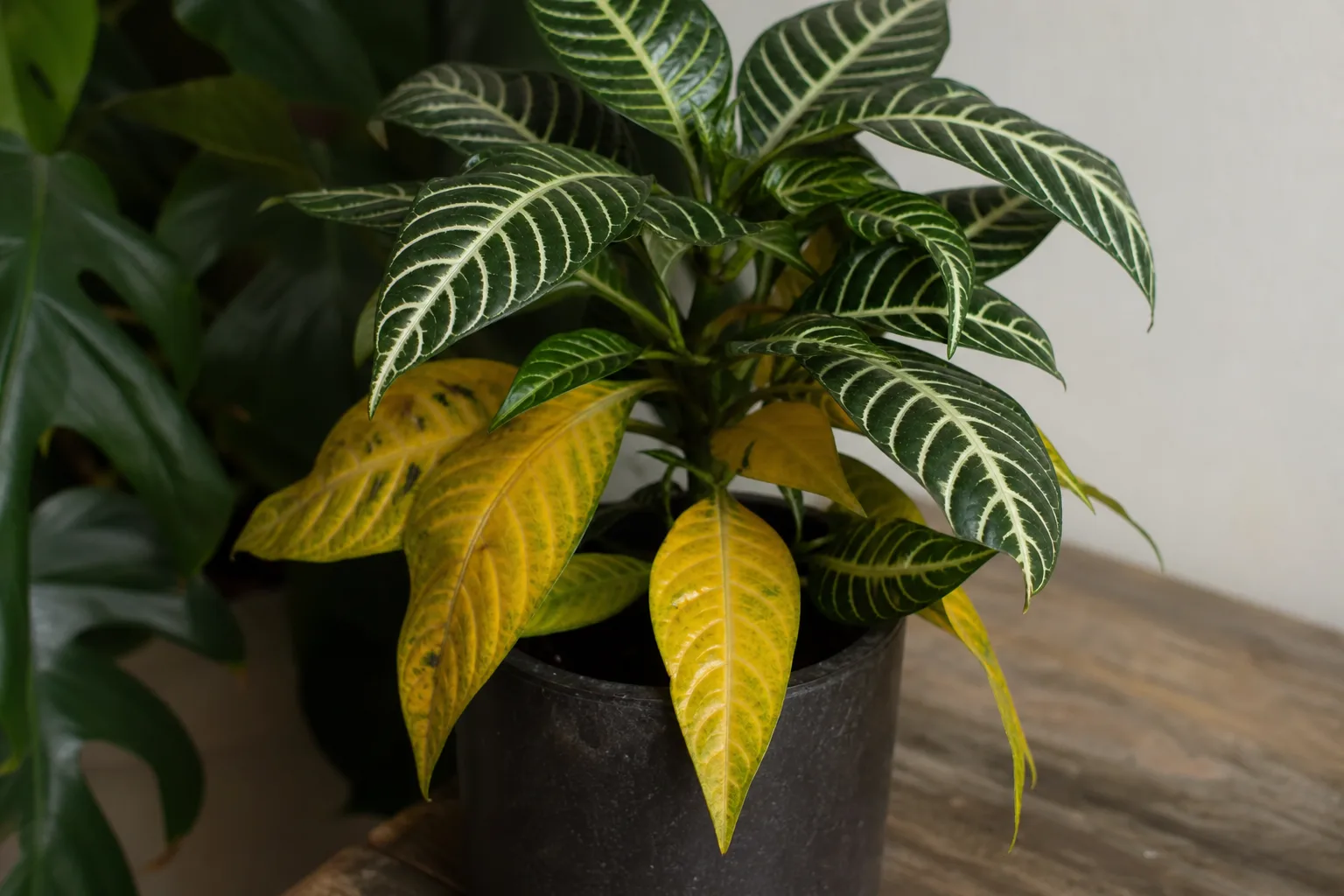
Yellow Leaves on Zebra Plant: Causes, Checks & Fixes
This guide covers yellow leaves on Zebra Plant. See also the general Yellow Leaves guide, watering, and light pages for this plant.
Yellow Leaves on Zebra Plant: Causes, Checks & Fixes
Quick answer
Yellow leaves on Zebra Plant (Aphelandra squarrosa) almost always signal that the root zone cannot keep up with what the foliage demands-not a harmless part of aging on a healthy specimen. This tropical acanthus from northeast and southeast Brazil carries large, glossy striped leaves that show stress quickly when soil stays too wet or too dry. Crown rot and leaf spots may occur when peaty mix stays saturated in dim corners; excessive amounts of water, or extremely dry conditions, will cause the bottom leaves to brown and drop-yellowing often appears on those lower leaves first.
First step: check whether the top inch of soil is wet or dry before you water, repot, or fertilize. Wet heavy soil with limp stems → follow the overwatering guide. Dry light pot with crispy leaf edges → see underwatering. Limp leaves on wet soil without obvious rot → read the wilting guide for the wet-wilt paradox.
Do not confuse Zebra Plant overview with succulent “zebra plants” such as Haworthia-they need infrequent deep drought cycles, not the even moisture Aphelandra expects. Wrong-species care is a common reason yellow-leaf advice fails online.
Yellow leaves vs. brown leaves vs. wilting - which page to use
| What you see | Soil / pot clues | Best next read |
|---|---|---|
| Lower leaves pale green → yellow, may drop | Wet, heavy pot; top inch damp for days | Overwatering |
| Yellow edges, then whole leaf yellows | Dry, light pot; mix pulls from pot walls | Underwatering |
| Limp striped leaves, plant looks thirsty | Wet mix, sour smell possible | Wilting (wet-wilt paradox) |
| Yellow halos around brown/black spots | Foliage wet overnight, stagnant air | Leaf spot disease |
| Tan-to-brown whole leaves, not yellow first | Sun, cold, or drought swings | Brown leaves |
| Leggy pale new growth, slow dry-down | Dim corner, soil wet too long | Not enough light |
This page focuses on yellow as the primary symptom. Use the table to route overlapping patterns without repeating full deep-dives from sibling guides.
What yellow leaves look like on Zebra Plant
Overwatering yellowing (most common indoors):
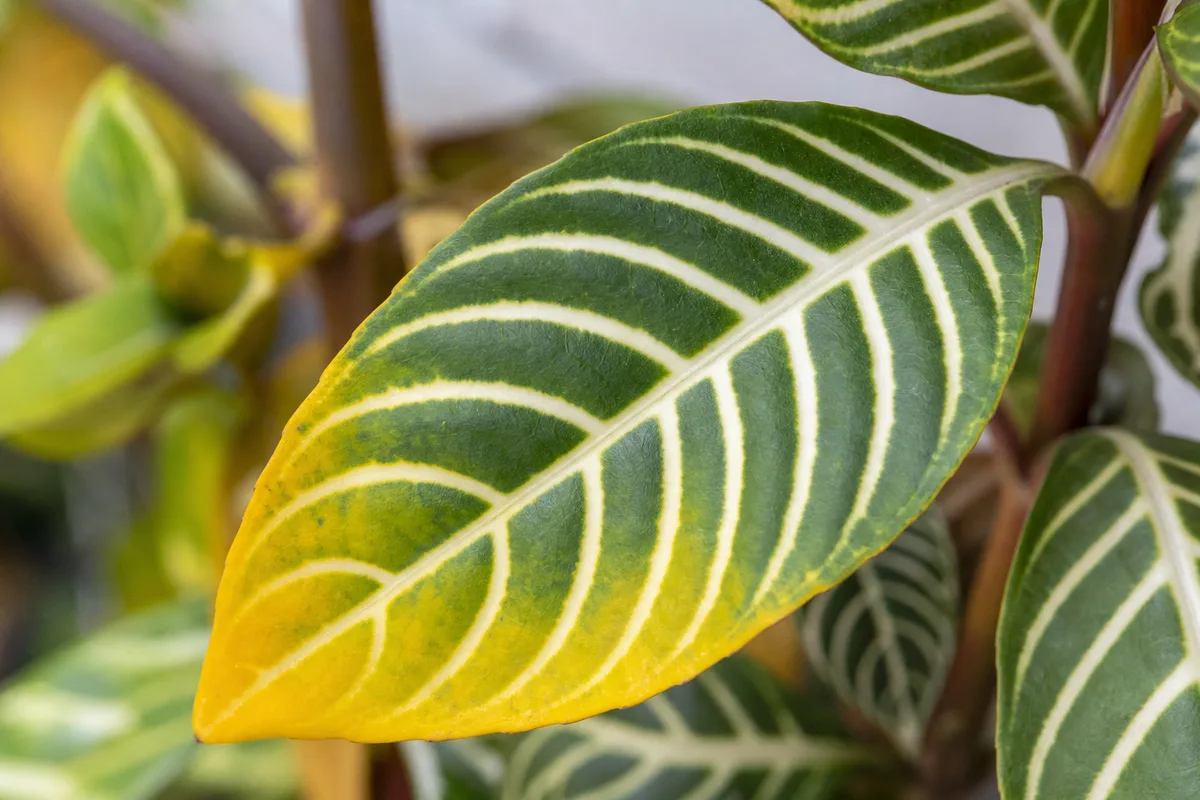
Yellow Leaves symptoms on Zebra Plant - compare with healthy tissue on the same plant.
- Lower opposite leaves turn pale green, then yellow, while upper striped foliage still looks relatively healthy
- Yellow leaves may feel soft and drop easily; pot stays heavy and cool
- Stems droop even though mix is wet-the wet-wilt paradox growers misread as thirst
- White mold, algae on soil surface, or fungus gnats often appear with chronic surface wetness
Underwatering yellowing:
- Leaf edges yellow and crisp before the whole blade fades
- Pot feels light; top inch and often deeper mix are dry
- Leaves dropping can indicate soil is too dry during active growth when the plant cannot replace transpiration from large glossy leaves
Low-light slow-dry compounding:
- Uniform pale yellowing on lower leaves in a dim corner while soil stays wet longer than you expect
- New growth small, spaced out, or pale-not the bold striped tips Aphelandra shows in Zebra Plant light guide
- Same watering schedule that worked in summer keeps winter peat soggy when growth slows
Leaf spot (yellow halos, not uniform yellow):
- Discrete brown or black spots with yellow rings on otherwise green tissue
- Unlike whole-leaf yellow from root stress, spots stay localized and may merge on heavily infected leaves
- Often follows overhead misting, wet foliage overnight, or stagnant humid corners
Normal post-flowering lower-leaf drop:
- One to several older bottom leaves yellow slowly after bright yellow bracts fade and the plant enters rest
- Stems stay firm, soil dries predictably at the top inch, and new growth resumes in late winter
- Rapid yellowing of many leaves at once during rest is not normal-it usually means watering did not adjust with slower growth
New-growth yellow as root-stress signal:
- Tips or young leaves yellow while lower leaves also decline-roots failing to deliver water and nutrients evenly
- Different from occasional single bottom-leaf senescence on an otherwise vigorous plant
The white veining on dark green leaves makes yellow lower leaves easy to spot against healthy upper stripes-use that pattern to judge whether the problem is working up from the base (water or roots) or appearing on new tissue (systemic root failure or light/fertility stress).
Why Zebra Plant gets yellow leaves
Overwatering and poor drainage
Aphelandra needs consistent moisture year around in a well-drained, peaty potting mixture-but this plant does not like wet feet. Growers hear “keep it moist” and soak on a calendar, flooding roots that lose oxygen in stagnant peat. NC State’s guidance to water frequently, not thoroughly means smaller regular drinks that maintain even moisture, not deep flooding every few days.
Pots without drainage holes, saucers left full, or decorative cache pots trap runoff. Even correct volume becomes overwatering when water cannot escape-overwatering kills more houseplants than underwatering because roots die when soil aeration fails.
Underwatering during active growth
During spring and summer growth, letting the entire root ball go bone dry starves large leaves that transpire heavily in warm rooms. Soils must not be allowed to dry out completely, yet the top inch should dry between drinks. Underwatering yellows edges first; chronic drought drops lower leaves entirely.
Low light and slow dry-down
Zebra Plant wants bright indirect light, avoiding direct sun. In weak light, photosynthesis and transpiration drop, so the same watering routine keeps soil wetter than roots can handle-overwatering symptoms without adding more water than before. Low light also produces pale, weak new growth that yellows easily.
Nutrient stress
Light feeding supports bold foliage and future bracts, but fertilizer is rarely the first cause of yellow leaves. MOBOT suggests a weak fertilizer solution every few weeks only after new growth appears in late winter-not while roots are stressed on wet soil. Yellowing from nitrogen lack usually follows long periods without feed during active growth, with older leaves fading uniformly while veins stay relatively green. Fix water and light before assuming a nutrient crisis.
Leaf spot disease
Fungal leaf spots produce yellow halos around brown lesions when foliage stays wet and airflow is poor-not the uniform lower-leaf yellow of root stress.
Post-bloom rest mismatch
After flowering, Aphelandra enters a resting period with slightly reduced watering. Winter brings semi-dormancy with reduced but not stopped watering. Continuing summer-frequency soaking while growth stalls keeps peat soggy and yellows lower leaves-the highest-risk yellowing window for indoor growers who miss the seasonal shift.
How to confirm the cause
Work through these checks in order before Zebra Plant repotting guide:
- Top-inch moisture - Stick a finger into the surface layer. Soggy or cold wet mix for three or more days after watering supports overwatering. Dry, dusty surface with limp leaves points to underwatering.
- Pot weight - Lift the container when you think it is dry and again right after watering. Learn the difference; a heavy cool pot with yellow lower leaves usually means wet mix throughout.
- Drainage flow - Water until runoff, then confirm the saucer can be emptied within 30 minutes. Standing water confirms a drainage problem feeding yellow leaves.
- Light and temperature - Is the plant in bright indirect light with temperatures that do not dip below 65º F? Dim, cool placement slows drying and is a hidden cause of chronic wet soil.
- Leaf pattern - Bottom-up yellow on wet soil fits overwatering. Crispy yellow edges with dry soil fit underwatering. Spots with halos fit leaf spot. One or two slow yellow bottom leaves after bloom on firm stems may be normal rest.
- Smell and stem firmness - Sour odor, soft stems at the base, or blackening tissue near the soil line escalate to possible root rot-do not wait on calendar watering alone.
- Recent care changes - New pot without drainage, moved to a dim corner, or doubled watering after seeing wilt often explain sudden yellowing better than disease.
Wilted leaves may indicate soil that is too dry or too wet-always pair leaf appearance with soil evidence, not assumptions.
The first fix to try
Match your first action to what the top inch tells you-one correction at a time.
Wet-soil path
If the surface stays damp for days and lower leaves are yellowing:
- Stop watering until the top inch dries to barely damp-not bone dry throughout the pot, because Aphelandra still needs moisture below the surface
- Empty any saucer water immediately
- Move to the brightest indirect light available so remaining moisture evaporates faster
- Do not repot, heavily prune, fertilize, or spray pesticides the same day
When the top inch dries, resume with modest drinks following the watering guide rhythm-enough to moisten mix without flooding.
Dry-soil path
If the pot is light, mix pulls from the sides, and edges are crispy:
- Water thoroughly until excess runs from drainage holes, then empty the saucer within 30 minutes
- Do not desert-soak repeatedly on a fixed schedule afterward; return to top-inch dry-down checks
- Increase humidity around 60–70%-Aphelandra requires high humidity-so large leaves lose less moisture between drinks; dry air accelerates edge yellowing even when roots are recovering
Root inspection escalation
If yellowing continues one to two weeks after correcting water and light, or stems soften at the base:
- Unpot and inspect roots-firm pale tan or white roots are healthy; mushy brown roots are rot
- Trim only rotten tissue with clean scissors; see root rot for full repot protocol
- Remove fully yellow leaves to reduce pest hiding spots, but keep partially green leaves until replacements open
Do not fertilize stressed yellowing plants hoping to green them up-salts in wet mix worsen root injury.
Step-by-step recovery
Once the first fix matches the soil reading:
- Stabilize environment - Bright indirect light, temperatures above 65°F, high humidity, no cold drafts on striped foliage
- Establish dry-down rhythm - Water when the top inch dries; water frequently, not thoroughly per NC State’s phrasing for Aphelandra
- Monitor pot weight weekly - Compare lift feel after watering vs. when the top inch is dry; weight beats calendar guessing
- Trim only fully yellow leaves - They will not re-green; partial green tissue still supports recovery
- Hold fertilizer until new striped growth looks normal at stem tips-then resume weak feeds during active growth only
- Adjust post-bloom - After bracts fade, reduce watering slightly during the resting period while still avoiding complete dry-out
If crown tissue at the soil line is fully mushy with no firm green stem above it, saving the plant is unlikely. Take firm stem cuttings above healthy nodes only if green tissue remains-Aphelandra propagates easily from stem cuttings obtained during pruning.
Recovery timeline and what to watch
Minor water imbalance caught while stems are still firm: Yellowing often stops within one to two weeks once the top inch dries predictably on the wet path, or within several days after a thorough drink on the dry path. Expect continued drop of already-yellow lower leaves-they will not green up.
First success signal: New striped leaf or bract bud opening clean at a stem tip, firmer stem posture, and soil that dries at the top inch within three to five days in your home conditions.
Moderate root stress: Three to six weeks before the plant looks full again. Continued lower-leaf drop is normal while roots rebuild; judge by tip growth, not old yellow blades.
Worsening signs - act same day: Spreading soft tissue at the base, sour smell returning after you corrected watering, yellowing accelerating on new growth while soil stays wet, or collapse of multiple stems. These point to advancing rot-inspect roots immediately.
Post-flowering rest: One to three lower leaves yellowing slowly over several weeks on an otherwise firm plant after bloom may resolve without intervention if watering reduced appropriately. Mass yellowing during rest means watering still exceeds what semi-dormant roots use.
Lookalike symptoms to rule out
Brown before or instead of yellow - Sun scorch, cold injury, and drought often brown whole leaves on Aphelandra. If tan crispy tissue dominates without a yellow phase, see brown leaves.
Wilting without obvious yellow yet - Limp striped foliage on wet soil is often the stage before lower leaves yellow. Route to wilting when collapse is the main complaint.
Brown tips only - Low humidity or fluoride in tap water crisp edges while most of the blade stays green. Tips-only damage is not the whole-leaf yellow pattern this page covers.
Pest stippling - Spider mites and aphids can pale tissue before yellow-brown patches appear. Inspect undersides and growing tips if yellowing is speckled rather than uniform on lower leaves.
Natural aging on short-lived specimens - Aphelandra is short-lived as a houseplant; occasional bottom-leaf senescence after years or post-bloom differs from rapid mass yellowing mid-season on a young plant.
Mistakes to avoid
- Watering every yellow plant without checking soil-wet wilt worsens when you add more water to saturated peat
- Confusing Aphelandra with Haworthia - Succulent zebra plants need dry cycles; tropical Aphelandra yellows on that schedule
- Repotting on day one unless roots are mushy or mix has failed drainage-disturbing stable roots adds stress
- Moving suddenly from dim corner to direct sun - Scorch browns striped leaves; acclimate to bright indirect light over days
- Fertilizing yellow plants on wet soil - Fix roots first; feed only after healthy new growth resumes
- Pruning every leaf at once - Partially green leaves still photosynthesize during recovery
- Ignoring post-bloom watering reduction - Summer soak frequency during rest floods slow roots
How to prevent yellow leaves next time
Build prevention around the Zebra Plant watering guide triangle:
- Water: Top inch dries between drinks; saucers emptied within 30 minutes; never bone dry for weeks, never soggy for days
- Light: Bright indirect-enough for steady transpiration so peat dries at a healthy rate
- Climate: Above 65°F, 60–70% humidity, no cold glass contact in winter
Use good drainage with moist available space in a pot with holes sized to the root mass-not dramatically oversized containers that hold extra wet peat.
After flowering, plan for slightly reduced watering through rest and winter semi-dormancy while watching for slow bottom-leaf yellow that is normal versus stress.
Scout when humidity drops in heating season-pests on stressed Aphelandra often follow dry air plus irregular watering.
Zebra Plant is listed as non-toxic to dogs, cats, and horses, so trimming yellow leaves for plant health does not add pet emergency risk-but still dispose of fallen tissue to reduce fungus gnat habitat.
When to worry
Treat as urgent when:
- Yellowing spreads to most of the plant within a week
- Stems soften at the soil line with wet mix and sour smell-crown rot risk on Aphelandra
- Limp leaves worsen daily despite wet soil-roots likely cannot absorb water
- Black spots with yellow halos reach new growth despite dry foliage practices
- Multiple stems collapse after a cold night below 65°F on wet roots
Manageable without panic: one to three yellow bottom leaves on firm stems after bloom, or slow lower-leaf yellow that stops within two weeks once you corrected a single overwatering episode.
If the crown is gone but firm stem sections remain above damage, propagation may be the only salvage-see the propagation guide before discarding the pot.
Conclusion
Yellow leaves on Zebra Plant trace back to root-zone balance more often than mystery disease or normal aging. Check whether the top inch is wet or dry, route wet-wilt and spot patterns to the right sibling guide, and correct one variable at a time. Fully yellow blades will not turn green again-judge recovery by firm stems and fresh striped growth at the tips within two to six weeks once moisture, light, and warmth stay consistent for Aphelandra squarrosa, not the succulent zebra plants that share its common name.
When to use this page vs other Zebra Plant guides
- Zebra Plant watering guide - Use for routine moisture checks before assuming yellow leaves is the main issue.
- Zebra Plant problems hub - Browse all 32 common issues on this species.
- Overwatering on Zebra Plant - Different entry point when symptoms overlap with yellow leaves.
- Underwatering on Zebra Plant - Different entry point when symptoms overlap with yellow leaves.
- Not Enough Light on Zebra Plant - Different entry point when symptoms overlap with yellow leaves.