Zebra Plant Light Needs: Bright Indirect and Sun Protection
Zebra Plant Light Needs: Bright Indirect and Sun Protection
Zebra Plant Light Needs: Bright Indirect and Sun Protection
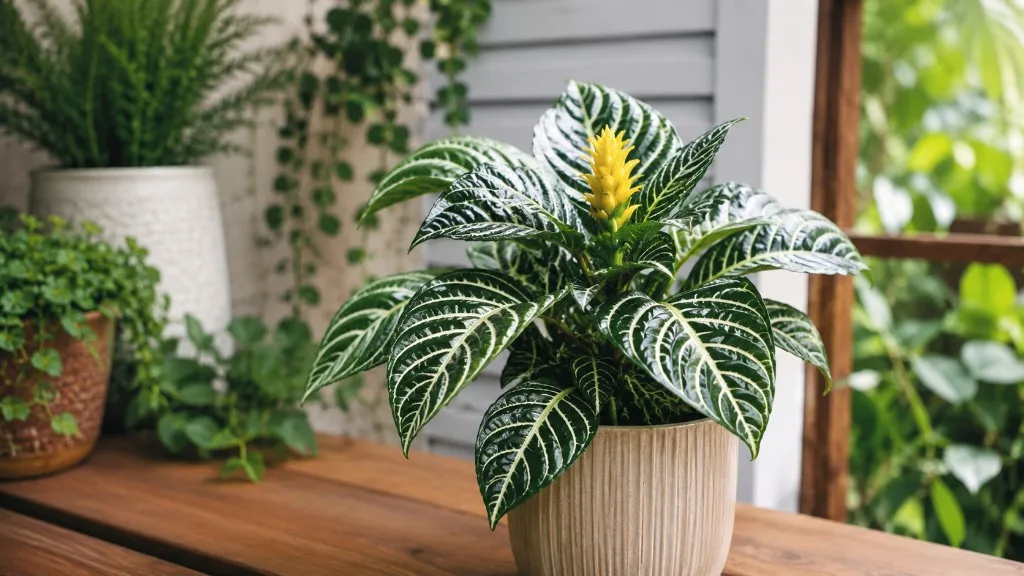
Zebra plant is sold for two reasons that both depend on light: the glossy, dark green leaves striped with crisp white veining, and the golden-yellow bract spikes that rise above the foliage like a torch. Aphelandra squarrosa will sit in a dim corner for months looking merely tired, but it will not look like the plant on the nursery bench unless it receives bright indirect light for most of the day. Give it too much direct sun and those same leaves bleach, crisp, and curl within days. The practical target is not vague “medium light.” It is a placement you can verify by reading new leaf color, vein contrast, and internode length over two weeks - the same diagnostic habit experienced growers use for other tropical understory plants.
North Carolina State Extension lists zebra plant cultural light as dappled sunlight and partial shade - the filtered brightness of a rainforest floor rather than open midday sun or deep forest darkness. (NC State Extension) That matches extension guidance for this Brazilian understory native: strong ambient light without prolonged direct rays on the leaf surface. Low light does not usually kill zebra plant quickly, but it weakens veining, produces leggy stems, and removes the light accumulation zebra plant needs before it will flower. This guide covers how much light zebra plant actually needs, where to place it indoors, how to avoid direct sun scorch, what happens in dim conditions, and how light ties into watering and blooming.
How Much Light Zebra Plant Actually Needs
Zebra plant is not a succulent that hardens off in full sun, and it is not a cast-iron plant that thrives in a hallway with no window sightline. It occupies a narrower band: bright indirect light strong enough to keep internodes short and vein contrast sharp, but filtered enough that no leaf sits in a hot sunbeam for hours at a time. In most homes that translates to one to two feet from an east-facing window, a bright north exposure in a well-lit room, or a south- or west-facing window softened by a sheer curtain so the plant sees brightness without bearing direct radiation load.
NC State Extension lists partial shade and dappled sunlight as the cultural light range, and notes that scorching can result from too much sunlight while prolonged indirect light encourages blooming. That is the core trade-off you are managing: enough intensity for foliage quality and flower potential, not enough direct exposure to trigger photodamage. If you are unsure whether your spot qualifies, skip the debate about room aesthetics and run the new-growth test described later. Old leaves keep old scars; new leaves tell the truth about current light within ten to fourteen days.
The Short Answer for Indoor Growers
If you want the compressed version before we unpack the why: place zebra plant where it receives bright, indirect light for most daylight hours, protect it from direct afternoon sun, and treat any spot where leaves cast a sharp dark shadow at midday as too intense unless you have acclimated the plant slowly and it shows no scorch. East windows and bright north windows are the easiest wins. South and west windows work with sheer curtains or a few feet of setback from the glass. If new growth is compact with bold white veining, you are in range. If stems stretch, veins fade, or leaves bleach, adjust before changing water, fertilizer, or pot size.
Why Zebra Plant Is an Understory Plant
Aphelandra squarrosa belongs to the Acanthaceae family and is native to the warm, humid forests of eastern Brazil, where it grows as a compact shrub beneath taller canopy trees. Chicago Botanic Garden describes it as a tropical perennial with large, glossy, dark green leaves and prominent white veins, often sold as a flowering pot plant that declines when watering, temperature, or light drift out of range. (Chicago Botanic Garden) That origin story is not botanical trivia. It is the reason your zebra plant reacts badly to a south-window sunbeam and equally badly to a shelf six feet from any window.
Understory plants evolved for high ambient brightness with low direct beam exposure. The canopy filters harsh midday radiation while still delivering enough photosynthetically active light for bold foliage and reproductive signaling. When you replicate that indoors, you are not “coddling” the plant. You are matching the environmental contract it already runs on. Ignore that contract and you get the two failure modes zebra plant owners report most often: sun scorch from too much direct exposure, and weak veining with no flowers from too little cumulative light.
What That Means for Your Window Placement
Room brightness deceives growers constantly. A living room can feel well lit to your eyes while the plant on the far wall receives a fraction of the footcandles available at the window plane. Zebra plant reads light at the leaf surface, not at the sofa across the room. University of Arkansas Cooperative Extension notes that zebra plant is a photo-accumulator that must accumulate a prescribed number of days under bright conditions before flowers form - historically cited around 650 footcandles for roughly twelve weeks under favorable temperatures. (University of Arkansas Extension) You do not need a light meter to keep the plant healthy, but the takeaway is clear: zebra plant is measuring cumulative brightness over time, not surviving on occasional glances of sun.
Practical implication: put the pot where the plant actually lives in the light field, usually within one to three feet of the window glass or under a dedicated grow light, rather than where it looks best on a credenza. Rotate the pot a quarter turn every week or two so all sides receive similar exposure and growth does not lean hard toward the glass.
Bright Indirect Light Explained for Aphelandra squarrosa
Bright indirect light means the plant sees a strongly lit environment - enough that you could comfortably read a book without switching on a lamp - but no direct sun disk strikes the leaves for extended periods. You can test this with your hand: in a good bright-indirect spot, your hand casts a soft, fuzzy shadow at midday. A sharp, high-contrast shadow with defined edges usually means direct beam exposure that zebra plant will not tolerate without damage.
For zebra plant specifically, bright indirect light supports three visible outcomes growers care about. First, internodes stay short, so the plant remains bushy rather than leggy. Second, vein contrast stays crisp, with creamy-white to silver striping standing out against the glossy green blade - the feature that earned the common name. Third, the plant maintains the energy budget it needs for bract and flower development when temperature and humidity cooperate. NC State Extension explicitly links prolonged indirect light to better blooming performance, which aligns with the photo-accumulator behavior described in extension literature. (NC State Extension)
If your home only offers medium indirect light - a soft shadow, readable but dim - zebra plant may persist, but you should expect thinner leaves, less dramatic veining, and little to no flowering. That is not a moral failure of the plant. It is a predictable response to suboptimal photon supply.
Direct Sun and Leaf Scorch Risks
Zebra plant and direct sun are a poor long-term pairing. NC State Extension notes that leaf scorching can indicate too much sunlight, and that blooming improves with prolonged indirect light. Leaves formed under nursery shade or store lighting are especially vulnerable because they lack the thickened cuticle and pigment adjustments that sun-acclimated foliage develops. Moving a zebra plant from a shaded greenhouse bench to a south-window sill without transition is one of the fastest ways to collect bleached, crispy leaves.
Brief early-morning sun through an east window is sometimes tolerated, particularly in cooler seasons when beam intensity is lower. That is not an invitation to park the plant in all-day southern exposure. Afternoon sun carries higher heat load per photon, and zebra plant leaves are broad, glossy, and slow to dissipate that heat. The damage sequence is usually visible within one to three days: pale or chalky patches on the sun-facing side, brown crisping along margins, upward curling during peak brightness, and in severe cases partial leaf collapse that does not recover on the damaged tissue.
Signs Your Zebra Plant Is Sunburned
Sunburn on zebra plant is not subtle once you know the pattern. Look for bleached or whitened patches on the side facing the window, often appearing faster on the upper leaves that intercept more beam. Margins may turn brown and papery, and the leaf may curl upward or inward during midday as the tissue loses turgor from heat and photodamage combined. Sometimes growers mistake sunburn for underwatering on Zebra Plant because the leaf feels crisp, but checking the soil reveals moisture while the damage pattern follows sun orientation rather than uniform wilting.
Old sunburned leaves will not revert to green. Your job after moving the plant is to protect new growth. Place zebra plant back into bright indirect light, remove only leaves that are mostly dead if you need to reduce stress, and wait two weeks before judging success. If the newest emerging leaf opens without fresh bleach, you have corrected the exposure. If scorch continues on new tissue, the spot is still too intense or too hot - add distance, add a sheer curtain, or shift to an east or north exposure.
Low Light Limits and Faded Veining
Low light is the quieter failure mode, and it is the one most likely to weaken veining before anything looks obviously “wrong.” Zebra plant in dim conditions often remains alive, which tricks owners into thinking the placement works. Over weeks, internodes lengthen, new leaves emerge smaller and paler, and the white stripe contrast that makes the plant desirable softens into a muddy, low-contrast pattern. Stems may lean toward the brightest vector in the room, and the overall silhouette becomes sparse rather than compact.
This matters because zebra plant’s ornamental value is the foliage graphic - dark glossy green with sharp pale veins - not merely green leaves on a stick. When light is insufficient, the plant prioritizes stem extension toward photons over thickening leaf tissue and maintaining pigment contrast. You are essentially growing a green silhouette of a zebra plant rather than the striped specimen you purchased. Extension sources consistently place zebra plant in partial shade or dappled light categories, not deep shade, for a reason: the species still needs meaningful daily light totals even though it rejects direct sun. (NC State Extension)
How Dim Light Weakens Stripes and Blooms
Veining intensity is a light-linked display trait. In adequate bright indirect exposure, the creamy-white midrib and lateral veins read as high contrast against the waxy green lamina - the visual “zebra stripe” effect. In dim light, chlorophyll production and vein pigmentation both shift toward a flatter, greener overall appearance, and the stripes lose punch. New leaves may look uniformly dull green until you compare them to older leaves formed under better light at the nursery.
Flowering takes an even harder hit. U of Arkansas Extension explains that zebra plant must accumulate enough days of bright light and favorable growing conditions to initiate blooms; if light is too dim or other environmental factors drift, you get only leaves. (University of Arkansas Extension) That photo-accumulator behavior means a zebra plant on a dim bookshelf may grow foliage indefinitely while never building the light budget required for yellow bracts. If blooms matter to you, bright indirect light is not optional - it is the prerequisite that watering and fertilizer cannot replace.
Best Window Placement for Zebra Plant
Window direction is a shorthand, not a law, because latitude, outdoor obstructions, and curtain type all modify intensity. Still, direction gives you a reliable starting map before you fine-tune with the new-growth test.
East-facing windows are the sweet spot for many zebra plants. Plants receive gentle morning sun when angles are low, then bright indirect light for the rest of the day without the punishing afternoon heat load. Place the pot one to two feet from the glass so leaves are not in direct beam for more than an hour or two, or set it on the sill if your climate’s morning sun is mild and you watch for scorch during heat waves.
North-facing windows work when the room is otherwise bright and the window is unobstructed. In northern exposures you may need the plant closer to the glass - sometimes directly on the sill - because intensity is lower. If new growth stays compact with strong veining, north is sufficient. If stems stretch, supplement with a grow light rather than forcing the plant closer to a cold winter pane.
South- and west-facing windows demand filtration. Use a sheer curtain or place zebra plant three to five feet back from the glass so it lives in reflected room brightness without intercepting direct beams. West afternoon sun is particularly risky in summer when leaf temperature spikes. If you only have harsh exposures, treat the curtain as mandatory, not decorative.
East, North, South, and West Windows Compared
East windows offer the best balance of intensity and safety for most growers: enough light for veining and bloom potential, low scorch risk if the plant is not pressed against hot glass at noon. North windows are the second-easiest indoors when outdoor light is not blocked by porches or neighboring buildings; watch for stretch in winter and add artificial light if needed. South windows are usable only with diffusion or significant setback; unfiltered south sills scorch zebra plant predictably. West windows are similar to south for afternoon risk - fine with curtains, dangerous without them.
Regardless of direction, avoid placing zebra plant where a HVAC vent, radiator, or cold winter draft shares the same microclimate. Light correction fails if the leaf is also desiccating from dry hot air or chilling overnight on a windowsill below 65°F (18°C), which is the lower comfort threshold most sources cite for Zebra Plant overview.
Using Grow Lights When Natural Light Is Weak
When windows cannot deliver enough intensity - common in winter, north apartments, or rooms with deep overhangs - a full-spectrum LED grow light is a legitimate primary light source, not a desperation move. Mount the fixture twelve to eighteen inches above the canopy for a typical household LED panel in the 20–40 watt consumer range, then adjust based on leaf response. Run the light ten to twelve hours daily to approximate a reasonable day length without overheating foliage.
Watch two variables: leaf temperature and new growth quality. If leaf edges crisp despite good watering and humidity, the fixture is too close or too intense. If internodes lengthen and veining fades, raise intensity slightly or extend duration by an hour, changing only one variable at a time. Full-spectrum white LEDs in the 4000K–6500K range work well for foliage plants like zebra plant because they support both photosynthesis and the grower’s ability to read leaf color accurately.
Grow lights also solve the seasonal slump when cloudy winters strip footcandles from window placements that work in summer. If your zebra plant flowered last year near an east window but refuses to build bracts this year after a dim autumn, supplemental lighting from late winter through early summer often restores the photo-accumulation pathway without moving the pot to a scorch-prone sill.
Light and Zebra Plant watering guide
Light and water are coupled variables on zebra plant, even though this is a light guide. A plant in brighter indirect light photosynthesizes faster, transpires more, and dries its pot quicker. One in dim light uses water slowly and sits in moist mix longer, which raises root stress risk in a species that already dislikes wet feet. NC State Extension notes that drooping leaves can indicate too much water, while leaf drop and scorching can tie to dryness, cool temperatures, or excess sun - which is why changing light without revisiting watering produces confusing symptoms. (NC State Extension)
When you move zebra plant brighter, check soil moisture more often for the first two weeks and expect to water slightly sooner. When you move it dimmer, stretch the interval and verify the top inch of mix is approaching dry before watering again. Do not compensate for low light with extra fertilizer; that does not replace photons and can salt-stress roots in a plant that is already growing slowly.
Light Requirements for Flowering
Zebra plant flowers are worth the light discussion. The showy yellow bracts persist for weeks, with small tubular yellow flowers emerging from the spike. Bloom timing in commerce is often fall, but extension sources note zebra plant can be induced to flower in other seasons if light and temperature conditions align - the same photo-accumulator logic used for scheduling greenhouse crops. (University of Arkansas Extension)
For home growers, the actionable rule is simpler: maintain bright indirect light consistently through the growing season if you want bracts. University of Arkansas Extension describes zebra plant as a photo-accumulator that must accumulate bright light over many weeks before flowers form - a cooler winter rest followed by warmer bright spring conditions mirrors commercial forcing rhythms. You are not trying to blast the plant with direct sun; you are ensuring the brightest safe indirect exposure your home can offer for sustained weeks.
If light is dim, zebra plant may remain a handsome foliage plant indefinitely. That is a valid choice - but you should not expect bracts or blame fertilizer for a failure that is fundamentally photon-limited. Veining weakness and bloom absence often appear together because both are high-light display traits.
How to Move or Acclimate Zebra Plant Safely
Sudden light jumps cause more zebra plant casualties than gradual ones. If you are moving from a dim interior shelf to a brighter east window, do it in steps over seven to ten days: first a few hours daily in the new spot, then half days, then full placement once newest leaves show no curl or bleach. If you are moving toward more direct exposure - generally not recommended - extend acclimation to two weeks and watch midday leaves closely.
When bringing a new zebra plant home from a shaded nursery, assume it is not sun-hardened. Even an east sill can scorch on day one. Start a foot or two back from where you eventually want it, then inch closer only if new growth stays clean. Resist stacking changes: do not repot, fertilize heavily, and relocate to a new window on the same weekend. Change light first, read new growth for ten days, then address other variables if needed.
Seasonal Light Changes Through the Year
Seasonal shifts matter more than many growers expect. Summer sun angle can turn a safe east sill into a brief direct-beam exposure at sunrise earlier in the season. Winter lowers outdoor brightness and may cool the window microclimate, slowing growth and extending dry-down intervals even when the plant sits in the same physical spot. A placement that produced crisp veining in June may produce slight stretch by February unless you compensate with a grow light or accept slower winter metabolism.
Rotate zebra plant gently through seasons rather than chasing maximum brightness at all costs. If summer west-window heat becomes extreme, pull the pot deeper into the room or tighten the sheer curtain. If winter stretch appears, add supplemental LED hours instead of pushing the plant against cold glass. The goal is stable bright indirect totals across seasons, not maximum sun at any single month.
Warning Signs Your Zebra Plant Has the Wrong Light
Too much light and too little light produce different signatures. Learning the split saves you from watering a sunburned plant or fertilizing a light-starved one.
Too much direct sun or excessive intensity shows as bleached or whitened patches on sun-facing leaves, brown crisp margins, upward leaf curl during midday, and sometimes sudden leaf drop after a recent move to a brighter sill. Heat amplifies the problem - leaves may feel warm to the touch near hot glass. Too little light shows as elongated internodes, smaller new leaves, faded or low-contrast veining, leaning growth toward the window, and absence of flowering despite otherwise decent care. Soil may stay wet longer because the plant is using less water.
Use the newest leaf or shoot as your primary evidence. Older leaves carry history from previous placements. If the latest leaf opens with bold veining and compact spacing, your current light is working. If the latest leaf is pale with weak stripes, increase safe brightness. If the latest leaf shows bleach, reduce beam exposure. This single habit prevents most zebra plant light mistakes from becoming permanent.
Quick Troubleshooting Guide
When symptoms appear, run this sequence before Zebra Plant repotting guide or feeding. First, identify whether the problem matches scorch (localized bleach on sun-facing tissue) or starvation (general paleness, stretch, weak veins). Second, confirm where the plant sat relative to direct beams at 10 a.m., noon, and 4 p.m. - three checks beat one glance. Third, compare newest growth to older leaves; improvement means your fix is working even if old damage remains visible.
If scorch is active, move to bright indirect light immediately, add a sheer curtain if needed, and wait for clean new growth. If low light is suspected, move closer to the brightest safe window or add a grow light for ten to twelve hours daily, then watch veining on the next two leaves. Adjust watering to match the new light level. Do not prune heavily during recovery unless leaves are mostly dead; zebra plant needs foliage area to photosynthesize while rebuilding.
Conclusion
Zebra plant light needs reduce to a clear, testable standard: bright indirect light strong enough to keep veining sharp and internodes short, with direct sun avoided because it scorches the glossy leaves this plant is grown for. Low light is a slow downgrade - weaker stripes, leggier stems, and little to no flowering - not an instant crisis, which makes it easy to ignore until the plant no longer resembles the nursery specimen. Place zebra plant where leaves receive real brightness, not just where the room looks lit to you; favor east and filtered exposures; use grow lights when winter or architecture limits window intensity; and judge every adjustment by new growth, not old scars.
Get that placement right and zebra plant becomes a manageable, high-impact houseplant whose foliage carries the show and whose yellow bracts become a realistic bonus. Get it wrong and you will fight a cycle of crisp sunburned tips or dull, stretching stems that no amount of misting will fix. Light is the first variable. Everything else - water, humidity, bloom timing - lines up behind it.
When to use this page vs other Zebra Plant guides
- Zebra Plant overview - Start here for whole-plant context before deep-diving this topic.
- Zebra Plant problems hub - Jump to symptom-specific fix guides when this care topic does not resolve the issue.
- Not Enough Light on Zebra Plant - Escalate here when light adjustments are not enough.
- Leggy Growth on Zebra Plant - Escalate here when light adjustments are not enough.
- Leaf Drop on Zebra Plant - Escalate here when light adjustments are not enough.
Related Zebra Plant guides
- Zebra Plant overview
- Zebra Plant watering
- Zebra Plant soil
- Zebra Plant propagation
- Zebra Plant fertilizer
- Zebra Plant repotting
- Not Enough Light on Zebra Plant
- Leggy Growth on Zebra Plant
- Leaf Drop on Zebra Plant
- Zebra Plant problems
Related tool
Try the Plant Problem Diagnosis Tool with zebra-plant pre-selected to estimate needs for your setup.