Polka Dot Plant Fertilizer: When, How & Mistakes
Polka Dot Plant Fertilizer: When, How & Mistakes
Polka Dot Plant Fertilizer: When, How & Mistakes
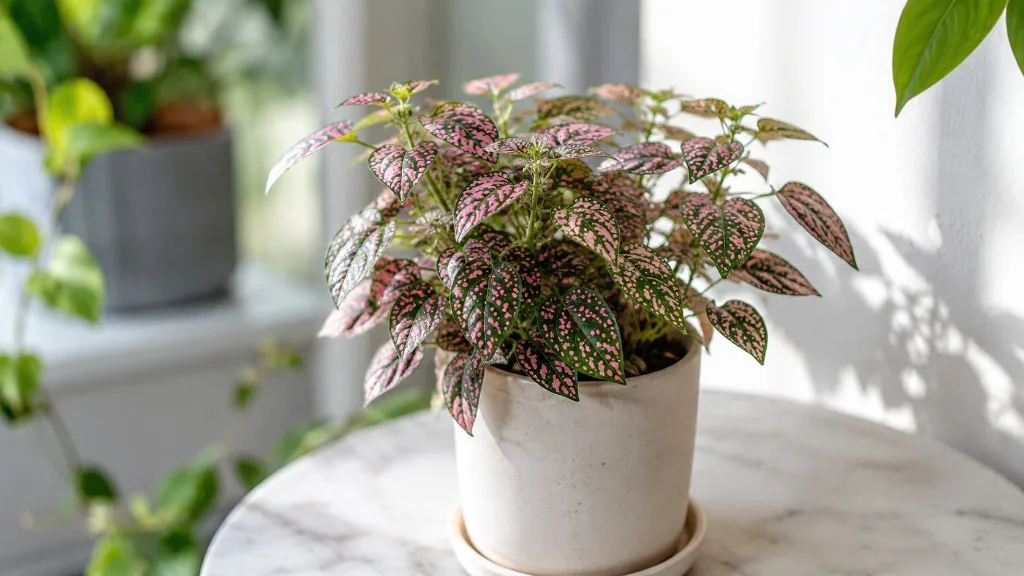
Polka dot plant fertilizer sits at an awkward intersection: Hypoestes phyllostachya grows fast enough to use nutrients steadily, yet its shallow root system in small nursery pots accumulates salts quickly when feeding gets aggressive. The Royal Horticultural Society recommends feeding during the growing season from April through September, every two to three weeks, with a liquid general-purpose or houseplant fertiliser - and warns that overfeeding produces tall, spindly shoots rather than the compact, vividly speckled plant you bought. NC State Extension lists polka dot plant with a rapid growth rate and showy pink, red, or white variegation that depends as much on bright indirect light as on nutrition. Feed too little in depleted mix and pink spotting fades; feed too much or onto dry roots and brown tips, white salt crust, and leggy stems follow.
The practical goal for most indoor growers is a balanced water-soluble fertilizer at half the label strength, applied on a clear spring–summer schedule while new speckled leaves confirm active growth, with a full pause from late autumn through winter. Water onto moist soil, never dry roots. Skip fertilizer on stressed, wilted, or newly repotted plants until they stabilize. If you remember one rule: underfeeding is safer than overfeeding on polka dot plant - a plant in fresh mix with good light still looks respectable without fertilizer; a salted pot shows damage on leaves that will not heal.
This guide covers when to feed, how to reconcile RHS biweekly guidance with a conservative monthly default, dilution math, a diagnostic table separating salt burn from low-light green reversion, terrarium adjustments, flush recovery, and the mistakes that cause more harm than skipping a month.
Why Fertilizer Matters for Polka Dot Plant
Polka dot plant (Hypoestes phyllostachya) is a Madagascar-native herbaceous perennial in the Acanthaceae family, widely sold as a compact houseplant, terrarium filler, and annual bedding accent. NC State describes ovate green leaves dotted with splotches of rose, pink, or white and notes the plant is not grown for its small lilac flowers - pinching flower spikes redirects energy to foliage, which is exactly what indoor growers want (NC State Extension - Hypoestes phyllostachya). That foliage-forward biology means nitrogen and micronutrients support leaf color density and stem branching, not bloom size.
Container culture changes the math. Every watering leaches some nutrients; root growth and microbial activity consume others. Fertilizer replaces what the plant uses - but only up to the point shallow roots can absorb without salt injury. Polka dot plant in a 3-inch nursery pot with moisture-retentive mix and frequent watering is more salt-sensitive than the same species in a garden bed where rain flushes the profile naturally.
Think of feeding as maintenance for an actively growing, well-lit plant - not a rescue for a wilted specimen in a dim corner or a pot that has stayed wet for two weeks. Fix light and watering first, then add nutrients on a conservative schedule. The RHS explicitly ties feeding to boost growth during the growing season - implying growth phase, not calendar guilt (RHS - How to grow Hypoestes).
Fast Growth, Shallow Roots, and Variegation
NC State’s rapid growth rate label matters for frequency decisions. A fast grower in bright light can deplete a small pot’s nutrient reserve within one active season, especially if you pinch regularly to keep the plant bushy per the pruning guide. Shallow, fibrous roots in tight pots cannot spread salts across a large soil volume - concentration spikes at the root surface after heavy or dry-soil applications.
Variegation is the reason most people own Polka Dot Plant overview. Pink, red, and white splashes require adequate light plus balanced nutrition. RHS notes that loss of leaf colouring may result from reversion or insufficient light, while too much sun fades vibrant colours (RHS - How to grow Hypoestes). Fertilizer sits in the middle: chronic underfeeding in old, exhausted mix can produce pale, washed-out new leaves, but excess nitrogen can push soft, green, fast growth that outruns the plant’s genetic spotting pattern - especially in low light where chlorophyll dominates anyway.
When to Fertilize Polka Dot Plant
Timing follows metabolism and visible new growth, not a wall calendar alone. Feed when the plant pushes new speckled leaves and side shoots during warm, bright months. Stop when growth slows sharply, even if foliage still looks colorful.
Indoors, active growth typically tracks longer days and warmer room temperatures from late winter through early autumn. A polka dot plant under strong grow lights in a heated room may grow modestly year-round, but most specimens still slow from late fall through winter.
Spring and Summer Active Window
Start feeding when you see fresh growth - new leaf pairs with visible spotting, stems extending after a pinching round, or a propagation cutting that has rooted and unfurled its first true leaves. In temperate homes, that usually means March through September, aligning with the RHS April–September growing-season window with a little latitude at the shoulders for early spring wake-up.
During this window, apply half-strength balanced liquid fertilizer on the schedule in the frequency section below. Plants in bright bathrooms, east windows, or terrariums with strong light may use the shorter RHS interval comfortably. Plants in dim corners or very small pots should stay on the conservative monthly default unless new growth clearly accelerates and no salt crust appears.
| Month (temperate indoor climate) | Growth phase | Feeding guidance |
|---|---|---|
| February–March | Waking up | First half-strength feed when new speckled leaves appear |
| April–August | Peak growth | Monthly default; every 2–3 weeks only if bright light + no salt crust |
| September | Slowing | Reduce to every 6–8 weeks or skip |
| October | Wind-down | Final light feed if still growing, then pause |
| November–January | Low growth | No fertilizer for typical indoor setups |
The table is a framework. Your light, pot size, and cultivar matter. ‘Carmina’ with red splashes and ‘White Splash’ with heavy white coverage both follow the same timing logic; intensity of spotting depends more on light than on marginal NPK tweaks.
Fall Taper and Winter Pause
Do not fertilize polka dot plant through winter under typical indoor conditions. Taper in early to mid-fall as day length drops. Give a final half-strength feed in early fall only if you still see active new leaves, then pause entirely from late autumn through early spring - roughly November through February for most homes.
Unused nutrients accumulate as soluble salts when growth slows, producing brown tips and weak spring comeback (University of Maryland Extension - Fertilizer Toxicity). Winter rest is not full dormancy, but metabolic demand drops sharply in cool, dim rooms.
Exception: a plant under supplemental grow lights that keeps producing new speckled shoots all winter may take a light feed every six to eight weeks at half strength - watch for salt crust and extend intervals at the first sign of tip burn.
Best Fertilizer Type for Polka Dot Plant
The best polka dot plant fertilizer for most homes is a complete, water-soluble, balanced houseplant formula with nitrogen, phosphorus, potassium in roughly equal proportions plus listed micronutrients. You want enough nitrogen for healthy foliage and branching, moderate phosphorus for root function, and potassium for overall vigor - without pushing the soft, leggy growth RHS warns about.
Avoid shopping by the words “polka dot” on the bottle unless you trust the brand’s dosing guidance. A standard balanced indoor formula used conservatively outperforms specialty products at full label strength.
Balanced Liquid Formulas and NPK Ratios
A 10-10-10 or 20-20-20 water-soluble fertilizer diluted to half strength is the default for foliage houseplants in active growth. The RHS recommends a liquid general-purpose or houseplant fertiliser during the growing season - equal-ratio products keep feeding simple when your main goal is steady speckled foliage, not maximum vegetative bulk.
Liquid formulas win for control in small pots where salts concentrate quickly: mix at half strength, apply to moist soil until a little drains, and discard saucer water. Hard tap water adds another mineral load; if you see tip burn while feeding modestly, switch to filtered or rainwater for a few months before increasing fertilizer concentration.
Slow-Release, Organic, and What to Skip
Slow-release pellets in a 3-inch nursery pot release unpredictably and stack with liquid feeds - if slow-release was mixed in at repotting, skip liquid for two to three months and reassess. Organic liquids (fish emulsion, compost tea) work at half strength or weaker but smell stronger indoors and can still salt up if overapplied.
Skip foliar feeding as a routine practice; fertilizer residue on soft leaves can cause localized burn. Skip fertilizer–pesticide combo products for standard care. Skip full label strength unless the product is explicitly labeled for frequent weak feeding - polka dot plant roots punish concentration spikes.
Pet note: The ASPCA lists Hypoestes phyllostachya as non-toxic to cats, dogs, and horses, though large ingestions may cause mild vomiting or diarrhea. Concentrated fertilizer solution and crusty soil are not safe for pets to ingest - keep bottles, runoff, and salted pots out of reach.
How Much and How Often to Feed
If you remember one number, make it half strength. Treat quarter strength as the safer starting point for a new plant, a dim room, or a history of tip burn.
Dilution Math You Can Trust
Houseplant labels assume a range of species and pot sizes. Polka dot plant sits in the moderate feeder category for a small foliage plant - hungrier than a snake plant, less tolerant of full-strength doses than a outdoor annual in garden soil.
Example: if the bottle says 1 teaspoon per gallon for houseplants, use ½ teaspoon per gallon for half strength or ¼ teaspoon per gallon for quarter strength. If it says 1 tablespoon per gallon for outdoor beds, find the houseplant dilution on the label and halve that - do not use the outdoor rate indoors. Measure with a spoon or syringe; eyeballing concentrates errors.
For a 4-inch pot, many growers use roughly ¼ to ½ cup of half-strength solution - enough to moisten the root zone lightly with a little drainage, not a flood. Scale up proportionally for larger containers.
Frequency Decision Framework
Two authoritative intervals coexist:
- RHS: every 2–3 weeks April–September (RHS - How to grow Hypoestes)
- Conservative indoor default: once monthly at half strength during active growth, extending to every 6–8 weeks in low light or terrariums
Both can be correct. The reconciliation:
| Situation | Suggested frequency | Strength |
|---|---|---|
| Bright indirect light, 4–6 inch pot, plain water between feeds | Every 2–3 weeks OR monthly | Half label strength |
| Low light, dim office, north window | Every 6–8 weeks | Half or quarter strength |
| Terrarium, sealed glass, high humidity | Every 6–8 weeks max | Quarter to half strength |
| Early fall, slowing growth | Once, then pause | Half strength |
| November–February, typical indoor light | Skip | - |
| After repotting into fresh mix | Wait 4–6 weeks | Then resume half strength |
| Recovering from over-fertilizing | Pause 4–6 weeks | Flush; resume at quarter strength |
| New propagation cutting, first roots | Wait until 2–3 new speckled leaves | Then half strength monthly |
| Slow-release already in mix | Skip liquid 2–3 months | Reassess |
Default recommendation for most readers: start monthly at half strength during spring and summer. If new growth is vigorous, spotting stays vivid, and no salt crust appears after two months, you may shorten to every two to three weeks - the RHS interval - through peak summer only. If tips brown or stems stretch, lengthen the interval instead of diluting further first.
Step-by-Step: How to Fertilize Polka Dot Plant
Safe feeding is mostly order of operations. The brand matters less than moist soil, unstressed tissue, and salt awareness.
- Check season and plant. Confirm active growth - new speckled leaves, not just old colorful ones. If it is winter and nothing is growing, stop here.
- Inspect for salt crust or tip burn. White residue on soil or rim means skip feeding and flush instead. See brown tips for overlap with low humidity.
- Water with plain water if the top layer is dry. Bring the root zone to evenly moist before fertilizer touches it. Never pour fertilizer onto dry soil - salts burn shallow roots instantly.
- Mix fertilizer at half strength in room-temperature water.
- Apply slowly across the soil surface, keeping solution off speckled leaves when possible.
- Stop when a little water drains; empty the saucer within 30 minutes.
- Mark the date so you do not double-feed during an enthusiastic week.
Pre-Feed Checks and the Moist-Soil Rule
Before every feed, run a three-point check: soil moisture, newest leaf pattern, season.
Soil moisture first - the watering guide rhythm (surface begins to dry every few days in active growth) should leave the root zone moist but not waterlogged at feeding time. Polka dot plant wilts dramatically when thirsty; do not misread wilt as hunger.
Newest leaf pattern next: vivid speckling on fresh leaves means light and nutrition are roughly aligned. Solid green new leaves usually mean insufficient light per RHS reversion guidance - moving the pot beats doubling fertilizer. Pale, thin new leaves in very old mix may indicate depletion - try half-strength feeding for one season before chasing individual elements.
Season is the gatekeeper: active speckled growth gets food; winter gets plain water.
Signs Your Feeding Routine Is Working
Success on polka dot plant is not “deep green leaves” - that is the wrong target for a speckled cultivar. Look for:
- New leaves emerge with strong pink, red, or white patterning appropriate to your cultivar
- Stems branch after pinching rather than shooting up single spindly leaders (RHS overfeed warning)
- Steady but compact growth - the plant fills out sideways when pinched on schedule
- No white salt crust on soil surface or pot rim
- Leaf edges stay clean without progressive brown tips (brown tips guide)
- Soil dries on a predictable rhythm - overfed root damage slows uptake and can mimic underwatering on Polka Dot Plant
If spotting fades on new leaves while old leaves still look good, suspect light first, then nutrition, then excess nitrogen - in that order.
Deficiency, Salt Burn, and Low-Light Reversion
Three different problems produce loss of pink spotting or brown leaf edges. Treating all three with more fertilizer is the most common mistake.
Under-feeding / depleted mix: gradual pale new leaves, smaller leaf size, slow growth despite good light and moisture, often after 12+ months in the same pot with no feeding.
Salt burn / over-feeding: brown tips and margins, white crust, sudden leaf drop, wilting despite moist soil, often within days to two weeks after a heavy feed (University of Maryland Extension - Fertilizer Toxicity).
Low-light reversion: solid green new growth, stretching toward windows, soil staying wet too long - matches RHS insufficient light and loss of leaf colouring notes (RHS - How to grow Hypoestes). Fix with brighter placement per the light guide and not enough light troubleshooting page.
Diagnostic Comparison Table
| Symptom pattern | Most likely cause | First action |
|---|---|---|
| Brown tips + white soil crust after recent feed | Salt burn / over-feeding | Flush; pause feed 4–6 weeks |
| Solid green new leaves, stretching toward window | Low light reversion | Move brighter; pinch; do not increase feed |
| Pale, thin new leaves, old mix, good light | Nutrient depletion | Half-strength monthly feed; consider repot |
| Brown tips, no crust, dry air, winter heat | Low humidity | Humidity tray; see low humidity |
| Yellow lower leaves, wet soil smell | Overwatering | Fix drainage; see overwatering |
| Slow growth, pale leaves, dim room | Light + possible underfeed | Improve light first, then conservative feed |
How to Flush Salts After Over-Feeding
If you suspect over-fertilizing, stop feeding immediately and leach salts from the root zone.
- Move the plant to a sink or tub where drainage is acceptable.
- Water slowly with plain room-temperature water until it runs freely from drainage holes; let drain completely.
- Repeat two to three times over 30–60 minutes, with full drainage between rounds.
- Empty the saucer; return the plant only when the pot feels lighter.
- Pause all fertilizer for four to six weeks. Resume at quarter to half strength on the longer interval.
- Pinch spindly shoots that grew during overfeed - withhold feed until new compact growth appears.
Illustrative recovery scenario (not field-documented): A grower notices white crust and brown tips one week after feeding full-strength 20-20-20 to a dry 4-inch pot. They flush three times, pause feeding for five weeks, pinch two leggy stems, and move the plant to brighter indirect light. New leaves three weeks later show restored pink spotting without tip burn - suggesting salt load dropped before resuming quarter-strength monthly feeds. Your timeline may differ; judge by new leaf quality, not the calendar.
Badly burned leaf tips will not green up again - trim for appearance if needed. If wilting persists in moist soil after flushing, inspect roots for rot before feeding again.
Terrarium, Repotting, and Special Situations
Terrariums and sealed glass jars hold humidity beautifully - RHS recommends them for hypoestes - but leaching salts is harder when you cannot flush aggressively without disturbing the layout. Feed less often (every 6–8 weeks at quarter to half strength), watch for crust at the soil line, and prefer plain water for most irrigations. If salt crust appears, top-water heavily at the edge or temporarily remove the plant for a full flush.
After repotting, hold fertilizer four to six weeks. Fresh soil mix often contains starter nutrients; damaged roots need healing time.
Propagation cuttings with new roots should wait until two to three speckled true leaves unfurl before the first feed - see the propagation guide.
Hard water + fertilizer stacks minerals. If tips brown despite conservative feeding, test or filter water before increasing nutrients.
Cultivar nuance: ‘Carmina’ red splashes and ‘White Splash’ heavy white coverage respond to the same NPK logic; intensity tracks light and genetics more than formula tweaks.
Fertilizer and Other Polka Dot Plant Care
Fertilizer only works when light, water, soil pH, and humidity are in range. Polka dot plant prefers acid to neutral soil pH 5.5–7.0 per LeafyPixels care data and NC State’s acid (<6.0) to neutral (6.0–8.0) cultural range (NC State Extension - Hypoestes phyllostachya). Extreme pH locks out nutrients even when fertilizer is present.
RHS emphasizes high humidity to prevent browning leaf edges (RHS - Hypoestes genus) - brown tips from dry air mimic fertilizer burn. Pair feeding with 50–70% humidity when possible; see low humidity if edges crisp in winter heat.
Bright indirect light from the light guide increases nutrient use; dim light reduces it - tune frequency, not concentration, when moving pots between rooms. The overview ties the full care triangle together.
For related symptom pages: pale leaves, yellow leaves, slow growth, and leggy growth when feeding alone does not fix the display.
Conclusion
Polka dot plant fertilizer is less about a magic product and more about matching a fast-growing, shallow-rooted, variegated foliage plant in a small pot. Use a balanced water-soluble formula such as 10-10-10 or 20-20-20, dilute to half the label strength, and feed on a monthly default during spring and summer while new speckled leaves confirm active growth - shortening to every two to three weeks only in bright light with no salt crust, per RHS guidance. Pause through winter, always apply to moist soil, and flush when tips brown or crust appears.
Five-step checklist before your next feed:
- Confirm new speckled growth - not winter rest or post-repot stress.
- Check for salt crust; flush instead of feed if present.
- Moisten dry soil with plain water first.
- Mix at half strength; mark the date.
- Re-evaluate light and humidity if spotting fades on new leaves - fertilizer rarely fixes reversion alone.
When in doubt, skip a month. Polka dot plant tolerates a missed feed far better than an extra one.
When to use this page vs other Polka Dot Plant guides
- Polka Dot Plant overview - Start here for whole-plant context before deep-diving this topic.
- Polka Dot Plant problems hub - Jump to symptom-specific fix guides when this care topic does not resolve the issue.