Best Soil for Polka Dot Plant: Mix, Drainage & Repotting
Best Soil for Polka Dot Plant: Mix, Drainage & Repotting
Best Soil for Polka Dot Plant: Mix, Drainage & Repotting
Author: sai-ananth · Reviewed by: LeafyPixels Review Board · Updated: 2026-06-15
Best Soil for Polka Dot Plant: Mix, Drainage & Repotting
Scope note: This page owns mix building, drainage validation, wet-wilt-on-wet-soil diagnosis, and refresh timing for Hypoestes phyllostachya. The polka dot plant overview summarizes soil in a few lines; here you get recipes, modifier tables, and test workflows. For rot-only recovery steps, see root rot on polka dot plant. For watering rhythm after the mix is right, see the watering guide.
Quick Answer
The best polka dot plant soil is a rich, well-draining indoor mix that holds even moisture without staying waterlogged. Start with quality peat-free or all-purpose houseplant compost, add roughly 15% perlite by volume for aeration, and 10% worm castings for gentle organic matter - editorial starting ratios you calibrate with a squeeze test, not a fixed law. Target pH 5.5–7.0, always use a pot with drainage holes, and confirm the handful forms a moist crumb that falls apart, not a tight mud ball. In sealed terrariums, reduce perlite because high humidity slows dry-down. Refresh the mix every one to two years, or sooner when drainage fails, the mix smells sour, or the plant wilts while soil is still wet.
Why Soil Matters for Polka Dot Plant
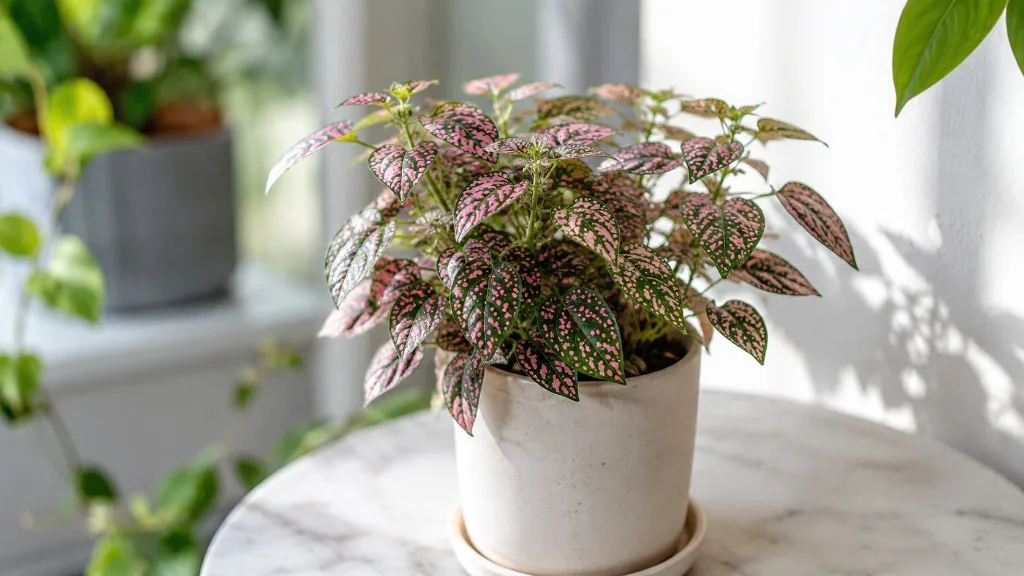
Hypoestes phyllostachya - polka dot plant, freckle face, pink splash - is sold for vividly speckled foliage, but the root zone decides whether those colors stay bright or fade into a leggy green stick. It is an herbaceous perennial native to Madagascar with a rapid growth rate and a dense, mounding habit that only looks bushy when roots below are healthy. Indoors you are growing that tropical herb in a container a fraction of its outdoor potential - often in a bathroom, kitchen, or terrarium where humidity is high but oxygen at the roots still matters.
Soil controls how fast water moves through the pot after you water, how much air reaches fine feeder roots between drinks, whether fertilizer salts accumulate at the surface, and how quickly a stressed plant recovers after repotting. Missouri Botanical Garden recommends organically rich, medium-moisture, well-drained soils in part shade for bedding and container culture - language that translates indoors to a quality houseplant mix amended for porosity, not heavy garden soil or straight succulent mix.
If your polka dot plant yellows despite careful watering, wilts while the mix still feels damp an inch down, or dries out in hours after every repot, inspect soil texture and drainage before you change light or fertilizer. A well-built mix makes every other care signal easier to read.
What Polka Dot Plant Roots Need from a Potting Mix
Polka dot plant roots are shallow, fine, and close to the crown - a structural fact that changes every soil decision. Unlike deep-rooted trees or thick succulent taproots, Hypoestes explores only the upper profile of the container. When that thin layer compacts, stays saturated, or dries into a hydrophobic crust, the entire root system suffers within days because there is no deep reserve zone to buffer the mistake.
NC State lists cultural soil preferences as high organic matter, loam (silt) texture, acid to neutral pH, and good drainage. That combination means the mix should feel light and crumbly in your hand, hold moisture in the middle without turning the lower inch into a swamp, and re-wet evenly when you water rather than channeling down the pot wall. The RHS growing guide recommends peat-free houseplant compost or peat-free multi-purpose compost that is moisture-retentive - appropriate for a species that wilts on dry soil but also browns at the edges in dry air.
Four jobs your mix must perform simultaneously: drain excess water within minutes after a thorough watering so lower roots are not sitting in standing moisture; retain enough moisture in the upper root zone that the plant does not swing between bone-dry and saturated on a one-day cycle; stay structurally open for 12 to 18 months without collapsing into a brick; and support normal nutrient uptake at a slightly acid to neutral pH without loading salts that mimic drought damage on leaf tips. No single bagged product guarantees all four jobs in every home - which is why houseplant compost plus perlite and a modest organic amendment remains the most practical starting point, with ratios adjusted after you observe how fast your specific pot dries in your specific room.
The Ideal Polka Dot Plant Soil Mix
The best soil for polka dot plant is not a specialty labeled bag. It is a blend whose texture matches what a Madagascar herb with fine shallow roots expects when confined to a pot: organic-rich, evenly moist, and never swampy at the bottom. Commercial indoor potting mixes are a reasonable base because they are pasteurized and balanced for houseplants, but most benefit from additional perlite and a small amount of worm castings to improve drainage and maintain structure over time. Garden soil, topsoil, and dense outdoor planting mixes compact in containers and invite root rot.
Simple DIY Recipe: Standard Potting Mix Plus Perlite and Worm Castings
For most indoor polka dot plants in plastic or glazed ceramic pots with drainage holes, start with this DIY polka dot plant soil mix (editorial starting ratios - calibrate with the squeeze test below):
- 75% quality peat-free or all-purpose indoor potting compost (by volume)
- 15% perlite
- 10% worm castings
Measure by volume, not weight - a scoop or yogurt tub works fine. Mix thoroughly in a clean tub until perlite is evenly distributed and the texture feels light. When you squeeze a handful, it should hold together briefly and then crumble apart; it should not form a tight, muddy ball or fall apart like dry sand.
Correct squeeze-test texture (home observation): a moist handful looks like coarse crumb cake - visible perlite flecks, no shiny mud sheen, and it breaks apart when you open your fist. A failing mix forms a tight ball that smears between your fingers like clay; that is your signal to increase perlite before the next repot.
If your pot stays wet longer than five to seven days in moderate light, increase perlite to 20–25% and reduce base compost accordingly. If the mix dries completely in 24 hours and the plant wilts repeatedly, reduce perlite slightly or move to a smaller pot - the problem may be pot volume as much as mix.
Can you use cactus or succulent mix? Only as an amendment. Straight cactus mix is usually too free-draining for polka dot plant unless you blend it 50/50 with houseplant compost to restore moisture retention. Unamended succulent media dries the shallow root zone too fast and forces repeated wilt cycles that weaken roots.
The Moisture-Retentive but Well-Draining Balance
Polka dot plant occupies a narrower moisture band than desert succulents and a wetter band than snake plants. The RHS instructs growers to keep compost moist but allow the surface to dry out slightly between waterings - underwatering on Polka Dot Plant plants droop dramatically but recover after a thorough soak, provided you do not let dry cycles repeat for days. That rhythm only works when water penetrates the full depth of the shallow root ball, drains out the bottom within minutes, and leaves behind a uniformly damp - not saturated - profile.
After watering, excess water should exit the drainage hole within two to five minutes as a home-climate heuristic. If it pools on top, runs down the gap between mix and pot wall, or the saucer stays full for hours, the soil system needs correction - more perlite, a smaller pot, better light, or fresh media. The useful metric is not a calendar interval but how the pot behaves in your room: learn its weight when dry and after watering, and coordinate with our light guide because dim placement slows dry-down and can make a good mix behave like a bad one.
Peat-free vs peat-based compost in dry winter rooms: Peat-free blends built from coir and bark often dry faster on the surface while holding moisture deeper - fine in humid bathrooms, but in heated rooms below 35% relative humidity the top layer can crust and repel water while the center stays cool and damp. If winter watering runs off the surface without soaking in, probe with a skewer, bottom-water once to re-wet the core, and consider slightly less perlite (10–12%) or a humidity tray - not a return to dense garden soil. Full winter watering rhythm lives on the watering guide.
Terrarium vs Open-Container Mix Modifiers
Polka dot plant is a popular terrarium plant because it tolerates the humid, bright indirect conditions inside sealed or semi-sealed glass (RHS; Missouri Botanical Garden). High humidity changes acceptable mix porosity. In an open pot on a windowsill, you need more perlite to prevent the upper layer from staying wet too long between waterings. In a closed terrarium, compost dries slowly because evaporation is minimal - reduce perlite to roughly 10% or skip it entirely in very small jars, and water less often. In a steam-heavy bathroom with an open pot, split the difference: keep the standard 15% perlite recipe but watch saucer drainage carefully.
If leaves brown at the margins in a terrarium while the mix stays constantly wet, the problem is often too much water in a low-porosity blend, not low humidity. Open the container briefly to dry the surface, adjust perlite upward at the next refresh, and improve airflow.
Mix-Ratio Modifier Decision Table
Use this table to pick a starting perlite band. Confirm with squeeze and drainage tests in your room - do not copy percentages without observing dry-down.
| Growing context | Perlite starting band | Dry-down signal | Common failure mode | Urgency if signs appear |
|---|---|---|---|---|
| Open pot, average room (40–55% RH) | 15% | Top 1–2 cm begins to dry in 2–4 days | Mix dries too fast; repeated wilt | Low - increase compost fraction or pot up one size only if roots filled old pot |
| Bright bathroom, open pot | 15–20% | Pot lightens; surface dry in 1–2 days | Chronic wet feet; fungus gnats | Medium - bump perlite 5%, empty saucer every watering |
| Open terrarium / large jar | 10–15% | Condensation steady; surface barely dries | Brown leaf margins on wet mix | Medium - reduce watering before repot; increase perlite at refresh |
| Sealed terrarium / small jar | 0–10% | Water infrequently; no saucer drainage | Crown rot; mold on soil | High - open container, dry surface, repot with less organic matter if smell persists |
| Dry winter room (<35% RH), peat-free compost | 10–15% | Surface crusts; water runs off top | Hydrophobic dry pockets; false “underwatering” | Medium - skewer probe, bottom-water once, slight perlite reduction |
| Dim shelf, same 15% recipe | 15–20% | Pot heavy 7+ days after watering | Wet wilt on saturated mix | High - improve light or unpot same-day if leaves yellow on wet soil |
Worked scenario (home observation, 2025): A 10 cm plastic pot in a steamy bathroom stayed heavy six days after each watering on the standard 15% recipe. Perlite was increased to 22% at refresh; dry-down returned to roughly three days, brown margins stopped spreading, and no repot size change was needed. Your numbers will differ - use the table as a starting band, not a prescription.
Why Compacted or Waterlogged Soil Fails Polka Dot Plant
Compacted or chronically wet soil kills polka dot plant faster than most growers expect because the entire root system sits in the danger zone. When fine roots lose oxygen in saturated media, they stop taking up water even though the mix is wet - the plant wilts on wet soil, a classic sign of root trouble often confused with underwatering. NC State notes that root rot and powdery mildew can affect Polka Dot Plant overview; chronic overwatering on Polka Dot Plant in dense mix is the indoor pathway to rot.
Wet wilt vs dry wilt is the diagnostic fork every soil guide should teach. Dry wilt: surface mix is dry, pot feels light, leaves droop and recover within hours of a thorough soak. Wet wilt: mix is damp or wet an inch down, pot feels heavy, leaves droop or yellow anyway, and a sour smell may rise from the drainage hole. Wet wilt means inspect roots immediately - see root rot on polka dot plant - not another watering.
Other signs your current soil is failing: water pools on the surface for more than a few seconds then channels down the sides; white crust on the soil surface from salt buildup; fungus gnats hovering because the upper mix never dries; new growth stalls while old leaves yellow from the bottom up; repotting into the same dense mix produces decline within two weeks. If several signs appear together, changing the watering calendar alone will not fix the problem. Refreshing the mix - and pairing it with a properly sized, drained container - is the structural correction the plant needs.
Perlite, Pumice, and Drainage Additives
Perlite is expanded volcanic glass - lightweight, sterile, and full of air pockets. It is the primary amendment in most polka dot plant soil mix recipes because shallow roots are highly sensitive to standing water. Perlite does not hold meaningful moisture itself; it keeps the blend open so water drains and oxygen returns quickly after watering.
Pumice performs a similar function with slightly more weight and longevity in the mix - useful if perlite floats to the surface when you water aggressively. Either works; choose based on availability. Pine bark fines at 5–10% can add long-term structure in slightly larger pots but are optional for typical 10–15 cm containers.
Do not add a layer of gravel or pottery shards at the bottom thinking it improves drainage. Illinois Extension explains that water perches in the finer soil above a coarse layer rather than draining freely into gravel - creating a perched water table exactly where polka dot plant roots sit in a shallow pot. Perlite mixed throughout the entire profile solves the problem correctly.
Vermiculite holds more moisture than perlite. Use it sparingly - rarely more than 10% - in very dry homes, because excess vermiculite can tip the mix toward slow drainage in a species already vulnerable to wet feet.
Container Drainage: Pots, Holes, and Cachepots
Soil mix and pot design work as a single system. The best amended compost in a pot without drainage will still kill polka dot plant over time.
Drainage Holes and Saucer Management
Drainage holes are non-negotiable for long-term indoor culture in open containers. One clear hole is minimum; several holes in larger pots improve flow across the shallow root ball base. After every thorough watering, empty the saucer within an hour so the pot is not sitting in runoff that re-saturates the lower zone. Decorative cachepots without holes are fine only as outer shells: grow the plant in a plain nursery pot with drainage, lift it out to water, and never let the inner pot sit submerged in collected water.
Pot Size and Shallow Crown Placement
Choose a pot only one size larger than the root ball at repotting - typically 1–2 inches (2.5–5 cm) wider in diameter. An oversized container holds excess moisture around roots that are not yet exploring that volume, which extends dry-down time and invites rot. Plastic retains moisture longer than terracotta; if you tend to overwater in humid rooms, unglazed terracotta can forgive slight excess by pulling moisture through porous walls.
Because polka dot plant roots are fine and close to the surface, avoid packing mix tight when repotting - firm gently with your fingers, do not stomp or press heavily. Never bury the crown deeper than it sat before; herbaceous stems rot easily if soil piles against the base. Match pot depth to root habit, not leaf spread - a wide shallow bowl is often better than a tall narrow cylinder that holds a deep wet zone the roots never use.
For step-by-step repot procedure, see our polka dot plant repotting guide.
Soil pH and Organic Matter
Polka dot plant grows best in slightly acidic to neutral soil. NC State lists acid (<6.0) to neutral (6.0–8.0) pH with high organic matter. LeafyPixels and overview guidance target pH 5.5–7.0 - a practical indoor range that standard peat-free or loam-based houseplant composts usually meet without adjustment.
Where pH matters practically is in mineral and fertilizer behavior, not chasing decimal points. Hard tap water, repeated fertilizer applications, and slow evaporation in a cachepot can raise soluble salts in the shallow root zone. Symptoms include white crust on the soil surface, brown leaf tips and margins, and stunted new growth despite adequate watering. Flush the pot with plain water until runoff runs freely - repeated two or three times - to leach accumulated salts without repotting. If crust returns within weeks or the mix is more than two years old, refreshing soil at repot is the cleaner fix. Always apply fertilizer to already-moist soil so salts do not burn shallow roots - details on our fertilizer guide.
Worm castings at roughly 10% add gentle organic matter without the compaction risk of heavy straight peat or unamended compost. They improve moisture retention in the upper profile where roots feed, without the salt spike of frequent synthetic feeding on dry media.
When to Refresh Polka Dot Plant Soil
Even a good polka dot plant potting mix degrades. Organic components break down, perlite settles, salts accumulate, and the profile that drained well in year one behaves like compacted mud in year two. Plan to refresh soil every one to two years for actively growing indoor plants, or when the RHS repot interval of every two or three years arrives and roots fill the container.
Repot or refresh when:
- Roots emerge from drainage holes or circle the bottom
- Water runs straight through without soaking in, or sits on top and will not penetrate
- Mix smells sour or stagnant at the drainage hole
- Plant wilts on wet soil or yellows from the base up despite adjusted watering
- White salt crust persists after flushing
Early spring, as active growth resumes, is the safest timing. Avoid repotting a stressed plant unless the roots or soil are clearly the problem. Do not repot on day one after purchase unless the mix is failing or pests are obvious - let the plant acclimate first, as covered in our overview.
Root rot recovery requires fresh mix in a smaller pot if you removed significant root mass: trim black mushy roots with sterile scissors, repot into the amended blend, withhold fertilizer until new growth appears, and match watering to actual light and humidity.
How to Test Whether Your Mix Is Working
Do not trust a recipe on paper until your pot proves it in your room. Three quick tests catch most soil failures before leaves show the full damage.
One-minute drainage check: After a full watering until runoff exits the holes, watch the pot for sixty seconds. Water should not sit on the surface in a pool. Excess should leave the bottom promptly. If water runs down the sides between mix and pot wall, the root ball may be hydrophobic or compacted - probe with a skewer and consider refreshing media.
Root-zone smell test: Fresh mix smells earthy. Sour, swampy, or stagnant odor at the drainage hole means roots may be losing oxygen even before wilting shows - unpot and inspect if smell persists after you correct watering.
Squeeze test: Scoop a damp handful of mix from mid-pot. It should form a moist crumb that breaks apart when you open your hand. A tight mud ball means too little perlite or collapsed organic matter. Dust that will not hold together means too much drainage for this species - add compost or reduce perlite slightly.
Track days-to-dry after repotting: note when the top 1–2 cm begins to dry in your normal care rhythm. If that interval shrinks to hours or stretches beyond a week in moderate light, adjust the mix before you chase symptoms on the foliage.
Common Polka Dot Plant Soil Mistakes to Avoid
Using unamended garden soil or dense outdoor mix compacts within weeks and drains slowly in pots. Oversized pots with fresh, unrooted volume keep mix wet long after each watering. Gravel layers at the bottom do not fix poor drainage and can worsen saturation at the root zone per extension container physics. Repotting into dry, dusty mix and watering lightly once leaves air pockets and uneven moisture. Stacking repot, relocation, and fertilizer in the same week multiplies stress for a species that reacts to change quickly. Refreshing mix and moving to lower light the same week traps moisture in the new profile - fix light or mix, not both at once unless roots are failing. Fix the root zone first when symptoms point to soil - wet wilt, sour smell, or chronic sogginess - before you chase light or feeding changes.
Polka Dot Plant Soil Questions Answered
What is the best soil mix for polka dot plant?
Start with roughly 75% quality peat-free or all-purpose houseplant compost, 15% perlite, and 10% worm castings by volume. The mix should feel light and crumbly, drain within minutes after watering, and hold even moisture in the shallow root zone without staying waterlogged. Adjust perlite up if the pot stays wet more than a week in moderate light, or down slightly if the plant wilts on dry soil within 24 hours. Target pH 5.5–7.0; most commercial houseplant composts already fall in range.
Can I use cactus soil for polka dot plant?
Not straight from the bag. Cactus and succulent mixes are too free-draining for Hypoestes phyllostachya’s shallow roots, which wilt quickly when the mix dries completely. If you already have cactus soil, blend it about 50/50 with regular houseplant compost and add a small amount of worm castings for organic matter. Test with a squeeze test - the blend should hold a moist crumb, not fall apart like dry sand.
Does terrarium planting change the soil mix for polka dot plant?
Yes. Closed terrariums and large glass jars hold humidity and slow evaporation, so compost stays wet longer. Use less perlite - often 0–10% in very small sealed jars - and water less frequently than you would in an open pot. Open terrariums and bright bathrooms sit between extremes: the standard 15% perlite recipe usually works, but watch for constant wetness and brown leaf margins, which signal excess moisture retention rather than low humidity.
How often should I replace polka dot plant soil?
Refresh the mix every one to two years, or when roots fill the pot, water runs through without soaking in, the mix smells sour, or the plant wilts while soil is still wet. Early spring, as new growth starts, is the best timing. Repot into the same amended blend, move up only one pot size, and see the repotting guide for step-by-step procedure. Do not repot a stressed plant unless roots or media are clearly failing.
Why does my polka dot plant wilt when the soil is still wet?
Wilting on wet soil usually means roots are not absorbing water - often from oxygen loss in compacted or waterlogged mix, or early root rot - not from drought. Compare with dry wilt: dry wilt happens when the surface is dry and the pot feels light, and the plant recovers after a soak. Wet wilt happens when mix is damp, the pot feels heavy, and leaves droop or yellow anyway. Inspect roots, refresh into a perlite-amended mix, reduce pot size if needed, and improve drainage before watering again.
Is peat-free compost too dry for polka dot plant in winter?
Not inherently - but in heated dry rooms, peat-free blends can develop a hydrophobic surface crust while the center stays cool and damp, so water runs off without re-wetting shallow roots. Probe with a skewer, bottom-water once if needed, and consider 10–12% perlite instead of 15% until humidity improves. The plant still wants evenly moist compost per RHS guidance; winter care is about re-wetting technique, not switching to desert mix.
Related Polka Dot Plant Care
- Polka dot plant overview - full care picture including pinching and humidity
- Watering rhythm - check-first schedule after mix is built
- Light needs - brightness changes dry-down speed
- Repotting steps - procedure after you choose a mix
- Fertilizer - feeding refreshed mix safely
- Root rot - wet-wilt emergency workflow
- Drooping leaves - when wilt is not soil alone
Conclusion
Polka dot plant soil work does not end at mixing a bag - it ends when your pot drains in minutes, re-wets evenly, and smells earthy at the drainage hole. Use the escalation ladder when something fails: (1) Perlite-only tweak - if dry-down is slightly off but leaves are healthy, adjust perlite 5% at the next scheduled watering week without unpotting. (2) Full refresh - if squeeze test shows mud ball texture, salt crust persists, or dry-down exceeds a week in moderate light, repot into fresh 75/15/10 (or modifier-table band) in the same or one-size-smaller pot. (3) Same-day unpot - if you see wet wilt (limp leaves on heavy, damp mix) or sour smell, stop watering, inspect roots today, trim rot, and repot immediately - waiting for spring can cost the plant.
Soil will not make polka dot plant immune to low light, missed pinching, or dry winter air. It will make those problems visible earlier and give fine shallow roots a fair chance to recover. When the mix drains predictably, every other polka dot plant care decision - watering, light, fertilizer - becomes easier to read.
When to use this page vs other Polka Dot Plant guides
- Polka Dot Plant overview - Start here for whole-plant context before deep-diving this topic.
- Polka Dot Plant problems hub - Jump to symptom-specific fix guides when this care topic does not resolve the issue.
- Root Rot on Polka Dot Plant - Escalate here when soil adjustments are not enough.
- Mold on Soil on Polka Dot Plant - Escalate here when soil adjustments are not enough.