Polka Dot Plant Light Needs: Best Window, Sun & Warning
Polka Dot Plant Light Needs: Best Window, Sun & Warning Signs
Polka Dot Plant Light Needs: Best Window, Sun & Warning Signs
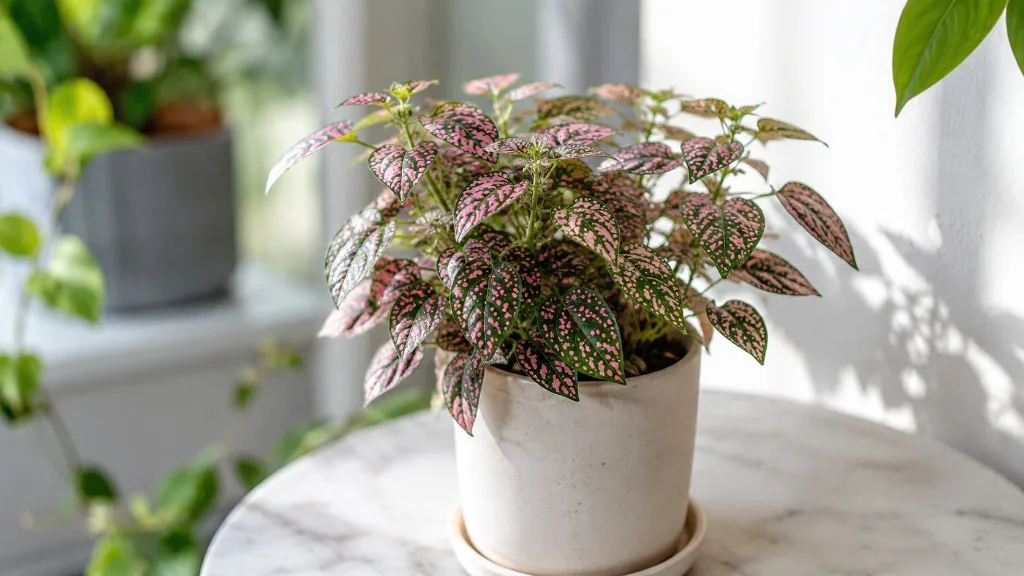
You bought polka dot plant (Hypoestes phyllostachya) for the bubblegum-pink speckles on deep green leaves - freckle face, measles plant, pink splash, whatever the tag called it. Three weeks on a dim bookshelf and those speckles quietly disappear. Stems stretch. New leaves arrive nearly solid green. The plant still lives, but it no longer looks like the one that caught your eye at the nursery. That fade is not a mystery disease or a fertilizer deficiency. It is almost always light.
Polka dot plant is a tropical understory species from Madagascar in the Acanthaceae family. Indoors it wants medium to bright indirect light as the daily target - enough brightness to keep variegation vivid and internodes short - not the dim corner where many colorful houseplants end up because they “look cute” on a shelf. Light also sets the throttle on watering: a bright plant dries its pot faster and uses more water; a dim plant sits wet longer and invites root trouble even when you follow the same calendar as last month.
This guide covers how much light polka dot plant actually needs, where to place it window by window, whether direct sun is safe, when grow lights make sense, and the warning signs that tell you to move the pot before color loss becomes permanent leggy stretch.
Why Pink Speckles Depend on Light
The entire commercial appeal of polka dot plant is variegated foliage - green leaves irregularly splashed with pink, red, or white. The RHS genus guide describes leaves as irregularly spotted and splashed in various shades, forming low spreading clumps. Modern series like Proven Winners’ Hippo cultivars (Rose, White, Red) were bred for larger leaves and stronger color, but even those hybrids still need adequate light indoors to hold their pattern.
Color intensity is not fixed at purchase. It is a live report on light exposure. The RHS growing guide is explicit: deep shade reduces leaf colouring and turns foliage more green. The plant sacrifices decorative pink sectors to build more chlorophyll and photosynthesize efficiently when photons are scarce. The reverse failure - harsh unfiltered summer sun through south or west glass - scorches thin leaves and bleaches pigments, leaving crisp brown margins and washed-out patches.
Color Fade Is a Live Light Report
If your polka dot plant is turning green, check light before fertilizer. Extra nitrogen cannot repaint a leaf that lost variegation because the plant is starving for brightness. Move the pot to an east-facing window behind a sheer curtain, or add a grow light 8–12 inches above the canopy for 12–14 hours daily, and judge new growth at the stem tips - not old leaves that will never regain their speckles. A worked example many growers recognize: a pink polka dot on a dim north desk slowly reverts over two to three weeks; moved to a bright east sill with morning sun and filtered afternoon brightness, the next pair of leaves at each tip often carry pink back within a similar timeframe if roots and moisture are healthy.
Pinching alone on a dark shelf produces a shorter pale plant, not a colorful one. Brighter light plus weekly pinching of stem tips is the combination that preserves the nursery look. For severe legginess, see the leggy growth fix guide after you improve placement.
How Much Light Polka Dot Plant Actually Needs
Indoors, the practical target is medium to bright indirect light for most of the day - strong ambient brightness at the leaf surface without prolonged harsh direct beams through glass. The NC State Extension profile lists light requirements as part shade to shade for outdoor culture, which confuses indoor growers until you remember that outdoor “shade” in a Florida summer is still brighter than many interior shelves. The UF IFAS fact sheet notes that variegated foliage coloration is often more pronounced in shaded outdoor locations - again, a brightness level that usually exceeds dim indoor corners.
Low light is tolerance, not preference. Polka dot plant may survive a north room or distant shelf for a while, but growth slows, internodes stretch, and pink sectors fade. That is survival mode, not the display quality you bought.
The Short Answer for Busy Growers
Place polka dot plant where new leaves emerge compact, correctly speckled, and without scorch - typically an east-facing window, a few feet back from a filtered south or west pane, or under a full-spectrum LED grow light on a timer. If the newest pair of leaves at each stem tip looks pale, solid green, or far apart on the stem, the light is too low. If sun-facing tissue bleaches or crisps within days of a move, pull back or filter. Judge by new growth after any change, not by whether old damage remains visible.
Rainforest Floor Origins and What They Mean Indoors
In native Madagascar habitat, polka dot plant grows as a low spreading herbaceous perennial in warm, humid understory conditions - bright sky brightness filtered through irregular canopy gaps rather than all-day blazing sun on open rock. The Missouri Botanical Garden describes ovate leaves spotted with rose, pink, or lavender on plants typically reaching 12–20 inches indoors unless pinched. That ecology explains three indoor behaviors beginners misread.
First, the plant wants consistent brightness, not a single dramatic sunbeam followed by dim hours. Second, it tolerates short direct sun doses when introduced gradually - the same source recommends overwintering houseplants in bright indoor light with some direct sun - but midday summer beams through west glass often exceed what thin leaves handle without filtering. Third, leggy etiolation is the plant reaching for more light; it is so common on Polka Dot Plant overview that some growers assume straggly stems are inevitable. They are not. They are a signal to move the pot before you pinch.
Terrarium culture works because trapped humidity suits the genus; the RHS growing guide specifically recommends terrariums for Hypoestes. Light still matters inside glass - a sealed terrarium on a hot south sill can cook leaves even when moisture is perfect. Aim for bright filtered light and watch condensation and leaf temperature, not humidity alone.
Best Window Placement for Polka Dot Plant
Window direction is a starting point, not the whole answer. Outside tree shade, overhangs, tinted glass, and pot distance all change intensity. Still, compass orientation gives a reliable first guess in the northern hemisphere. Place the pot where leaves receive plant-facing light, not where the room merely looks bright to your eyes. Human vision adapts to dim interiors; polka dot plant does not.
Rotate the container a quarter turn weekly if growth leans toward the glass. Leaning is normal directional growth; rotation keeps color and form even on all sides.
Quick-Reference Window Table
| Window | Typical indoor light | Color outcome | Notes |
|---|---|---|---|
| East | Soft morning direct sun + bright indirect rest of day | Best default - vivid pink speckles, compact growth | Safest bright placement for most homes |
| South | Highest total daily light | Excellent with sheer curtain or 3–5 ft setback | Watch summer midday heat on leaves |
| West | Strong late-afternoon sun | Good in spring/fall; filter in summer | Heat load higher than east |
| North | Gentle indirect all day | Often too dim for strong variegation | Add grow light or accept slower fade |
An east-facing window is the sweet spot most growers should try first. Morning sun tends to be bright but cooler than afternoon rays. Two to three feet from an unobstructed east pane often delivers the medium-to-bright indirect range where speckles stay vivid without daily scorch scares.
A south-facing window delivers the most total light, especially valuable in winter at mid and high latitudes. Place the pot three to five feet back or behind a sheer curtain to soften direct beams. In summer, watch for bleached patches on leaves facing the glass.
A west-facing window can work in cooler seasons and becomes risky in midsummer when late-afternoon sun carries heat through the pane. Treat west like south with extra caution, not like east with bonus hours.
A north-facing window provides gentle indirect light all day but often lands in the low to moderate range where pink sectors fade over time. Survival is possible; nursery-grade color usually is not without supplementation.
Can Polka Dot Plant Take Direct Sun?
Yes - with conditions. Polka dot plant can handle some direct sun when acclimated gradually and when exposure is limited to gentler periods - especially morning sun on an east sill or filtered direct light through sheer fabric. Problems start when intensity jumps faster than leaves formed in lower light can adjust. A greenhouse-shade plant moved straight to unfiltered south glass in July may show bleached patches, crisp margins, or sudden leaf collapse within days.
The RHS growing guide warns that too much sun scorches foliage. The Missouri Botanical Garden suggests bright indoor light with some direct sun when overwintering - a hint that short sun doses can work indoors if heat and duration stay moderate. Never assume tolerance of dim corners means tolerance of blazing afternoon beams. Sunburn on polka dot plant leaves is permanent on affected tissue; only new growth will look clean.
Low-Light Limits and Color Fade
Polka dot plant can tolerate lower light longer than many vividly variegated tropicals, but long-term dim placement produces predictable decline: slower growth, longer internodes, smaller paler new leaves, and progressive loss of pink speckles as chlorophyll increases. The NC State profile notes pinching back leggy plants maintains compact form - but pinching without brighter light only branches a still-pale plant.
How dark is too dark for a plant you want to display? If new leaves arrive mostly green for a month and internodes visibly lengthen, you are below the growth-and-color threshold. If the pot takes much longer to dry than it did near a window, metabolism has slowed - reduce watering to match, but recognize that light is the root throttle, not the calendar. Short-term dim holding - a few weeks during a move - is fine. Multi-year bookshelf storage is not if you care about speckles.
Bathrooms with frosted windows can work when brightness is adequate; a steamy dark bathroom fades color even at 70% humidity. Read the leaf, not the room label.
Grow Lights When Windows Fall Short
When windows cannot deliver enough daily brightness - obstructed exposures, deep interior desks, winter north-only rooms, or shelves far from glass - full-spectrum LED grow lights are the most reliable fix. Polka dot plant responds well to moderate artificial light because it does not need flowering-crop PAR levels for foliage color.
Choose a fixture labeled for houseplants or seedlings, not a standard room bulb optimized for human lumens. Full-spectrum white LEDs in roughly the 4000K–6500K range support foliage maintenance and steady variegation.
Distance, Hours, and Spectrum
Position the lamp 8–12 inches (20–30 cm) above the tallest leaf tip as a home starting point - consistent with successful indoor culture for this genus. If new growth stretches toward the lamp, lower slightly or extend duration. If leaf edges crisp only under the fixture, raise it or reduce hours. Run lights 12–14 hours daily on a timer to mimic useful day length; consistency matters more than chasing exact photoperiod science on a windowsill backup.
Coverage beats pinpoint intensity. A single bulb over the center leaves outer stems in shadow. Use a bar or panel spanning the pot, or rotate every few days under a clip-on lamp. When you add a lamp, check soil moisture after two weeks - brighter total daily light increases dry-down rate even if the window did not change. Link to the watering guide when adjusting rhythm.
How to Move Polka Dot Plant Safely
Change placement gradually when upgrading light. Move a low-light plant toward brighter exposure in stages over 7–14 days, not in one afternoon. Week one: place the pot in the target room but several feet back from the window. Week two: move halfway to the final distance. Week three: settle at the intended spot unless new growth shows stress.
Watch newest leaves first. Slight temporary leaning toward brighter glass is normal during acclimation. Bleaching, large brown patches, or softening tissue mean you moved too fast - step back immediately and hold at the last safe distance for another week. Store-bought plants often arrive from low-light retail displays; give them a week in moderate indirect light before pushing toward your brightest east or filtered south station.
Change one variable at a time. Combining immediate Polka Dot Plant repotting guide, fertilizing, and a major light jump stacks stress unnecessarily. Adjust light first; let new speckled growth confirm success before other interventions.
Warning Signs Your Polka Dot Plant Has the Wrong Light
Polka dot plant communicates light stress through color, internode length, and growth pace more than dramatic wilting. Use a two-week observation window after any move. Old scars are historical; new leaves at stem tips tell you whether today’s placement works.
Too Little Light Symptoms and Fixes
Too little light typically shows as loss of pink speckles on new growth, long gaps between leaves (leggy etiolation), smaller paler leaves, soil that stays wet unusually long, and slow or absent new shoots. Fixes: move to east or filtered bright exposure, add a grow light 8–12 inches above for 12–14 hours daily, pinch stem tips weekly once brightness improves, and reduce watering to match slower metabolism. Do not fertilize to restore color.
Too Much Direct Sun Symptoms and Fixes
Too much light or heat shows as bleached white or yellow patches, crisp brown edges on the sun-facing side, curled leaves during brightest hours, and sudden damage right after an unacclimated move to strong south or west glass. Fixes: pull back from glass, add sheer curtain filtering, acclimate more slowly next time, and trim permanently scorched leaves only after new clean growth appears. Prioritize removing heat and direct beam before worrying about total daily brightness - scorch can happen in days; fade takes weeks.
Practical Checks and the Watering Link
New-growth test: Judge light by the newest leaf pair at each stem tip on polka dot plant. Old green leaves will not repaint; firm, correctly speckled new foliage proves the placement works.
Watering link: Every light change changes watering. Brighter placement increases transpiration - check moisture more often and follow the watering guide rhythm for top 1–2 cm dry-down. Dimmer placement slows water use - let the surface dry longer before soaking to avoid root stress in wet mix.
Do not fertilize for color: If speckles fade, light is the first variable. Fertilizer on a dim, stressed plant adds salt stress without restoring pink sectors.
Pet-safe note: The ASPCA lists Hypoestes phyllostachya as non-toxic to cats and dogs - useful if you place the pot on a bright windowsill pets can reach, though chewing any houseplant can still upset stomachs.
When to use this page vs other Polka Dot Plant guides
- Polka Dot Plant overview - Start here for whole-plant context before deep-diving this topic.
- Polka Dot Plant problems hub - Jump to symptom-specific fix guides when this care topic does not resolve the issue.
- Not Enough Light on Polka Dot Plant - Escalate here when light adjustments are not enough.
- Leggy Growth on Polka Dot Plant - Escalate here when light adjustments are not enough.
Related Polka Dot Plant guides
- Polka Dot Plant overview
- Polka Dot Plant watering
- Polka Dot Plant soil
- Polka Dot Plant propagation
- Polka Dot Plant fertilizer
- Polka Dot Plant repotting
- Not Enough Light on Polka Dot Plant
- Leggy Growth on Polka Dot Plant
- Polka Dot Plant problems
Conclusion
Polka dot plant light needs reduce to one idea beginners skip and color-focused growers learn fast: pink speckles are a live light report, not a permanent paint job. Hypoestes phyllostachya tolerates dim corners longer than its fading variegation suggests, but it grows, branches, and holds nursery color best in medium to bright indirect light - the brightness of an east window with soft morning sun, a filtered south exposure with sensible setback, or a modest full-spectrum LED on a 12–14 hour timer.
Place the pot where new growth proves the light works, not where the shelf looks best. Treat low light as a fade and stretch warning, not a long-term goal. Introduce direct sun gradually and filter harsh afternoon beams. When speckles disappear, move brighter and pinch weekly - not fertilize harder. If stems are already bare and tall, combine brighter light with the leggy-growth workflow and propagate a fresh cutting while the parent recovers.
Read the newest leaves after every move. Old damage does not heal, but the right window today still produces vivid speckles tomorrow.