Leggy Growth on Polka Dot Plant: Causes, Checks & Fixes
Quick answer
Leggy polka dot plant shows long bare internodes, leaning stems, faded pink or white spotting, and often lilac flower spikes on weak shoots-usually from missed weekly pinching, insufficient bright filtered light, or post-bloom decline. First step: snip off every flower spike just above the top leaf node, then pinch extending tips above nodes and move to brighter filtered light.
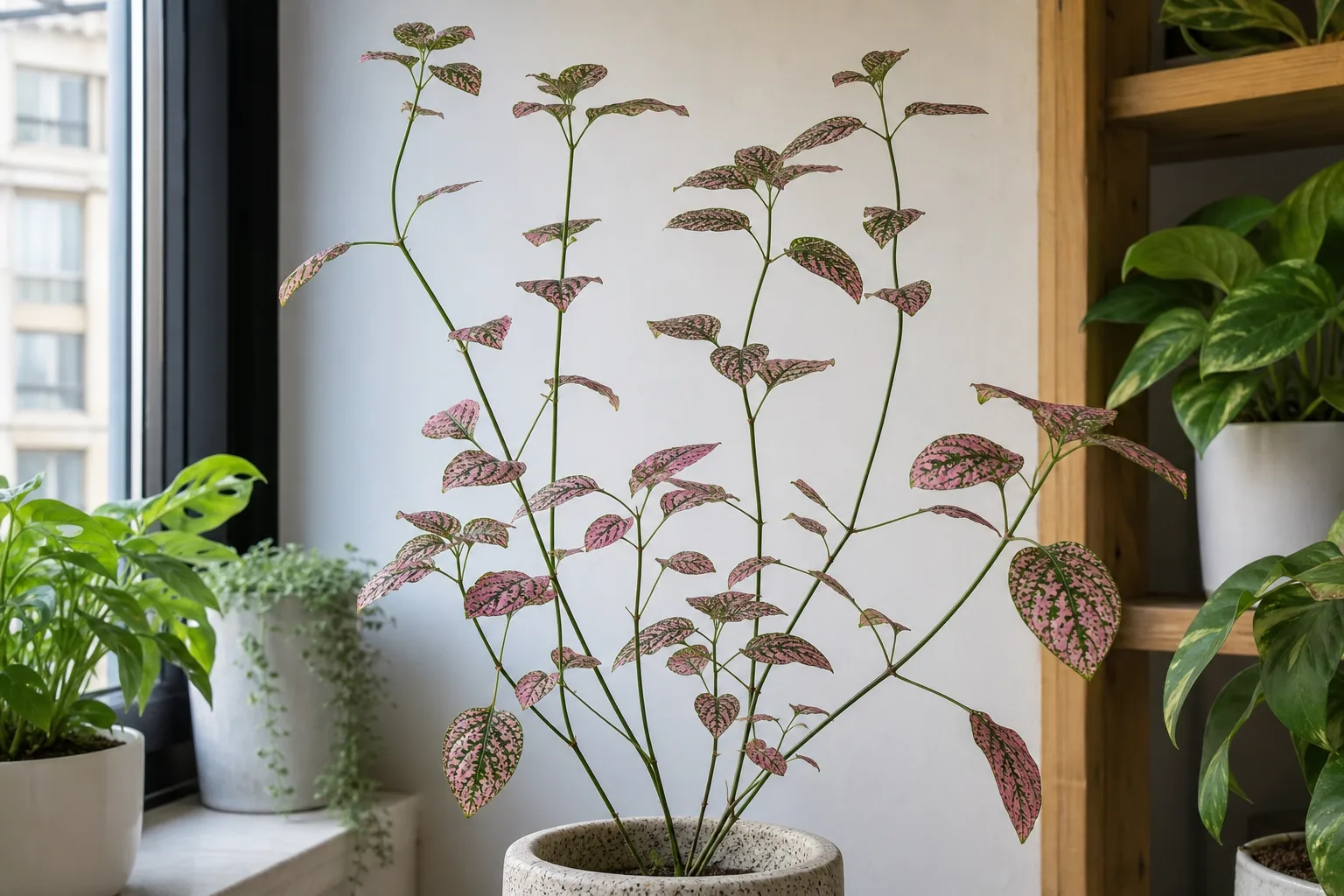
Leggy Growth on Polka Dot Plant: Causes, Checks & Fixes
This guide covers leggy growth on Polka Dot Plant. See also the general Leggy Growth guide, watering, and light pages for this plant.
Leggy Growth on Polka Dot Plant: Causes, Checks & Fixes
Quick answer
Leggy polka dot plant (Hypoestes phyllostachya) is a shape and light problem, not a mystery disease. Healthy pots should carry vivid pink, red, or white spotting along multiple short stems. When pinching stops or light slips, one dominant shoot races upward-long bare internodes below, color concentrated at the tips, and lilac flower spikes often forming on weak apexes.
First step: remove every flower spike just above the top leaf node below the buds. That is the highest-priority cut on this foliage plant. Then pinch each extending tip above an opposite leaf pair and move the pot to brighter filtered light with gradual acclimation.
This page covers maintenance legginess-missed pinching, post-bloom stretch, and lanky form even when light is borderline-adequate. If your main symptoms are washed-out spotting, strong window lean, and a dim-room placement, start with our not enough light on polka dot plant guide; pinching alone in deep shade cannot restore compact spotted foliage.
What leggy growth looks like on Polka Dot Plant
Leggy polka dot plant is easy to spot once you look at stem form, not a single faded leaf.
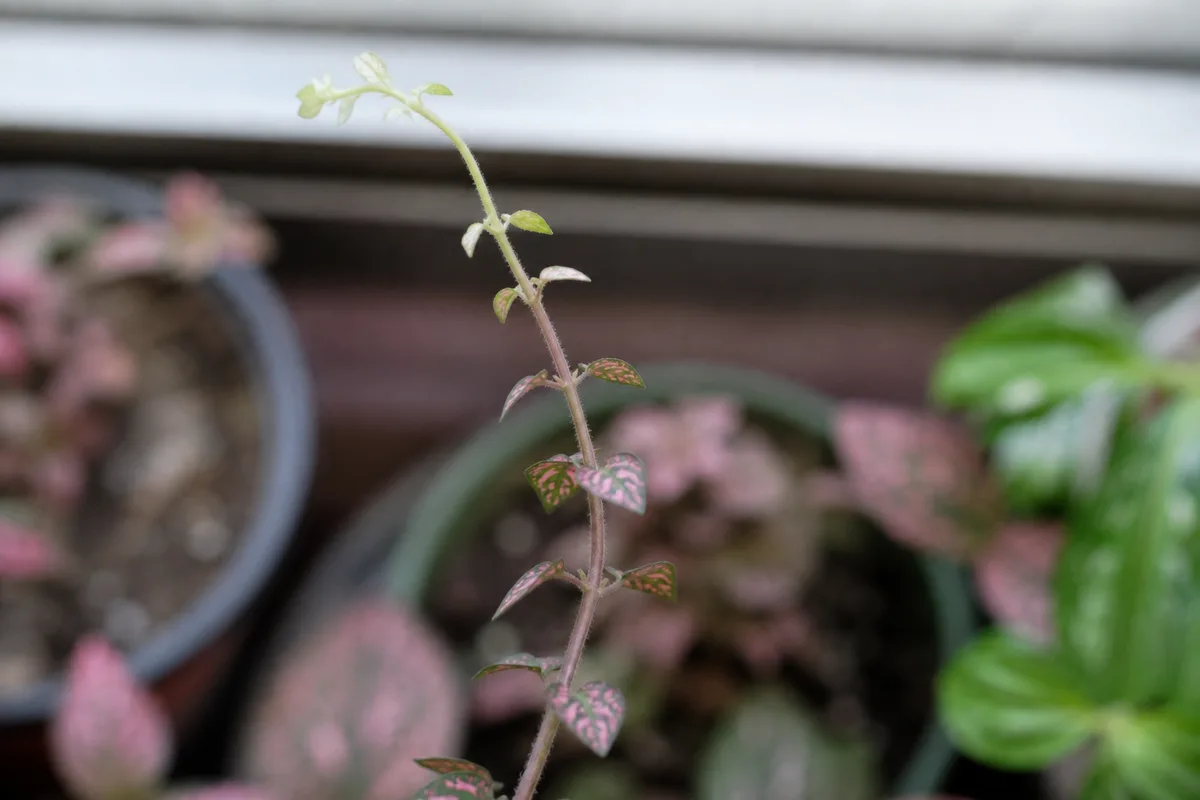
Leggy Growth symptoms on Polka Dot Plant - compare with healthy tissue on the same plant.
Typical leggy-growth signs:
- Long internodes-gaps of 3–6 cm or more between opposite leaf pairs on new growth, longer than older compact sections lower on the stem
- Leaning stems that reach toward the brightest window or grow light
- Faded or solid-green new leaves as anthocyanin spotting weakens before or during stretch
- Sparse lower foliage with most pink, red, or white color clustered at stem tips
- Lilac flower spikes on elongated weak shoots-a decline-phase signal, not a bonus bloom
- One dominant vertical runner when weekly pinching stopped and apical dominance took over
Compare with not enough light on polka dot plant: low light adds strong window lean, green reversion across the canopy, and stalled growth in dim rooms. Leggy growth from skipped pinching can happen in a reasonably bright east window-the plant simply never branched.
Leggy form differs from drooping leaves on polka dot plant: drooping means limp blades and often dry or wet soil stress. A leggy polka dot may stand upright while looking top-heavy and bare below.
Long internodes and leaning stems
Measure the newest stem section between leaf pairs. NC State Extension notes that too little lighting can result in a plant that becomes leggy as it reaches for brighter lighting. Stretch toward glass is etiolation-the plant invests in stem length to capture more photons. Missed pinching lets that single runner continue unchecked.
Faded pink or white spotting
Spotted pigment needs adequate photosynthetic light. In dim corners, leaves revert toward green while stems elongate. Faded spotting on stretched shoots often means light and pinching both need attention-not fertilizer alone.
Flower spikes on stretched shoots
Small lilac tubular flowers on upright spikes are normal on mature plants-but on an already leggy silhouette they signal energy leaving foliage mode. NC State Extension states the plant is not grown for flowers and that removing blooms directs more energy to the leaves. Spikes on weak apexes often appear near the post-bloom decline phase many indoor growers recognize.
Why Polka Dot Plant gets leggy
Insufficient bright filtered light
Polka dot plant is not a low-light foliage plant despite its small size. NC State Extension recommends bright, filtered lighting for best color and warns that too little light causes leggy reach. RHS guidance notes hypoestes need plenty of light but not direct strong sunshine-east windows, filtered south exposure, or supplemental grow lamps in winter.
On this page we treat light as a co-factor when pinching has been neglected: you can pinch a dim plant and still get thin pale side shoots. When color fade and window lean dominate, read not enough light on polka dot plant first-fix light, then pinch once compact new growth appears.
Missed weekly pinching and apical dominance
Left alone, polka dot plant stretches upward with long internodes, especially when one apical bud suppresses side branches at each stem tip. Missouri Botanical Garden recommends pinching tips to promote bushiness on this fast-growing herbaceous plant. NC State Extension notes that pinching back leggy plants can maintain a more compact plant.
Indoor growers often buy a compact potted plant, place it in decent light, and never pinch again. Within three to four weeks one shoot outpaces its neighbors and the mound opens into a tall stick with spots only at the top.
Post-bloom decline phase
University of Wisconsin–Madison Extension explains that regular pinching keeps houseplants compact, but eventually they will need to be replaced-propagation from tip cuttings is part of normal care. Wisconsin Extension also notes that flowering on houseplants often appears in late summer or fall, and heavy flowering indoors often coincides with a tired, open silhouette. Once a mature plant finishes a heavy bloom cycle, it becomes leggier and less worth saving than a fresh cutting.
Leggy growth vs not enough light - which guide to read
| What you see most | Start here | Why |
|---|---|---|
| Bare lower stems, tip-heavy shape, no pinching in weeks | This page (leggy growth) | Form, flowering, and pinching rhythm are the fix |
| Washed-out spotting, lean toward window, dim room placement | Not enough light | Energy deficit drives stretch and color loss |
| Limp leaves, dry surface mix, sudden wilt | Drooping leaves | Water stress, not form alone |
| Almost no new growth for weeks | Slow growth | Stall, not just shape |
| Node placement, flower removal, one-third rule | Polka dot plant pruning | Full shaping workflow |
Both leggy-growth and low-light pages can apply to the same plant. Work light first when color and lean scream “dim,” then pinch once brighter growth proves the plant has energy to branch.
How to confirm the cause
Run this polka-dot-specific checklist before you repot or fertilize:
- Flower spike check - Scan every stem apex for lilac bud clusters. Spikes on elongated shoots confirm decline-phase stretch; remove them first regardless of other fixes.
- Internode pattern - Measure the newest stem section. Gaps longer than older compact growth below confirm ongoing stretch.
- Pinch history - When did you last remove growing tips above a node? If the answer is “never” or “not since purchase,” missed pinching is the prime suspect.
- Window distance and newest leaf color - Is the pot within roughly 30–60 cm of an east or filtered south window? If it sits on a distant shelf with green reversion, confirm light before blaming pinching alone. See our polka dot plant light guide for placement detail.
- Light sanity check - Compare canopy light with a spot receiving morning sun through sheer curtains-that is the target zone for vivid spotting.
- Soil moisture in dim bathrooms or terrariums - Shallow roots dry quickly, but dim light slows water use and can leave mix wet while stems still stretch. Firm roots and normal dry-down support a pinching-first approach; soggy mix with yellow lower leaves needs separate treatment.
Confirmation test: Remove flower spikes, pinch all active tips above nodes, and move to brighter filtered light with acclimation. In warm bright conditions, you should see bud swelling or tiny new leaves at nodes within three to seven days and side shoots filling in within two to three weeks. If side growth stays pale and sparse, move to the not-enough-light guide before the next pinch round.
Lookalikes: drooping, underwatering on Polka Dot Plant, low-light fade alone
Drooping leaves - Limp blades, often with dry surface mix or sudden wilt after missed watering. Shallow roots make polka dot plant sensitive to dry-down. Leggy stretch can coexist but drooping needs water correction first. See drooping leaves on polka dot plant.
Low-light fade alone - Green reversion and window lean without extreme internode length if pinching was recent. Fix light before repeated pinching.
overwatering on Polka Dot Plant in dim corners - Yellow lower leaves, soggy mix, soft stem base. Leggy stretch can coexist, but root trouble needs separate treatment.
First fix for Polka Dot Plant
Remove flower spikes first
Snip every lilac bud cluster just above the top leaf node below the flowers-before you pinch for shape or move the pot. Do not wait for full bloom. RHS advises removing flowers to keep growth neat and compact, and NC State Extension notes removing blooms directs energy to foliage. This single action is the correct first response on a leggy plant showing spikes.
Pinch above nodes on extending tips
After spikes are gone, pinch or snip just above an opposite leaf pair on each extending shoot-remove the top one to two leaf pairs including the apical bud. Because leaves are opposite, a clean pinch above the top pair leaves a symmetrical node ready to branch both ways. Never cut halfway down a bare internode; polka dot plant branches from nodes, not from empty stem tissue.
For cut placement diagrams and the one-third rule, see our full polka dot plant pruning guide.
Move to brighter filtered light with acclimation
Relocate to an east-facing window or 30–60 cm from a filtered south window. Add a full-spectrum grow lamp 10–12 hours daily in winter if internodes lengthen seasonally. Do not jump from a dim corner to harsh afternoon sun in one move-too much direct sun can crinkle and curl leaves. Acclimate over one to two weeks by increasing bright exposure gradually.
Make one major change at a time when diagnosing. Remove spikes and pinch first when form is the issue; move the pot first when color fade and window lean dominate.
Step-by-step recovery
Once spikes are removed and tips are pinched:
- Wait three to seven days for lateral buds to break in bright filtered light during active growth.
- Pinch again when new tips reach two leaf pairs-repeat every one to two weeks during spring through fall to keep the mound compact.
- Shorten severely bare stems after side shoots establish-cut back to the lowest node that still carries healthy spotted foliage, not into naked internodes with no buds.
- Root tip cuttings 10 cm (4 in) long from healthy pinch trimmings if you want backup plants; strip lower leaves and root in water or clean potting mix.
- Upgrade light if needed after two weeks of weak side growth-pinching cannot substitute for photosynthesis.
- Hold fertilizer for one week unless the plant is actively growing in warm bright conditions with firm roots.
Recovery timeline
Expect bud swelling or tiny new leaves at nodes within three to seven days after pinching in bright filtered light during active growth. Side shoots that noticeably fill the plant usually take two to three weeks in spring or summer. Recovery slows in winter when lower light stalls replacement growth.
Old stretched internodes never shorten. Long bare stem sections stay long; success means new branches emerging lower on the plant and a fuller silhouette from the top down. Faded leaves on old stretched sections may not regain full pink or white pigment even after light improves.
If no side shoots appear after three to four weeks in a clearly bright spot, revisit light placement, check for root stress in wet soil, or consider restarting from tip cuttings rather than continued rescue.
What not to do
Do not wait for full bloom before removing flower spikes-early removal keeps energy in spotted foliage.
Do not pinch repeatedly in a dark corner hoping for bushiness. Side shoots need light to thicken.
Do not place in harsh afternoon sun as an overcorrection for legginess-acclimate over one to two weeks.
Do not fertilize a stressed polka dot plant before fixing light and removing spikes. Nutrients cannot replace photons or restore compact form.
Do not expect old elongated internodes to shorten without pruning-only new branching below the pinch point rebuilds width.
Do not stack Polka Dot Plant repotting guide, heavy pruning, and pesticide on the same day. Give the plant one stress at a time.
How to prevent leggy growth next time
Pinch on a schedule-every one to two weeks during active growth, not only when the plant already looks like a tall stick.
Remove flower spikes the moment bud clusters form so energy stays in foliage branching.
Keep bright filtered light year-round-east window, filtered south, or grow-lamp supplementation in winter. See our polka dot plant light guide.
Rotate the pot weekly so all sides branch evenly and spotting stays vivid.
Start pinching young plants once stems have at least four to six leaf pairs so enough foliage remains to fuel recovery after each tip removal.
Plan renewal-Wisconsin Extension notes polka dot plants are often treated as short-lived houseplants that may need replacement; propagation from tip cuttings is normal, not failure.
Keep technique reference handy in our polka dot plant pruning guide for node placement and tool hygiene.
When to restart from tip cuttings instead of rescuing
Pure legginess is a maintenance issue-your polka dot plant is not dying because it looks open and top-heavy.
Restart from fresh tip cuttings when:
- The plant has finished a heavy bloom cycle and the silhouette stays open despite pinching and good light
- Lower stems are bare for several inches with no useful side shoots to cut back to
- Repeated pinching in bright filtered light fails to produce compact spotted regrowth within three to four weeks
- Multiple woody runners dominate and no longer carry healthy spotted foliage at lower nodes
Take 10 cm (4 in) tip cuttings from the healthiest spotted shoots, strip lower leaves, and root in water or clean mix. Keep the parent only if side shoots prove the rescue is worth continuing.
Escalate for non-leggy emergencies when wet soil, yellow leaves, and soft stems suggest root trouble, or pest populations explode on weak new tips after prolonged neglect.
Conclusion
Leggy polka dot plant is usually telling you flower spikes were left on, the pinching schedule lapsed, or light slipped-not that the plant needs a miracle product. Remove blooms first, pinch tips above opposite nodes, and move to brighter filtered light with gradual acclimation. Old bare internodes will not shrink-new branching lower on the plant is the proof the fix worked. When color fade and window lean dominate, pair pinching with the not-enough-light guide; when you need cut placement detail, use the polka dot plant pruning guide.
Related problems: not enough light, drooping leaves, slow growth. Care guides: pruning, light, overview.
When to use this page vs other Polka Dot Plant guides
- Polka Dot Plant watering guide - Use for routine moisture checks before assuming leggy growth is the main issue.
- Polka Dot Plant problems hub - Browse all 17 common issues on this species.
- Not Enough Light on Polka Dot Plant - Different entry point when symptoms overlap with leggy growth.
- Slow Growth on Polka Dot Plant - Different entry point when symptoms overlap with leggy growth.
- Yellow Leaves on Polka Dot Plant - Different entry point when symptoms overlap with leggy growth.