Pearls and Jade Pothos Care: Light, Water & Tips
Epipremnum aureum 'Pearls and Jade'
Pearls and Jade Pothos needs bright indirect light for white/grey variegation, watering every 7–10 days when top 3–5 cm is dry, and well-draining potting mix.
Pearls and Jade Pothos Care: Light, Water & Tips
Start with wateringThe most common care mistake for Pearls and Jade PothosWatering guide →Pearls and Jade Pothos care essentials
Light
bright indirect light
Water
Every 7–10 days in summer - allow top 3–5 cm to dry. Every 10–14 days in winter. Slow grower - overwatering is a significant risk.
Soil
Standard potting mix + 20–25 % perlite. Well-draining. pH 6.0–6.5.
Humidity
40–60%
Temperature
18–29°C (65–85°F)
Fertilizer
Use balanced liquid fertilizer at half strength and stop if the plant is stressed, newly repotted, or not actively growing.
About Pearls and Jade Pothos
Pearls and Jade Pothos is native to Cultivar developed at the University of Florida, typically reaches Up to 2 m trailing; smaller than most Pothos cultivars indoors, with slow to moderate growth. Pearls and Jade Pothos has a trailing growth habit and part of the Araceae family. It is also known as NR11 and Pearls and Jade Devil's Ivy.
| Detail | Information |
|---|---|
| Also known as | NR11, Pearls and Jade Devil's Ivy |
| Native region | Cultivar developed at the University of Florida |
| Mature size | Up to 2 m trailing; smaller than most Pothos cultivars |
| Growth rate | Slow to moderate |
| Growth habit | Trailing |
| Scientific name | Epipremnum aureum 'Pearls and Jade' |
| Family | Araceae |
Pearls and Jade Pothos Care: Light, Water & Tips
What Is Pearls and Jade Pothos?
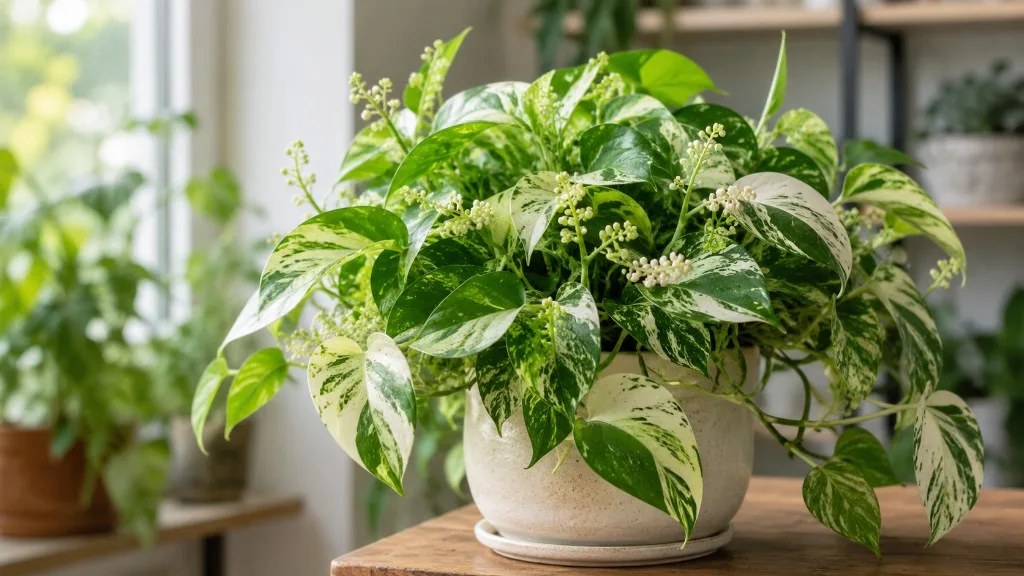
Pearls and Jade pothos is a compact, heavily variegated cultivar of Epipremnum aureum - the species behind golden pothos, marble queen, and most of the trailing “devil’s ivy” sold as beginner houseplants. Its leaves are smaller than classic pothos, typically reaching about 7 to 8 cm (2.5 to 3 in.) long and 4 to 5 cm (1.5 to 2 in.) wide at maturity, and they carry an irregular patchwork of green, white, ivory, and gray-green with distinctive green speckling inside the white zones. The overall effect reads as a dense, painterly trailing vine rather than the broad, chartreuse-splashed leaves you see on golden pothos.
Indoors, Pearls and Jade grows at a slow to moderate pace compared with faster cultivars like golden or jade pothos, and it trails to roughly 2 m (6 to 7 ft) over time in bright conditions - though many specimens stay visually compact on a shelf or in a hanging basket for years before reaching that length. The growth habit is trailing and vining, with aerial roots along the stems that can cling to a moss pole, trellis, or bark board if you train it upward instead of letting it cascade. Like all pothos, it is grown for foliage; Epipremnum aureum rarely flowers indoors, and the UF breeding program that created Pearls and Jade relied on mutation rather than hybridization because pothos does not set seed under typical greenhouse or home conditions.
If you are deciding whether this cultivar fits your home, the honest summary is this: Pearls and Jade rewards Pearls and Jade Pothos light guide, well-draining soil, and patient watering - and it punishes dim corners, soggy pots, and pet access. It is easier than a calathea and slightly more demanding than a solid-green jade pothos when it comes to light, because variegation fades when photosynthetic tissue is insufficient. The payoff is one of the prettiest small-leaf pothos patterns on the market, with a trailing silhouette that works on desks, mantels, and elevated shelves. One non-negotiable caveat: all Epipremnum aureum cultivars, including Pearls and Jade, are toxic to cats and dogs because of insoluble calcium oxalate crystals - confirmed on the ASPCA’s golden pothos listing, which applies to the species regardless of variegation pattern.
Botanical Background and University of Florida Origin
Pearls and Jade belongs to the family Araceae, which matters for care because aroid houseplants share a few baseline patterns: they prefer airy, well-drained mix, they dislike cold wet roots, and most failures start underground long before the leaves tell the full story. The species Epipremnum aureum is native to the Solomon Islands and surrounding Pacific regions, where it climbs tree trunks as a hemiepiphyte - rooted in soil early, then sending stems upward toward brighter canopy light. Your living room is not a rainforest, but the plant still reads light intensity and drying speed the same way: too little light produces thin, green-heavy growth; too much direct sun bleaches or scorches the white tissue.
Pearls and Jade itself is not a wild species form. Researchers at the University of Florida IFAS Mid-Florida Research and Education Center (MREC) in Apopka developed it through a mutation-breeding program aimed at new pothos foliage patterns. According to UF/IFAS publication EP441, ‘Pearls and Jade’® is a mutation selected from irradiated ‘Marble Queen’ plants - a sport that appeared as a stable stem mutation and was then multiplied by tip and single-node cuttings for evaluation. The HortScience cultivar release notes that the parent Marble Queen group had been treated with gamma radiation from a cesium-137 source, after which a uniform mutant shoot appeared and proved stable through years of asexual propagation. The cultivar is marketed under the name Epipremnum aureum ‘UFM12’ and is patented (PP21,217) in the United States, as noted by UF documentation.
That origin story explains two practical traits you will notice at home: smaller leaves than Marble Queen and a slower, more compact growth habit. Mature Pearls and Jade leaves average roughly 7–8 cm long and 4–5 cm wide compared with about 12 cm by 8 cm on Marble Queen in published UF measurements, and the plant was selected partly for use in desk bowls, dish gardens, and small totems - roles where oversized golden pothos leaves would overwhelm the composition. None of that makes the plant fragile, but it does mean you should not expect the same weekly inch of new vine you might get from a neon pothos in a sunny window.
How It Differs from Marble Queen, N’Joy, and Classic Pothos
Retail naming for variegated pothos is messy, and Pearls and Jade is often confused with Pothos N’Joy, Manjula, and its direct parent Marble Queen. Identification matters because all share similar care, but variegation pattern and leaf size help you confirm you have the cultivar you think you do - and adjust light expectations accordingly.
Marble Queen is the parent lineage: larger leaves with broad green and white sectors, generally faster growth, and a coarser variegation blocks rather than fine speckling. Pearls and Jade keeps the white-and-green palette but adds gray-green zones and green flecks inside white areas, and it stays visibly smaller at maturity. N’Joy also came from UF breeding and features cleaner white patches with sharper edges and less of the speckled “pearls” effect; N’Joy’s higher white percentage often makes it slightly less forgiving in low light than Pearls and Jade, because green speckles contribute extra photosynthetic tissue. Manjula - another UF-related cultivar - tends toward wavy, twisted leaves with swirled cream, silver, and green; Pearls and Jade leaves are heart-shaped and flat, not ruffled.
Compared with golden pothos or solid jade pothos, Pearls and Jade is slower, smaller-leaved, and more light-sensitive because variegation reduces chlorophyll. Compared with neon pothos, it is the opposite aesthetic: muted white-and-silver patterning instead of uniform chartreuse. If your plant is pushing out large, mostly green leaves with long internodes, you may have a mislabeled golden or jade pothos, or your Pearls and Jade may be reverting toward green in insufficient light - a common issue with variegated sports, not necessarily a sign you bought the wrong plant initially.
Best Growing Conditions for Pearls and Jade Pothos
Pearls and Jade does best when your space approximates the bright, warm, airy conditions of a tropical understory - filtered light, roots that breathe, and a drying rhythm that never stalls into perpetual wetness. The four variables that decide almost every outcome are light, water, soil, and temperature. Align those and feeding, Pearls and Jade Pothos repotting guide, training, and propagation become straightforward. Misalign one - especially light or water - and the plant fades, yellows, or rots despite your best intentions elsewhere.
Light Requirements for Strong Variegation
Pearls and Jade pothos needs bright, indirect light to hold its variegation and compact leaf size. This is the single most important care variable for the cultivar. A practical target is the kind of light you get near an east-facing window, or several feet back from a south- or west-facing window where sunbeams do not land directly on the leaves for hours at a time. In numeric terms, many growers aim for roughly 8,000 to 12,000 lux of bright indirect exposure - enough that the room feels clearly lit without casting hard shadows at midday. The green speckles within white tissue give Pearls and Jade slightly more tolerance for medium light than extremely white cultivars like N’Joy, but “medium” still means bright by indoor standards, not a dim hallway.
Watch new leaves, not old ones, when diagnosing light. Healthy Pearls and Jade produces small, firm leaves with visible white, gray, and green patterning on the newest node. Long internodes, smaller leaves, and increasing green percentage mean the plant wants more light. Bleached white patches, brown crisping on sun-facing leaves, or midday curling mean direct sun is too strong - move the pot back, filter with a sheer curtain, or shift to an east exposure. Acclimate gradually over one to two weeks when moving from a shop’s lower-light bench to a bright sill; leaves formed in dim conditions burn easily if you jump straight into afternoon sun.
Variegation is not purely cosmetic. White and silver sectors contain less chlorophyll, so the plant photosynthesizes less per leaf area than a solid-green jade pothos in the same pot. That is why Pearls and Jade stalls or reverts in low light while a golden pothos might still look acceptable in the same corner. If you lack a bright window, a full-spectrum grow light on a 10–12 hour timer, positioned roughly 12–18 inches above the canopy, preserves patterning through winter better than hoping a north window will suffice. Rotate the pot every week or two so both sides of the vine receive similar exposure and the plant does not lean dramatically toward the glass.
Temperature and Humidity
Pearls and Jade prefers stable indoor temperatures between about 65 and 85°F (18 and 29°C) during active growth - the same comfortable range most people already maintain. It tolerates brief warmth above that if soil moisture keeps pace, but it slows sharply below about 60°F (15°C) and can show yellowing or stalled growth in cold drafts. Problem spots in many homes include window sills on winter nights, direct airflow from AC vents, and radiators that heat one side of the pot while the other stays cool. Any of those can stress an aroid faster than the plant’s tough reputation suggests.
Frost is irrelevant indoors but matters if you summer the plant outdoors: Epipremnum aureum is not frost-hardy, and Pearls and Jade should come back inside before nights drop toward 50°F (10°C). Outdoor shade with bright ambient light can boost growth in warm months, but acclimate to lower indoor light before bringing the pot back inside for winter.
Humidity is helpful but secondary compared with light and watering. Average home humidity in the 40–50% range is usually adequate. Very dry winter air - below about 30% - can encourage spider mites on indoor pothos, especially if the plant sits near a heating vent. Grouping plants, using a pebble tray with the pot elevated above the water line, or running a small humidifier nearby all help more than misting, which raises humidity briefly and can leave wet foliage that invites fungal spotting when air circulation is poor.
Soil Mix and Drainage
Use a standard well-draining houseplant potting mix amended with roughly 20–25% perlite - or an equivalent ratio of pumice or coarse orchid bark - so water moves through the root zone instead of pooling. The exact branded recipe matters less than the principle: the mix should hold moisture without staying soggy for days, and it should retain enough air space that roots can breathe. Pearls and Jade is slow-growing, which means an oversized, water-retentive pot stays wet longer relative to root uptake - a common hidden cause of yellow leaves and root rot on Pearls and Jade Pothos on variegated pothos that look “easy” on paper.
Target substrate pH around 6.0–6.5, which most quality peat-free or peat-based indoor mixes approximate without adjustment. Hobbyists rarely need a pH meter for pothos; the bigger practical issues are compaction after a year or two in the same pot and salt buildup from hard tap water and fertilizer, which show up as crust on the soil surface and brown leaf tips. Always plant in a container with a drainage hole. Decorative cachepots are fine only if you empty runoff after every watering and never let the inner pot sit in standing water.
How to Water Pearls and Jade Pothos
The general rule for Pearls and Jade is: water when the top 3 to 5 cm (1 to 2 in.) of mix is dry and the pot is approaching light weight, then soak thoroughly until a small amount runs from the drainage hole. Because this cultivar grows more slowly than golden pothos, the mix stays moist longer in the same pot size and light level, which makes overwatering the primary risk. A calendar interval of roughly every 7 to 10 days in warm, bright months and every 10 to 14 days in cooler, dimmer months is a starting point only - your finger, a wooden skewer, or the pot’s weight should confirm dryness before you pour.
Water until the entire root zone is moistened, not just the surface. Empty the saucer afterward so the plant is not sitting in stale runoff. If you use a cachepot, lift the nursery pot, water at the sink, let it drain fully, then return it to the decorative outer shell. Pearls and Jade wilts less dramatically than a peace lily when dry, but chronic underwatering still produces crisp brown edges and smaller new leaves; chronic overwatering produces yellow leaves, blackened stems, and fungus gnats long before the plant collapses.
Pearls and Jade Pothos watering guide During Active Growth
During the warm, bright months when new leaves unfurl regularly, Pearls and Jade uses water on a relatively steady rhythm - but “steady” still means checking each pot individually, not watering every Friday because the calendar says so. The goal is a root zone that cycles between evenly moist after watering and approaching dry at the top third of the pot before the next soak. If you pinch the mix at depth and feel damp, cool soil, wait even if the surface looks lighter in color.
Newly purchased plants often arrive in peat-heavy greenhouse mix that dries on a different schedule than your home blend after repotting. Give the plant two to three weeks to acclimate to your light before you lock in a mental interval. Do not compensate for post-shipping leaf loss by watering more frequently unless the pot is genuinely dry; stabilize light first, then fine-tune moisture based on how fast your specific container dries in its actual window.
Seasonal Adjustments
In cooler, dimmer months - roughly late fall through early spring in temperate climates - growth slows and the pot dries more slowly. Stretch the interval between waterings, reduce or pause fertilizer, and resist the urge to “help” a plant that is not pushing new leaves by keeping the mix constantly wet. The most common winter failure mode on pothos is continuing a midsummer watering rhythm in lower light, which keeps roots cold and oxygen-starved while leaves yellow from the bottom up.
If you run heating that dries the air, the top of the mix may crust while the center stays damp; scrape lightly or probe deeper before assuming drought. Conversely, if the plant sits in a cool drafty window, the mix can stay wet dangerously long even though the surface feels dry - another reason to check at depth, not by sight alone.
Common Watering Mistakes
The most damaging mistake is watering on a fixed schedule without checking the pot. The second is letting the plant sit in a full saucer or cachepot, which suffocates roots within days even when the top inch looks fine. The third is giving tiny daily sips instead of a full soak when the plant is dry - that wets only the surface while the center of the root ball stays parched, producing a cycle of partial drought stress that shows up as brown tips and stalled variegation.
People also misread yellow leaves as “needs water” by reflex. On Pearls and Jade, yellow leaves with wet mix usually mean too much water or failing roots, not thirst. Pair every leaf symptom with a moisture check at depth and a light assessment on the newest node before changing your routine. If stems are mushy at the base and the mix smells sour, stop watering, inspect roots, trim brown soft tissue, and repot into fresh airy mix rather than adding more water in hope of recovery.
How to Feed Pearls and Jade Pothos
Pearls and Jade is a light feeder compared with fast-growing tropical foliage plants. A balanced water-soluble houseplant fertilizer - for example 10-10-10 or 20-20-20 - diluted to one-quarter to one-half of the label rate is sufficient during active growth. Apply to already-moist soil roughly once a month from spring through early fall, or every six weeks if your potting mix already contains a slow-release starter charge. Because variegated leaves photosynthesize less per area, heavy feeding does not restore faded patterning; light fixes variegation, not nitrogen.
Hold fertilizer entirely during the cool, low-light months, after a major repot until new growth appears, and while the plant is recovering from root rot or pest damage. Overfeeding produces salt buildup and brown leaf margins that persist even when watering seems correct. If margins crisp despite good moisture, flush the pot with plain water at two to three times the pot volume and pause feeding for six to eight weeks. Never fertilize a dry, stressed root ball - the concentrated salts burn fine roots on slow-growing aroids faster than on thirsty summer annuals.
Repotting and Root Health
Repot Pearls and Jade roughly every one to two years, or whenever roots circle drainage holes, the plant dries out within a day of watering, or water runs straight through without soaking in. The best timing is early spring as active growth resumes, giving the plant a full warm season to colonize the new mix. Go up only one pot size at a time - typically 1 to 2 inches (2.5 to 5 cm) wider in diameter. Oversized pots hold excess wet mix around a slow root system, which is the most common trigger for rot after repotting on variegated pothos.
Use fresh, well-draining mix with extra perlite as described above, plant at the same depth as before, and water lightly for the first week while cut roots heal. Keep the plant in bright indirect light and skip fertilizer until you see a new leaf unfurling. Pearls and Jade tolerates being slightly root-bound better than being drowned in a giant pot; when in doubt, prioritize drainage and pot size over aggressive upsizing.
Signs It Is Time to Repot
Physical signs include roots emerging from drainage holes, a top-heavy vine that wilts soon after watering despite moist surface mix, or soil that has broken down into fine, water-retentive mud. Performance signs include stalled growth for months during warm, bright weather despite corrected light, or chronic tip burn that persists after you have fixed watering - sometimes indicating mineral-loaded old mix rather than current care errors.
Do not repot a plant that is actively collapsing from overwatering until you have inspected roots and trimmed rot. Moving a failing root ball into fresh mix without fixing the underlying moisture and light problem rarely saves slow-growing cultivars. If more than half the root mass is brown and mushy, consider propagating healthy stem cuttings above the damage and restarting with clean material rather than forcing the parent plant to recover from advanced rot.
Propagation Methods for Pearls and Jade Pothos
The standard home propagation method for Pearls and Jade is stem cuttings with at least one node - the swollen joint where leaves and aerial roots emerge. Division is rarely necessary because most specimens are single-vine or few-vine pots rather than dense clumps. Stem propagation is also how the cultivar was originally multiplied after the UF mutation was isolated, which tells you the method is genetically stable when you include nodes and avoid reverting green-only sections if you want to preserve variegation patterning.
Take a 4- to 6-inch (10 to 15 cm) cutting just below a node using clean, sharp shears or scissors. Remove leaves from the lower half of the stem, leaving one or two variegated leaf pairs at the top. You can root cuttings in plain water - change the water every few days to limit bacteria - or directly in a moist, well-draining mix. For water propagation, transplant into potting mix once roots reach 1 to 2 inches (2.5 to 5 cm) long, usually within two to four weeks at warm room temperatures near 70°F (21°C). For mix propagation, bury the node, keep the medium evenly moist but not soggy, and place the pot in bright indirect light until new growth confirms roots have formed.
Choose cuttings from variegated sections of the vine if you want offspring that match the parent pattern; all-green stems root easily but may produce green-reverted plants. Do not propagate stressed, diseased, or heavily pest-infested vines - cuttings inherit the parent’s problems. Also note that ‘Pearls and Jade’® is a patented cultivar (PP21,217); home propagation for personal use is common, but commercial propagation for sale may require licensing - check plant tags if you operate a nursery business.
Common Pearls and Jade Pothos Problems
Most Pearls and Jade problems are environmental, not mysterious diseases. The plant signals through variegation quality, internode length, and yellowing pattern long before the entire vine collapses. The useful diagnostic order is light first, moisture second, pests third - the opposite of how many owners reach for fertilizer or a new watering app first.
Yellow Leaves, Brown Tips, and Fading Variegation
Yellow leaves can mean overwatering, underwatering, natural aging of older leaves, cold drafts, or root damage. If yellow leaves are soft and the mix is wet, suspect overwatering and inspect roots for brown mushy tissue. If yellow leaves are crisp and the pot is light, drought stress is more likely. A single yellow lower leaf on an otherwise patterned vine is often normal senescence - remove it and watch new growth rather than overcorrecting every variable at once.
Brown leaf tips and margins usually point to underwatering, low humidity, salt buildup from over-fertilizing, or fluoride/chlorine stress in tap water in sensitive homes. Flush the pot periodically with plain water if salts are suspected, and review whether the watering rhythm matches how fast the plant actually dries in its current light. Tips that are already brown will not turn green again; judge success by undamaged new leaves.
Fading variegation - increasing green, shrinking white sectors, larger leaves - is almost always insufficient light, especially on vines far from the window. Move the plant closer to bright indirect exposure or add a grow light, then evaluate the next two or three leaves after two weeks. Pruning back a reverting green tip to a variegated node can redirect energy into patterned growth, but pruning alone does not fix a dark room.
Watch for spider mites in dry indoor air - fine webbing and stippled leaves are the tell. Mealybugs hide in leaf axils as white cottony clusters. Scale appears as immobile bumps along stems. Fungus gnats indicate overly wet surface mix; let the top layer dry slightly between waterings. Catch pests early with weekly inspection. A strong shower, manual removal, and insecticidal soap applied per label directions handle most infestations if you act before the population spreads.
Is Pearls and Jade Pothos Safe for Pets?
No - Pearls and Jade pothos is toxic to cats and dogs, along with every other Epipremnum aureum cultivar. The ASPCA lists golden pothos (Epipremnum aureum) as toxic to dogs and cats, with insoluble calcium oxalates as the toxic principle. Clinical signs include oral irritation, intense burning of the mouth, tongue, and lips, excessive drooling, vomiting, and difficulty swallowing. Variegation color does not change the toxin profile - white, green, and gray tissue all contain the same needle-like calcium oxalate crystals (raphides) that embed in mouth and gastrointestinal tissues when chewed.
Toxic does not always mean fatal in tiny nibbles, but cats and dogs lack a reliable off switch for chewing plants, and trailing vines at nose level are an accident waiting to happen. Do not rely on “my pet never eats plants” as a safety plan. Hang baskets high enough that cats cannot jump to them, keep pots on shelves away from climbing routes, and trim long trailers that dangle into reach. For dogs, remember that a vine on a coffee table becomes accessible the moment someone bumps the pot.
If you suspect ingestion, contact your veterinarian or the ASPCA Animal Poison Control Center at (888) 426-4435 (a consultation fee may apply). Bring a photo of the plant or leaf for identification. Do not induce vomiting unless a veterinary professional specifically instructs you to do so. This is general information, not veterinary advice - when drooling, swelling, or vomiting persists, professional care is the right move.
For households with curious pets, Pearls and Jade belongs in the same caution category as philodendron or dieffenbachia: beautiful at elevation, poor choice on the floor. If you want trailing greenery in a pet-forward home, choose confirmed non-toxic species instead of hoping pothos will be ignored.
Conclusion
Pearls and Jade pothos (Epipremnum aureum ‘Pearls and Jade’) is a University of Florida mutation cultivar with small, speckled green-white-silver leaves on a slow to moderate trailing vine. Give it bright indirect light to protect variegation, well-draining mix with extra perlite, warm stable temperatures, and a watering rhythm driven by dryness checks rather than the calendar, and it will stay compact and patterned for years on a shelf, totem, or hanging basket. Take stem cuttings from variegated nodes when you want backup plants, repot on a modest schedule without oversizing the pot, and treat fading patterning as a light problem first.
When something looks wrong, read the plant in context: long green internodes mean more light; bleached white patches mean less direct sun; yellow leaves on wet mix mean roots; crisp tips on a light pot mean drought or salts. Fix environment before escalating to fertilizer or pesticides. Do that, and Pearls and Jade becomes one of the most rewarding small-leaf pothos cultivars you can grow - as long as you keep it out of reach of pets that chew leaves and out of dim corners that steal its variegation.
When to use this page vs other Pearls and Jade Pothos guides
- Pearls and Jade Pothos overview - Canonical hub for this species - care topics and problems branch from here.
- Pearls and Jade Pothos problems - Symptom-first path when you already know something is wrong.
Related Pearls and Jade Pothos guides
- Pearls and Jade Pothos watering
- Pearls and Jade Pothos light
- Pearls and Jade Pothos soil
- Pearls and Jade Pothos propagation
- Pearls and Jade Pothos fertilizer
- Pearls and Jade Pothos repotting
- Pearls and Jade Pothos pruning
- Brown Tips on Pearls and Jade Pothos
- Leggy Growth on Pearls and Jade Pothos
- Root Rot on Pearls and Jade Pothos
- Yellow Leaves on Pearls and Jade Pothos
- Pearls and Jade Pothos problems
How to care for Pearls and Jade Pothos?
How much light does Pearls and Jade Pothos need?
bright indirect light
- bright indirect light - bright indirect light.
When should you water Pearls and Jade Pothos?
Every 7–10 days in summer - allow top 3–5 cm to dry. Every 10–14 days in winter. Slow grower - overwatering is a significant risk.
- Top 4–5 cm dry test - Every 7–10 days in summer - allow top 3–5 cm to dry.
- Drain excess water - Slow grower - overwatering is a significant risk.
What soil works best for Pearls and Jade Pothos?
Standard potting mix + 20–25 % perlite. Well-draining. pH 6.0–6.5.
- potting mix - Standard potting mix + 20–25 % perlite.
- perlite - Standard potting mix + 20–25 % perlite.
Grower notes for Pearls and Jade Pothos
What matters most with Pearls and Jade Pothos
Pearls and Jade Pothos is forgiving, but its variegation and leaf size tell you whether the placement is actually working. Long bare vines usually mean the plant needs pruning, stronger light, or a support, not just more fertilizer. In practice, the care checkpoint is simple: bright indirect light. Pair that with standard potting mix + 20–25 % perlite. Well-draining; pH 6.0–6.5, and avoid changing water, pot size, and placement all at once.
Best placement in a real home
Pearls and Jade Pothos belongs where bright indirect light is realistic for most of the day, not only where the pot looks good. Every 7–10 days in summer - allow top 3–5 cm to dry. Every 10–14 days in winter. Slow grower - overwatering is a significant risk. If the pot stays wet longer than expected, move the plant into better light or reassess the mix before watering again. Humidity target: 40–60%. Temperature comfort zone: 18–29°C (65–85°F).
Before you buy this plant
Choose Pearls and Jade Pothos with firm new growth, clean leaf undersides, and soil that does not smell sour or feel compacted. Be cautious if you see yellow-leaves, sticky residue, collapsed crowns, or a pot that is wet in poor light. Cosmetic old-leaf damage is less worrying than weak roots or active pests.
First month after bringing it home
Do not repot Pearls and Jade Pothos on day one unless the mix is failing or pests are obvious. Quarantine it, learn how fast the pot dries, and keep care boring while it adjusts. Watch especially for yellow-leaves, leggy-growth, and root-rot. If problems appear, correct the condition first rather than stacking fertilizer, repotting, and pruning together.
Safety note for Pearls and Jade Pothos
Pearls and Jade Pothos is not a plant to keep within reach of pets or children. The database flags it for cats and dogs. Use gloves if sap or plant tissue is irritating, and pick a pet-safe alternative for floor pots or low shelves.
How to tell Pearls and Jade Pothos is settling in
Also sold as NR11 and Pearls and Jade Devil's Ivy, this plant should be judged by stable new growth rather than label names alone. If you plan to multiply it later, common methods include Stem cuttings in water. Repot only when you see root-bound and rapid drying. If leggy-growth shows up early, inspect light, watering, and roots before assuming the plant is permanently weak.
Is Pearls and Jade Pothos safe for pets?
Pearls and Jade Pothos is toxic to cats and dogs. Calcium oxalate crystals cause oral irritation and vomiting. Keep out of reach of all pets.
All Epipremnum aureum varieties contain insoluble calcium oxalate crystals. Toxic to cats and dogs.
Watering Pearls and Jade Pothos
For Pearls and Jade Pothos, top 4–5 cm dry test and water every 7–14 days in growing season. Reduce frequency in winter.
| Detail | Information |
|---|---|
| How often | Every 7–14 days in growing season |
| How to check | Top 4–5 cm dry test |
| Seasonal changes | Reduce frequency in winter |
Signs of overwatering
- yellowing leaves
- root rot
Signs of underwatering
- wilting
- dry soil
Soil & potting for Pearls and Jade Pothos
Use a mix of potting mix, perlite for Pearls and Jade Pothos. Good. Target soil pH around 6.0–6.5. Repot every 2 years (slow grower), ideally in spring.
| Detail | Information |
|---|---|
| Recommended mix | potting mix, perlite |
| Drainage | Good |
| Soil pH | 6.0–6.5 |
| Repotting frequency | Every 2 years (slow grower) |
| Best season to repot | Spring |
Signs it needs repotting
- root-bound
- rapid drying
Humidity & temperature for Pearls and Jade Pothos
Pearls and Jade Pothos prefers 40–60%, though normal home humidity is usually fine. Keep temperatures around 18–29°C (65–85°F).
| Detail | Information |
|---|---|
| Humidity | 40–60% - normal home humidity is fine. |
| Ideal temperature | 18–29°C (65–85°F) |
Fertilizer & pruning for Pearls and Jade Pothos
Use use balanced liquid fertilizer at half strength and stop if the plant is stressed, newly repotted, or not actively growing. for Pearls and Jade Pothos.
| Detail | Information |
|---|---|
| Fertilizer type | Use balanced liquid fertilizer at half strength and stop if the plant is stressed, newly repotted, or not actively growing. |
Common problems on Pearls and Jade Pothos
Brown Tips
LowLikely cause: Low humidity or hard water
Quick fix: Increase humidity; use filtered water
Full fix guide →Leggy Growth
MediumLikely cause: Insufficient light causing green reversion
Quick fix: Move to brighter indirect light
Full fix guide →Root Rot
MediumLikely cause: Consistently wet soil
Quick fix: Repot in fresh draining mix
Full fix guide →Yellow Leaves
MediumLikely cause: Overwatering - primary risk for slow growers
Quick fix: Allow top 3–5 cm to dry; reduce watering frequency
Full fix guide →