Leggy Growth on Pearls and Jade Pothos: Causes, Checks &
Quick answer
Leggy growth on Pearls and Jade Pothos is etiolation-long internodes and thin vines reaching for light while white marbling fades on new teardrop leaves. First step: move the pot within 12–36 inches of your brightest suitable window, or add a grow light 12–18 inches above the top leaves for 10–12 hours daily. Prune stretched stems only after two to three compact marbled new leaves confirm the brighter spot works.
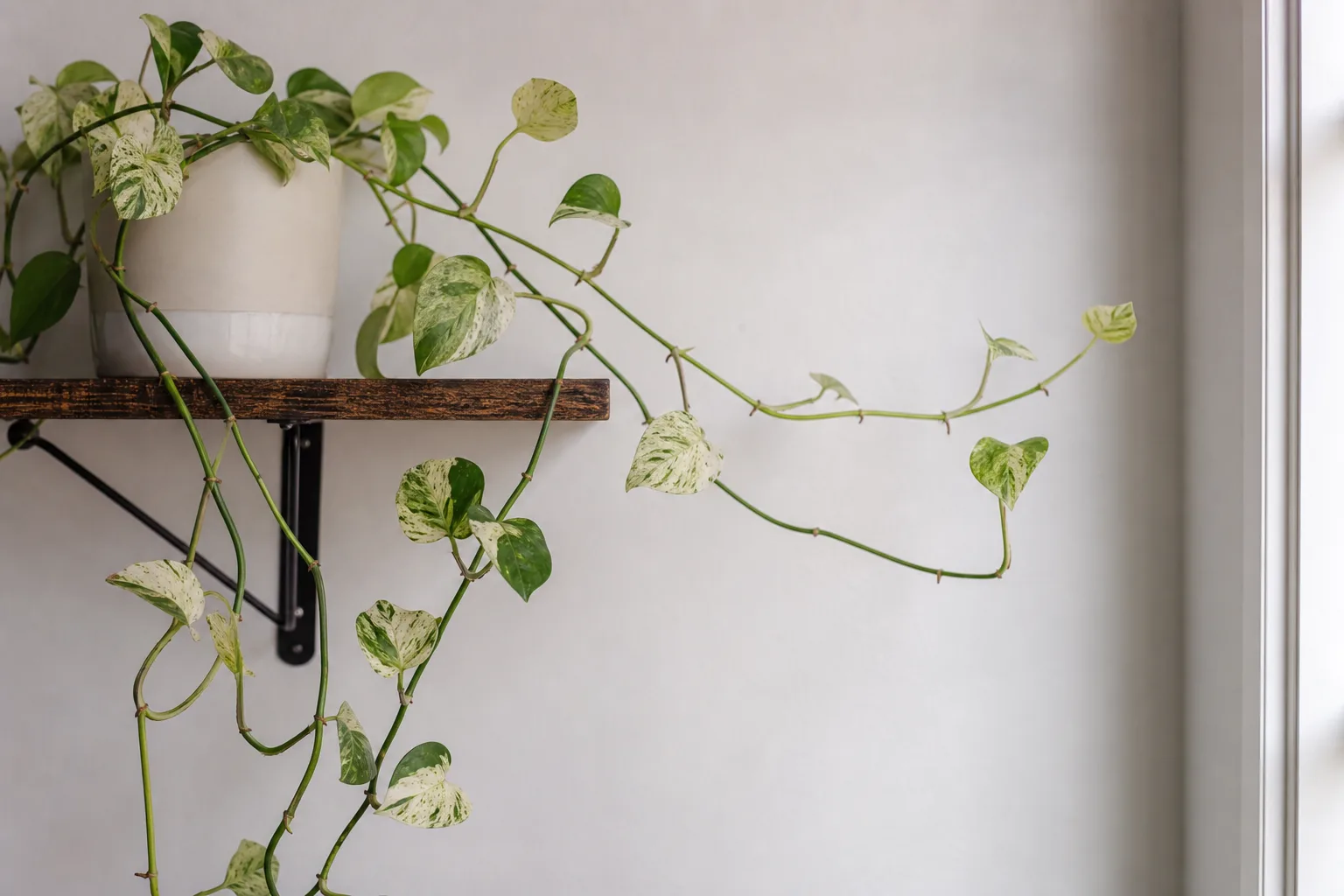
Leggy Growth on Pearls and Jade Pothos: Causes, Checks & Fixes
This guide covers leggy growth on Pearls and Jade Pothos. See also the general Leggy Growth guide, watering, and light pages for this plant.
Leggy Growth on Pearls and Jade Pothos: Causes, Checks & Fixes
Quick answer
Leggy growth on Pearls and Jade Pothos (Epipremnum aureum ‘Pearls and Jade’) is etiolation-the plant stretching toward photons when light is too weak for compact growth. This University of Florida cultivar has small teardrop leaves with pearl-white patches on jade-green speckling; those white sectors contain little chlorophyll, so the plant needs bright indirect light to hold short internodes and its marbled pattern. In shade, stems develop long bare sections, smaller new leaves, and mostly green reversion on fresh growth.
First step: move the pot within 12–36 inches of your brightest suitable window, or add a full-spectrum grow light 12–18 inches above the top leaves for 10–12 hours daily. Do not fertilize, repot, or increase watering on the same day. Stretched sections will not compact on their own-plan to prune above nodes after two to three marbled teardrop leaves confirm the brighter spot works. This page covers internode stretch, pruning, and recovery; our not enough light guide focuses on marbling fade and placement when color loss is your main concern.
Leggy growth vs not enough light on Pearls and Jade Pothos
Both problems share the same root cause-too few photons-but owners search them for different reasons. Use this page when long bare stems, widely spaced teardrop leaves, or pruning and support are the headline. Use the not enough light guide when “Why is my Pearls and Jade turning green?” is the headline.
| Your main question | Start here | Also check |
|---|---|---|
| Vines are long, thin, and sparse with small teardrop leaves | This page - etiolation and internode stretch | Light guide for placement targets |
| New leaves lose pearl-white speckling and turn mostly green | Not enough light - marbling fade | This page if stems also stretched |
| Bare lower stems with foliage only at the tips | This page - prune after light fix | Pruning guide for cut placement |
| Plant barely grows anywhere | Slow growth | Light and fertilizer limits |
| Wet soil + droop in a dim corner | Overwatering | Low light slows dry-down-fix both |
Improving light addresses both stretch and reversion. Prune elongated stems after brightness increases, not before-you need compact new growth to judge success.
What leggy growth looks like on Pearls and Jade Pothos
Etiolation on Pearls and Jade reads as structure first, marbling second. The vine may still show partial white speckling while the architecture already tells you light is marginal.
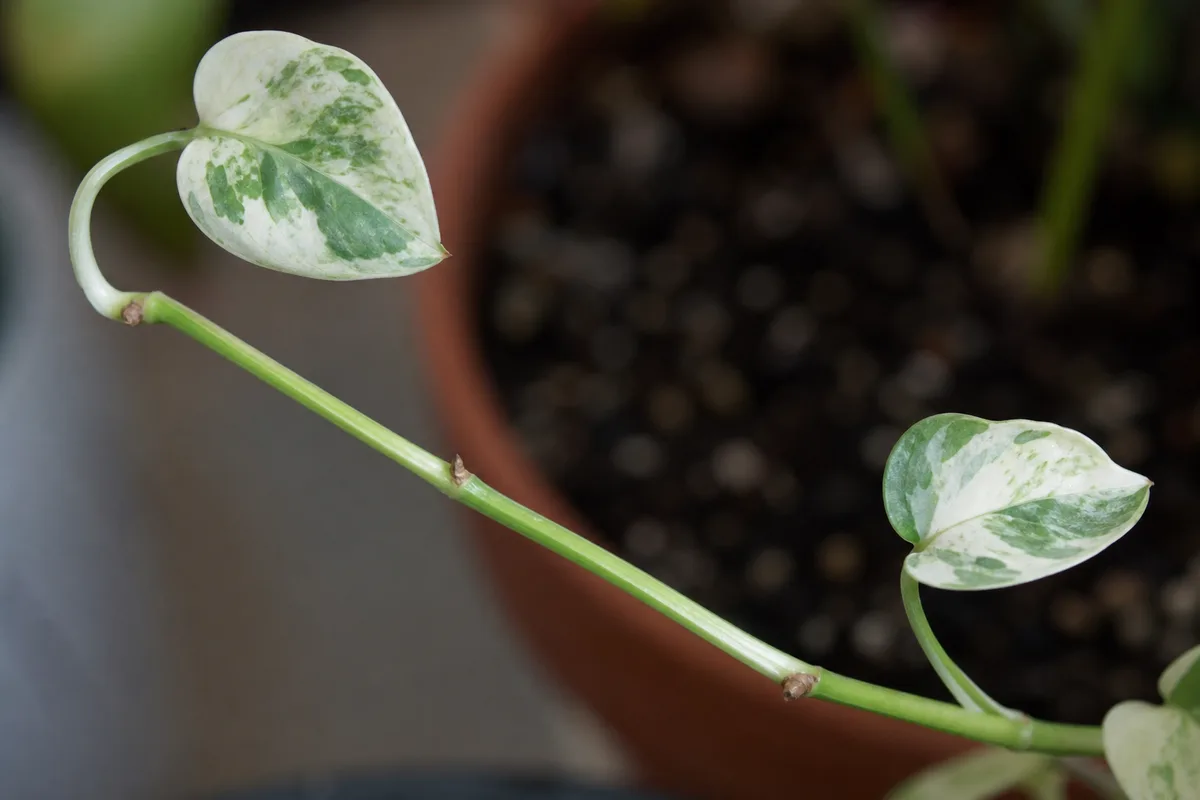
Leggy Growth symptoms on Pearls and Jade Pothos - compare with healthy tissue on the same plant.
Primary Pearls and Jade signals:
- Long gaps between small teardrop leaves on new growth-the internode between nodes stretches while leaf size shrinks
- Thin, reaching stems that lean hard toward one window or lamp
- Mostly green new leaves where pearl-white marbling used to dominate on fresh teardrop foliage
- Bare lower stems with foliage clustered at the vine tips-a “palm tree” silhouette on an old trailing plant
- Soil that stays wet longer than expected because photosynthesis drops in dim light and water uptake slows
- Slower pace than Golden Pothos even in the same corner-Pearls and Jade already grows at a slow to moderate rate; etiolation makes the gap obvious
What compact healthy growth looks like for comparison:
- New teardrop leaves emerge with tight internode spacing and visible pearl-white patches on jade-green speckling
- Firm small blades and steady vine extension through spring and summer without a permanent lean
- Even distribution of leaves along actively growing sections-not only at the ends
What winter slow growth looks like-different urgency:
- Growth pauses or slows uniformly in short days without dramatic new internode stretch
- Existing marbled leaves may age normally-concern is warranted when new growth keeps spacing out on the same sill through winter while the plant leans
Pearls and Jade survives dim corners longer than many houseplants but harder to keep compact and marbled than solid-green Golden Pothos in the same hall. Treat stretch as a placement problem, not a fertilizer shortage.
Why Pearls and Jade Pothos gets leggy
Plants stretch toward light when photon supply falls below what the species needs for compact architecture. On Pearls and Jade, that biology intersects with variegated-cultivar pigment economics.
Phototropism and etiolation. Pothos is a tropical climbing vine that scales tree trunks toward broken canopy light. Indoors, weak light triggers the same response: elongated internodes, smaller leaves, and directional lean. Insufficient light causes leggy stretch and fading leaf color on many foliage houseplants-variegated Pearls and Jade is not exempt.
White-sector chlorophyll deficit. Pearls and Jade has light and dark green speckled leaves with large white spots on teardrop-shaped foliage smaller than Marble Queen or Golden Pothos. White patches lack the chlorophyll that powers photosynthesis. In low light the plant cannot produce enough energy to support highly variegated tissue, so it prioritizes survival by pushing out greener leaves with more photosynthetic surface-low light can cause loss of variegation on cultivars like Pearls and Jade.
Slower cultivar pace. Pearls and Jade grows at a slow to moderate pace even in good conditions-slower than solid-green pothos because pale sections contribute less to food production. That slower metabolism means dim placement hits this cultivar harder: less new growth, faster reversion, and longer recovery once light improves.
Pearls and Jade vs Golden Pothos in the same corner. Solid-green Golden tolerates dim offices with modest stretch. Pearls and Jade beside it in the same hall develops longer internodes sooner because the white sectors are effectively offline photosynthetic panels-this cultivar requires lots of light to maintain its intense coloring.
The dim-room overwatering trap. A stretched Pearls and Jade on a back shelf transpires slowly. Owners who keep a bright-window watering rhythm see yellow leaves and sour soil-symptoms labeled overwatering that start when light slows metabolism. Brighter light increases water use; dim light demands patience before the next drink. Cross-check overwatering if mix stays wet for weeks.
Leggy growth vs slow winter growth vs overwatering
| Pattern | Stem spacing | New leaf pattern | Soil / roots | First fix |
|---|---|---|---|---|
| Etiolation (this page) | Long new internodes; lean toward light | Smaller teardrop leaves; green reversion on tips | Often slow dry-down in dim rooms | Brighter indirect light, then prune |
| Normal winter pause | Little new growth; old spacing unchanged | No new leaves to compare | Normal dry-down for season | Wait for spring; optional grow light |
| Overwatering in dim corner | May stretch if light also low | Yellowing, not just small | Wet mix 10+ days; soft roots | Dry-down correction + light |
| Sun scorch on white patches | May not stretch | Bleached or crisp brown white zones | Normal dry-down | Filter sun; move back from hot glass |
Use new growth as the tiebreaker. If the youngest teardrop leaf keeps spacing out while the plant tilts toward glass, etiolation is active-not dormant winter rest.
How to confirm the cause
Work through this checklist before assuming fertilizer, Pearls and Jade Pothos repotting guide, or pest treatment is needed:
-
Internode spacing on the newest section - Measure the gap between the last two teardrop leaves. Longer gaps on fresh growth than on older marbled leaves below strongly suggest etiolation.
-
Lean direction - Consistent tilt toward one window or grow lamp confirms phototropic stretch.
-
Hand-shadow test - On a clear day, hold your open hand 12 inches (30 cm) above the leaves at the plant’s height. Bright indirect light usually casts a soft, diffuse shadow with recognizable shape. No meaningful shadow means you are likely below what Pearls and Jade needs for compact growth. Sharp, dark shadows with hot leaf surfaces on white patches mean direct sun-different problem.
-
Window distance and direction - Is the pot more than 1.5–2 m from the brightest window? Light intensity decreases rapidly with distance from the glass. North rooms and interior corners often read as “fine” to human eyes but deliver low light to foliage.
-
New-vs-old leaf comparison - Compare the newest teardrop leaf on each runner to leaves produced when you first got the plant. Shrinking white speckles on fresh growth confirms current light is too low.
-
Two-week window move - Shift the pot closer to the brightest suitable glass (or add a grow light) and change nothing else. If the next one to two leaves emerge closer together with restored pearl-white speckling, light was the limiter.
-
Water-use check - Press the top 3–5 cm of mix. If soil stays damp ten days or more with stalled growth, low light may be slowing metabolism. Confirm roots are still firm-not rot masked as thirst.
-
Rule out fertilizer stretch - Dark green, soft, fast elongation on a bright windowsill with recent heavy feeding may be excess nitrogen, not shade. Do not feed leggy vines before fixing light-see the fertilizer guide.
If stems are firm, pests are absent, and yellowing appears only on lower leaves while new growth is mostly green and stretched, insufficient light is the most likely primary cause.
First fix for Pearls and Jade Pothos
Move the pot within 12–36 inches of your brightest suitable window-or add a full-spectrum grow light 12–18 inches above the top leaves for 10–12 hours daily-and leave watering, fertilizer, and pot size alone for two weeks.
Concrete placements that often restore compact marbled growth:
- East windowsill or table within 12 inches of east glass - morning sun may touch leaves briefly; afternoon stays bright and indirect
- Filtered south or west window with a sheer curtain, pot one to three feet back from the pane so intensity diffuses before it hits pale white zones
- North or northeast window with unobstructed outdoor view - consistent soft light; may need a grow lamp in winter
If the plant lived in a very dim interior room for months, acclimate over 7–14 days: move six inches closer every two to three days, or add a sheer curtain if bleached patches appear on white leaf sectors. Pearls and Jade coming from moderate shade can usually take one deliberate step to a brighter east or filtered south spot.
Grow-light setup when windows fall short: Mount a full-spectrum LED fixture 12–18 inches above the top of the vine, timer set for 10–12 hours daily. Combine with weak natural light if available. Spectrum and seasonal supplementation details live in the light guide.
After moving:
- Do not fertilize until new growth looks firm and marbled for two weeks
- Do not repot unless mix is clearly failing
- Recheck soil moisture every few days-brighter light usually means faster dry-down per the watering guide
Step-by-step recovery: light, then prune, then propagate
Once exposure improves, follow this sequence-pruning before light correction often produces another round of stretch within weeks:
-
Hold position for two weeks - One deliberate placement change beats daily shuffling. Read the next teardrop leaf before adjusting again.
-
Confirm compact new growth - Wait for two to three new leaves with shorter internodes and restored pearl-white speckling before any hard cutback. That proves the brighter spot works.
-
Prune the worst bare runners - Cut each elongated whip 5–10 mm above a healthy node, just above the swollen joint where a leaf attaches. Pothos branches from nodes, not bare internodes. For severely leggy plants in spring, you can cut individual vines back to 4–6 inches above the soil line when roots are sound and warmth supports rebound. Full cut placement and staging live in the pruning guide.
-
Propagate cuttings to fill bare bases - Healthy node sections with visible variegation root readily in water or soil. Plant three rooted cuttings around a naked crown to hide bare stems while new shoots emerge from low nodes. Propagation timing and node rules are in the propagation guide.
-
Adjust watering to match new light - When growth speeds up in better light, the mix will dry faster. Allow the top 3–5 cm to dry before watering again.
-
Hold fertilizer two to three weeks after pruning - Then resume balanced feeding at half strength only if growth rate stabilizes. Extra nitrogen on a previously dim vine pushes weak elongation.
Pet note: Pearls and Jade Pothos contains insoluble calcium oxalate crystals toxic to cats and dogs if chewed. Wear gloves or wash hands after handling cut vines during pruning if pets may contact trimmings. Bag stems promptly, keep propagation jars away from pets, and contact your veterinarian or the ASPCA Animal Poison Control Center at (888) 426-4435 if ingestion is suspected.
Recovery timeline
| Stage | What to expect |
|---|---|
| 1–2 weeks | Lean may reduce slightly; next leaf spacing is the first real signal |
| 2–4 weeks | New teardrop leaves emerge closer together with pearl-white speckling returning in warm bright conditions |
| 4–8 weeks | Safe window for hard prune of worst bare runners after compact growth confirmed |
| 1–2 months | Multiple fresh shoots from low nodes after spring cutback; cuttings root in parallel |
| 3+ months | Display-quality compact vine if bright indirect light stays consistent; old stretched sections remain unless pruned |
Judge success on new internode length and marbling on fresh teardrop leaves, not nostalgia for old whips. Old stretched stems and reverted leaves never regain white marbling or shorten without pruning even after light improves permanently.
What not to do
- Hard-pruning before confirming brighter light works - Legginess returns within weeks if photons are still scarce.
- Over-fertilizing to compensate for low light - Nutrients cannot replace photons. High nitrogen in dim light pushes more weak stretch and can burn low-chlorophyll white sections.
- Jumping from deep shade to unfiltered south or west sun in one day - Photobleaching can appear within hours on thin white leaf patches. Acclimate gradually.
- Expecting bare internodes to sprout leaves - Only nodes produce new shoots. Leafless stem sections stay leafless unless you cut back to a node or fill with cuttings.
- Repotting to “fix” stretch - Fresh mix does not substitute for brightness.
- Assuming survival equals health - Pothos survives for long periods in low light longer than many houseplants, but Pearls and Jade will lose the variegation that defines the cultivar.
How to prevent leggy growth next time
- Default placement: Within 12–36 inches of the brightest suitable window-east first, or filtered south/west, or strong north/northeast with open sky
- Rotate weekly during active growth, as Penn State Extension recommends for balanced pothos foliage
- Pinch or trim soft tips in spring and summer before vines double in length-prevention beats hard cutback
- Seasonal light audit: Retest the hand-shadow test in late November; add a grow light before winter stretch sets in
- Clean windows at least twice a year-film and screens cut more light than owners expect
- Match watering to placement - Dim rooms need longer dry-down intervals; see the watering guide
- Prune solid-green runners before they dominate the pot-reverted stems grow faster than variegated ones once light improves
Pearls and Jade survives dim corners longer than many houseplants-but survival is not a compact marbled cascade. Treat it like a display cultivar, not like indestructible Golden Pothos, if short nodes and pearl-white speckling matter to you.
When to worry
Cosmetic etiolation alone is rarely fatal on pothos. Worry when stretch pairs with other stress:
- Mix wet for two weeks or more with yellow lower leaves and soft roots-rot risk needs immediate watering correction, not only relocation; see root rot if stems soften at nodes
- Rapid collapse with sour soil in a dark room-confirm roots before assuming more light alone will save the plant
- No compact new growth after six weeks in a spot that passes the hand-shadow test-verify with a grow light; the window may still be too dim for this variegated cultivar
- Repeated stretch after multiple prunes - Light, not shears, is still the limiter. Re-read the light guide before cutting again
A healthy Pearls and Jade with firm stems and stretched-but green-vines is recoverable. Move it to brighter indirect light, wait for compact marbled new growth, then prune and propagate as needed.
When to use this page vs other Pearls and Jade Pothos guides
- Pearls and Jade Pothos watering guide - Use for routine moisture checks before assuming leggy growth is the main issue.
- Pearls and Jade Pothos problems hub - Browse all 4 common issues on this species.
- Yellow Leaves on Pearls and Jade Pothos - Different entry point when symptoms overlap with leggy growth.