Pearls and Jade Pothos Light Needs: Bright Indirect
Pearls and Jade Pothos Light Needs: Bright Indirect and Burn Signs
Pearls and Jade Pothos Light Needs: Bright Indirect and Burn Signs
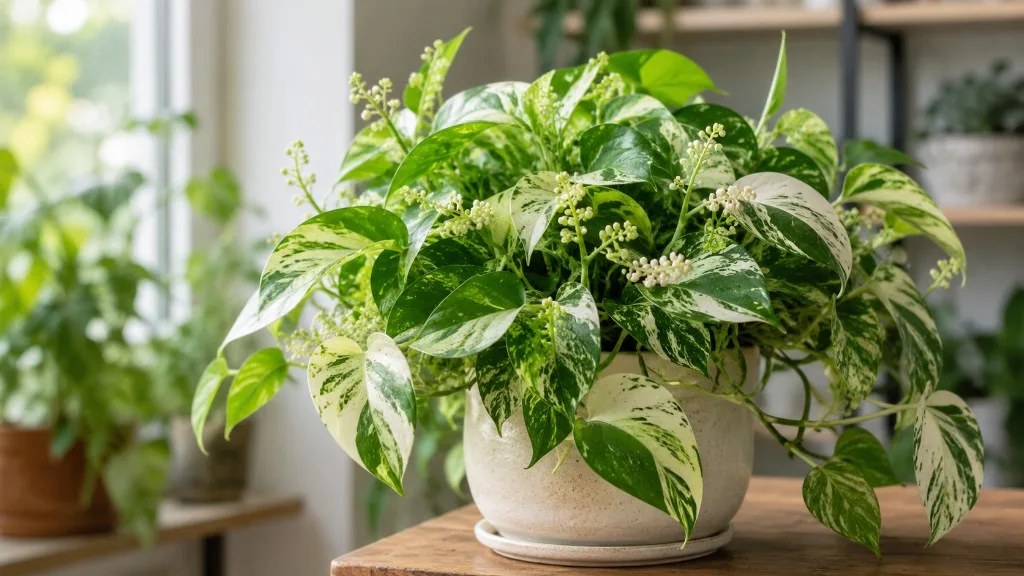
Pearls and Jade pothos looks effortless on Instagram - compact teardrop leaves splashed with green, silver-gray, and clean white. In a dim corner, the same plant quietly rewrites itself. New leaves arrive smaller, stems stretch, and the white Pearls fade until the pot reads as ordinary green pothos with a memory of variegation. That is not a watering failure or a fertilizer mystery. It is almost always a light budget problem, and Pearls and Jade spends its budget faster than the solid-green Golden pothos on the shelf below it.
Epipremnum aureum ‘Pearls and Jade’ is a University of Florida cultivar selected for dense, small-leaf variegation - light and dark green speckling plus large white sectors on thinner foliage than Marble Queen or Golden pothos. Clemson Cooperative Extension notes that this cultivar requires lots of light to maintain its intense coloring, while the species overall prefers bright, indirect light and may lose variegation in lower conditions. (Clemson HGIC) The practical target for home growers is bright indirect light for most of the day - strong ambient brightness without harsh direct rays landing on pale leaf tissue - with a fallback grow light when windows cannot deliver that consistently.
This guide covers the decisions that protect variegation: why Pearls and Jade is more light-hungry than Neon or Golden types, where to place the pot by window direction, what happens when white patches meet direct sun, how fast reversion shows up in low light, and how to read new growth as your diagnostic tool.
Why Pearls and Jade Needs More Light Than Solid-Green Pothos
Pothos evolved as an understory vine native to the Solomon Islands, climbing toward dappled canopy light. The species tolerates a wide exposure band - which is why Golden pothos survives office fluorescents and north windows that would starve a fiddle-leaf fig. Cultivar breeding pushed that tolerance in different directions. Neon pothos and Jessenia were selected partly for performance in moderate light. Pearls and Jade, Snow Queen, and Marble Queen were selected for white and cream display - pigments and absent chlorophyll that look stunning but do not photosynthesize.
Every variegated leaf is a compromise. Green tissue captures light energy; white and cream sectors reflect it and contribute little photosynthetic output. The plant must compensate by running green areas harder or by producing more green tissue in the next leaf. When total light is insufficient, compensation wins: new leaves emerge with more green and less white. That is reversion, and on Pearls and Jade it can move quickly enough to notice within a few leaf cycles in a dim room.
Pearls and Jade adds a second constraint: smaller, thinner leaves than many pothos cultivars. Less total leaf area means fewer photons captured per node even when the room feels bright to your eyes. The Spruce and multiple extension-style guides rank Pearls and Jade among pothos varieties that do not tolerate low light as well as Golden or Jade-green types and that need several hours of bright, indirect light daily to support variegated foliage. (Clemson HGIC - Pearls and Jade cultivar profile) Treat it as a display cultivar, not a low-light filler plant.
Smaller Leaves and White Sectors Have Less Working Chlorophyll
Think of each leaf as a solar panel array. On Golden pothos, most of the surface is green chlorophyll working at moderate efficiency. On Pearls and Jade, large white patches are effectively offline panels - beautiful, but not contributing energy. The speckled green zones must supply the whole leaf, and the plant’s meristem “notices” when the math stops working.
In bright, indirect light, the green sectors keep up. The plant can afford to keep producing white splashes on slow-to-moderate new growth. Drop below the usable threshold - often the case on interior bookshelves, hall tables far from glass, or north windows in winter - and the meristem prioritizes survival: more chlorophyll, tighter spacing of green, fewer white pearls. Older leaves may still show the old pattern for months; only new leaves tell you the current light is wrong.
Human eyes are poor light meters. A room that looks adequately bright to you may deliver far less photosynthetically active radiation (PAR) at leaf height than you assume, especially in the afternoon when your pupils adjust. Variegated pothos generally perform best when midday PPFD at the canopy sits roughly in the 180–300+ µmol/m²/s range for many hours, accumulating a daily light integral (DLI) high enough to support patterning - observational targets from variegated houseplant light studies, not a requirement to buy equipment. (RHS Epipremnum growing guide) If you are not measuring, use the new-leaf test instead: compact nodes, firm leaves, and stable white sectors on the newest foliage mean you are close enough.
The Ideal Light Range for Pearls and Jade Pothos
The phrase you will see on every credible care sheet is bright indirect light. For Pearls and Jade, translate that into behavior, not décor: the plant should see the sky for much of the day without sunbeams hitting leaves long enough to heat them. Several hours - commonly four to eight of strong indirect brightness - support healthy variegation indoors. Less than that for weeks, and reversion pressure builds. More, with unfiltered midday sun on white tissue, and photobleaching or crisp brown scorch follows.
Bright indirect sits between two failure zones. Low light produces etiolation - longer internodes, smaller leaves, pale green new growth, and progressive loss of white patterning. Harsh direct sun - especially afternoon rays through south or west glass - burns the white and cream sectors first because they lack protective pigment and overheat faster than green tissue. Clemson Extension lists leaf scorch from intense light alongside low humidity as a cause of tip dieback and damaged foliage on pothos. (Clemson HGIC) Pearls and Jade’s pale patches are the early warning system.
Season matters. Summer brightness at an east window may suffice while winter sun at the same spot may not. Re-evaluate after daylight saving shifts, tree leaf-out outside your window, or moving furniture. A placement that worked in June often fails in February without a grow light or a closer position to glass.
Bright Indirect Light in Plain Language
Use this field test if horticulture jargon feels abstract. Hold your hand 12 inches (30 cm) above the pot during the brightest part of the day. Bright indirect usually means a soft, diffuse shadow with recognizable shape - not a sharp dark shadow (too much direct sun), and not almost no shadow (too dim for Pearls and Jade). At the window itself, sheer white curtain should turn harsh beams into an even glow. If the white sectors on the top leaves feel warm to the touch at solar noon, pull the plant back or filter the glass.
For growers who like numbers without buying a PAR meter, a free lux meter app on your phone is imprecise but directional. Rough indoor targets at leaf height often land around 1,500–3,500 lux for bright indirect on variegated foliage - apps vary by phone, so treat numbers as comparison tools between spots in your home, not gospel. The spot that reads highest without direct sunbeams is usually your Pearls and Jade candidate.
Best Window Placement for Pearls and Jade
Window direction sets the daily shape of light: intensity, duration, and heat load on leaves. Pearls and Jade rewards placement that maximizes total usable brightness while keeping direct rays off white patches.
East and Filtered West Windows
An east-facing window is the safest default for many homes. Morning sun is lower in angle, cooler, and shorter in duration than afternoon sun. Pearls and Jade can often sit within one to three feet (30–90 cm) of east glass and receive excellent bright indirect light with only brief, gentler direct contact. If you see slight yellowing on white sectors facing the glass in summer, add a sheer curtain or move the pot six inches back.
A west-facing window is workable with filtration. Unfiltered west sun - especially late afternoon - is hot, low-angle, and notorious for scorching pale variegation within hours. Hang a sheer curtain, use light-filter film, or place the plant three to five feet (90–150 cm) back from the glass so it rides the bright ambient glow without taking the beam. West exposures excel in winter when the sun angle drops; watch spring and summer when intensity spikes.
South and North Exposures Compared
South-facing glass delivers the highest light totals in the Northern Hemisphere - excellent for variegation if you manage direct sun. Unfiltered south light frequently burns Pearls and Jade’s white sectors. Practical setups include: pot five to eight feet (1.5–2.4 m) back from the sill, sheer diffusion on the lower pane, or a spot on a side table that catches reflected light from the window wall without sitting in the beam. South rooms with white walls and light floors often have strong ambient brightness several feet inward - measure with the hand-shadow test before assuming the sill is the only option.
North-facing windows rarely supply enough intensity alone for Pearls and Jade to hold crisp variegation long term, especially in winter or when outdoor obstructions block sky view. The plant may survive - pothos as a species tolerates lower light - but expect gradual greening, smaller leaves, and leggy stems over months. If north is your only option, plan on a supplemental grow light rather than accepting slow reversion as normal.
Rotate the pot a quarter turn weekly once growth leans toward the glass. Even good light from one direction produces asymmetric vines; rotation keeps variegation display balanced on hanging baskets and shelf pots.
Direct Sun and White Patches - Burn Risk You Cannot Ignore
Can Pearls and Jade take any direct sun? Sometimes, with conditions - but harsh direct sun on white patches is the fastest way to permanent cosmetic damage. Green tissue may recover from mild stress; bleached or brown-crisp white sectors do not green back. You live with the scar until that leaf ages out.
Direct sun fails Pearls and Jade for three reasons. Intensity: white tissue reflects less usable light for photosynthesis but still absorbs enough heat to overheat. Duration: minutes of hot beam on a leaf through glass exceed what the same leaf would tolerate in outdoor shade. Acclimation: leaves formed in lower light lack the structural and pigment defenses of sun-hardened foliage. Moving a nursery pot from a shaded greenhouse bench to a south sill without transition is a common burn trigger.
Morning Sun vs Harsh Midday Rays
Not all direct sun is equal. Early morning sun - roughly the first one to two hours after sunrise at east or lightly filtered southeast exposures - is lower in UV and heat load. Some growers successfully give Pearls and Jade a short morning kiss of direct sun when leaves were formed in moderate light and the plant is well hydrated. That is an advanced placement, not the starting recommendation.
Midday and afternoon direct sun through clear glass is where damage happens. Symptoms show within hours to a few days: paper-thin white areas turn translucent, then tan or brown and crisp; leaf margins curl; sun-facing sides look bleached while shaded sides stay normal. If you see a sharp line between damaged and healthy tissue on a single leaf, suspect a sunbeam, not root rot on Pearls and Jade Pothos.
When burn occurs, move the plant immediately to bright indirect only - do not swing to deep shade, which trades one problem for reversion. Remove leaves that are more than half dead tissue if you want a cleaner look; they will not repair. Wait for new growth under safer light before judging recovery.
Low Light, Reversion, and Solid Green New Leaves
Low light is the primary long-term enemy of Pearls and Jade variegation. The plant may persist for months in a dim office or far interior shelf - pothos roots are forgiving - but the cultivar identity fades. Clemson Extension states plainly that lower light may cause variegated varieties to lose some of their coloring. (Clemson HGIC) On Pearls and Jade, “some” often reads as most of the white on new leaves.
Reversion is not a random mutation in the first weeks of dim care. It is predictable chlorophyll compensation. The plant needs more photosynthetic area; the meristem delivers green leaves. You may also see longer gaps between nodes (etiolation) as stems stretch toward the brightest vector in the room. Leaves may arrive smaller than older foliage because the plant lacks energy for full size. Together, these signs distinguish light starvation from overwatering, which yellows leaves with wet soil - though chronic low light and overwatering often coexist because dim plants use less water and pots stay soggy.
How Fast Variegation Fades in Dim Rooms
Timelines vary with how dim “dim” is, but watch the third and fourth new leaves after a bad placement. If white sectors shrink leaf by leaf, act before the vine produces fully green growth. Fully green stems are still Pearls and Jade genetically, but pruning is the main tool to re-establish variegated display after recovery - cut back to a node below the last well-variegated leaf once light improves, root the tip if you wish, and grow out fresh patterned foliage.
Low light also invites leggy-growth complaints covered on problem pages: bare lower stems, sparse leaves at the soil line, and a top-heavy hanger. Brighter light alone will not fill old bare stems; pairing improved light with pruning redirects energy to bushier new growth. Do not compensate with extra fertilizer in shade - without photons, feed cannot restore white patterning and may salt-stress a slow plant.
If you must keep Pearls and Jade in a marginal spot for aesthetics, accept green-forward foliage or choose Neon or Golden pothos for that location instead. Matching cultivar genetics to photon budget is easier than fighting biology.
Grow Lights When Natural Light Falls Short
When windows cannot hit bright indirect consistently - north rooms, winter at high latitude, office desks, or shelves more than eight feet (2.4 m) from glass - a full-spectrum LED grow light is the reliable fix for variegation stability. Pearls and Jade responds well to artificial light when intensity and photoperiod mimic a long bright day without leaf overheating.
Choose a full-spectrum or balanced white horticultural LED rather than a purely red-blue “blurple” panel unless that is what you already own; foliage color reads most naturally under broad spectrum. Position the fixture 12–24 inches (30–60 cm) above the canopy initially - exact distance depends on bulb wattage and beam angle. Run 12–14 hours daily on a timer to approximate a solid bright day; pothos does not need a short-day treatment indoors.
Watch leaf temperature and color during the first week. Leaves curling upward at midday under the lamp, or white sectors browning at the center, mean move up or dim down. Dark green glossy leaves with short internodes and stable white patterning on new growth mean hold steady. Grow lights also help in south rooms where you must pull the plant far from scorching window glass but still need DLI for variegation - the lamp supplies photons without the heat spike of direct beams.
Fixture Distance, Hours, and When to Upgrade
Start conservative and adjust by new growth, not old leaf color. If new leaves are compact and variegated at 18 inches (45 cm) for 12 hours, you found the working setting. If stems stretch toward the bulb, lower it slightly or extend duration by an hour - not both at once. If white patches brown, raise the fixture two to four inches (5–10 cm) and re-evaluate in ten days.
Small desktop clip lights can maintain a single pot on a work desk. Hanging basket setups may need a wider panel or a floor lamp with an adjustable neck aimed at the canopy, not the floor. Upgrade when the illuminated footprint no longer covers the whole trailing mass - lower leaves in shade on a dense hanger will revert while top leaves stay pretty.
Link grow-light adoption to watering checks: brighter light from any source increases transpiration and dry-down speed. A plant that suddenly needs water twice as often after adding a lamp is normal; a plant that stays wet for weeks in new light suggests the lamp is still too weak or too far.
Pearls and Jade vs Marble Queen, Golden, and Neon
Placement mistakes often come from assuming all pothos share one light rule. They do not. Cultivar selection is a light decision.
Golden pothos and Neon pothos tolerate lower light and remain acceptable houseplants in moderate indoor conditions. Neon may lose some lime intensity in shade but rarely “break” the way white-variegated types do. Jessenia similarly handles less light than Pearls and Jade.
Marble Queen, Snow Queen, and Manjula sit in the same high-light variegated camp as Pearls and Jade. Marble Queen leaves are larger and can capture more light per leaf; Snow Queen runs even whiter and is more burn-prone in direct sun. Manjula shares Pearls and Jade’s coloring family but grows more upright and slowly - it still needs bright indirect, not a dim corner. If Golden pothos thrives on your north desk but Pearls and Jade greens out there, that is expected genetics, not a “bad” plant.
Use this comparison when shopping: if your brightest spot is a filtered east window or a desk with a grow light, Pearls and Jade belongs on the roster. If your only available surface is a ** bathroom or hallway** with a small skylight, a solid-green cultivar will look better longer.
Reading Warning Signs on New Growth
Old leaves carry history; new leaves carry the current verdict. Judge Pearls and Jade light by the newest fully unfurled leaf and the internode above it, not by damaged foliage from a past placement or shipping stress.
Give any change 10 to 14 days before declaring failure, unless acute sunburn spreads. Pothos adjusts on a leaf-by-leaf timeline - roughly one to three weeks per node in moderate growth - so panic Pearls and Jade Pothos repotting guide or fertilizing after four days in a new window obscures the signal.
Too Little Light - Leggy Vines and Smaller Leaves
Under-lighting symptoms stack predictably:
- Longer stem gaps between leaves; the plant leans toward the brightest direction
- Smaller new leaves compared to older foliage formed in better light
- Reduced white patterning; green dominates new speckling
- Fully green new leaves after several nodes - reversion in progress
- Slower dry-down and softer stems from reduced transpiration
- Yellowing lower leaves if overwatering continues on a slow plant
Fix path: move to brighter indirect in one step if the jump is moderate, or acclimate in stages if jumping from deep shade to strong south ambient. Prune reverted tips after light improves so variegated lateral buds can break.
Too Much Light - Bleached White, Brown Crisp Spots
Over-lighting and sunburn symptoms differ:
- Translucent or papery white patches turning tan, then crisp brown
- Bleached, faded appearance on sun-facing leaf surfaces while the shaded half looks normal
- Leaf curl or cupping during the brightest hours
- Sudden damage within days of a window move - timing implicates sun, not chronic root issues
- Dry brown tips combined with low humidity and intense light - double stress common on heat registers near sunny sills
Fix path: remove from direct beams immediately; use sheer filter or increase distance; maintain bright indirect so the plant does not slide into reversion. Trim severely damaged leaves if unsightly. Do not mist burned white tissue as “first aid” - focus on placement.
Moving and Acclimating to Brighter Light Safely
Sudden jumps in exposure shock Pearls and Jade like any pothos, but white sectors burn faster than green ones during acclimation. Whether you are rescuing a reverted plant from a dim shop or upgrading a healthy one to a brighter east window, gradual change preserves both variegation and leaf integrity.
Step one: Identify the target bright indirect spot using the hand-shadow test, not eye guesswork. Step two: Move the plant closer over 7 to 14 days - for example, from five feet to three feet to one foot from east glass, or from no curtain to sheer-filtered south ambient. Step three: Watch new leaves only during the transition; expect older leaves to look unchanged. Step four: Change one variable at a time - light first, then Pearls and Jade Pothos watering guide if dry-down shifts, then feed only if growth is clearly active.
If the plant arrived from a low-light retail display, assume leaves are not sun-hardened. Even an east window can burn on day one if the plant sits touching glass at noon. Start three feet back and walk in. For hanging baskets, remember the top leaves receive more light than trailing tips - rotate and check both zones.
Winter moves deserve caution: cold glass plus leaf contact causes chill damage separate from light issues. Keep foliage from pressing cold panes when pulling pots closer for brightness.
Light and watering move together. Brighter placement shortens the dry-down window; dimmer placement extends it. A Pearls and Jade that suddenly wilts after a light upgrade may simply need earlier watering, not less light - check the mix before reacting.
Conclusion
Pearls and Jade pothos rewards one placement principle above the rest: bright indirect light stable enough to hold white variegation on new leaves, without harsh direct sun that destroys pale sectors permanently. It is a more light-demanding cultivar than Golden or Neon pothos because white and cream patches carry less chlorophyll and because its smaller leaves capture fewer total photons. East windows and filtered bright south or west exposures are the usual winners; north windows alone or deep interior shelves push reversion unless you add a grow light.
Protect variegation by reading new growth - compact nodes, firm leaves, and consistent white patterning mean the current setup works. Leggy stems and green-only new leaves mean brighten; bleached or crisp white patches mean soften and filter. Move light gradually over one to two weeks, adjust watering when dry-down changes, and prune reverted tips only after conditions improve. Match the cultivar to the photon budget you actually have, and Pearls and Jade stays the speckled, pearlescent plant you bought - not a plain green pothos wearing an old disguise.
When to use this page vs other Pearls and Jade Pothos guides
- Pearls and Jade Pothos overview - Start here for whole-plant context before deep-diving this topic.
- Pearls and Jade Pothos problems hub - Jump to symptom-specific fix guides when this care topic does not resolve the issue.
- Leggy Growth on Pearls and Jade Pothos - Escalate here when light adjustments are not enough.
Related Pearls and Jade Pothos guides
- Pearls and Jade Pothos overview
- Pearls and Jade Pothos watering
- Pearls and Jade Pothos soil
- Pearls and Jade Pothos propagation
- Pearls and Jade Pothos fertilizer
- Pearls and Jade Pothos repotting
- Leggy Growth on Pearls and Jade Pothos
- Pearls and Jade Pothos problems
Related tool
Try the Plant Problem Diagnosis Tool with pearls-and-jade-pothos pre-selected to estimate needs for your setup.