Wind Damage on Lemongrass: Causes, Checks & Fixes
Quick answer
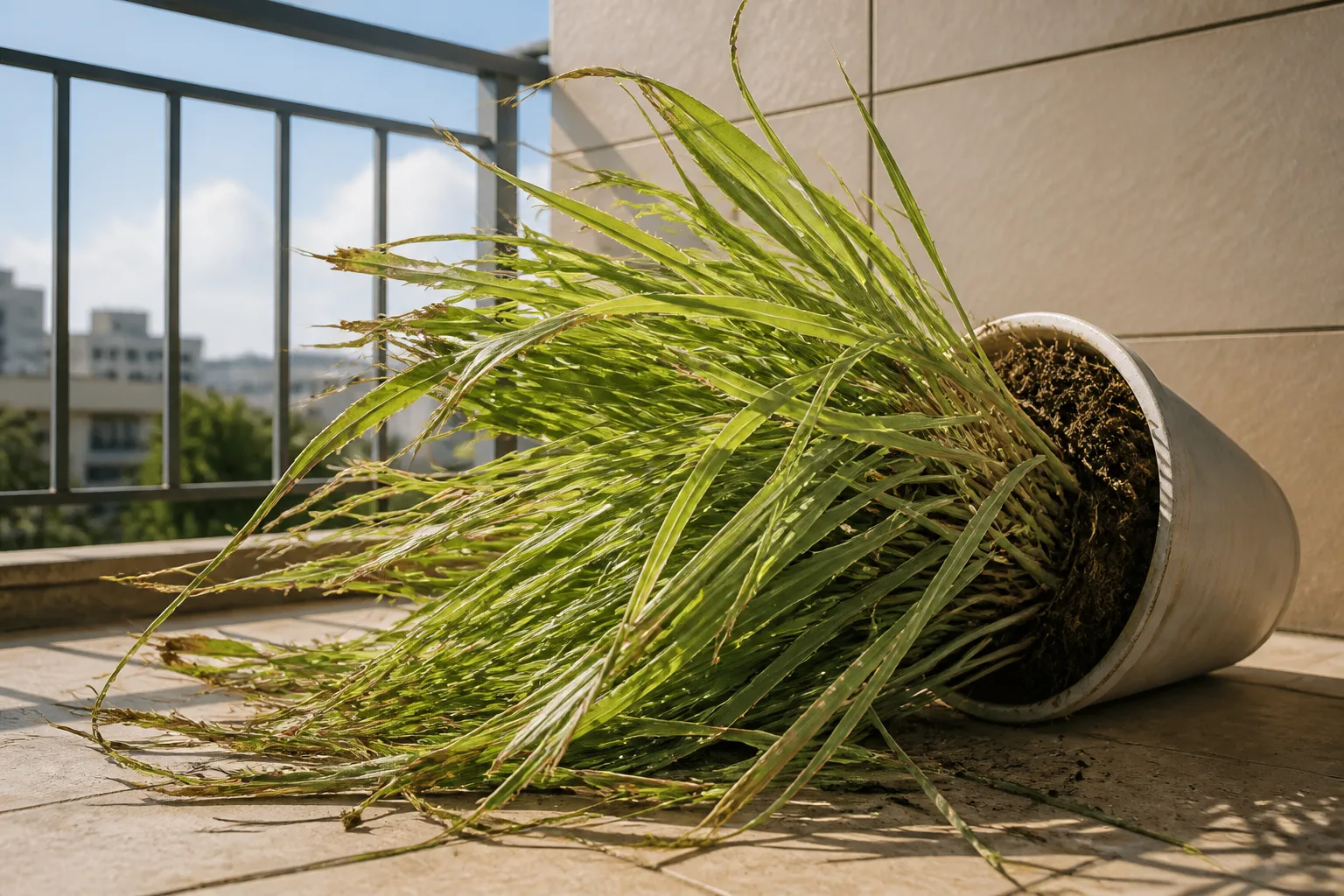
Wind damage on lemongrass shreds blade tips, flattens tall clumps, or blows over lightweight pots on exposed patios-plastic nursery pots on balcony rails are the most common failure point. First step: Move the pot to leeward shelter, right it immediately, and trim torn blades at the base-then stabilize with a heavier wide container or ring stake before the next gust.
Wind Damage on Lemongrass: Causes, Checks & Fixes
This guide covers wind damage on Lemongrass. See also the general Wind Damage guide, watering, and light pages for this plant.
Wind Damage on Lemongrass: Causes, Checks & Fixes
Quick answer
Wind damage on lemongrass (Cymbopogon citratus) shreds blade tips, flattens tall clumps, or blows over lightweight pots on exposed patios and balcony rails. Plastic nursery pots on open railings are the most common failure point-tall blade sails meet shallow fibrous roots in a narrow soil ball.
First step: move the pot to leeward shelter, right it immediately, and trim torn blades at the base-then stabilize with a heavier wide container or ring stake before the next gust.
Lemongrass is a clumping tropical grass with long arching strap-like blades that can reach 3 feet (90 cm) on mature outdoor clumps. Those blades catch wind like sails. In-ground plantings anchor through spreading fibrous roots, but container clumps on open terraces tip easily when top-heavy after summer growth or one-sided harvest.
Wind damage vs. cold damage and other lookalikes on Lemongrass
This page covers mechanical wind injury-shredded blades, tipped pots, and wind-driven desiccation after gust events. It is not a full guide to every wilt or browning pattern on lemongrass.
| Pattern | Leading cause | This page vs. sibling guide |
|---|---|---|
| Ragged windward blade tips, one-direction flattening, tipped pot after gusts | Wind mechanical injury | Start here - right pot, leeward shelter, trim |
| Uniform overnight limp or water-soaked blades after frost | Cold damage | See cold damage on lemongrass - no pot tipping required |
| Mushy stalk bases, sour soil, wilt despite moisture | Root rot | See root rot on lemongrass - not mechanical tearing |
| Slow one-direction lean over weeks toward a window | Light-seeking stretch | See plant leaning on lemongrass - no storm timing |
| Gradual crisp tips on all sides without storm or pot movement | Underwatering | See underwatering on lemongrass |
| Bleached crisp patches on sun-facing blades without tearing | Heat scorch | See heat stress on lemongrass |
Winter storms can deliver wind and cold on the same night. If blades tore on one side and the pot tipped, treat wind stabilization first; if blades went uniformly limp after a freeze with no mechanical shred, start with the cold damage guide.
What wind damage looks like on Lemongrass
Mechanical wind injury shows up differently from drought, disease, or frost:
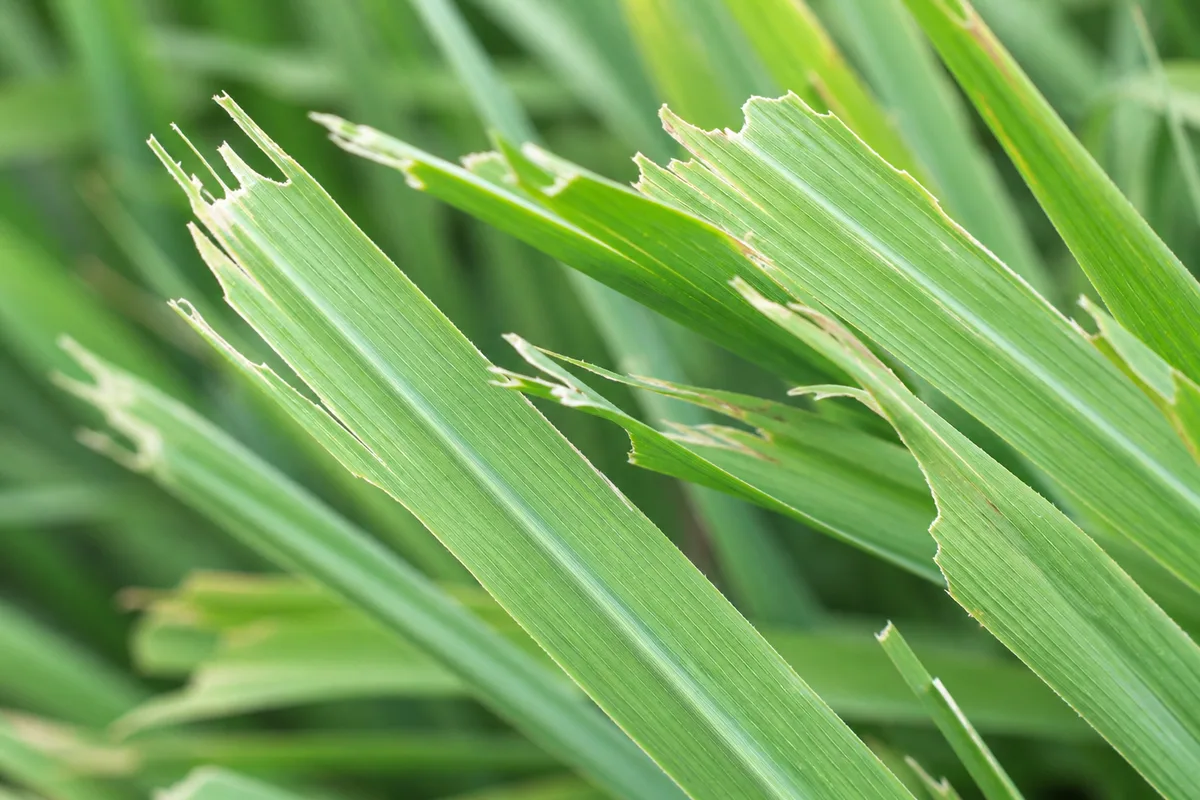
Wind Damage symptoms on Lemongrass - compare with healthy tissue on the same plant.
Shredded blades, tipped pots, and desiccation after gusts
- Shredded or torn blade tips - Ragged edges and split leaf margins after gusts, often on the windward side only.
- One-direction flattening - The whole clump leans or lies flat toward the prevailing wind after a storm.
- Tipped or rolled pots - Lightweight plastic containers on railings end up on their side with soil exposed at the lift edge.
- Partial root lift - Crown still attached but roots pulled slightly away from the container wall at the soil surface.
- Snapped outer stalks - Tall mature blades break near the base while inner shoots stay upright.
- Desiccation on windy dry days - Crisp brown tips on blades that were firm before a hot, gusty afternoon-not the same as underwatering alone, but wind accelerates moisture loss through long leaf surfaces.
What wind damage is not: circular leaf spots, uniform overnight blackening after frost, sticky residue from pests, or yellowing from soggy soil without a recent storm event.
Why Lemongrass gets wind damage
Lemongrass evolved as a dense clumping grass in warm humid climates. Wisconsin Horticulture notes plants grow in dense clumps with long strap-like leaves that arch and droop at the tips-excellent for movement in a breeze, but dangerous on a top-heavy balcony pot.
Tall blade canopy as a sail
Fast summer growth in full sun produces a wide blade mass. UF/IFAS recommends full sunlight and regular moisture during active season, which builds height quickly. Uneven harvest on one side makes the clump asymmetric and easier to tip-even harvest from all sides before storm season reduces sail imbalance.
Lightweight or narrow containers
Fibrous grass roots spread horizontally rather than deep. A tall narrow pot holds less soil ballast and tips where a wide shallow tub stays planted. Plastic nursery pots on windy rooftops are the most common failure point. NC State Extension notes windy rooftop sites need heavier potting mixes with greater bulk density to resist container blow-over.
Exposed placement and recent repotting
Corner balconies, open deck rails, and rooftop edges without windbreaks channel gusts. Lemongrass tolerates normal garden breezes in ground beds; elevated containers face much higher effective wind speed.
Supermarket stalks newly potted, or spring divisions with long leaves and minimal root mass, lack anchorage until roots fill the mix. The root-to-canopy ratio is wrong for the first windy week after repotting-tall blades act as sails while roots have barely left the stalk base. See repotting and propagation for safer timing and pot sizing.
Dry gusty heat
Wind strips moisture from long blades faster than calm hot weather. Soil can read moist while blades crisp at the tips-a combined wind and desiccation pattern common on exposed summer patios.
Container vs in-ground wind risk
In-ground lemongrass in warm zones spreads fibrous roots horizontally through garden soil. The crown sits low; surrounding earth and neighboring plants buffer gusts. Normal garden breezes rarely shred mature clumps unless exposed on an open hillside.
Container lemongrass concentrates the entire root ball in a few liters of mix. The pot becomes a lever: wind pushes the blade sail, the narrow soil column rocks, and lightweight plastic lifts or rolls. Blow-over risk rises on balcony rails where wind swirls between buildings and no soil rim anchors the container.
If you grow both, treat pots as the high-risk group-heavier bases, leeward corners, and ring stakes-not the in-ground bed.
How to confirm the cause
- Storm timing - Did damage appear within hours of known high winds or after moving the pot to an exposed rail?
- Direction pattern - Is tearing or flattening mostly on one side consistent with prevailing gusts?
- Pot evidence - Was the container on its side, shifted in the saucer, or missing from the rail entirely?
- Crown firmness - Press stalk bases at soil level. Firm green tissue supports wind diagnosis; soft mushy bases with sour smell suggest root rot unrelated to wind.
- Soil moisture - Dry blow-over soil needs water; soggy soil with collapse suggests a different problem.
- Pest and disease scan - No spots, mildew coating, or insect clusters should be visible if pure mechanical injury.
If only one plant on an exposed rail shows ragged blades while sheltered neighbors look fine, wind is the leading cause.
First fix for Lemongrass
Right the pot and move it to leeward shelter the same day. Leeward means the side sheltered from the prevailing wind-behind a wall, corner, larger planter, or interior balcony rail-not a permanently shaded room.
Steps in order:
- Lift the container upright and check that the crown sits at the original soil level.
- Gently firm soil back around any lifted root edge; do not bury the crown deeper.
- Move to a protected spot that still receives full sun for most of the day-wind shelter is not the same as shade relocation.
- Water thoroughly if the mix dried during blow-over; skip feeding until new growth looks stable.
- Trim fully shredded outer blades at the base with clean shears. Partial tip tears can wait until you harvest.
Do not repot on day one unless the root ball separated completely from the container. Stability and water come first.
Step-by-step recovery
- Stabilize the container - Shift to a heavier wide pot if tipping repeats, or add a pot ring stake around the outside of the container rather than piercing edible stalk bases.
- Trim mechanical damage - Remove blades torn more than halfway; leave firm green tissue that can still photosynthesize. Follow normal pruning hygiene-clean shears, cut at the base.
- Hold fertilizer - Wait until upright new center shoots appear, usually one to two weeks in warm sun.
- Even out harvest - On the next cut, take stalks from all sides so canopy weight balances.
- Monitor moisture - Windy exposed sites dry pots faster; check the top 3–4 cm and water when dry without keeping roots soggy. See the watering guide for active-season rhythm.
- Divide if the clump is oversized - Spring division into smaller sections reduces sail area per pot and improves anchorage in each container.
Recovery timeline
Minor tip shredding on a stable pot: new upright blades within 7–14 days in warm full sun.
Tipped pot with firm crown and partial root lift: stabilization shows within a few days; full symmetry returns after the next balanced harvest cycle.
Snapped outer stalks with firm base: inner shoots fill gaps within two to three weeks.
Completely uprooted dry clump: recovery depends on same-day repotting and water-delay beyond 24 hours in hot sun sharply reduces survival as exposed roots desiccate.
Torn blade tissue does not heal in place; recovery means new shoots from the crown, not re-greening shredded tips.
Lookalike symptoms
- Cold damage - Uniform overnight limp blades after frost, not ragged tearing after wind.
- Underwatering - Gradual crisp tips on all sides without storm timing or pot tipping.
- Root rot - Mushy stalk bases, sour soil, wilt despite moisture-no mechanical shred pattern.
- Plant leaning - Slow directional stretch toward a window over weeks, not sudden post-storm flattening.
- Heat stress - Bleached or crisp patches on sun-facing blades without tearing or pot movement.
Causes to rule out
- Disease - Spots, blight margins, or mildew powder; wind tears are irregular and mechanical.
- Pest shredding - Caterpillar chew shows bite margins and frass; wind splits run with blade grain.
- Chemical drift - Bleached patterns after spraying, not weather-linked.
What not to do
Do not leave a tipped pot with exposed roots baking in afternoon sun without water. Do not move wind-beaten lemongrass into deep shade to “rest”-it needs bright light to regrow. Do not fertilize stressed clumps immediately after blow-over. Do not assume the whole plant is dead when only outer blades shredded; check firm crown tissue first. Do not use narrow tall tower pots on windy decks if tipping repeats. Do not pierce edible stalk bases with stakes-use a ring around the pot exterior.
How to prevent wind damage
- Choose wide, heavy pots - Terracotta or glazed ceramic outweighs plastic; wider bases lower the center of gravity. Aim for at least 30 cm (12 in) diameter on mature balcony clumps; a filled wide pot with moist mix often weighs 15–20 kg (33–44 lb) .
- Shelter placement - Position containers in leeward corners, behind railings, or clustered with heavier neighbors. NC State recommends heavier mixes on windy rooftops to reduce blow-down.
- Reduce sail area before storm season - Harvest tall outer stalks on exposed sites when high-wind days are forecast.
- Stake after division - Use a loose ring around the pot for the first two weeks after spring divide, not stakes through stalks you plan to eat.
- Match pot size to clump - Repot before roots circle and top growth far exceeds container width; repeated tipping may signal root-bound stress.
- Keep full sun once stable - Lemongrass grows best in full sun with moist well-drained soil; protection means blocking wind, not sacrificing light long term.
When to worry
Escalate when the crown uproots completely and roots dry out, when repeated tipping exposes more root mass each event, or when stalk bases soften after blow-over on wet soil-those patterns suggest rot compounding mechanical stress. A firm crown with only outer blade damage will regrow.
Pots that blow off high balconies are a safety issue as well as a plant issue; relocate before the next storm. If your building restricts pot weight on rails, ask management about load limits-falling containers are a serious hazard on high-rise decks.
Lemongrass care cross-check
Wind prevention fits normal lemongrass culture: full sun, consistently moist active-season watering, and repot or divide before clumps become top-heavy relative to the container. Treat torn blades like a harvest trim rather than a reason to change watering, light, or feeding routines all at once. For species context and seasonal rhythm, see the lemongrass overview.
Related lemongrass guides
- Lemongrass overview - Sun, water, and container culture hub
- Lemongrass repotting - Wider pots and division after repeated tipping
- Lemongrass pruning - Balanced harvest to reduce sail asymmetry
- Cold damage on lemongrass - Frost limp vs. wind shred after winter storms
- Root rot on lemongrass - Mushy crowns after blow-over on wet soil
- Plant leaning on lemongrass - Slow light-seeking lean without storm timing
- Root-bound lemongrass - When top-heavy clumps outgrow narrow pots
- Heat stress on lemongrass - Calm hot-day scorch vs. gust-driven tearing
Conclusion
Wind damage on lemongrass is mechanical, not mysterious-confirm by storm timing and one-sided tearing, right the pot immediately, shelter from gusts without losing sun, and judge recovery by firm new center shoots. Heavy wide pots and leeward placement prevent most balcony blow-overs. For frost limp after the same storm, wet-soil rot after tip-over, or slow lean without gusts, use the sibling guides above so this page stays focused on wind-driven mechanical injury.