Root Bound Lemongrass: Causes, Checks & Fixes
Quick answer
Root-bound lemongrass shows circling roots, water running straight through the pot, and thin pale new shoots despite regular feeding. First step: tip the clump out, divide it into sections with roots attached, and repot into fresh well-draining mix in wide containers-not just a slightly larger pot.
Root Bound Lemongrass: Causes, Checks & Fixes
This guide covers root bound on Lemongrass. See also the general Root Bound guide, watering, and light pages for this plant.
Root Bound Lemongrass: Causes, Checks & Fixes
Quick answer
Root-bound lemongrass fills its pot with a dense mat of fibrous roots, dries out unusually fast after watering, and pushes thin pale tillers instead of thick harvestable stalks. The clump may look full on top while the center thins and water runs through without soaking in.
First step: tip the clump out, divide it into sections with healthy roots attached, and repot into fresh well-draining mix in wide containers. Do not simply move the whole congested mass into a slightly larger pot-that leaves the root pancake intact and often creates a wet outer ring around a dry, unusable core.
Why lemongrass becomes root bound
Lemongrass (Cymbopogon citratus) is a fast-growing clumping grass that spreads by tillers and rhizomes at the base. In warm sun with regular moisture, a single division can expand dramatically through one growing season. That vigor is an asset in the garden but a liability in pots that are too small or left unchanged for too long.
The root system matches the clump habit. Lemongrass forms a dense clump of narrow foliage from bulbous shoot bases with fibrous roots that circle pot walls quickly rather than forming a deep taproot. Those roots consume both space and nutrients in the mix. A 3-liter starter pot that looked generous in spring can become a solid root cylinder by late summer if the plant sits in Lemongrass light guide and receives steady water and fertilizer.
Container growers often underestimate how fast this happens because the foliage still looks green. Lemongrass is harvested from the outside of the clump, so outer stalks may stay usable while the interior root mass suffocates. Same pot year after year, aggressive summer feeding without division, and choosing tall narrow containers for a grass that prefers width all accelerate binding.
Indoor or overwintered plants bind more slowly in cool dim conditions but still exhaust mix within one to two years. Old peat-based soil collapses, loses air pockets, and holds water unevenly-symptoms overlap with binding but the fix is still division and fresh mix, not more fertilizer on depleted soil.
What root bound looks like on lemongrass
Above-ground signs:
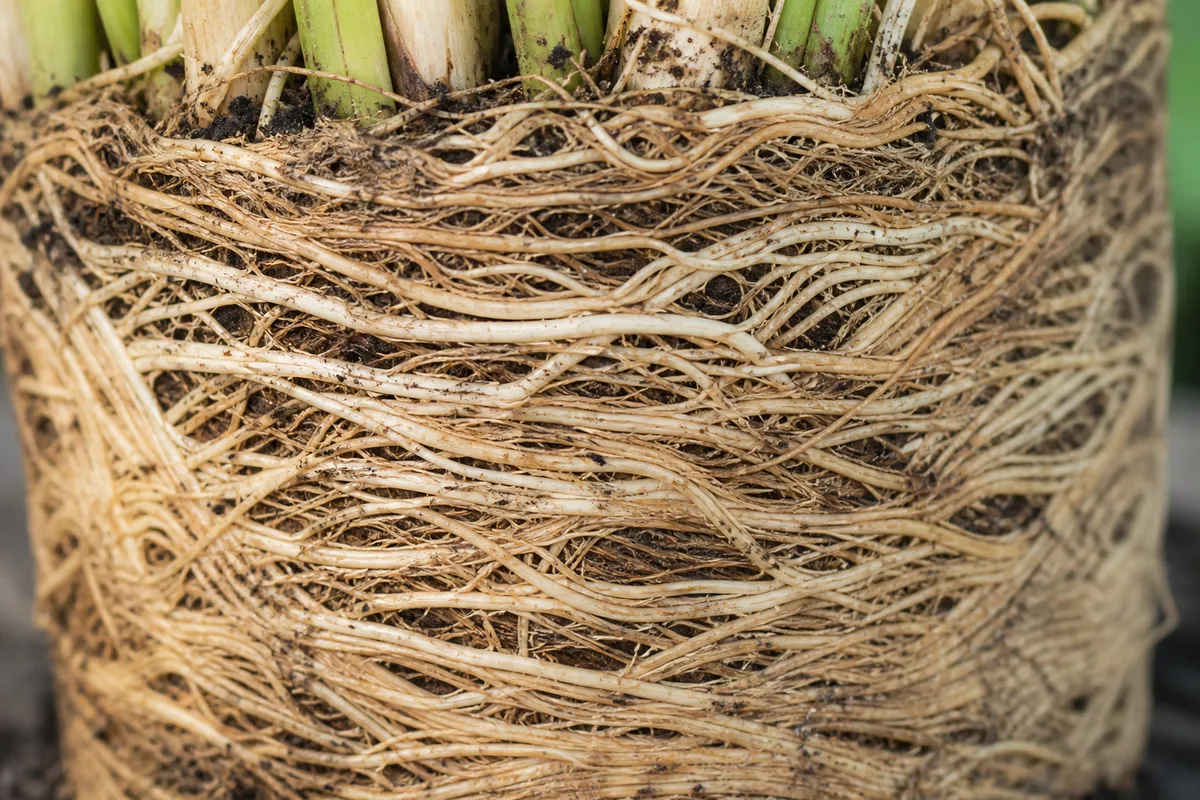
Root Bound symptoms on Lemongrass - compare with healthy tissue on the same plant.
- New tillers stay thin, pale, and floppy compared with earlier growth
- Outer stalks harvest fine while the clump center looks sparse or empty
- Blades wilt soon after watering even when surface soil feels moist
- Pot dries out within hours of a full soak in hot weather
- Clump becomes top-heavy; pot tips easily in wind
- Plastic pot walls bulge, crack, or lift slightly from root pressure
- Growth stalls in warm sun despite regular feeding
Below-ground signs (visible when tipped out):
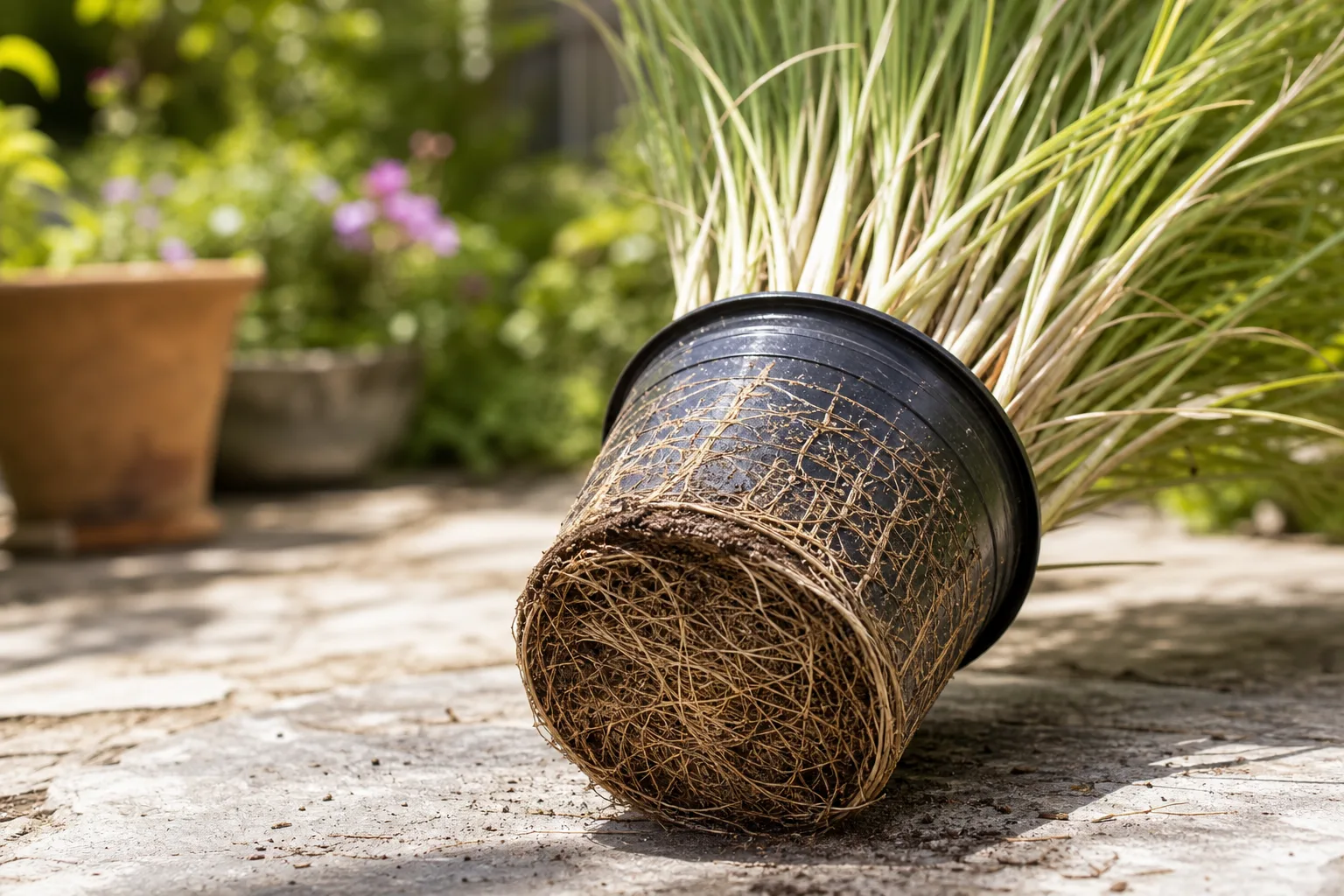
- White or tan roots wrapped tightly around the root ball perimeter
- Minimal loose mix left; root mat holds the shape of the old pot
- Roots emerging from drain holes or over the rim
- Water channels through dry gaps in the root mass when you irrigate
- In advanced cases, brown mushy sections at the center if the mat stayed wet too long-check texture before assuming pure binding
Root-bound lemongrass rarely shows the sour smell of rot unless the congested core has stayed soggy. Firm circling roots with fast dry-down point to space exhaustion; black mush and odor point to a different problem.
How to confirm the cause
Work through these checks before you divide:
- Pot-to-clump ratio - Measure whether foliage spread exceeds pot width by a wide margin. A clump 60 cm across in a 25 cm pot is a binding risk regardless of leaf color.
- Water behavior - Water thoroughly and watch absorption. If water runs out in seconds and the pot feels light again within half a day in summer, roots likely dominate the volume. If mix stays wet for days, suspect compaction or overwatering on Lemongrass instead.
- Partial lift test - Gently slide the clump out 5–10 cm. Circling roots at the wall confirm binding without full Lemongrass repotting guide drama.
- Root texture - Healthy binding roots are firm and white to tan. Mushy black roots with sour smell indicate rot; treat that separately before or during division.
- Growth pattern - Compare newest tillers to stalks from last season. Uniform thinness across the clump in full sun suggests root limitation. Patchy yellowing with wet soil may implicate rot or nitrogen issues.
- Season and care history - Binding builds over months in the same container. Sudden wilt after a recent repot suggests transplant shock, not binding.
If two or more binding signs appear and roots look firm, proceed with division. If roots are mostly mush, address rot first-trim damaged tissue, discard sour mix, and repot into aerated fresh soil.
First fix for lemongrass
Divide the clump into sections with roots attached, then repot each section into fresh well-draining mix in a wide container one size appropriate to that section’s root mass.
This is the correct first response for confirmed root-bound lemongrass-not foliar fertilizer, not a deep watering binge, and not sliding the entire root pancake into a pot two sizes larger.
Division restores usable soil volume, breaks circling roots, and matches lemongrass’s natural maintenance cycle. Mature clumps are routinely split for propagation and renewal; each section with several stalks and a healthy root mass can become an independent plant.
Water the clump thoroughly the day before dividing so crowns are hydrated and roots flex instead of snapping. Work in spring or early summer when temperatures support rapid regrowth. Hold fertilizer for the first two to three weeks after repotting while new feeder roots establish.
Step-by-step recovery
Prepare materials
Use wide pots with multiple drain holes-lemongrass roots spread horizontally. A mix rich in organic matter with perlite or coarse sand for drainage suits Lemongrass overview: moisture-retaining but never waterlogged during active growth. Have a sharp knife or spade, clean scissors, and a tarp or table for messy division work.
Divide the clump
- Tip the plant out and brush away loose surface debris.
- Identify natural seams where tillers separate at the base.
- Cut or pull the mass into sections with at least three to five healthy stalks and attached roots each. Sections too small often stall.
- Trim circling outer roots lightly-remove only coiled mats that cannot spread, not the entire root system.
- Cut foliage back to roughly 15–25 cm to reduce water loss while roots recover.
- Discard or compost the woody, unproductive center if it has no firm roots or new shoots.
Repot each division
- Place fresh mix in the new pot and position the section at the same depth it grew before.
- Fill around roots and firm gently-do not pack mix into a brick.
- Water once until drain runs clear, then place in bright indirect light for seven to ten days before returning to full sun.
- Resume watering when the top 3–4 cm of mix dries during active growth.
- Wait two to three weeks before feeding; then use a balanced liquid fertilizer at half strength if new tillers appear.
Optional: refresh without upsizing
If the root ball still fits comfortably but mix is exhausted, you can remove the clump, trim circling roots, shake off old soil, and return to the same clean pot with all-new mix. That is still a valid fix when binding is moderate rather than severe.
Recovery timeline
Under warm conditions-roughly 20°C and above-with good light, new tillers often emerge at the clump edge within one to two weeks. Stalk thickness improves over the next three to four weeks as feeder roots colonize fresh mix.
Mild droop for several days after division is normal. Persistent wilt beyond two weeks with wet mix suggests rot in a section, a division too small to support itself, or repotting during cold weather when root activity is slow.
Judge success by new shoot thickness and stable Lemongrass watering guide, not by how quickly old outer leaves green up. Lemongrass is grown for harvest; replace weak center growth rather than nursing woody stems indefinitely.
Hold heavy harvest for at least two weeks after division so the plant can allocate energy to roots. Light trimming of outer stalks is fine if the section still has plenty of leaf area.
Lookalike symptoms
underwatering on Lemongrass - Pot feels light, mix is dry throughout including the center, and roots are white and firm when you check. Rehydrate on schedule; no division needed unless binding is also present.
Overwatering and root rot on Lemongrass - Mix stays wet for days, base stalks turn mushy, roots are brown or black with sour smell. Reduce water, trim rot, repot into fresh aerated mix. Rot can follow long-term binding when water channels around a dense mat and the core stays soggy.
Insufficient light - Thin pale tillers in dim winter windows without fast dry-down or circling roots. Move to full sun; division does not fix low light.
Nutrient deficiency - Yellowing across older leaves with reasonable root space and normal water behavior. Confirm roots first; feed only after the root zone is healthy and the plant is actively growing.
Transplant shock - Wilt and paused growth immediately after a recent repot without prior binding signs. Stabilize light and moisture; avoid re-dividing for several months.
Mistakes to avoid
- Upsizing without dividing - A huge pot around an intact root pancake stays wet at the edges while the center remains impenetrable, inviting rot-most container plants prefer moist, not soggy, soil.
- Top-dressing only - Fresh mix on the surface does not break a circling root mat below.
- Dividing dry crowns - Water the day before; dry grass snaps and loses roots.
- Sections too small - Single-stalk divisions often fail to re-establish.
- Immediate full sun after repot - Acclimate for a week to reduce transpiration stress.
- Fertilizing on day one - Stressed roots cannot use nutrients; wait until new growth appears.
- Pulling apart aggressively by hand - Use a knife along natural seams to preserve roots.
- Ignoring mush at the center - Trim rot before repotting; binding and rot can coexist.
Lemongrass care cross-check
Root binding is a container problem, but recovery depends on the rest of the routine:
- Light - Full sun drives the growth that fills pots quickly; weak light slows recovery after division.
- Water - Consistently moist mix during active growth, never bone dry at root level for long stretches. After repotting, let the top few centimeters dry between sessions rather than keeping sodden mix.
- Temperature - Growth stalls below roughly 13°C (55°F); division recovery stretches in cool rooms.
- Harvest habit - Regular outer stalk removal manages clump size and delays re-binding.
- Pet safety - Lemongrass is toxic to cats and dogs; wear gloves if sap irritates skin and keep divided sections out of pet reach during recovery.
If you correct binding but leave the plant in deep shade or chronically wet mix, thin tillers will return for different reasons.
How to prevent root bound next time
Plan division or full repot every one to two years in spring, before summer heat pushes maximum growth. Match pot width to clump spread-wide shallow containers suit fibrous grass roots better than tall narrow ones.
Refresh mix when water runs through too fast or stays wet too long, even if foliage looks acceptable. Harvest aggressively during the growing season to limit clump diameter. Start grocery-store stalks in appropriately sized pots rather than leaving a fast grower in a temporary small container for a full year.
Watch drain holes and lifting tests in late summer; binding that develops during one hot season is easier to fix in early spring than during winter dormancy indoors.
When to worry
Escalate promptly if:
- Blades yellow widely while surface soil stays wet and roots at the center are mushy-rot may exceed what division alone fixes
- The pot has cracked and crowns desiccate between superficial waterings
- No new tillers appear four weeks after division in warm sun with proper moisture
- Entire sections collapse with foul-smelling roots-discard failed divisions rather than re-watering repeatedly
Lemongrass is resilient when some firm roots and several stalks remain. A completely rotted base with no firm roots is better replaced from a healthy division or fresh rooted stalk than nursed indefinitely.
Conclusion
Root-bound lemongrass outgrows containers faster than many culinary herbs because it is a sun-loving clumping grass with shallow, aggressive roots. Thin tillers, fast dry-down, and circling roots at drain holes are the practical tells. Divide the clump, repot into fresh well-draining mix in wide pots, acclimate briefly, and judge recovery by thick new shoots-not by saving every old stem. Plan spring division every year or two and the harvest quality stays high without emergency repots mid-season.
When to use this page vs other Lemongrass guides
- Lemongrass watering guide - Use for routine moisture checks before assuming root bound is the main issue.
- Lemongrass problems hub - Browse all 52 common issues on this species.