Downy Mildew on Lemongrass: Causes, Checks & Fixes
Quick answer
Downy mildew on lemongrass (*Cymbopogon citratus*) shows yellowing blades with gray or purple fuzzy growth underneath in humid, wet-blade conditions. First step: remove affected leaves at the base, improve airflow through the clump, switch to base watering, and do not harvest fuzzy blades for cooking.
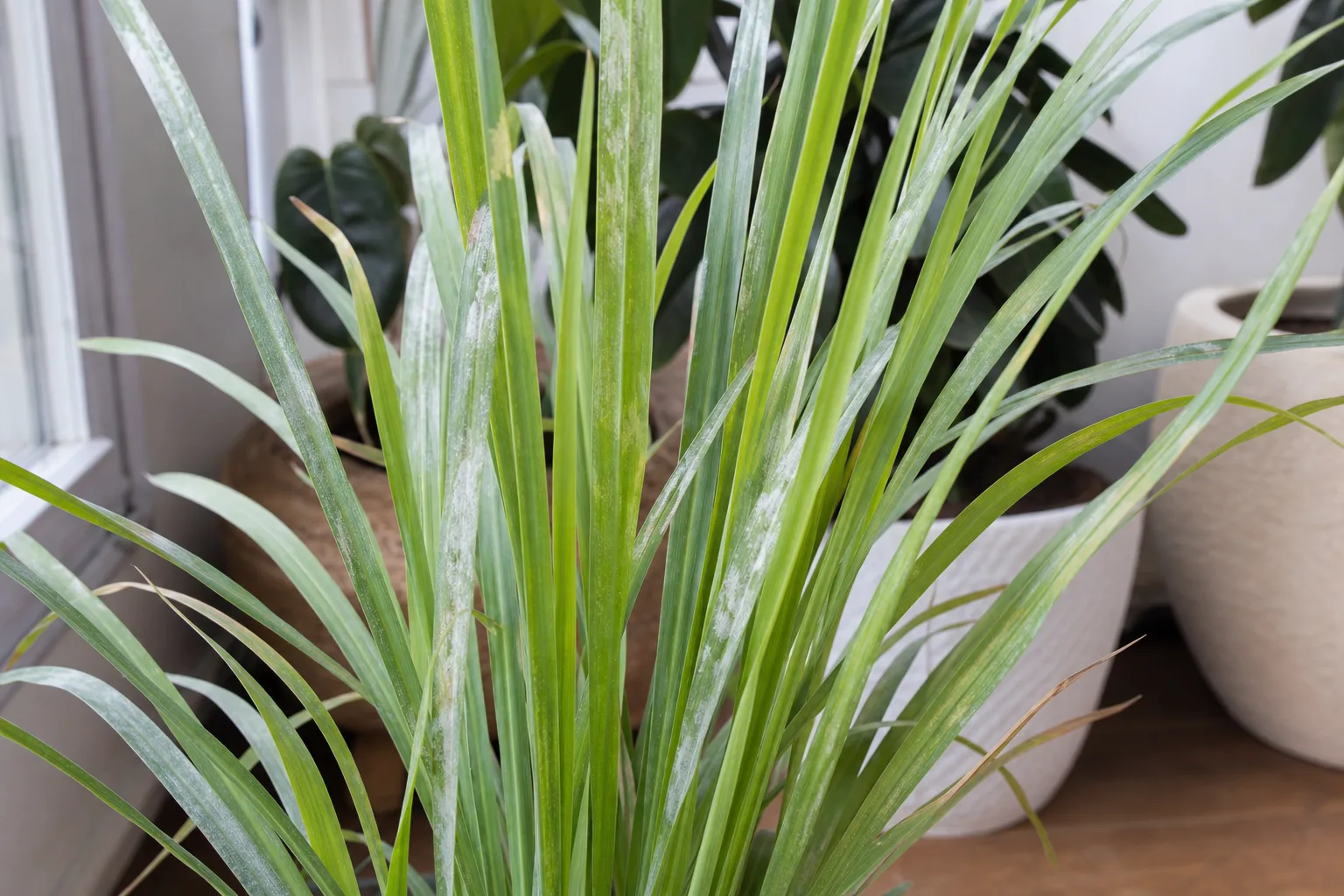
Downy Mildew on Lemongrass: Causes, Checks & Fixes
This guide covers downy mildew on Lemongrass. See also the general Downy Mildew guide, watering, and light pages for this plant.
Downy Mildew on Lemongrass: Causes, Checks & Fixes
Quick answer
Downy mildew on lemongrass (Cymbopogon citratus) shows yellowing blades with gray or purple fuzzy growth underneath during humid weather when foliage stays wet too long. It is caused by oomycete water molds in the Peronospora group-not true fungi-and each downy mildew species typically infects a narrow host range, so basil and cucurbit pathogens are not the same organisms that may affect your grass clump.
First step: remove affected blades at the base, open the clump for airflow, and switch to base watering. Do not harvest fuzzy blades for cooking. If you need to rule out other yellowing causes first, see yellow leaves on lemongrass; if you see dry white powder on upper surfaces only, use the powdery mildew guide instead.
Extension literature documents rust and powdery mildew on lemongrass more often than downy mildew, but the same cultural fixes-dry blades, airflow, prompt removal-apply when underside fuzz confirms an oomycete foliar infection on your kitchen clump.
What downy mildew looks like on lemongrass
Lemongrass grows as stiff, blade-like leaves on upright tillers from a shared crown. Downy mildew hits surfaces where humidity pools, not uniformly across a healthy open clump.
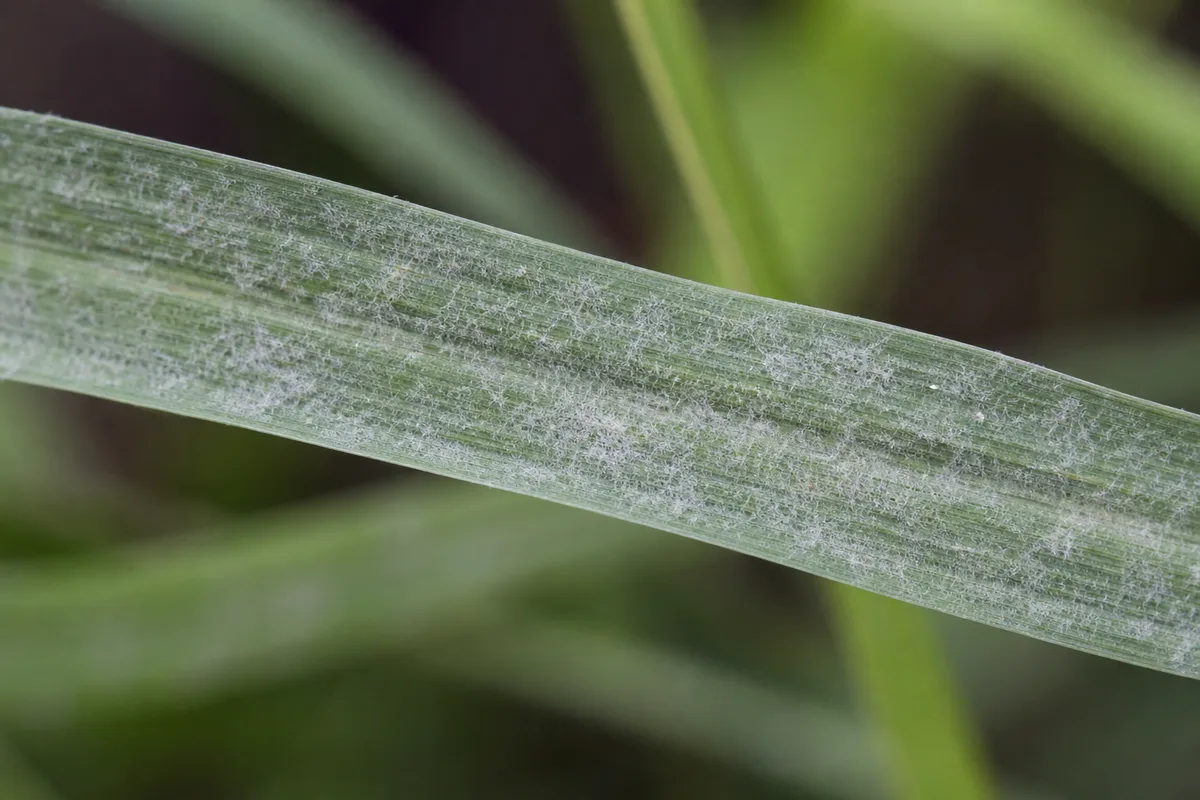
Downy Mildew symptoms on Lemongrass - compare with healthy tissue on the same plant.
Typical signs on lemongrass:
- Pale green to yellow blotches on upper blade surfaces, sometimes bounded by veins on wider leaves
- Gray, purple, or velvety fuzz on undersides when humidity is high-the sporulation that confirms downy mildew over simple nutrient yellowing
- Brown, frost-killed appearance on heavily infected blades as tissue collapses
- Lower inner blades failing first where crowded harvest growth traps stale air
- Firm stalk bases while leaf tissue fails-unlike root rot, crowns stay solid when only foliage is infected
Unlike powdery mildew on lemongrass, the growth is primarily underneath, not dry white talc on tops that rubs off. Unlike root rot, the problem is wet foliage and poor drying, not saturated soil alone.
Visual check without a microscope
In morning humidity, fold a suspect blade and look at the underside in good light. Downy mildew shows a mat of fluffy or velvety growth opposite yellow or pale patches on the upper surface-matching the classic downy mildew pattern of sporangia below and discolored tissue above. No fuzz on either surface after a humid night makes nutrient yellowing, shade fade, or old-blade dieback more likely.
Why lemongrass clumps get downy mildew
Lemongrass wants warm humid tropical conditions and full sun with good spacing-the same climate that favors downy mildew when leaf wetness persists too long. The paradox is familiar on culinary herbs: the plant tolerates ambient humidity, but blades that stay wet overnight invite oomycete infection favored by prolonged leaf wetness.
Dense harvest clumps. Lemongrass fills pots quickly. Growers harvest outer stalks but leave the center thick-a living wall that holds moisture after rain, evening watering, or kitchen steam and blocks sun from drying inner blades.
Overhead watering and misting. Lemongrass tolerates high humidity, but repeatedly wetting foliage-especially late in the day-extends the leaf wetness window downy mildews need. UF/IFAS recommends flood or hand watering at soil level rather than sprinklers that soak leaves.
Sheltered patios and eaves. Pots tucked under overhangs or between taller plants get less wind and more humidity pooling at the crown-exactly where lower inner blades stay damp longest.
Indoor overwinter placement. Clumps on humid windowsills with foliage pressed against glass, or next to a kitchen steam source without a fan, mimic the stagnant humid microclimate that keeps inner blades wet overnight.
Grocery-stalk restart clumps. First-year divisions from store-bought stalks often grow into dense single pots before growers learn to harvest-thin. That crowded first season is a common entry point for inner-blade mildew when humidity rises.
How to confirm downy mildew vs. lookalikes
Work through these checks before you treat an edible clump:
- Underside inspection - Fold blades in morning humidity. Gray-purple velvety fuzz on the underside opposite yellow or pale upper blotches confirms downy mildew. No fuzz after a humid night points away from this diagnosis.
- Surface location - Dry white powder on upper surfaces only that rubs off suggests powdery mildew, not downy mildew.
- Wipe test - Powdery mildew rubs off like talc. Downy fuzz and rust pustules do not behave like surface dust.
- Weather pattern - Symptoms spreading during cool, wet, humid spells fit downy mildew’s wet-weather biology. Powdery mildew can spread in drier conditions with humid nights.
- Clump density - Can you see the crown, or are blades layered three deep? Infection clusters where air cannot move-common on lemongrass left unthinned through summer harvest.
- Watering habit - Overhead sprays, evening hose-downs, or frequent misting on leaves extend wet-blade hours even when roots are fine.
- Rust cross-check - Lemongrass rust shows yellow spots, brown streaks, and dark pustules on undersides-not velvety gray-purple mats paired with yellow tops.
- Crown firmness - Soft, smelly bases with widespread yellowing suggest overwatering or root rot; firm crowns with fuzzy blades only point to foliar disease.
Symptom lookalike comparison
| Pattern | Upper blade | Underside | Common on lemongrass when… |
|---|---|---|---|
| Downy mildew (this page) | Yellow or pale blotches | Gray-purple velvety fuzz in humidity | Dense clump, wet blades overnight, sheltered humid placement |
| Powdery mildew | White dry talc | Clean or lightly coated; powder on top | Crowded clump, stagnant air; rubs off on tops |
| Yellow leaves (general) | Uniform yellow | No fuzz; may include wet-soil bases | Overwatering, nitrogen drain, seasonal shift |
| Rust | Yellow spots, brown streaks | Dark brown pustules | Humid regions; documented on lemongrass |
| Normal old-blade dieback | Outer blades brown at tips | No spreading fuzz | Age after repeated harvest; not clump-wide spread |
| Aphid honeydew | Sticky shine | Insects present | Not velvety mold; often with ants |
If underside fuzz pairs with yellow tops and clump density is high, downy mildew is the working diagnosis. Treat powdery mildew, rust, and root stress as separate problems when their patterns appear instead.
First fix for lemongrass
Remove infected blades at the base and dry the clump-not a mid-blade trim that leaves wet tissue hanging.
Use clean, sharp scissors or a knife. Cut every yellowed blade showing underside fuzz at soil level. Thin crowded inner growth so sun and air reach the crown. Space pots apart, move containers to the sunniest breezy spot you have, and water at the base in morning so leaves dry quickly.
Do not overhead mist during active infection. Do not work with wet foliage when moving between plants. Bag and trash infected clippings-do not compost diseased foliage where spores may survive home pile temperatures.
Culinary harvest pause until clean regrowth
Do not harvest fuzzy blades for soup, tea, or curry paste. Wait until several weeks of clean new shoots grow with no returning fuzz on undersides. When in doubt about whether tissue is safe for the kitchen after recovery, contact your local county extension office for guidance on edible herbs in your region.
Step-by-step recovery
If fuzz persists after the initial trim-out:
- Repeat thinning weekly until new tillers emerge clean. Lemongrass replaces outer growth fast in warm weather when roots stay moist-see the lemongrass pruning guide for harvest-thinning rhythm.
- Switch permanently to base watering per the lemongrass watering guide-moist roots, dry blades.
- Add airflow indoors - a fan on low near overwinter pots keeps blades off glass and breaks humid still air above the crown.
- Monitor new shoots for two weeks - spots should not return on fresh tissue once foliage dries consistently.
- Divide severely crowded clumps in spring if inner blades always stay damp after repeated trimming. Split into sections with airflow on all sides rather than nursing one dense humid ball.
- Escalate outdoors only if spread continues after cultural fixes (see below)-indoor kitchen-adjacent clumps rarely need spray when airflow and base watering fix the problem.
Recovery timeline
Clean new blades typically appear within one to two weeks during active summer growth once foliage dries consistently. Removed infected tissue does not recover or re-green-judge progress by fresh base shoots, not by bleached old blades.
Outdoor clumps in full warm sun often outgrow mild infections faster than indoor overwinter pots under short-day light.
Signs recovery is working:
- New blades open without underside fuzz
- Spread stops at the edge of the thinned clump
- Crown feels firm; roots stay healthy when you spot-check moisture at depth
Signs you need escalation:
- Inner blades collapse across most of the clump despite trimming
- New tillers emerge already infected after one thinning pass
- Fuzz returns every rainy season in the same sheltered placement
Mistakes to avoid on edible lemongrass
Do not overhead water in evening on infected clumps-the extended overnight leaf wetness downy mildews favor will spread infection faster.
Do not harvest fuzzy blades for cooking, even if upper surfaces look only lightly yellow.
Do not ignore crowding-airflow is the main home-garden control on dense culinary clumps.
Do not assume all yellow blades mean downy mildew without checking undersides; bright uniform yellow on wet soil may be overwatering instead.
Do not apply powdery-mildew fungicides expecting them to control oomycete downy mildew-the pathogen groups differ.
Do not leave infected clippings on soil around the crown; dispose of them away from the growing area.
Lemongrass care cross-check
Downy mildew pressure rises when tropical humidity meets poor drying-exactly the overlap a dense harvest clump invites. Before you treat repeatedly, confirm basics from the lemongrass overview:
- Light: Six or more hours of direct sun daily during the growing season. Indoor pots need the brightest window or supplemental light after thinning-see the light guide.
- Water: Moist roots, dry blades-match the watering schedule to season; deliver water to soil, not over foliage.
- Spacing and harvest rhythm: Regular outer-stalk harvest doubles as preventive thinning. Letting a culinary clump grow untouched all season builds mildew-friendly density at the center.
- Spring division: Split overcrowded plants when inner blades never dry-division is both normal lemongrass care and an escape hatch from chronic inner-blade collapse.
How to prevent downy mildew next time
Harvest-thin on schedule. Treat outer stalk removal as disease prevention, not only kitchen supply. Open the clump center every few weeks during peak summer growth.
Water at the base in morning. Use soil-level watering so blades dry the same day-avoid evening overhead sprays.
Give full sun and wind. Outdoor lemongrass belongs in open sun with pots spaced apart. Indoors, use a fan near overwinter clumps and keep blades off glass.
Scout lower inner blades early. First yellow tops with underside fuzz are easier to trim once than a full-clump outbreak the week before a planned harvest.
Relocate chronically sheltered pots. If fuzz returns every rainy season under the same eave, move containers permanently rather than repeated leaf stripping alone.
When to worry
Escalate when inner blades collapse across most of the clump during a humid spell-recovery depends on saving firm crown shoots through division. Culinary harvest should pause until several weeks of clean new regrowth pass without returning fuzz.
Chronic recurrence every rainy season in the same sheltered spot means placement is wrong-relocate containers and divide the clump, not just strip leaves again. Contact your county extension office when outbreaks persist after cultural fixes or when you need help confirming downy versus powdery mildew on an herb you plan to eat.
A few yellow inner blades on an otherwise vigorous outdoor clump after one humid week is moderate, not emergency-confirm underside fuzz, thin once, and improve drying first.
When cultural fixes are not enough - outdoor fungicide note
Home gardeners in many regions have limited labeled downy-mildew products for edible herbs-cultural control is the primary tool. If downy mildew keeps spreading on a valuable outdoor clump after removal and airflow fixes:
- Choose products labeled for downy mildew on herbs or edible plants-not powdery-mildew-only sprays.
- Copper or phosphorus-based fungicides may help as preventatives in some settings; they are not guaranteed cures and can affect some plants-read the label before use on narrow grass blades.
- Follow harvest withholding intervals strictly on an herb you cook with; when the label interval is longer than you can wait, prefer division and restart over repeated spray on the same pot.
- Apply in evening when bees are less active if using broad-spectrum organic sprays; never spray indoor kitchen-adjacent clumps without label clearance for enclosed use.
Indoor clumps that reinfect after thinning usually need more airflow and less leaf wetting, not stronger chemicals in a food-prep area.
Before your next kitchen harvest
If you grow lemongrass for cooking, treat underside fuzz as a stop sign for harvest until clean regrowth proves the clump is clean-not a cosmetic issue you can rinse away. Trim at the base, open the clump, dry the blades, and only then return to normal stalk cutting for soup or tea. That single habit separates a one-week humidity flare from a season of re-infection on the same dense pot.
When to use this page vs other Lemongrass guides
- Lemongrass watering guide - Use for routine moisture checks before assuming downy mildew is the main issue.
- Lemongrass problems hub - Browse all 52 common issues on this species.