Thin Stems on Janet Craig Dracaena: Causes, Checks & Fixes
Quick answer
Thin stems on Janet Craig Dracaena usually mean weak, spindly cane tissue-not healthy thickness. In dim offices, etiolation is the top cause: firm but pencil-thin cane with long bare gaps and undersized crown leaves. First step: feel the cane from crown to soil line-if tissue is firm but spindly, move one step brighter before pruning; if the base is soft on wet, heavy mix, stop watering and inspect roots.

Thin Stems on Janet Craig Dracaena: Causes, Checks & Fixes
This guide covers thin stems on Janet Craig Dracaena. See also the general Thin Stems guide, watering, and light pages for this plant.
Thin Stems on Janet Craig Dracaena: Causes, Checks & Fixes
Quick answer
Thin stems on Janet Craig Dracaena (Dracaena fragrans ‘Compacta’, often sold as Dracaena deremensis ‘Janet Craig’) mean the upright cane has lost healthy thickness-pencil-slim, weak, or narrowing toward the soil line-rather than the stout woody stems you see on a well-grown specimen. The most common indoor cause is etiolation in prolonged low light: the plant stretches spindly stems to reach for more light and invests in length over diameter, producing firm but spindly cane with undersized crown leaves.
First step: run your hand down the cane from crown to soil line. Firm, thin cane with long bare gaps in a dim office → improve filtered indirect light before pruning. Soft, narrowing tissue at the soil line on a heavy, wet pot → stop watering and inspect roots for rot. Pale, small new leaves on otherwise firm cane in adequate light → address nutrient stress after ruling out fluoride burn and water rhythm. Dense clusters of multiple thin canes in one nursery pot → selective thinning once health is confirmed.
This page focuses on cane diameter and structural weakness. For long internode stretch and window-lean patterns, see leggy growth on Janet Craig. Full species context: Janet Craig overview.
Thin stems vs. leggy growth vs. rot-weakened cane
Janet Craig problem pages overlap because weak structure shares causes. Use this scope guide:
| Symptom focus | Primary pattern | Cane feel | Soil / pot | First fix direction |
|---|---|---|---|---|
| Thin stems (this page) | Reduced cane diameter; weak, spindly woody tissue | Usually firm along most of cane if etiolation; soft at base if rot | Variable; wet heavy pot favors rot narrowing | Light improvement or root inspection by base feel |
| Leggy growth | Long internodes between leaf whorls; crown lean | Firm; bare trunk between clusters | Often dry long in dim corners | Move brighter; see leggy growth guide |
| Stunted growth | Little new tissue overall; crown may stay small | Firm but static | Often drought or chronic stress | Cross-check stunted growth |
| Plant leaning | Tilt without necessarily thin diameter | Firm; top-heavy | Uneven light or unstable pot | Plant leaning |
| Root rot | Cane narrows and softens at soil line | Mushy base; firm above only if early | Wet, sour, heavy weeks | Root rot - unpot, trim |
Many office Janet Craigs show etiolation and thin cane together-treat light first unless the base tells you otherwise.
What thin stems look like on Janet Craig
Janet Craig grows as an upright cane topped by a rosette of glossy, dark green strap leaves. Healthy mature cane feels stout and woody, roughly finger-thick on large floor specimens. Thin-stem stress changes the silhouette:
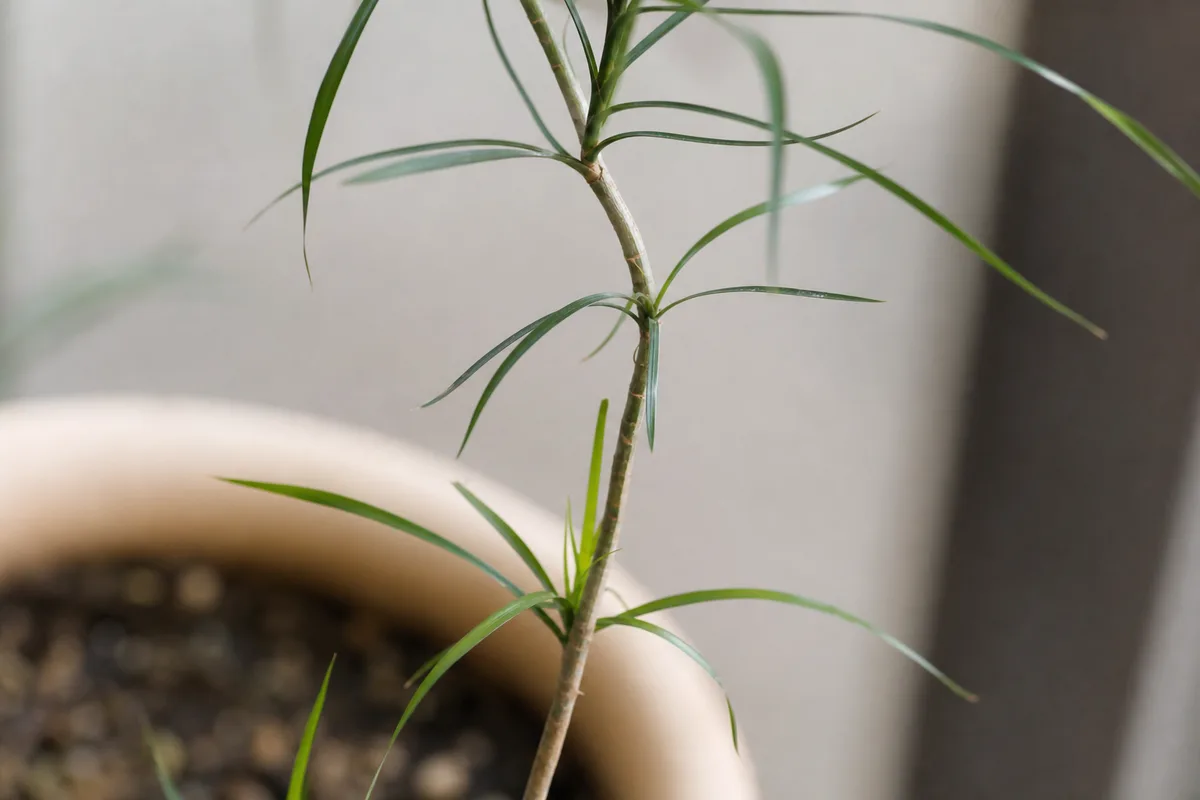
Thin Stems symptoms on Janet Craig Dracaena - compare with healthy tissue on the same plant.
Etiolation-driven spindly cane (most common indoors)
- Pencil-thin or whip-thin cane that feels firm but looks disproportionately slender for the leaf mass
- Long bare tan internodes between sparse leaf clusters (overlaps with legginess)
- Undersized crown leaves - newest foliage narrower or thinner than leaves formed in better light
- Pale or dull new green - not the deep gloss Janet Craig is known for
- Top-heavy lean toward the brightest window or doorway
- Cane above the soil line stays firm; base does not mush when pressed
Rot-softened narrowing at the soil line
- Cane tapers and feels soft right at or just above the mix surface
- Yellow lower leaves dropping while soil stays wet
- Heavy pot that does not lighten for weeks in a dim placement
- Sour or musty smell when you lift the plant or probe deep mix
- Upper cane may still look thin but base tissue fails the squeeze test
Nutrient weakness on firm cane
- Small, pale new leaves at the crown while older leaves retain size
- Cane diameter modest but not mushy; no sour soil signal
- Plant sits in the same pot for years with no feeding during active growth
- Light is adequate (compact new growth elsewhere on the plant or in the same window zone)
Overcrowded multi-cane clusters
- Three or more slender canes packed tightly in one nursery pot
- Each cane looks thin individually but tissue is firm and green
- Competition for root space and light at the center-not disease
- Selective thinning and better placement help structure after health checks
Normal vs. thin: Janet Craig naturally sheds lower leaves as cane lengthens, so some bare trunk on a tall plant is expected. Worry when recent growth is spindly, crown leaves are undersized, cane feels weak for its height, or the base softens on wet mix.
Why Janet Craig gets thin stems
Low-light office biology and cane stretch
Janet Craig is famous for tolerating dim interiors, but survival is not compact growth. When footcandles at the crown stay low for months, the plant runs an etiolation program: stem cells elongate and cane diameter stays slender as the plant reaches for light. NC State Extension notes that if light levels are too low, the leaves will narrow-crown foliage shrinks as the plant prioritizes stem extension over foliage mass.
In deep shade Janet Craig also transpires slowly and may go three to four weeks or longer between thorough soaks. Watering on a bright-room calendar while light stays dim keeps mix wetter than the slow metabolism needs-allow soil to dry between waterings is especially important in dim placements. Etiolation shows at the top while root stress can narrow the base. Thin cane from stretch and thin cane from rot can coexist; check both light and soil.
Wet soil weakening cane tissue at the base
Root damage from chronic overwatering reduces the flow of water and nutrients up the cane. Structural tissue at the soil line loses turgor and narrows before upper leaves show classic drought signs-because roots cannot supply the crown. Over-watered soil encourages fungus gnats and root problems together in low-light offices where growers keep summer watering frequency. See overwatering on Janet Craig when the pot stays heavy.
Nutrient stress on slow-growing cane
Janet Craig is not a heavy feeder, but years in depleted mix without any balanced fertilizer during spring and summer can produce weak, thin new growth on otherwise firm cane. This is more likely when light is finally adequate but the root zone has been exhausted. Do not fertilize a stressed, wet, or rot-suspected plant as a first fix.
Overcrowded cane density
Commercial Janet Craig pots often ship with multiple rooted canes for a full look-Clemson HGIC describes ‘Janet Craig’ as widely used in interior landscaping with wide leaves held along thick stems on plants that can grow quite tall. Each stem stays thinner than a single-specimen floor plant would. Without selective thinning or brighter even light, the cluster reads as uniformly spindly even when individual canes are healthy.
How to confirm the cause
Work through these checks in order. One pass down the cane plus pot weight tells you more than guessing from leaf tips alone.
- Cane squeeze test - Pinch gently from crown toward soil. Firm slender cane → etiolation likely. Soft, yielding base → rot or stem damage; stop watering.
- Cane diameter vs. height - Pencil-thin cane supporting a sparse top on a tall plant in a dim corner supports low-light stretch.
- Internode spacing - Increasing gaps between leaf whorls on newest growth confirm stretch (detail in leggy growth).
- Crown leaf size trend - New leaves noticeably smaller than six-month-old foliage → light or nutrient stress; compare to light placement.
- Pot weight and half-depth moisture - Heavy, damp mix for weeks in low light → overwatering overlap; light, dusty dry mix with droop → underwatering, not primary thin-cane etiolation.
- Light at the crown - Faint hand shadow at midday in a “bright” room means survival light, not growth light; see Janet Craig light guide.
- Cane count and firmness - Multiple firm thin canes, no sour soil → overcrowding candidate.
- Pest scan - Mealybugs or scale can weaken growth; inspect leaf axils before blaming culture alone.
Confirmation decision table
| What you find | Likely cause | First fix |
|---|---|---|
| Firm spindly cane, small crown leaves, dim placement | Etiolation | Move one step brighter |
| Soft base, wet heavy pot, yellow lower leaves | Root rot / overwatering | Stop water; unpot per root rot guide |
| Firm cane, pale small new leaves, years in same pot, decent light | Nutrient stress | Light feed only after water rhythm stable |
| Several firm thin canes, healthy green tissue | Overcrowding | Selective thin after spring growth flush |
| Brown tips only, firm cane, no stretch | Fluoride / humidity | Brown tips - not thin-stem primary |
First fix for Janet Craig (by likely cause)
Do not prune thin cane on day one in a dim office - new shoots will stretch again from the same spot.
If cane is firm and spindly (etiolation)
Move Janet Craig one step closer to bright, filtered indirect light.
Practical placements:
- East window - a few feet inside the glass, out of harsh direct summer beam
- Filtered south or west - behind sheer curtain or four to six feet back from the pane
- Interior office - full-spectrum grow light 12–14 inches above the crown, 12–14 hours daily
Acclimate gradually. Light intensity changes should be gradual-Janet Craig scorches in direct sunlight. You want brighter indirect light, not a hot western sill.
If the base is soft on wet mix (rot)
Stop all watering. Unpot, inspect roots, trim mushy tissue, and repot into fresh well-draining mix only as needed-follow the root rot guide. Do not increase light and water simultaneously on a rotting base; dry-down and root repair come first.
If firm cane has pale small new leaves (nutrient)
After water rhythm matches light for two weeks, apply balanced liquid fertilizer at half strength once during active spring or summer growth. Skip feed on recently repotted, pruned, or rot-recovering plants for several weeks.
If overcrowded canes are healthy but thin
In spring or early summer, remove the weakest cane at soil level with sterilized shears, leaving two to three strongest stems. Cutting bare dracaena stems prompts new leaf growth below the cut over time. Do not thin more than one-third of the cluster at once.
Recovery timeline
Janet Craig is slow-growing. Expect:
- 2–4 weeks - new leaves may emerge slightly larger; lean may slow after light improvement
- 1–3 months - visible improvement in crown leaf size and cane stiffness in better light
- Old thin cane sections - do not thicken; only new growth above the crown gains diameter
- Rot-trimmed plants - several months before new roots support normal crown expansion
- Overcrowding thin-out - side shoots may sprout below cuts over a growing season
Judge success by new leaf width, tighter crown, and firm cane above the soil line-not by old spindly sections shrinking.
What not to do
- Prune etiolated cane before improving light - the plant stretches again from the same dim placement
- Increase watering because thin cane “looks thirsty” - low-light stretch alone does not need more water; wet mix worsens rot narrowing
- Assume all thin cane means rot - firm spindly cane higher on the stem with dry-appropriate mix is usually light, not roots
- Stack Janet Craig Dracaena repotting guide, pruning, and fertilizer on one day - one variable at a time on a stressed Janet Craig
- Jump to harsh direct sun - scorches foliage; move in steps per the light guide
- Use untreated tap water if tips brown repeatedly - dracaenas are sensitive to fluoride; see brown tips
- Ignore pet access - Dracaena is toxic to cats and dogs; keep fallen leaves and trimmings away from pets
How to prevent thin stems next time
- Place Janet Craig where it receives consistent filtered indirect light when you want firm cane-not only where the pot looks good in a dark lobby
- Rotate the pot every few weeks for even crown development
- Match watering to light - deep shade means long dry-down; details in the watering guide
- Add supplemental lighting in winter or interior offices when natural light drops-most houseplants need no more than 16 hours combined natural and artificial light daily
- Thin overcrowded nursery clusters proactively in spring rather than letting many weak canes compete
- Feed lightly during active growth if the plant has been in the same mix for years
Practical checks
Urgency check
Escalate same day when:
- Cane base is soft or mushy with wet, sour-smelling mix - suspect root rot
- Cane tips blacken or feel waterlogged - not etiolation; inspect for stem rot or cold damage
- Plant topples - tall spindly cane is unstable; secure or prune after light fix, and keep toxic plants away from pets
Firm thin cane alone is a correctable culture issue, not an emergency.
Best inspection order
Crown leaf size → cane squeeze from tip to soil line → pot weight → half-depth moisture → light at crown → cane count (overcrowding) → roots only if base is soft on wet mix
Related Janet Craig problems
- Janet Craig overview - Fluoride, low-light watering, troubleshooting hub
- Light - Survive vs. thrive light levels
- Watering - Dry-down rhythm matched to office placement
- Leggy growth - Long internode stretch and window lean
- Stunted growth - Little new tissue overall
- Root rot - Soft cane base on wet mix
- Plant leaning - Tilt and stability
- Overwatering - Heavy wet pot in low light
When to use this page vs other Janet Craig Dracaena guides
- Janet Craig Dracaena watering guide - Use for routine moisture checks before assuming thin stems is the main issue.
- Janet Craig Dracaena problems hub - Browse all 50 common issues on this species.