Black Spots on Janet Craig Dracaena: Causes, Checks & Fixes
Quick answer
Black spots on Janet Craig Dracaena are usually fungal leaf spot from wet foliage, sooty mold from scale or mealybugs, or-not true spots-fluoride margin necrosis. First step: isolate the plant, remove leaves with discrete circular lesions, and stop wetting strap foliage when you water.
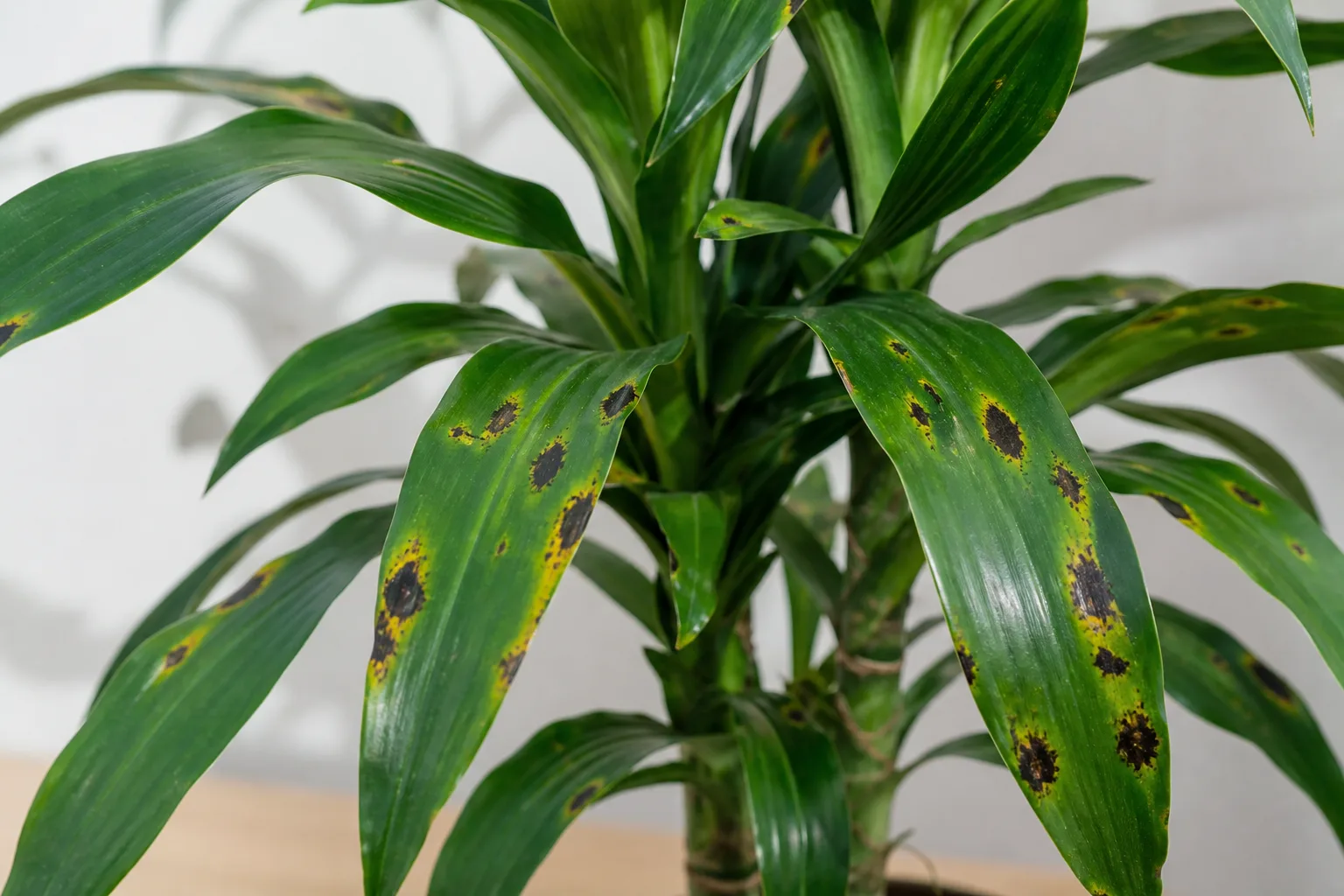
Black Spots on Janet Craig Dracaena: Causes, Checks & Fixes
This guide covers black spots on Janet Craig Dracaena. See also the general Black Spots guide, watering, and light pages for this plant.
Black Spots on Janet Craig Dracaena: Causes, Checks & Fixes
Quick answer
Black spots on Janet Craig Dracaena (Dracaena deremensis ‘Janet Craig’) fall into three buckets on this broad-leaf office plant: true leaf-spot lesions (fungal or bacterial infections that stay in the tissue), sooty mold (a black surface film from pest honeydew), and lookalikes such as fluoride margin necrosis or rot-related yellowing-not discrete spots at all.
First step: move the plant away from neighbors, prune strap leaves with discrete enlarging lesions, and commit to watering at the soil line so Janet Craig’s wide foliage stays dry. That single cultural correction stops most fungal spread in low-light cubicles where leaves hold surface moisture after misting or overhead watering. Only after you confirm whether spots wipe off (sooty mold) or stay embedded (disease) should you add pest treatment or escalation sprays.
This page triages what your black spots are. For pathogen-focused treatment detail, see leaf spot disease. For tip and margin burn, see brown tips.
What black spots look like on Janet Craig
Janet Craig carries large, upright, dark-green strap leaves on thick tan canes. Black markings show up differently depending on cause-and the pattern matters more than the color word “black.”
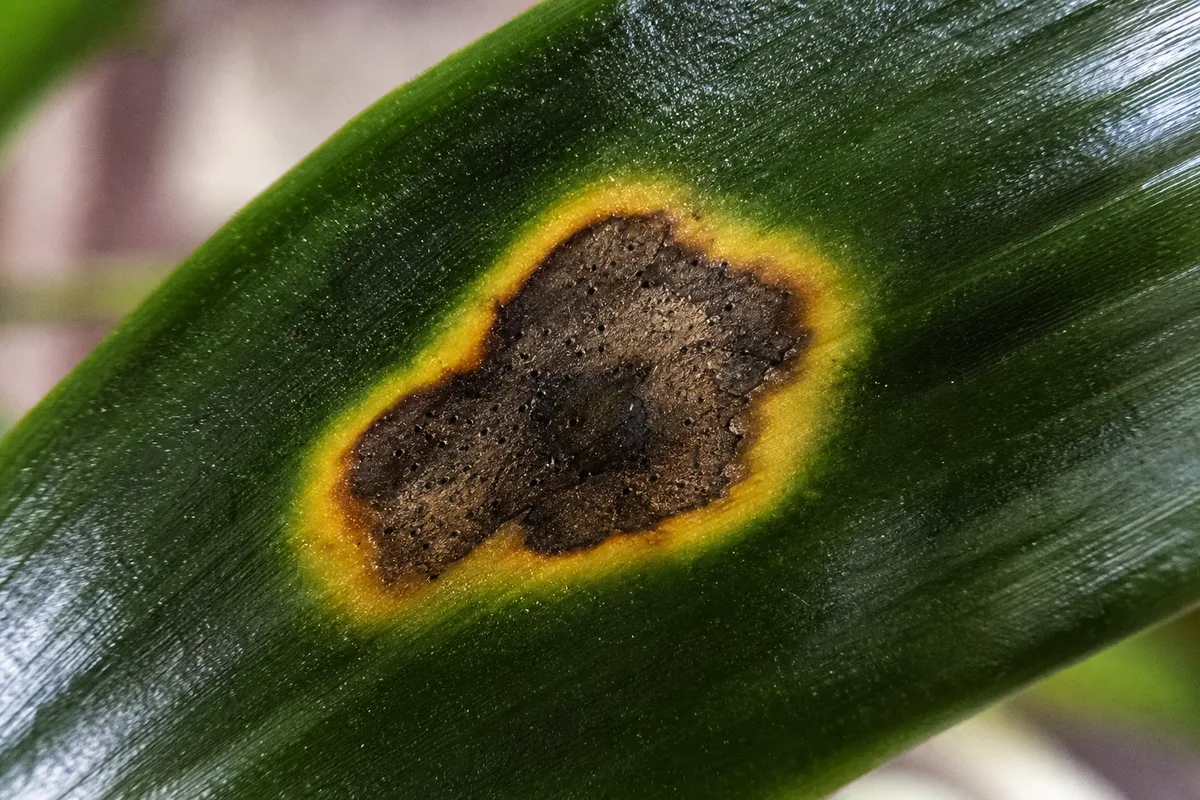
Black Spots symptoms on Janet Craig Dracaena - compare with healthy tissue on the same plant.
Fungal leaf spot on Dracaena often starts on older lower strap leaves as irregular yellow patches that turn brown with a purple or dark margin. Advanced lesions may show tiny black dots inside necrotic tissue-these are fungal fruiting bodies (pycnidia), not separate “spots” floating on the surface. A bright yellow halo sometimes rings older lesions. PNW Handbooks notes that Phoma draconis is the most common leaf-spot pathogen on Dracaena and that wet, humid conditions favor development.
Bacterial leaf spot on indoor Dracaena can appear as dark green, water-soaked spots that later turn tan, brown, or black, often with a yellow border. UC IPM describes Pseudomonas on Dracaena among hosts with greasy or water-soaked lesions that may enlarge until the whole leaf blade is affected. Bacterial spots can feel slightly oily when viewed from the underside.
Sooty mold looks like a uniform charcoal-gray to black coating across leaf surfaces-sometimes thin enough to peel away in sheets. It follows sticky honeydew from scale, mealybugs, or aphids rather than infecting leaf cells. NC Cooperative Extension explains that sooty mold is caused by insects, not a primary leaf disease, and that the black coating sticks to honeydew residue.
Fluoride margin necrosis-a frequent Janet Craig issue-shows as crisp brown-to-black tissue at tips or margins only, not scattered round spots mid-blade. Fluoride accumulates at leaf margins on sensitive species including Dracaena and does not wipe off.
On Janet Craig in dim offices, multiple random spotted leaves across the canopy suggest disease or sooty mold, while uniform margin burn on many leaves after months of tap water points to fluoride. Spots only on leaves you mist or overhead-water strongly implicate wet-foliage fungal infection.
Why Janet Craig gets black spots
Janet Craig’s biology and typical placement explain why “black spots” searchers land on several different problems.
Wet foliage in low airflow. Broad strap leaves in fluorescent-lit cubicles dry slowly when misted, showered, or splashed during watering. Many leaf-spot fungi require hours of continuous leaf wetness before infection occurs, and spores spread when water splashes from infected lower leaves to healthy upper ones. Janet Craig’s dense crown holds moisture longer than narrow-leaf dracaenas.
Overhead watering habits. Watering from above wets the entire leaf surface on a plant that NC Extension recommends watering at the soil line with filtered water. Wet leaves plus slow transpiration in deep shade create the humid microclimate PNW Handbooks identifies as favoring Dracaena leaf spot.
Pest honeydew and sooty mold. Floor-sized Janet Craig specimens often host scale on stems and leaf undersides or mealybugs in cane crotches. University of Maryland Extension lists corn plant (Dracaena) among foliage houseplants susceptible to scale, and moderate to heavy infestations produce honeydew that supports sooty mold growth. Owners see “black leaves” when the mold coats surfaces.
Fluoride misread as spots. Janet Craig is among the most fluoride-sensitive houseplants. Dark necrotic margins can look like spotting in photos, especially when multiple leaves show edge burn simultaneously-but the pattern stays marginal, not scattered.
Rot lookalikes. Whole-leaf yellowing with soft tissue on a heavy wet pot is overwatering or root rot-not black spot disease. Soft cane and sour soil need root assessment, not leaf fungicides.
Black spots vs. leaf spot disease vs. brown tips vs. fluoride margins
| What you see | Likely cause | Key check on Janet Craig |
|---|---|---|
| Circular to irregular brown-black lesions with yellow halo; tiny black dots inside dead tissue | Fungal leaf spot | Spots stay in leaf; do not wipe off; often on older leaves first |
| Water-soaked, greasy dark spots enlarging on blade | Bacterial leaf spot | Oily look from underside; spreads on wet foliage |
| Uniform charcoal film across leaf surface; wipes off with damp cloth | Sooty mold | Sticky honeydew underneath; pests on stems or undersides |
| Crisp brown-black tips or margins only; no mid-blade spots | Fluoride injury | Tap water history; see brown tips |
| Yellow soft lower leaves; heavy wet pot; soft cane | Overwatering / rot | No discrete spots; sour soil; see root rot |
Page scope: This guide helps you identify which black-spot pattern you have and take the right first action. The leaf spot disease page goes deeper on pathogen behavior and treatment escalation once you have confirmed true leaf spot-not sooty mold or fluoride.
How to confirm the cause
Work through these checks in order before buying fungicide or Janet Craig Dracaena repotting guide:
- Wipe test. Dampen a cloth and gently rub a black area. Sooty mold smears and lifts; true leaf-spot lesions remain in the tissue.
- Pattern on the leaf. Margins and tips only → fluoride or salt injury. Scattered lesions mid-blade → disease. Full-surface coating → sooty mold.
- Leaf age and spread. Fungal spot often starts on older lower strap leaves and moves upward with splashing. New crown spots after wetting foliage confirm active cultural trigger.
- Pest search. Inspect leaf undersides, cane joints, and the crown with a phone light. Look for domed scale bumps, white mealybug wax, or sticky residue. Honeydew and sooty mold indicate an underlying pest outbreak.
- Watering history. Overhead watering, misting, or showering the foliage? Recent habit change narrows fungal cause quickly.
- Pot weight and soil smell. Heavy wet mix with yellowing-not discrete spots-points to overwatering, not leaf spot.
- Water source. Months of municipal tap with margin necrosis only → fluoride before fungicide.
- Neighboring plants. Sooty mold and some fungal spores spread between bench mates-check the whole floor line.
Confirmed fungal or bacterial spot: embedded lesions, yellow halos, enlargement over days, wet-foliage history. Confirmed sooty mold: wipes off, pests or honeydew present. Confirmed fluoride lookalike: margin-only necrosis, tap water, no fruiting bodies in tissue.
First fix for Janet Craig
Isolate the plant, remove strap leaves with active discrete lesions, and water at the soil line only-keeping all Janet Craig foliage dry from this point forward.
PNW Handbooks recommends reducing moisture on leaves, watering from below foliage, and removing and destroying infected leaves for Dracaena leaf spot. Bag pruned tissue in the trash. Move the pot to a spot with better air movement-a fan on low in an office cubicle helps broad leaves dry faster than misting ever will.
If the wipe test shows sooty mold, do not reach for fungicide first. NC Extension advises suppressing the sap-sucking insects producing honeydew-scale, mealybugs, or aphids. See scale insects and mealybugs on this plant. Rinse sooty coating with lukewarm water after pests are controlled; the mold wears off once honeydew stops.
If lesions are margin-only with tap-water history, switch to filtered or distilled water per the brown tips protocol-not isolation and pruning for disease.
Do not stack repotting, heavy pruning, and fertilizer on the same day. Do not increase watering when spots appear-wet soil worsens rot and can extend leaf wetness in humid crowns.
Step-by-step recovery
After the first fix, continue based on what you confirmed:
Fungal or bacterial leaf spot path
- Prune affected leaves until no enlarging lesions remain on the plant. Sterilize scissors between cuts if multiple plants were nearby.
- Water at soil level only. Clemson HGIC advises avoiding splashing water on foliage to limit fungal spread.
- Improve airflow around the canopy without blasting cold AC directly on leaves.
- Wait two to three weeks and watch new crown leaves. Spotting halted on clean new growth means cultural control worked.
- Escalate only if needed. Clemson HGIC lists copper soap and other labeled products after infected parts are removed when cultural fixes fail-follow label directions for houseplants and keep pet-toxic Janet Craig away from treated foliage.
Sooty mold path
- Identify and treat the pest producing honeydew-alcohol dab for light scale, insecticidal soap or horticultural oil per label for heavier infestations.
- Rinse sooty coating with lukewarm water once insects are declining. Sooty mold does not infect plants directly but blocks light until it weathers away.
- Inspect neighboring floor plants on the same bench line.
Fluoride lookalike path
- Switch water source to filtered, distilled, or rainwater.
- Flush salts from the mix with plain low-fluoride water at two to three times pot volume.
- Trim dead margins cosmetically. Judge recovery by clean new crown leaves-not old burned edges.
Match watering to light during recovery per the Janet Craig watering guide-allow the top half of mix to dry in Janet Craig Dracaena light guide, longer in deep office shade.
Recovery timeline
Fungal leaf spot controlled by dry foliage and pruning: expect no new lesions on crown leaves within two to three weeks. Old spotted strap leaves do not heal-Janet Craig replaces foliage slowly, so the canopy may look blemished for months until new growth fills in.
Sooty mold clears over two to four weeks after pests are controlled and honeydew production stops. Existing mold dries and flakes; new growth emerges clean.
Fluoride margins improve on new crown leaves within three to six weeks after water-source change. Damaged margin tissue never re-greens.
Worsening signs: spots enlarge on new crown flush despite dry foliage; yellow halos spread leaf-to-leaf weekly; soft cane with sour soil on a heavy pot-switch to root rot assessment, not more leaf pruning alone.
What not to do
Do not mist or overhead-water Janet Craig strap leaves to “wash spots off”-that worsens fungal infection in low airflow. Do not apply fungicide to sooty mold without treating underlying pests-the mold returns with honeydew. Do not assume every black mark is disease and prune half the canopy before a wipe test and water-source review.
Do not increase watering when leaves show spots; wet mix in dim offices compounds rot. Do not use untreated tap water if margins keep necrosing-fluoride will not respond to fungicide.
Keep pruned material and rinse runoff away from pets; Dracaena is toxic to cats and dogs. Do not stack repotting, systemic products, and heavy pruning on the same day on this slow cultivar.
How to prevent black spots next time
Water at the soil line with filtered water on fluoride-sensitive Janet Craig. NC Extension recommends allowing the top half of mix to dry between waterings and avoiding fluoride-heavy tap when possible.
Skip routine misting on this cultivar in cubicles-use airflow instead. If you dust broad leaves, wipe with a barely damp cloth and let surfaces dry before night.
Inspect cane joints monthly for scale and mealybugs before sooty mold coats the canopy. Quarantine new floor plants two to three weeks before placing them beside Janet Craig.
Remove spotted lower leaves promptly when lesions first appear-early pruning limits splash spread. Use pasteurized or fresh mix when repotting; Clemson HGIC notes fungi survive in dead plant debris in soil.
Match pot size to root mass and light level per the overview guide-oversized pots stay wet too long in office shade.
When to worry
Escalate same-day if lesions spread to multiple new crown leaves within a week despite dry foliage, or if soft cane and sour soil accompany spotting-rot may be advancing. Persistent spread after three weeks of cultural control warrants a labeled fungicide per extension guidance or a sample to a local extension plant clinic.
You can observe if one or two older lower leaves show stable embedded spots, the crown is firm, new growth is clean, and you have already stopped wetting foliage.
Practical checks
Urgency check
Urgent: rapid lesion enlargement on new crown flush; water-soaked spots doubling in size within days; soft cane on wet mix; pest outbreak with heavy honeydew coating multiple plants on the same bench.
Monitor: a few stable spots on older leaves only; sooty film already linked to a light scale infestation you are treating; margin necrosis improving after water-source switch.
Best inspection order
Newest crown strap leaves → lesion wipe test → leaf undersides and cane joints for pests → older spotted leaves for spread pattern → pot weight and soil moisture → water source history → neighboring floor plants.
Janet Craig care cross-check during recovery
Hold fertilizer until two weeks of clean new crown growth. Match dry-down to light per watering. Use filtered water for long-term fluoride control after any stress episode.
Conclusion
Black spots on Janet Craig Dracaena are not one problem-they are a pattern-recognition task. Embedded circular lesions with yellow halos on wet-watered strap leaves point to leaf spot; charcoal film that wipes away points to sooty mold and pests; margin-only necrosis points to fluoride. Isolate, prune true spots, and keep foliage dry before you reach for sprays. Use the leaf spot disease guide for pathogen depth, brown tips for water-quality margins, and pest pages when honeydew is present.
Related Janet Craig guides:
- Janet Craig overview - Light, watering, and culture baseline
- Leaf spot disease - Pathogen-focused treatment after you confirm true leaf spot
- Brown tips - Fluoride margin necrosis lookalike
- Scale insects - Common sooty mold trigger
- Mealybugs - Honeydew and sooty mold source
- Watering - Dry-down rhythm to keep crowns healthy
When to use this page vs other Janet Craig Dracaena guides
- Janet Craig Dracaena watering guide - Use for routine moisture checks before assuming black spots is the main issue.
- Janet Craig Dracaena problems hub - Browse all 50 common issues on this species.
- Overwatering on Janet Craig Dracaena - Different entry point when symptoms overlap with black spots.