Ixora Light Requirements: Full Sun to Bright Indirect
Ixora Light Requirements: Full Sun to Bright Indirect for Blooms
Ixora Light Requirements: Full Sun to Bright Indirect for Blooms
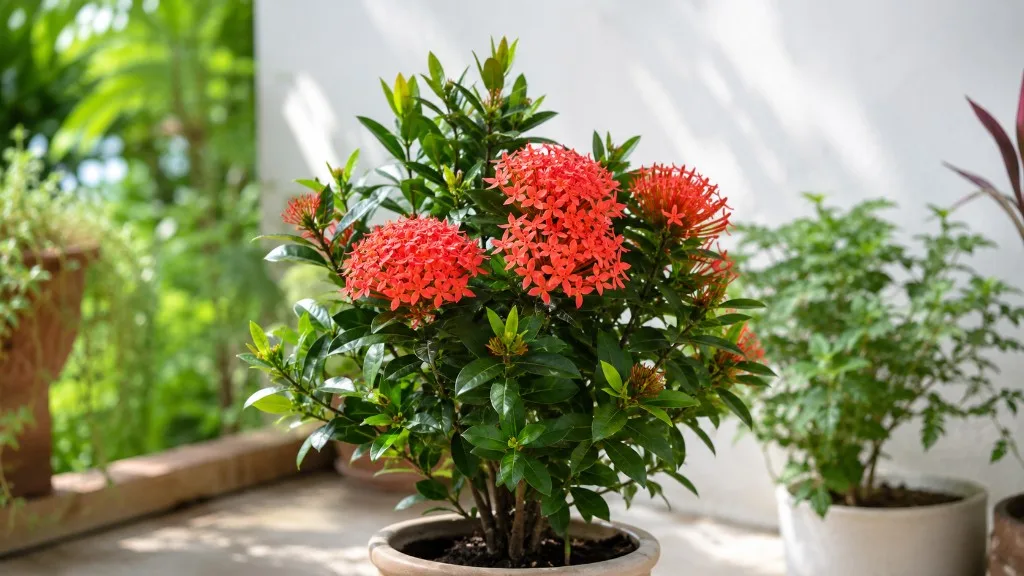
Ixora is not a foliage houseplant you keep alive in a dim corner and call success. It is a tropical flowering shrub - Ixora coccinea and its many cultivars - grown for dense clusters of red, orange, pink, or yellow blooms that can persist six to eight weeks per flower head when conditions align. Light is the gatekeeper for those clusters. Give ixora enough photons and stable warmth, and it can flower repeatedly through the year in frost-free climates. Starve it of brightness while keeping everything else perfect, and you get a glossy green shrub that looks healthy enough to fool you - until you realize it has not produced a bud in months.
The practical light band runs from full sun outdoors to bright indirect light indoors, with partial shade tolerated mainly for survival rather than prolific blooming. University of Florida IFAS Extension states plainly that while ixora can be grown in partial shade, full sun is necessary for maximum flower production - a distinction most generic houseplant guides blur into “bright light” without explaining what that costs in bloom count. (UF/IFAS Gardening Solutions) Indoors, where true full sun is rare, your job is to approximate outdoor intensity with the brightest window you have, optional direct morning rays, and supplemental grow lighting when winter or room layout cannot deliver eight to ten hours of usable brightness.
This guide focuses on the decisions that protect blooms: how much light ixora actually needs, how outdoor full sun translates to indoor placement, when direct sun helps versus scorches, how to set up grow lights for flowering shrubs, how to read warning signs before legginess becomes permanent habit, and how to avoid mistaking iron chlorosis for a light problem.
How Much Light Ixora Actually Needs
Ixora evolved in the humid tropics of southern India and Sri Lanka, where it grows as an understory-to-edge shrub receiving strong filtered brightness and, in open exposures, long days of direct tropical sun. That origin explains the species’ appetite for light and its intolerance of deep shade. Outdoors in USDA zones 9 through 11, ixora is typically planted in full sun or dappled shade that still delivers many hours of direct rays. In South Florida landscapes, it flowers continuously under ideal conditions precisely because the sun angle and day length stay favorable most of the year. (UF/IFAS Gardening Solutions)
For bloom-focused care, treat six to eight hours of direct sun daily as the outdoor target for maximum flower production. Some references extend that to eight to ten hours for container plants held on bright patios. Partial shade - especially for large-leaved varieties - can keep the plant alive and leafy, but expect fewer flower clusters, smaller blooms, and longer gaps between flowering flushes. That trade-off is acceptable for a foundation hedge you value for evergreen structure; it is frustrating for a pot you bought specifically for color.
Indoors, the honest baseline is bright indirect light for most of the day, with the pot close enough to the glass that light lands on leaves rather than on the floor around the container. Many ixora houseplants receive four to six hours of bright ambient light and survive; fewer receive enough total daily photons to bloom abundantly. The Spruce notes that indoor ixora ideally belongs in a greenhouse or conservatory where light intensity approaches outdoor levels, though a well-placed home plant can still produce at least some flowers when humidity, warmth, and acidic soil cooperate. (The Spruce) Think of indoor ixora as a high-light tropical, not a pothos with prettier leaves.
Light also changes Ixora watering guide. A brighter ixora photosynthesizes faster, transpires more, and dries its pot quicker. A dim ixora sits in wet mix longer and becomes vulnerable to root stress. Every light move should trigger a moisture-check recalibration - not a new fertilizer plan, not an emergency repot.
The Short Answer for Busy Growers
If you only remember four rules, use these. Outdoors: plant or place pots in full sun for the strongest bloom cycle; accept partial shade only if you prioritize foliage over flowers. Indoors: give the brightest east, south, or west window available, with the plant within a few feet of the glass; add a grow light when the spot cannot deliver roughly eight to ten hours of strong brightness. Judge by buds, not old leaves: compact new growth plus visible flower cluster formation means light is adequate; long bare stems with glossy but budless tips mean increase brightness. Acclimate every sun increase: move exposure in steps over seven to fourteen days so leaves formed in lower light do not scorch in stronger rays.
Give any placement change ten to fourteen days before deciding it failed. Ixora responds on a tropical timeline - not overnight - and old damaged foliage will not repair; only new shoots and bud initials tell the truth.
Why Light Drives Ixora Blooms More Than Almost Anything Else
Flowering is expensive. A plant must accumulate enough photosynthetic energy to initiate buds, sustain weeks-long bloom clusters, and replace leaves lost to age or stress. Ixora packs dozens of four-petaled flowers into each spherical cluster at stem tips, then holds that display for up to two months when conditions hold. That display rhythm requires consistent carbohydrate production - which means consistent light capture across many hours, not a brief sunbeam that crosses the pot at breakfast.
Water, acidic soil, and micronutrients matter enormously for ixora, especially because alkaline conditions trigger iron and manganese chlorosis that weakens the plant indirectly. But even perfect ericaceous mix at pH 5.0–6.0 cannot compensate for chronic low light. A dim ixora may keep older leaves green while quietly abandoning its bloom budget, redirecting energy toward stem elongation in search of photons. You see a “healthy” plant. The plant sees a survival crisis with no surplus for reproduction.
Temperature and humidity modulate the bloom response but do not replace light. Ixora prefers warm stable conditions roughly between 20°C and 35°C (68°F and 95°F) with high humidity - often 60 to 80 percent in active growth. Cool, dim winter rooms can stall budding even when autumn light seemed adequate. That seasonal coupling is why year-round indoor blooming is harder than a single summer patio flush: shorter photoperiods and weaker window intensity arrive together.
What Happens When Light Is Too Low for Flower Production
Chronic under-lighting produces a recognizable syndrome. Internodes stretch - the gaps between leaf pairs lengthen - and stems lean hard toward the brightest vector. New leaves may be smaller and paler than mature ones, though they can still look superficially healthy because ixora foliage is naturally glossy. Flower initiation slows or stops entirely; existing buds may abort rather than open. Bloom clusters shrink when they do appear, sometimes producing only a few flowers instead of a dense sphere. Lower leaf drop can follow extended dim periods, especially if watering rhythm was not reduced to match slower metabolism.
The cruel part is that ixora tolerates mediocre light longer than many flowering plants before looking obviously miserable. Foliage plants telegraph distress quickly through pale expansion. Ixora can maintain a convincing green presence while failing the job you bought it for. That is why bloom count - not leaf count - is the correct light diagnostic for Ixora overview.
Full Sun Outdoors vs Bright Indirect Indoors
Outdoor and indoor light are not interchangeable units on a dial. Full sun outdoors means unfiltered or lightly filtered direct rays for most of the day, with sky brightness contributing from all angles. Bright indirect indoors means strong ambient illumination, often with some direct morning or late-afternoon beams through glass, but rarely the multi-hour direct load a Florida hedge receives. Glass filters ultraviolet and can intensify heat. A south window at noon may deliver fewer total photons than an open garden bed while still scorching leaves through heat concentration.
Treat these as separate playbooks linked by one goal: maximize photosynthetically useful light without crossing into scorch.
The Outdoor Sweet Spot for Prolific Blooming
In zones 9 through 11, site ixora where it receives full sun for at least six hours, preferably more during the growing season. Foundation plantings, low hedges along walkways, and patio containers on open exposures all work when irrigation and soil acidity are managed. UF/IFAS notes that ixora flowers continuously under ideal conditions outdoors, with each cluster lasting six to eight weeks - the benchmark you are aiming for when evaluating whether a landscape spot is bright enough. (UF/IFAS Gardening Solutions)
Large-leaved ixora varieties tolerate partial shade better than compact dwarfs, but bloom density still drops as shade deepens. Use partial shade strategically in hot inland climates where afternoon heat on pavement raises root-zone temperature, or where reflected glare off walls scorches leaf tips. That is dappled or afternoon-filtered sun, not a north-side alley with two hours of slanted brightness.
Container outdoor ixora needs the same sun honesty as in-ground plants, with one extra wrinkle: dark pots on hot surfaces can cook roots even when leaves receive acceptable light. If foliage looks fine but buds fail in a bright spot, check whether the container overheats at midday before blaming photons alone.
Translating Full Sun Into a Realistic Indoor Setup
Indoors, you are approximating outdoor full sun rather than replicating it. The best approximations combine three tactics: maximize natural window light, add direct morning sun when glass geometry allows, and supplement with full-spectrum LEDs when day length or room orientation falls short.
Place ixora within one to three feet of an east-facing window for gentle direct morning rays plus strong afternoon ambient brightness, or near a south or west window with sheer diffusion if midday beams are harsh. Avoid positioning the plant deep in a bright room where human eyes detect “lots of light” but the canopy sits in shade. A light meter is optional; the new-growth test is not.
Conservatories, sunrooms, and glazed patio doors outperform standard living-room placements because they offer longer sun arcs and higher cumulative daily exposure. If you have that infrastructure, ixora belongs there before it belongs on a bookshelf that happens to be near a window. If you do not, plan on a grow light for any bloom ambition past occasional clusters.
Best Window Placement for Ixora in Your Home
Window direction sets the daily shape of light - how long direct beams last, how hot they run, and how much sky brightness fills the gaps between sun patches. Ixora rewards growers who match window physics to the plant’s bloom goal rather than to furniture layout.
East, South, West, and North Exposures Compared
East-facing windows are the indoor sweet spot for many ixora plants. Direct morning sun is strong enough to charge photosynthesis without the furnace-like midday heat common on south and west glass. An ixora on an east sill often receives two to four hours of direct morning rays plus bright indirect light the rest of the day - a workable indoor compromise when humidity and warmth stay stable.
South-facing windows deliver the highest cumulative indoor brightness in the Northern Hemisphere. They are excellent for ixora when you manage heat: use sheer curtains during peak summer hours, keep leaves from touching hot glass, and rotate the pot weekly so growth does not lean into a single plane. South exposures are your best bet for pushing indoor bloom frequency if you can prevent scorch.
West-facing windows supply strong afternoon and evening direct sun. That can be valuable in winter when day length is short, but harsh in summer when air temperature and glass heat peak together. If west is your only high-light option, pull the plant back from the glass during the hottest months or diffuse with a sheer panel.
North-facing windows rarely provide enough intensity for bloom-focused ixora. The plant may survive with glossy foliage and slow growth, but flower production will disappoint unless you add substantial grow lighting. Do not interpret “it has not died” as proof the north window works.
Wherever you place the pot, rotate it a quarter turn weekly during active growth so stems do not develop permanent lean. Ixora does not need perfectly even sculpture, but extreme directional stretch wastes bloom sites on one side while the shaded side thins out.
Can Ixora Take Direct Sun?
Yes - with qualifications that matter more indoors than out. Outdoor ixora in tropical and subtropical climates commonly grows in full direct sun once established. Indoor ixora often arrives from nursery conditions with lower cumulative exposure, and leaves formed under shade lack the structural and pigment defenses for sudden harsh beams.
Direct sun helps when it arrives as morning exposure or late-afternoon warmth rather than as midday blast through south glass. Two to four hours of gentle direct sun on acclimated foliage can materially improve bloom potential compared with bright indirect alone. Unfiltered midday summer sun on unacclimated leaves produces bleached patches, crisp brown edges, and upward leaf cupping - stress signatures easy to misread as underwatering on Ixora.
Heat couples with direct sun indoors. Glass concentrates infrared; leaves can scorch even when the room air feels comfortable. Outdoor direct sun disperses heat more effectively and includes wind movement that cools leaf surfaces. That is another reason indoor “full sun” claims on care tags need translation.
Acclimation Steps That Prevent Leaf Scorch
Never jump from a dim shop corner to a south sill in one afternoon. Use a staged acclimation over seven to fourteen days:
Start by placing the plant in its brighter target window but three to four feet back from the glass for three days. Move six inches closer every two to three days while watching newest leaves for bleach spots or curl. If scorch appears, step back to the last safe distance and pause progression until new growth looks clean. Increase direct exposure only in morning hours first; add afternoon direct only if morning acclimation succeeds and your climate is not in peak summer heat.
During acclimation, do not simultaneously repot, fertilize heavily, or change watering volume. Light stress stacked on root disturbance produces leaf drop that looks catastrophic but is often reversible if you stop moving variables. One change at a time is tedious and effective.
If you move indoor ixora outdoors for summer, reverse the logic: begin in bright shade or morning sun only, then extend outdoor hours gradually. Patio concrete and dark pots amplify heat beyond what the same photon count indoors would produce.
Grow Lights When Natural Light Falls Short
Natural window light is the lowest-complexity solution when geometry and season cooperate. When winter shortens days, when buildings shade your only good window, or when you want bloom consistency beyond what ambient light delivers, supplemental grow lighting becomes the difference between a surviving ixora and a flowering one.
University of Minnesota Extension groups flowering houseplants in the 14 to 16 hours per day supplemental light category when natural light is insufficient - longer than foliage-only houseplants at 12 to 14 hours, reflecting the extra energy flowering demands. (University of Minnesota Extension) Ixora fits the flowering houseplant profile even when grown primarily for shrub form; bud production is the light-hungry process you are supporting.
Fixture Distance, Hours, and Spectrum for Indoor Blooms
A workable starting setup for indoor ixora:
Position a horticultural full-spectrum white LED - not a standard room bulb optimized for human lumens - 12 to 24 inches (30 to 60 cm) above the top of the canopy. Closer placement increases intensity; farther reduces heat stress on small pots. Run the fixture 14 to 16 hours daily on a timer to stabilize photoperiod through short winter days. Choose 5000–6500 K white full-spectrum LEDs; avoid “bloom-only” red-heavy spectra as your sole source unless you are experimenting with mixed overhead white plus side red - white full spectrum alone supports both foliage and flowering for tropical shrubs.
Combine overhead LED with the brightest window when possible so light arrives from multiple angles and the plant does not lean exclusively toward either source. If you must choose one, overhead LED at correct height often beats a distant window because intensity drops sharply with distance.
Adjust using new-growth and bud signals. After two weeks, if stems still stretch and no bud initials appear, lower the fixture two inches or add one hour to the timer - not both at once. If leaf edges bleach or cup upward only under the lamp, raise the fixture two to three inches or reduce hours slightly. Monitor leaf temperature with your hand at midday lamp-on; modern LEDs run cool relative to older HID systems, but enclosed shelves still overheat.
Grow lights do not replace other ixora non-negotiables. Acidic ericaceous mix, careful watering, and micronutrient availability still decide whether buds mature. But growers who fix soil while ignoring photons often conclude ixora “just does not bloom indoors” - when the fixture was never turned on.
Warning Signs Your Ixora Has the Wrong Light
Ixora reports light problems on new tissue and bud initials first. Old scorched or stretched leaves will not revert; watch the youngest leaves, the next flush after pruning, and whether stem tips are forming clusters or only leaves. Make one light change, then wait ten to fourteen days before also changing water, fertilizer, or pot size. Overlapping edits make diagnosis guesswork because wilt, yellowing, and edge crisping overlap across stress types.
Too Little Light - Leggy Growth, Dull Foliage, Few Buds
Long internodes and visible stretching toward the window or bulb mean the plant is escaping shade. Glossy but budless stem tips over months of good care strongly suggest insufficient photons for flowering, even when individual leaves look acceptable. Smaller new leaves and duller green sheen confirm chronic deficit rather than a temporary cloudy week. Hard lean to one side shows directional starvation common on single-window placements without rotation or supplemental overhead light. Delayed or absent bloom flushes during warm seasons when watering and feed are correct point to light as the limiting factor. Leaf drop on lower stems in dim cool rooms often couples low light to overwatering on Ixora; fix light and dry-down together rather than adding fertilizer.
Fixes: move closer to glass, remove obstructions, rotate pots, shift to a brighter exposure, add or lower a grow light, extend photoperiod on the timer, and wait for new growth before judging success. Accept that some interior rooms cannot support bloom-heavy ixora without permanent supplemental lighting.
Too Much Light - Scorch, Bleach, and Rapid Dry-Down
White or tan patches on sun-facing leaf zones indicate photobleaching, especially on leaves not acclimated to direct rays. Crisp, dry leaf margins appearing suddenly after a move closer to glass suggest scorch or heat stress, not necessarily drought. Upward cupping or curling during peak hours can be a protective response to excess light or leaf temperature load. Wilting on moist soil at midday in strong direct sun may signal root-zone heat in dark containers on windowsills, not underwatering. Sudden leaf drop after relocation to harsh exposure without acclimation is a common acclimation failure. Bloom buds aborting after a sharp light increase can occur when stress redirects energy away from flowering.
Fixes: pull back from glass, add sheer diffusion, shift to east or filtered exposure, acclimate gradually over seven to fourteen days, and avoid dark pots on hot sills. For summer south windows, treat afternoon protection as standard care, not as failure.
When Yellow Leaves Are Not a Light Problem
Yellowing sends every plant owner toward the window first. With ixora, that instinct is sometimes wrong. Iron and manganese chlorosis - interveinal yellowing on new growth while veins stay green - is a classic symptom of alkaline root conditions, not low light. UF/IFAS research on South Florida ixora documents chronic chlorosis and nutrient spot disorders tied to high-pH sandy soils and irrigation water that raises substrate pH over time. (UF/IFAS Collier County)
True low-light yellowing tends toward uniform pale green or dull yellow across entire young leaves, often accompanied by stretch and thin stems. Chlorosis from iron lockout keeps leaves comparatively firm but striped or mottled between veins. If you increase light on a chlorotic ixora, you may burn already-stressed foliage without fixing the yellowing.
Ixora demands ericaceous acidic compost near pH 5.0–6.0; alkaline tap water is a slow pH drift mechanism indoors. Use collected rainwater or filtered water when possible, and address micronutrient availability before concluding the plant wants more sun. If light is adequate - compact growth, good bud set on other stems - but new leaves yellow between veins, test soil pH logic and feeding strategy rather than moving the pot again.
This distinction saves months of circular troubleshooting. Light and pH problems can coexist in a neglected plant, but diagnose them sequentially: fix obvious shade first if stems are leggy and budless; fix acidity and iron availability first if interveinal chlorosis dominates on compact plants in bright spots.
Seasonal Light Adjustments for Year-Round Blooms
Ixora does not hibernate like a temperate deciduous shrub, but indoor conditions still swing with season. Winter brings shorter photoperiods, weaker solar angle, and drier heated air. Summer brings longer days but sharper heat at glass. Your light strategy should move with those shifts instead of treating placement as permanent furniture.
In late autumn through early spring, extend artificial photoperiod if natural window intensity drops. A plant that bloomed on a south sill in August may budless in February at the same coordinates because total daily photons fell below the flowering threshold. Add or lengthen grow light hours into the 14-to-16-hour range before assuming the plant needs fertilizer.
In peak summer, prioritize heat management over maximum photon hoarding. Pull ixora back from south glass during heat waves, use sheer diffusion, and increase watering checks without increasing water volume by reflex - brighter light plus heat raises evaporation, but root rot on Ixora still kills dim-watered plants that were overcompensated in the wrong direction.
When moving ixora between indoor and outdoor seasons, treat each transition as acclimation, not relocation. Outdoor summer can reset bloom cycles beautifully; abrupt indoor withdrawal in autumn without light compensation can drop buds. Plan the September move with a grow light already timed before day length collapses.
Pruning timing interacts with light seasonality. UF/IFAS notes that ixora can be pruned anytime but pruning reduces flowering because flower clusters form at stem tips. Heavy shearing before the brightest season wastes the photon surplus that could have driven blooms on existing wood. Schedule hard cuts for after a flush fades, then give strong light during regrowth so the plant rebuilds blooming wood faster.
Conclusion
Ixora light requirements are not a vague “bright light” footnote - they are the primary bloom contract. Outdoors, full sun drives the dense, long-lasting flower clusters this shrub is grown for; partial shade is a compromise that trades bloom count for leaf comfort. Indoors, bright indirect light is the survival floor and bright indirect plus direct morning sun and/or 14-to-16-hour full-spectrum grow lighting is the realistic bloom ceiling most homes can achieve.
Read buds and new stems, not nostalgia for older leaves. Move exposure in steps, pair every light increase with acclimation and adjusted watering checks, and separate iron chlorosis from true shade stress before rearranging the room again. Ixora will forgive mediocre soil management longer than it will forgive a dim corner with a watering can. Put photons first, acidity second, and patience third - and those six-to-eight-week bloom spheres become a repeatable outcome instead of a nursery memory.
When to use this page vs other Ixora guides
- Ixora overview - Start here for whole-plant context before deep-diving this topic.
- Ixora problems hub - Jump to symptom-specific fix guides when this care topic does not resolve the issue.
- Not Enough Light on Ixora - Escalate here when light adjustments are not enough.
- Leggy Growth on Ixora - Escalate here when light adjustments are not enough.
- Leaf Drop on Ixora - Escalate here when light adjustments are not enough.
Related Ixora guides
- Ixora overview
- Ixora watering
- Ixora soil
- Ixora propagation
- Ixora fertilizer
- Ixora repotting
- Not Enough Light on Ixora
- Leggy Growth on Ixora
- Leaf Drop on Ixora
- Ixora problems
Related tool
Try the Plant Problem Diagnosis Tool with ixora pre-selected to estimate needs for your setup.