How to Propagate Ixora: Stem Cuttings and Air Layering
How to Propagate Ixora: Stem Cuttings and Air Layering
How to Propagate Ixora: Stem Cuttings and Air Layering
Ixora propagation rewards patience more than shortcuts. Unlike soft-stemmed vines that root in a glass of water within days, Ixora (Ixora coccinea and related species) is a woody tropical shrub from Southern India and Sri Lanka that roots best from semi-hardwood stem cuttings or air layering during active growth. UF/IFAS Extension describes propagation by 4- to 6-inch tip cuttings of tender or semi-hardwood growth rooted in well-drained medium for four to six weeks - woody stems often benefit from rooting hormone and warm conditions for reliable success. Success depends on three factors working together: selecting the right stem tissue, maintaining high humidity around the wound, and keeping the rooting medium acidic from the start. Ixora is an acid-loving member of the Rubiaceae family; alkaline mix or hard tap water can stall rooting and trigger iron chlorosis before the new plant ever reaches a display pot.
The two reliable home methods are stem cuttings rooted in moist, airy acidic mix and air layering on a mature branch still attached to the parent plant. Both produce vegetative clones that match the parent flower color - important because seed-grown Ixora often varies in bloom shade and germination is slow and unreliable. Cuttings duplicate the exact red, orange, pink, or yellow clusters you already have on the parent shrub. Air layering suits larger specimens where a single cutting might lack the stored energy to survive weeks of rooting. Either way, the goal is the same: adventitious roots from stem tissue at or near a node, in conditions warm enough and humid enough that the cutting does not desiccate before those roots form.
Why Ixora Is Worth the Extra Propagation Patience
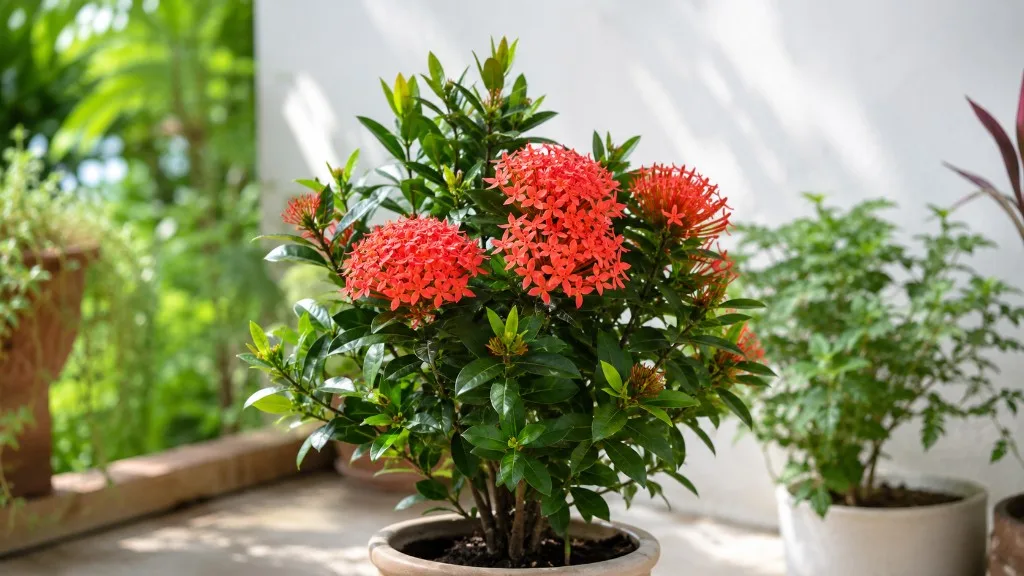
Ixora - also called jungle flame, flame of the woods, or West Indian jasmine - is grown for dense clusters of four-petaled flowers against glossy evergreen foliage. In warm climates it serves as a hedge, foundation shrub, or container specimen; indoors and in conservatories, dwarf forms stay manageable at roughly 1–2 m tall and 60–90 cm wide in pots. Propagation lets you multiply a cultivar you already know performs well in your light and soil, refresh an overgrown pot-bound plant by starting compact replacements, or share rooted material with another gardener without buying nursery stock.
The biology explains the moderate difficulty. Ixora stems lignify quickly compared to pothos or coleus. A cutting taken from fully woody lower growth has fewer cells capable of forming root initials, and a cutting stripped of too many leaves may lose water faster than it can replace through stem uptake. At the same time, Ixora cuttings carry enough leaf area and stored carbohydrates to support rooting when you choose semi-hardwood tips - stems firm enough to snap cleanly but still green enough at the growing end to show active meristem tissue. UF/IFAS recommends 4- to 6-inch (10–15 cm) tip cuttings of tender or semi-hardwood growth taken during active warm-season growth, with lower leaves removed and at least one node exposed to moist medium (UF/IFAS - Ixora propagation).
Propagation also solves practical display problems. A leggy, pot-bound Ixora can donate tip cuttings while you air layer a lower branch for a larger replacement. Starting from healthy non-flowering stems produces stronger rooted specimens than bloom-stressed tissue.
How Ixora Stem Propagation Works
Stem propagation asks wounded plant tissue to prevent excessive water loss through the leaves while building a new root system from nodes along the stem. An Ixora cutting without roots still transpires moisture from its leaf surfaces. If it loses water faster than the stem can supply - or faster than new roots can replace - it wilts, browns at the base, or rots in wet anaerobic mix. Your setup must close that gap: enough upper leaf area for modest photosynthesis, enough contact between at least one node and moist oxygenated medium, and enough enclosure to keep relative humidity high without cooking the cutting in stagnant air.
Adventitious roots form from cells at or near nodes, the joints where leaves attach to the stem. On Ixora, nodes appear as slight swellings along the stem, sometimes with a visible leaf scar from a removed lower leaf. Burying or contacting at least one node with moist peat-perlite mix gives root initials a place to emerge. The upper leaves continue limited gas exchange and energy production, supporting rooting before the new root system is fully functional. Smooth internodal tissue between nodes does not reliably produce roots and tends to decay if buried without a node at that level.
Ixora is not a good candidate for water propagation the way pothos or tradescantia are. Its woody stems often sit in water for weeks without forming roots, then soften and rot at the submerged end. Soil or moss contact at a node, combined with rooting hormone and humidity, matches how commercial growers and experienced home gardeners root this genus. If you want visible root progress, air layering with sphagnum moss wrapped around a wounded stem on the parent plant is the better monitoring method than a water jar.
Semi-Hardwood Stems and What Actually Roots
Semi-hardwood sits between soft new growth and fully woody old branches. Press your thumbnail into the stem: soft green tips dent easily and may wilt fast as cuttings; lower woody sections feel rigid and root slowly or not at all. The ideal Ixora cutting comes from the middle zone - firm enough that the stem does not flop, green enough that the bark has not turned grey-brown and thick. UF/IFAS Extension specifies 4- to 6-inch branch sections during warm-season propagation, which aligns with semi-hardwood timing in temperate homes that overwinter Ixora indoors.
A node is non-negotiable. A leaf detached without stem tissue, or a stem segment with no node, cannot become a full plant. For Ixora, aim for two or three nodes on the portion you will bury, with the basal cut made just below a node at a slight angle so water does not pool on a flat cut surface. Remove lower leaves so 5–8 cm (2–3 inches) of bare stem sits in medium, leaving two to four leaves at the tip for photosynthesis. Strip any flower buds or open blooms - reproductive growth diverts energy away from root formation and the extra transpiration stress works against you.
Choosing the Best Ixora Cuttings
Start with a healthy parent plant that is actively growing, not drought-stressed, pest-ridden, or showing advanced iron chlorosis from alkaline soil. Ixora displays stress through yellowing leaves with green veins, sparse new tips, bud drop, and general lack of vigor. Weak parent tissue produces weak cuttings, and propagation cannot reverse a plant already failing on light, water, or pH. If the parent looks tired but you still want to try, take material from the firmest new growth at the stem tip rather than the oldest woody sections near the base.
Prefer stems with glossy green leaves, normal color for the cultivar, and no black mushy spots at nodes or stem bases. Avoid cuttings from branches with sticky residue (aphids or scale), chewed foliage, or recent sun scorch. Ixora rarely flowers heavily indoors year-round, but stems carrying tight bud clusters or heavy bloom should be skipped for propagation - use adjacent non-flowering side shoots instead. Take three to five cuttings rather than one when learning the method; Ixora rooting percentages are not 100%, and redundancy costs little beyond extra pots and mix.
Which Stems to Cut and Which to Avoid
Take cuttings from terminal shoots or healthy lateral branches on the outer canopy where light is strongest and tissue is most vigorous. Make the cut with sharp bypass pruners or a clean knife so you do not crush the stem. A crushed wound oxidizes slowly and invites fungal entry; a clean angled cut heals faster and exposes more cambium for hormone uptake.
Reject stems that are mushy at the base, blackened, heavily corky and grey, or bent from mechanical damage. Skip the lowest branches on a leggy shrub if they have lost all leaves and turned fully woody - air layering may still work on those if the branch is flexible and healthy beneath the bark, but they make poor detached cuttings. When refreshing shape on a mature Ixora, combine tip cuttings from the top with air layering on a lower lateral if you want a larger rooted piece with more immediate shrub presence.
The Best Time to Propagate Ixora
Ixora roots fastest during active growth, when temperatures are warm and day length supports new leaf production. Late spring through early summer is the optimal window in temperate climates - roughly when the parent pushes firm new tips and you are past the coldest indoor night temperatures. In frost-free zones USDA 9–11 where Ixora grows outdoors year-round, take cuttings after the spring flush when stems are semi-hard but not heat-stressed from midsummer drought.
Use plant readiness, not only the calendar. The parent should show firm new tips, healthy leaf color without widespread chlorosis, and no active mealybug, scale, or mite outbreak. Do not propagate immediately after shipping, Ixora repotting guide, or a severe wilt episode - wait until new growth looks stable for two to three weeks. Propagation during stress sometimes works, but it is a poor teaching example when you are learning the method. Target air and medium temperatures around 21–27°C (70–80°F); The Spruce and tropical nursery guidance both emphasize warmth, and a heat mat set to the low end of that range under propagation trays noticeably improves rooting speed for slow-rooting woody cuttings.
Cool, dim winter propagation often ends in slow rot or leaf drop without roots. If you must try off-season, add a grow light and heat mat, and accept a longer timeline.
Tools, Materials, and Acidic Mix Basics
You need modest equipment: sharp bypass pruners, a clean knife for air layering, small pots with drainage holes, rooting hormone (powder or gel containing IBA), a propagation dome or clear plastic bags, labels, and 70% isopropyl alcohol for disinfecting blades between cuts. Optional but valuable: a heat mat, sphagnum moss for air layering, clear plastic wrap or grafting tape, and a chopstick for dibbing planting holes without burying hormone off the stem.
The mix matters as much as the cutting. Ixora requires acidic, well-draining medium with a pH roughly 5.0–6.5. UF/IFAS Extension notes that a pH of around 5 suits ixora - slightly lower than for most landscape plants - and that acidity requirement starts at propagation, not after transplant. A reliable rooting blend is equal parts peat moss and perlite, or two parts peat to one part coarse sand or perlite. Pre-moisten the mix until it holds together when squeezed but does not drip freely. Avoid straight garden soil, heavy compost, or lime-amended potting mix; alkaline conditions block iron uptake and produce yellow leaves with green veins (iron chlorosis) even on a cutting that managed to root.
Use rainwater, distilled water, or filtered water for misting and watering propagations if your tap water is hard and alkaline. Chronic high-pH irrigation is one of the most overlooked reasons Ixora cuttings look sick after rooting - the roots form, then the new growth yellows within weeks. Disinfect tools before cutting and between plants if pests or stem rot have been an issue on the parent.
Preparing Ixora Stem Cuttings Step by Step
Work in order so stems do not dry out between steps. First, fill propagation pots three-quarters full with pre-moistened acidic mix and dib a hole 5–8 cm (2–3 inches) deep with a pencil - do not push bare stems into dry mix, which rubs hormone off and compacts medium against the wound. Second, select and cut your semi-hardwood sections, keeping a bucket or damp paper towel nearby if you are processing several at once. Third, remove lower leaves and any flowers or buds. Fourth, dip the basal 2–3 cm (1 inch) of stem, including the node region, into rooting hormone; tap off excess powder so it does not clump and hold too much moisture against the stem.
Insert the cutting gently into the prepared hole so at least one node sits below the surface; two nodes buried is better when stem length allows. Firm mix around the stem without compacting it into anaerobic mud. Water lightly with acidic water until a few drops exit the drainage holes, then discard saucer water. Cover the pot with a clear plastic bag supported by stakes or a propagation dome so plastic does not touch leaves - contact points breed fungal spots. Place the setup in Ixora light guide, not direct midday sun that cooks enclosed cuttings.
For air layering prep, choose a pencil-thick branch, identify a node zone 30–60 cm (12–24 inches) from the tip, and gather moss, wrap, and hormone before making any wound.
Method 1: Rooting Ixora Stem Cuttings in Soil
Soil rooting is the standard method for Ixora and the one UF/IFAS Extension describes: take a 4- to 6-inch (10–15 cm) branch piece, dip in rooting hormone, plant in well-drained medium, place in moderate light, and keep lightly watered until roots form in four to six weeks under favorable conditions. Home growers in cooler or dimmer rooms should plan on six to eight weeks before treating a cutting as rooted.
After planting, the cutting lives in a closed humidity environment for most of the rooting period. Open the bag or dome briefly every two to three days to exchange stale air and check moisture - mix should stay evenly damp, never waterlogged. If condensation fully clears and mix surface looks dry, mist lightly with acidic water rather than pouring heavy doses that saturate the bottom while the stem base rots. Leaves should look turgid; slight wilting on day one can recover if humidity is high, but persistent limp foliage with a brown stem base means failure.
Humidity, Heat, and Root Checks
High humidity (60–80%) around the foliage reduces transpiration while roots are absent. A dome or bag achieves this cheaply; misting alone without enclosure is usually insufficient for Ixora in dry air-conditioned rooms. Bottom heat at 21–24°C (70–75°F) accelerates root initiation on woody cuttings - set the heat mat on a thermostat and monitor enclosed temperature so it does not exceed 29°C (85°F), which encourages mold.
Test for roots with a gentle tug after four weeks: resistance without the stem pulling freely suggests root attachment. Do not yank weekly from day one - disturbance breaks fragile root hairs. Better signals include new leaf growth at the tip and visible white root tips through drainage holes on clear or slotted containers. Once roots hold the stem and new growth looks firm, begin hardening off by opening the humidity cover for longer periods each day over one week before full removal.
Method 2: Air Layering Ixora
Air layering propagates Ixora while the stem remains attached to the parent, so the branch continues receiving water and carbohydrates through the intact vascular connection above the wound. This method suits larger shrubs, low branches you want to turn into a new plant without risking a detached cutting, and situations where stem cuttings have failed but the parent is otherwise healthy. Roots typically appear in six to ten weeks, sometimes longer on thick woody stems.
Select a healthy semi-hardwood branch about pencil thickness or slightly larger. Roughly 30 cm (12 inches) below the tip, at a node, make an upward-slanting cut one-third to halfway through the stem, or remove a 2–3 cm (1 inch) ring of bark (girdling) down to the cambium. Insert a toothpick or small twig to keep the wound open if you used a single cut - open cambium contact with moist moss encourages root formation. Dust the exposed area with rooting hormone. Soak sphagnum moss in acidic water, squeeze out excess so it is damp not dripping, and wrap a generous handful around the wound. Cover the moss bundle with clear plastic wrap, seal top and bottom with twist ties or grafting tape so moisture stays in and rain or irrigation does not wash hormone away.
Check the wrap monthly by gently pressing - moss should stay damp. Open briefly to remoisten if it dries, then reseal. When white roots fill the moss and hold it together when you squeeze lightly through the plastic, sever the stem below the rooted zone with clean pruners. Remove plastic, plant the rooted section in acidic potting mix in a pot sized to the root ball, and water thoroughly. Keep the new plant in bright indirect light and high humidity for two weeks while it adjusts to independent life.
Wounding, Moss Wrap, and Separation Timing
The wound depth matters: too shallow and roots never form; too deep and the branch snaps or dies above the cut. A ring girdle about 2 cm (¾ inch) wide is the most reliable technique on Ixora-sized stems because it interrupts phloem flow and concentrates hormone response at the moss zone without fully severing the branch. Always wound at or just below a node - nodes are root-prone tissue.
Do not separate the layer too early. Roots thinner than hair will not survive transplant shock. Wait until you see a dense mat through the plastic and the moss holds together when probed. If roots are sparse after ten weeks, rewrap and wait rather than cutting prematurely. After separation, treat the new plant like a fresh cutting for two weeks - no fertilizer, no full sun, steady moisture in acidic mix.
Stem Cuttings Versus Air Layering: Which Method to Choose
Stem cuttings win on speed and batch size - root several in a tray on a heat mat without altering the parent shape. Air layering wins on large healthy parents, woody lower branches, or after failed cuttings, because the parent feeds the branch until roots form. Use cuttings for routine multiplication; air layer for difficult branches or high-value single clones.
Building the Right Rooting Environment for Ixora
Ixora evolved in humid tropical and subtropical regions of Asia. Propagation environments that mimic warmth, steady moisture, bright filtered light, and acidic substrate outperform setups optimized for desert succulents or temperate herbaceous cuttings. A windowsill that works for mature Ixora may still fail for cuttings if night temperatures drop or dry heating air desiccates enclosed foliage.
Avoid placing closed bags in direct south-facing glass where internal temperatures spike above 32°C (90°F). If mold appears on mix surface, open ventilation longer and reduce watering slightly.
Light, Temperature, and Humidity Targets
Bright indirect light means a spot where you could read comfortably without a lamp all day but where direct sunbeams do not hit the enclosure for more than an hour of gentle morning light. Ixora cuttings need light for photosynthesis but scorch easily under plastic in harsh sun. Temperature for rooting should stay 21–27°C (70–80°F) day and night; fluctuations below 15°C (59°F) stall root initials. Humidity around foliage should feel like a greenhouse - visible condensation on dome walls is normal; absent condensation in a sealed setup usually means a leak or dangerously dry air.
Mature Ixora prefers full sun to partial shade with four to six hours of direct sun for best flowering, but newly rooted plants need two to four weeks of gentler light before gradual acclimation to brighter conditions. Moving a rooted cutting from enclosed humidity to a sunny patio in one step burns leaves and sets back establishment by weeks.
Transplanting and Hardening Off Rooted Ixora
Transplant when roots are several centimeters long, hold the stem on a gentle tug, and new tip growth looks firm and green. Move into a pot one size larger than the root mass - oversized pots stay wet too long and encourage root rot on Ixora on a young Ixora. Use ericaceous or acid-loving potting mix with perlite for drainage; a typical ratio is peat-based acid compost amended with 20–30% perlite. Plant at the same depth the cutting rooted; burying the stem deeper invites stem rot.
Harden off over seven to ten days: remove humidity cover for increasing hours, then transplant, then keep in bright indirect light for two weeks before shifting toward the plant’s long-term placement. Water thoroughly at transplant, then let the top 2–3 cm (1 inch) of mix approach dry before watering again - wet feet on a small root system is a common post-transplant killer. Do not fertilize until four to six weeks after transplant when new growth is clearly active; early fertilizer on fragile roots causes salt burn.
For air-layered plants, the root ball is moss-bound - plant moss and all without teasing roots apart aggressively. Trim only obviously circling thick roots if the layer was left on the parent a long time.
Aftercare During and After Propagation Success
New Ixora plants need steadier conditions than established shrubs. Keep moisture even but not waterlogged - the same principle as mature care: Ixora likes consistently moist acidic mix, never sitting in anaerobic sog. Use rainwater or filtered water to protect pH. Maintain high ambient humidity for the first month if your home is dry; a pebble tray or grouping with other plants helps without enclosing the plant forever.
Watch for iron chlorosis - yellow leaves with dark green veins - especially if you irrigate with hard tap water or repotted into non-acid mix. Correct with acidic watering and, if needed, chelated iron foliar spray on established new growth, not on the day of transplant. Do not repot again for at least six months unless roots circle heavily or mix smells sour. Resist checking roots daily; new firm leaves are the success metric.
Once the plant pushes steady growth, transition toward normal Ixora care: increasing light toward full sun to partial shade, watering based on pot dry-down, and acid-forming fertilizer during active growth only.
Common Ixora Propagation Problems and Fixes
Brown, mushy stem base usually means oversaturated mix, poor drainage, or a cutting that was too woody or too weak before cutting. Discard the cutting, sterilize the pot, and retry with fresher semi-hardwood material and a perlite-heavier mix. Black spots on leaves under plastic indicate fungal issues from leaf contact with wet plastic or stale air - increase ventilation and support the bag away from foliage.
Cuttings green but no roots after eight weeks often trace to cool temperatures, woody stem selection, missing hormone, or alkaline mix. Move to heat mat, retake cuttings from greener growth, and verify mix pH. Wilting despite wet mix can mean stem rot below the surface while upper leaves temporarily stay turgid - tug gently; if the stem slides, discard.
Air layer moss dried out kills the attempt - rehydrate early or restart on a new branch. Roots formed but plant yellows after potting is classic alkaline soil or water; flush with acidic water and repot into ericaceous mix if needed. Pest transfer from parent to cutting happens when you propagate from infested stock - treat the parent first or take material only from clean upper growth after isolating the plant.
The ASPCA lists Ixora coccinea as non-toxic to dogs, cats, and horses - still keep rooting hormone and plastic off the floor where curious animals chew.
Conclusion
Ixora propagation through stem cuttings and air layering is absolutely achievable at home when you respect the plant’s tropical, acid-loving biology. Take semi-hardwood sections 10–15 cm long with two or three nodes during late spring to early summer, dip in rooting hormone, and root in moist peat-perlite mix under high humidity and warmth for four to eight weeks. For stubborn or lower branches on a healthy parent, air layer with a girdled wound, sphagnum moss, and sealed plastic for six to ten weeks before severing and potting.
Success is not guaranteed on every stem - Ixora roots more slowly than soft-stemmed houseplants - but clean cuts, acidic medium from day one, and patient humidity management shift the odds strongly in your favor. Skip water jars, skip alkaline mix, and skip propagation from stressed parents. When new firm leaves appear and roots hold on a gentle tug, transition gradually to normal Ixora care and you will have a clone ready to bloom on the same timeline as nursery stock, without guessing whether a seedling will match the parent’s flower color.
When to use this page vs other Ixora guides
- Ixora overview - Start here for whole-plant context before deep-diving this topic.
- Ixora problems hub - Jump to symptom-specific fix guides when this care topic does not resolve the issue.
Related Ixora guides
- Ixora overview
- Ixora watering
- Ixora light
- Ixora soil
- Ixora fertilizer
- Ixora repotting
- Ixora problems
Related tool
Try the Propagation Success Calculator with ixora pre-selected to estimate needs for your setup.