Leggy Growth on Ficus Benjamina: Causes, Checks & Fixes
Quick answer
Leggy growth on Ficus benjamina is etiolation-long gaps between leaves on weak shoots reaching toward light. First step: run the hand-shadow test at canopy height; if the shadow is faint, move the tree to bright indirect light within one to three feet of an east or filtered south window, or add a grow light, before pinching or pruning stretched stems.
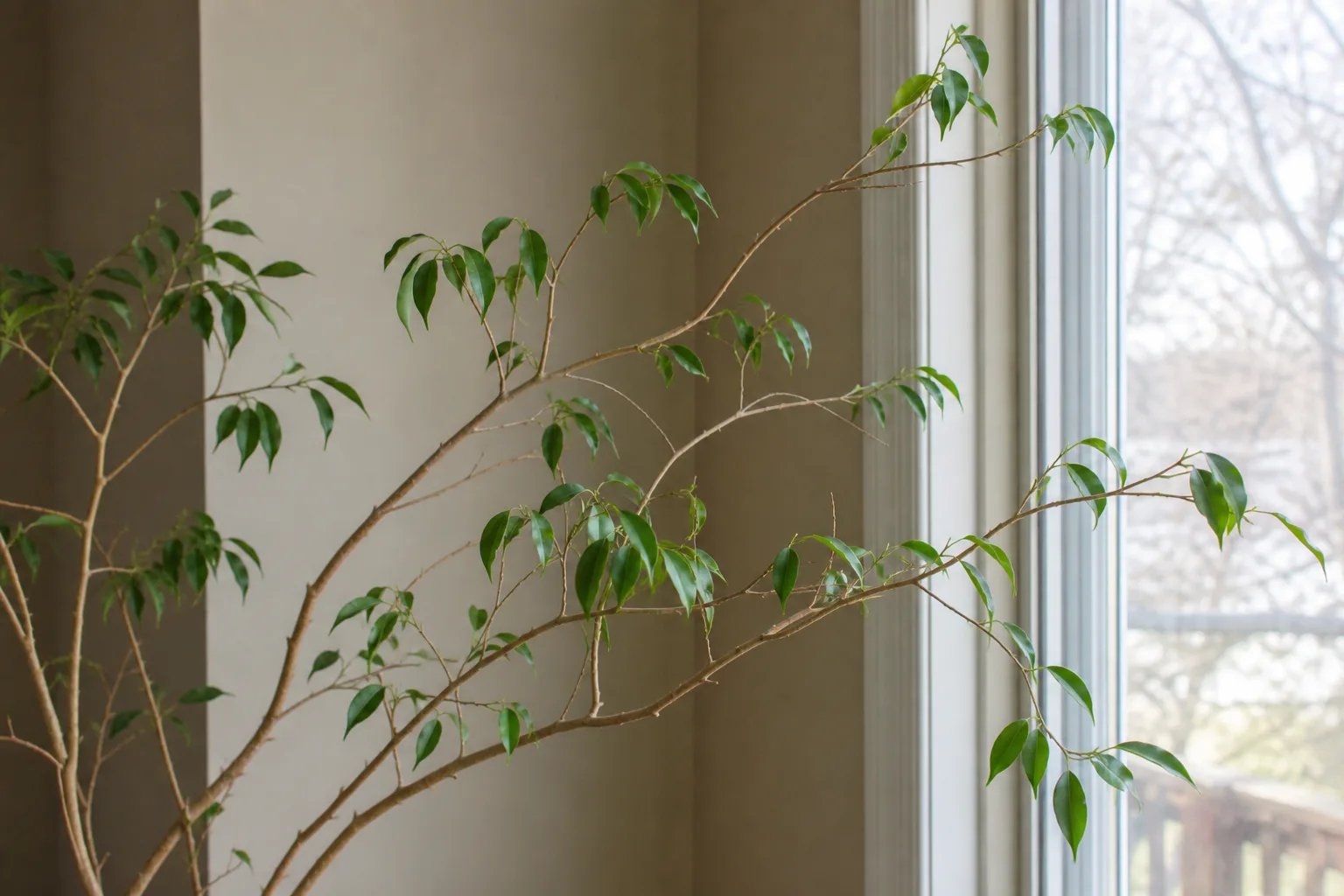
Leggy Growth on Ficus Benjamina: Causes, Checks & Fixes
This guide covers leggy growth on Ficus Benjamina. See also the general Leggy Growth guide, watering, and light pages for this plant.
Leggy Growth on Ficus Benjamina: Causes, Checks & Fixes
Quick answer
Leggy growth on Ficus benjamina - the weeping fig - means etiolation: the plant stretches toward available light, producing long internodes, small pale new leaves, and bare lower stems while fresh shoots reach toward windows. It is not vigorous healthy growth. Weeping fig is a high-light foliage tree that maintains its dense, glossy canopy only when daily brightness supports many leaves at once.
First step: test light where the pot actually sits. At canopy height on a bright day, hold your hand between the window and the plant. A soft, readable shadow means usable indirect light; almost no shadow means the spot is too dim and stretch will continue. If the test fails, move the tree to bright indirect light within one to three feet of an east window or a filtered south or west exposure-or mount a full-spectrum grow light above the canopy-before pinching or pruning. Reshaping without more photons produces another round of weak, elongated shoots.
For broader insufficient-light symptoms-inner canopy thinning, mass leaf drop, and wet soil in dim corners-see the not enough light on Ficus benjamina guide. This page focuses on recognizing and correcting stretch and rebuilding canopy density after light improves.
What leggy growth looks like on Ficus Benjamina
Read new growth first. Leggy weeping fig shows a recognizable architecture even when older leaves still look green.
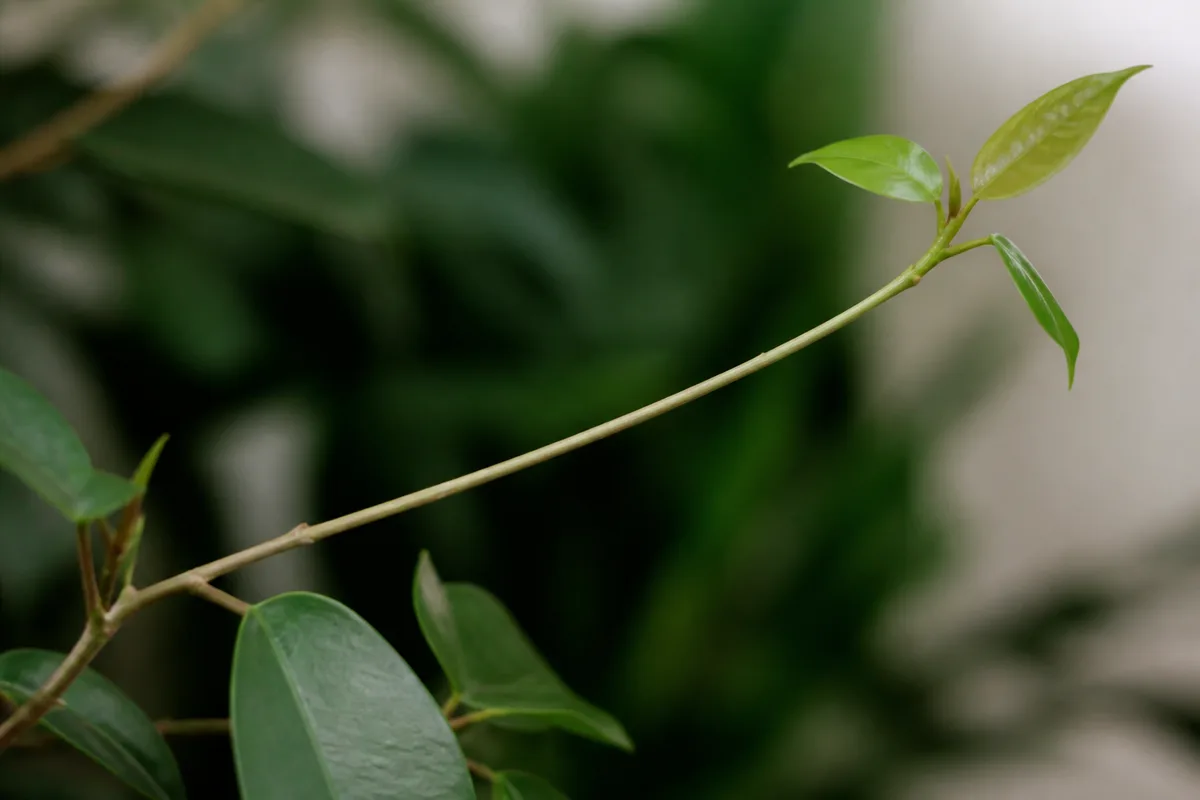
Leggy Growth symptoms on Ficus Benjamina - compare with healthy tissue on the same plant.
Long internodes are the hallmark. Compare the gap between the last two leaves on a growing tip to spacing on mature wood from six months ago. On a stretched shoot, new leaves emerge smaller, paler, and farther apart-sometimes two to three times the normal distance on severely etiolated stems. Indoor plants in too little light become spindly as they stretch toward brighter sources, and weeping fig is among the species most prone to this pattern indoors.
Directional lean often follows. The whole crown or individual leaders bend permanently toward the brightest wall or window. One-sided stretch is common when the pot never rotates; the window-facing side carries elongated shoots while the shaded side stays sparse.
Bare lower trunk with stretched upper growth is the classic floor-tree silhouette. Inner and lower leaves drop or never develop while the top keeps extending-producing a lollipop or palm-like profile instead of the weeping dome most buyers expect. This overlaps with insufficient light canopy thinning but leggy growth emphasizes stem elongation, not leaf drop alone.
Variegated cultivars such as ‘Starlight’, ‘Exotica’, and ‘Reginald’ show stress early. White or cream sections on new leaves shrink or disappear in dim rooms because those patches photosynthesize poorly. Solid-green shoots may look healthier while the plant is still etiolating.
Leggy growth develops gradually over weeks to months. Sudden mass leaf fall within days of a move fits relocation shock more than chronic stretch-though both can coexist if a recently moved tree sits in deep shade.
Why Ficus Benjamina gets leggy
Weeping fig evolved as a tropical edge tree in bright, filtered daylight-not deep interior shade. Indoors, that translates to bright indirect or curtain-filtered sunlight for most of the day. When daily light integrals fall too low, the plant cannot afford the metabolic cost of a full canopy. It enters a survival strategy: extend stems toward photons and shed leaves it cannot feed.
Missouri Botanical Garden notes that weeping fig does not tolerate poorly lit locations. Clemson Extension groups it with high-light houseplants suited to bright western or southern exposures with filtering-not snake plant or ZZ plant territory.
Distance from glass matters as much as compass direction. Light intensity drops sharply as you move away from windows, often halving every two to three feet. A weeping fig on a wall opposite a south window may receive enough brightness to survive but not enough to stay compact. Tall floor specimens add another layer: the top of the crown may stretch while the lower third starves.
Short winter photoperiods and obstructed sky view compound the problem. Even moderate reflected light may be inadequate if exposure hours are too short-stretch accelerates while the owner assumes slow growth is normal dormancy.
Lookalike symptoms to rule out
| Pattern | Likely cause | What differs from leggy etiolation |
|---|---|---|
| Long internodes + lean toward window + firm wood | Insufficient light (etiolation) | Primary match for this page |
| Mass leaf drop within days of any move | Relocation shock | Drop is sudden and widespread; stretch may pause temporarily |
| Yellowing + wet soil + possible sour smell in dim corner | Overwatering in low light | Soil stays saturated; fix light and dry-down together |
| Stippling + fine webbing on undersides | Spider mites on stressed trees | Pests present; weak stretch is secondary |
| Crisp dry edges + very light pot | Underwatering | Rare as sole cause when tree reaches toward light |
| Drop localized on one side facing HVAC | Draft or heat vent stress | Move away from blast; stems may not be elongated |
Soft stems at the base with sour-smelling wet soil point to root decline, not etiolation alone. Firm wood, directional stretch, and moderate soil moisture keep leggy growth at the top of the list.
How to confirm the cause
Work through this checklist before committing to pruning:
- Hand-shadow test at pot height - On a bright day, hold your hand at the top of the canopy. Soft shadow = likely adequate indirect light for maintenance. Faint or absent shadow = too dim; stretch will continue until light improves.
- Internode comparison - Measure or eyeball spacing on the newest shoot versus mature wood. Widening gaps confirm etiolation.
- Lean direction - Stretch toward a specific window supports light deficiency. Random wobble or pot tilt suggests mechanical instability or root issues.
- Drop timing - Gradual inner loss over weeks fits chronic low light plus stretch. More than twenty percent of foliage on the floor within a week after a move fits relocation shock; stabilize before reshaping unless the spot is deep shade.
- Soil dry-down rate - Dim plants transpire slowly; mix may stay wet ten days or more while stems elongate. Pair light correction with watering adjustments-do not treat stretch as thirst alone.
- Pest check - Fine webbing on leaf undersides on a thinned, dim-corner tree warrants mite treatment after light is adequate.
If four or more checks point to insufficient light at the pot, proceed with the light-first fix below-not fertilizer, Ficus Benjamina repotting guide, or heavy pruning on day one.
First fix for Ficus Benjamina
Increase usable light at the canopy in one deliberate placement change-then stop moving the tree.
Move the weeping fig to the brightest location that still qualifies as bright indirect light:
- One to three feet from an unobstructed east window, or
- Three to five feet back from south or west glass with a sheer curtain to block hot direct afternoon rays, or
- A full-spectrum LED grow light twelve to twenty-four inches above the top of the canopy on a twelve- to fourteen-hour timer if no window passes the hand-shadow test.
The canopy should see bright sky without leaves pressed against hot panes. Weeping figs react to relocation with temporary leaf drop even when the new site is better-make one move, then wait fourteen days before judging. Do not hunt for a perfect spot by shifting weekly; each move retriggers abscission.
If the upgrade is large-from a dim interior hallway to a bright east sill-acclimate over seven to fourteen days by increasing hours at the brighter location gradually while watching new leaf color.
Adjust watering to the new dry-down rate. Brighter spots dry faster; keep the old dim-corner schedule and you risk soggy roots while trying to fix stretch.
Step-by-step recovery: light, then pinching and pruning
Once light is corrected, rebuild canopy density in this order:
Phase 1 - Stabilize (days 1–14)
- Hold placement stable. No repotting, no fertilizer, no heavy cuts on the same week as the move.
- Check soil depth twice weekly until you learn the new rhythm.
- Rotate the pot a quarter turn every two to three weeks so all sides receive similar exposure.
Phase 2 - Confirm compact new growth (weeks 3–6)
- Judge recovery by new buds, not old stretched wood. Compact, normally colored leaves on shorter internodes confirm the light fix worked.
- Skip fertilizer until new growth looks normal in size and color for two weeks.
Phase 3 - Pinch and prune stretched stems (after new buds appear)
Only reshape after compact new growth proves light is adequate-pruning without improving light causes repeat legginess.
Pinching - Nip soft growing tips between thumb and finger just above a leaf node when a shoot reaches six to eight leaves. This removes the apical dominance signal and encourages lateral branching without large wounds. Repeat on new elongating tips through active growth.
Selective pruning - For bare lower trunk or severely stretched leaders, cut back to a leaf node or lateral branch with clean bypass pruners. Weeping fig can be pruned to shape as needed and tolerates hard pruning when necessary, but limit removal to one-third of live foliage per session on a stressed tree. Cut five to eight millimeters above a node with the nearest bud facing outward. Full protocol is on the Ficus benjamina pruning guide.
What old tissue cannot do - Elongated internodes never shorten. Bare inner wood may stay bare unless dormant buds activate; light pruning of dead tips after stabilization can redirect energy to viable nodes.
For north rooms and tall floor trees where window light reaches only the upper crown, keep supplemental grow lights through winter per the light requirements guide.
Recovery timeline
Expect some leaf drop in the first one to two weeks after a placement correction-often leaves formed for the old light level, not proof the new spot failed.
First compact new leaves typically appear within three to six weeks after light improves during spring or summer active growth. Late fall or winter corrections may stall until longer days return.
Old stretched sections remain visually long even when the tree is healthy. A severely etiolated floor tree may take four to eight months to look full again after light, pinching, and selective pruning-even when care is correct.
Worsening signs: continuing mass drop after twenty-one days of stable bright placement, soft stems, or soil that stays sour and wet-audit for root problems and pests rather than moving again.
What not to do
Do not prune heavily before light improves-you remove photosynthetic surface while the tree still cannot produce compact tissue. Do not fertilize heavily to compensate for dim placement; salt builds up while the plant cannot use it.
Avoid unfiltered afternoon sun as a panic fix; hot glass scorches leaves trained in low light. Do not water less as the only response when soil stays wet in a dark room; fix light so the tree uses moisture again.
Resist moving the plant weekly hunting for a perfect spot. Each move retriggers leaf drop on weeping fig. Do not repot on day one unless roots are clearly failing; repotting plus relocation stacks stress this species hates.
Do not assume rapid stem extension equals healthy vigor. Etiolated tissue is structurally weak and invites repeat stretch until photons match the species’ needs.
How to prevent leggy growth next time
Choose placement before décor. Weeping fig belongs where bright indirect light is realistic all day-not where an empty corner needs filling. East windows and filtered south or west exposures are the usual winners; north rooms need grow lights for compact foliage year-round.
Clean windows seasonally, trim outdoor obstructions when possible, and re-evaluate in late autumn before winter angle drops intensity. Pair stable light with consistent watering tied to dry-down rate, not a calendar.
Pinch or lightly prune during active growth so apical stretch does not rebuild a sparse silhouette. Rotate pots every two to three weeks. When you must move the tree, plan one morning relocation and leave it alone for a full month.
When to worry
Escalate beyond routine light correction when:
- Stems flop or crack under their own weight
- More than a third of the canopy drops in a month while stretch continues
- Base stems feel soft with sour, constantly wet soil
- Fine webbing and stippling spread despite improved light-treat spider mites actively
Slow directional lean with firm wood and moderate soil moisture is a standard etiolation case-correct light once, then reshape.
Ficus Benjamina care cross-check
After light improves, align related care so stretch does not return:
- Light - Window placement, grow-light hours, and hand-shadow testing
- Watering - Dry-down rate increases in brighter spots; soggy dim-corner schedules cause compound stress
- Pruning - Node placement, one-third rule, and timing for reshaping leggy specimens
- Not enough light - Canopy thinning, relocation shock, and full low-light recovery when stretch is part of broader dim-room decline
- Overview - Hub for weeping fig care rhythm and stability after any change
Conclusion
Leggy Ficus benjamina is etiolation-a light-seeking stretch that produces long bare stems and weak new leaves, not healthy vigor. The fix hierarchy is deliberate: measure light at the pot, upgrade placement or add a grow light as one stable change, wait for compact new buds, then pinch or prune to rebuild density. Old internodes never shrink; recovery shows on the next leaf set. Get photons right first, reshape second, and the weeping fig can regain the glossy, branching silhouette that made you choose it-without repeating the same stretch next season.
When to use this page vs other Ficus Benjamina guides
- Ficus Benjamina watering guide - Use for routine moisture checks before assuming leggy growth is the main issue.
- Ficus Benjamina problems hub - Browse all 17 common issues on this species.
- Not Enough Light on Ficus Benjamina - Different entry point when symptoms overlap with leggy growth.
- Slow Growth on Ficus Benjamina - Different entry point when symptoms overlap with leggy growth.
- Leaf Drop on Ficus Benjamina - Different entry point when symptoms overlap with leggy growth.