Root Rot on Ficus Benjamina: Causes, Checks & Fixes
Quick answer
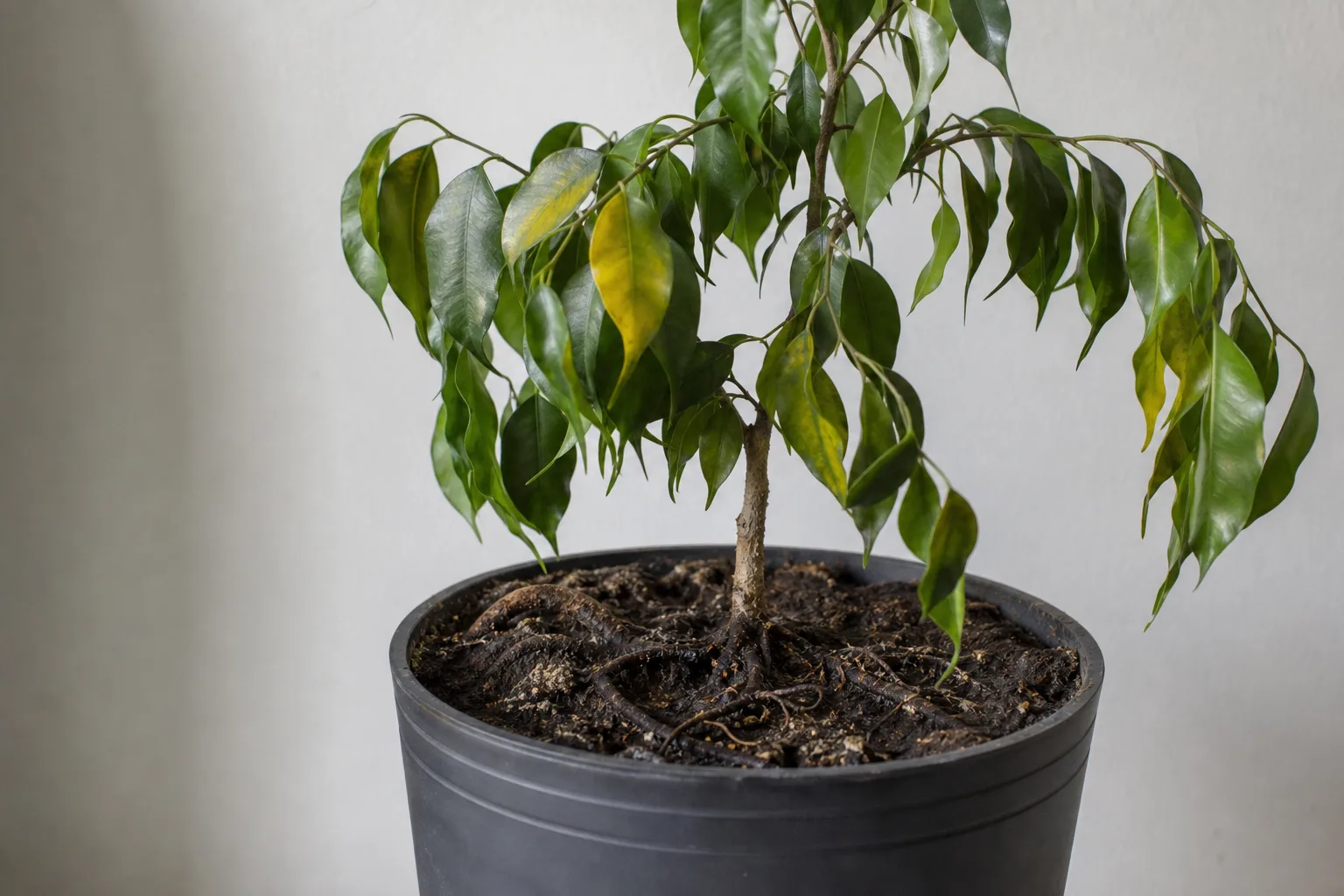
When a weeping fig wilts while the top inch of soil is still moist, stop watering immediately-that wilt-on-wet-soil pattern usually means roots are failing, not thirst. Unpot, trim mushy tissue, air-dry cuts, and repot into well-drained mix before the trunk softens at the soil line.
Root Rot on Ficus Benjamina: Causes, Checks & Fixes
This guide covers root rot on Ficus Benjamina. See also the general Root Rot guide, watering, and light pages for this plant.
Root Rot on Ficus Benjamina: Causes, Checks & Fixes
Quick answer
Ficus benjamina (weeping fig) is a tropical indoor tree with arching branches and small glossy elliptic leaves-not a compact rosette plant. Root rot here almost always starts when the root zone stays saturated too long: heavy mix, blocked drainage, cachepots holding runoff, or watering on a calendar while growth slows in a dim winter room.
The signature clue is wilt on wet soil. Leaves droop and lower foliage turns yellow while the top inch of mix still feels moist and the pot stays heavy. That pattern means rotting roots cannot absorb water-even though the soil is full-so adding another drink makes rot worse.
First step: stop watering immediately. Check whether the top inch is dry, lift the pot to feel weight, and press the trunk base at soil level for firmness. If soil is wet and stems are still firm, let the mix dry deeper than usual before any next soak. If mushy roots, sour smell, or soft trunk tissue appear on inspection, move to the numbered rescue workflow below. Prevention and the top-inch dry rhythm live on the Ficus benjamina watering guide.
Root rot vs. other weeping fig problems - why wilt on wet soil matters
Weeping figs are famous for shedding leaves when stressed-overwatering, underwatering, drafts, low light, and moves all trigger drop. Root rot is one specific failure mode within that spectrum, and mistaking it for thirst is the most common way owners kill an otherwise saveable tree.
Wilt on wet soil separates rot from drought. Underwatered weeping figs wilt when the pot is light, the top several inches are dusty dry, and soil may pull away from the pot wall. Rot-related wilt happens when soil stays wet for days, fungus gnats hover over the surface, and leaves feel soft rather than crisp. The owner sees drooping and waters again-stacking saturation on already dying roots.
Move shock can drop many green leaves within days of relocation without mushy roots. If you moved the tree recently and soil moisture is normal, stabilize placement before assuming rot. See leaf drop on Ficus benjamina when the whole canopy sheds after a shuffle.
Low light slows evaporation so the same watering rhythm that worked in summer keeps soil wet for weeks in winter. Rot develops quietly while only lower leaves yellow. Bright indirect light and a longer dry-down between drinks reduce that risk-details on not enough light.
What root rot looks like on Ficus benjamina
Symptoms build from the root zone upward. Because weeping figs carry hundreds of small leaves on pendulous branches, early rot can hide until a large batch of lower foliage yellows at once.
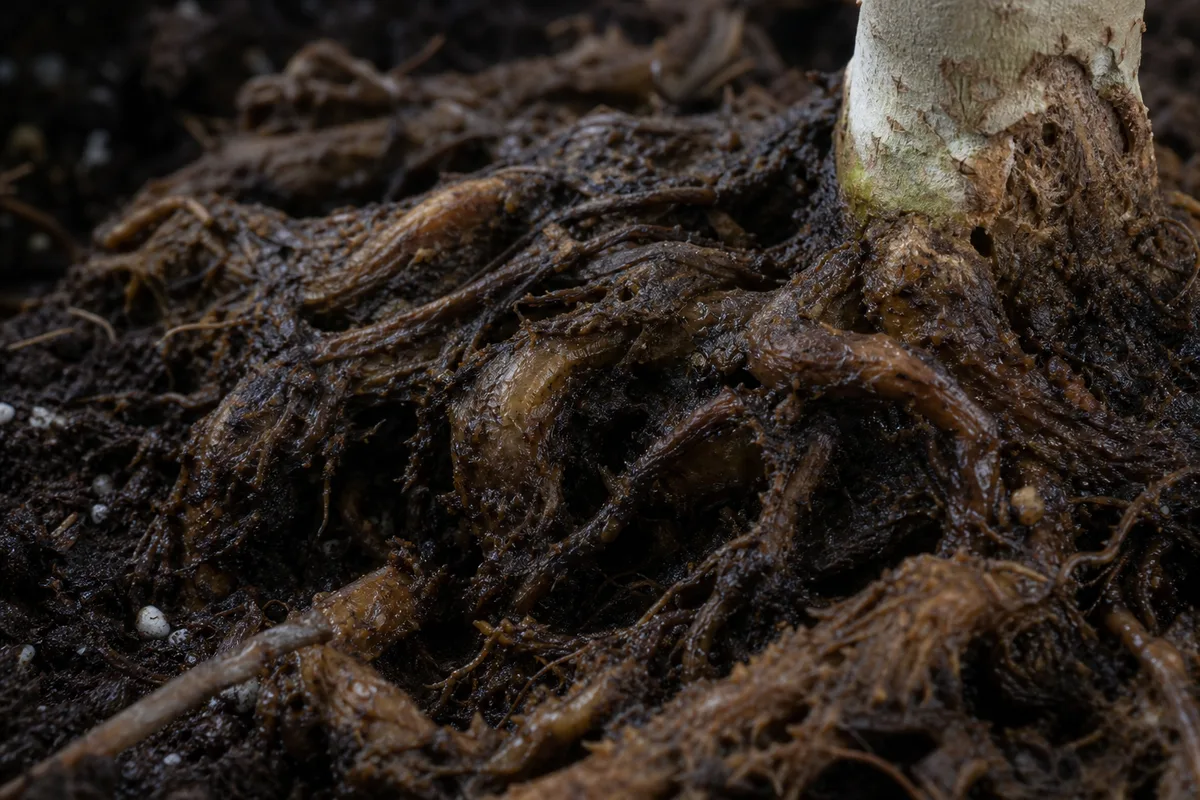
Root Rot symptoms on Ficus Benjamina - compare with healthy tissue on the same plant.
Early signs
- Lower elliptic leaves turn solid yellow and fall while soil stays wet for many days
- Limp, soft leaves across outer branches-not the crisp dryness of drought
- Canopy wilt despite moist mix; afternoon droop that does not match a light, dry pot
- Musty or sour odor from drainage holes or when lifting the plant from a cachepot
- Fungus gnats persistent on the soil surface-gnats alone are not proof of rot, but they signal chronic wetness worth investigating on the fungus gnats page
- Algae or green mold on the soil surface in low-light corners
Advanced signs
- Soft, dark tissue at the trunk base where stems enter the mix
- Branch-tip dieback on outer weeping limbs while inner stems still look green
- Mass leaf drop continuing for weeks after you reduce watering
- No firm white roots visible when you slide the root ball out-only brown, translucent, or slimy tissue
- Stunted or absent new buds at branch tips for more than four to six weeks after correction
Damaged leaves rarely re-green. Judge recovery by new glossy leaves opening at branch tips, not by old yellow foliage repairing itself.
Why Ficus benjamina gets root rot
Clemson HGIC states that root rot on weeping figs usually results from a mix that does not drain quickly or from overly frequent watering. Indoors, several habits stack on that vulnerability.
Overwatering, poor drainage, oversized pots, cachepots, saucers
Weeping figs prefer evenly moist soil during active growth-but evenly moist still includes a dry-down phase between thorough drinks. It does not mean the surface stays damp week after week.
Calendar watering ignores how fast the mix actually dries. A floor tree in bright indirect light may need water every five to seven days in summer; the same tree in a dim corner every ten to fourteen days-or longer-in winter. Watering every Tuesday regardless of soil state is a common rot trigger.
Heavy, compacted mix holds water around woody roots long after the top inch looks acceptable. Peat-heavy soil without enough perlite or bark stays anaerobic at the center of large pots.
Oversized decorative pots surround a small root ball with excess mix that never dries. Owners see a dry top inch and assume safety while the middle stays soggy-a classic post-repot rot setup. Right-sized containers are covered on the repotting guide.
Cachepots and saucers trap runoff. Even a well-drained inner pot rots if the outer shell holds an inch of standing water-weeping figs should never be waterlogged or allowed to sit with water in their saucers. Lift, drain at the sink, and empty saucers within thirty minutes of every watering.
Low light and cool rooms slowing dry-down
Winter combines shorter days, cooler room temperatures, and slower growth. The plant uses less water, but many owners maintain summer frequency. Soil stays wet for weeks; fine roots die from oxygen deprivation in anaerobic, waterlogged soil.
Pathogens such as Phytophthora and Pythium-water molds that thrive in saturated, low-oxygen mix-often colonize already injured roots in these conditions. Commercial greenhouse guidance on ornamental ficus lists yellowing leaves, wilting, root dieback, and sloughing root tissue under wet conditions as typical signs. Home growers rarely need fungicides; drying the root zone and repotting into fresh mix remove the environment those organisms need.
How to confirm the cause
Work through these checks before repotting. One wet-soil wilt episode with firm roots may need only a watering pause; mushy tissue needs surgery.
Top-inch dry, pot weight, and drainage check
- Finger test - Push your finger to the first knuckle (~1 inch). Sticky, cool mix on a wilting tree means do not water. For large floor trees, check the top 2–3 inches.
- Pot weight - Lift the container right after a known dry period versus after watering. Wet-soil wilt with a heavy pot confirms roots are failing, not dry.
- Drainage hole - Confirm holes are open, not sealed by roots or pebbles. Tilt the pot and sniff the exit-sour odor supports rot.
- Cachepot inspection - Remove the inner pot and look for pooled water in the outer shell.
- Skewer test - Insert a wooden skewer to mid-pot depth; moisture on the stick when leaves wilt on wet surface soil means the center is saturated.
Root and stem inspection on weeping branches
On a dry day, tip the tree out of its pot:
- Healthy roots: firm, white or tan, attached firmly to the root ball
- Rotting roots: brown, black, translucent, or slimy; outer cortex slips off when pinched
- Trunk base: should feel rigid; soft, dark bark at the soil line is advanced damage
If more than half the root mass is mushy but several branch tips remain firm, plan repotting plus possible stem-cutting salvage per the propagation guide. If the trunk is soft below soil level on multiple stems, prognosis is poor.
Lookalike comparison
| Pattern | Likely cause | First direction |
|---|---|---|
| Wilt + heavy wet pot + yellow lower leaves | Root rot | Stop water; inspect roots |
| Wilt + light pot + dry mix several inches down | Underwatering | Thorough soak; see underwatering |
| Mass green leaf drop days after move; firm roots | Location shock | Stabilize; see leaf drop |
| Gradual yellowing; wet soil; dim corner | Overwatering in low light | Stop water; brighten; see overwatering |
| Yellow lower leaves only; normal moisture | Natural senescence or nitrogen lack | Rule out wet soil first |
| Gnats + surface mold; stems still firm | Chronic wetness (early) | Dry-down; may prevent full rot |
First fix for Ficus benjamina
Stop watering the moment you confirm wet soil and wilt together. That single pause prevents the next drink from killing more fine roots. Everything else follows severity.
Stop watering and stabilize environment
Move the tree to bright indirect light if it sits in deep shade-evaporation slows in dim spots and compounds rot. Do not relocate repeatedly; weeping figs drop leaves when shuffled. Improve airflow around the pot base. Hold fertilizer entirely until new growth is stable for several weeks.
For mild cases-few dark root tips, sour smell just starting, stems still firm-letting the top third of the mix dry before one cautious, well-drained soak may be enough. Monitor pot weight daily.
Trim, air-dry, and repot steps
When inspection shows significant mushy root tissue, use this sequence:
- Prepare workspace - Cover the table with newspaper. Wear gloves: Ficus benjamina is toxic to cats and dogs, and latex sap can irritate skin when trimming rotted tissue.
- Unpot and rinse - Gently remove old mix so you can see the full root ball. Discard saturated soil; do not reuse it.
- Trim rot - With clean, sharp scissors or pruners, cut away all brown, mushy, or hollow roots back to firm tissue. Sterilize blades between cuts on severely infected plants (rubbing alcohol wipe).
- Air-dry - Let trimmed roots and the root ball surface air for one to two hours in shade so cut faces callus slightly.
- Repot smaller if needed - Choose a pot with drainage holes only slightly larger than the remaining root mass. Use light, well-drained mix-see Ficus benjamina soil for composition. Do not pack mix tightly.
- First watering after repot - Water lightly once so mix settles; drain fully. Wait until the top 2 inches dry before the next session.
- Reduce transpiration load - Light pruning of outer weeping branches lowers water demand while roots rebuild. Do not remove more than one-quarter of the canopy at once.
When to try stem-cutting salvage
If roots are mostly gone but firm branch tips remain above a soft trunk, take cuttings before discarding the parent. Select 4–6 inch sections with at least two nodes, remove lower leaves, and root in perlite or water following the propagation guide. Summer cuttings root fastest; winter salvage is slower but worthwhile when the main tree cannot be saved.
Recovery timeline
Recovery depends on how much healthy root tissue remains and whether stems stayed firm.
- Mild rot (mostly firm roots, corrected watering): Canopy may stabilize within one to two weeks after the mix dries and watering rhythm fixes. New branch-tip buds may appear in two to four weeks.
- Moderate rot (repot after ~30–50% root loss): Expect four to eight weeks before consistent new glossy leaves at stem ends. Some old leaves will continue to yellow and drop-that is normal shedding, not failure.
- Severe rot (major trim, small root ball): Two to three months for meaningful new growth. If no buds break after six weeks in bright indirect light with correct moisture, prognosis is poor.
- Stem-cutting salvage: Root formation in three to six weeks in warm, bright conditions; longer in cool winter rooms.
Signs of improvement: firm trunk base, new leaves at branch tips, pot weight cycling normally after watering, and stopped spread of yellowing up the weeping branches. Signs of worsening: softening trunk, continuing wilt on wet soil after repot, or total canopy collapse.
What not to do
- Do not water because leaves look wilted when soil is already wet. Watering a wilted plant with rotting roots makes the problem worse-that reflex accelerates rot on weeping figs more than almost any other mistake.
- Do not repot into dense garden soil or a pot without drainage holes.
- Do not fertilize stressed roots-salts injure tissue already compromised by anaerobic conditions.
- Do not leave the pot in a cachepot full of runoff while “letting it dry out.”
- Do not stack repotting, heavy pruning, and a location move on the same day. Weeping figs tolerate one major stress at a time.
- Do not assume all leaf drop equals rot-recent moves and drafts shed leaves on firm roots too.
How to prevent root rot next time
- Water when the top inch (or top 2–3 inches on large pots) feels dry-not on a fixed calendar. Full protocol: watering guide.
- Use well-drained mix and a pot sized to the root mass, not the desired canopy size.
- Empty saucers and cachepots within thirty minutes of every drink.
- Slow watering frequency in winter when growth pauses-the soil should dry slightly between waterings during low-growth periods in cooler, dimmer rooms.
- Place the tree in bright indirect light so the mix can dry predictably between sessions-see light requirements.
- Repot in late winter or early spring when needed, not into an oversized container “for growth room.”
- Watch for fungus gnats as an early wet-soil warning and correct drainage before rot sets in.
Stable placement, the top-inch dry rule, and zero standing water prevent most weeping fig root rot cases more reliably than rescue surgery after the trunk softens.
Conclusion
Root rot on Ficus benjamina is a drainage and watering failure-not a mysterious curse on indoor trees. The weeping fig’s small leaves and dense canopy can look fine while roots suffocate in wet mix; wilt on wet soil is the diagnostic hinge that tells you to stop watering, not pour more. Confirm with pot weight, smell, and a root inspection; trim mush, repot into fresh well-drained mix, and watch for new growth at branch tips. When roots are mostly lost, firm stems may still yield cuttings. Pair this rescue page with the watering, soil, and repotting guides so prevention becomes habit before the next overwatering season.
Related guides: Overview · Watering · Soil · Repotting · Propagation · Light · Overwatering · Wilting · Yellow leaves · Leaf drop · Fungus gnats
When to use this page vs other Ficus Benjamina guides
- Ficus Benjamina watering guide - Use for routine moisture checks before assuming root rot is the main issue.
- Ficus Benjamina problems hub - Browse all 17 common issues on this species.
- Overwatering on Ficus Benjamina - Different entry point when symptoms overlap with root rot.
- Yellow Leaves on Ficus Benjamina - Different entry point when symptoms overlap with root rot.
- Wilting on Ficus Benjamina - Different entry point when symptoms overlap with root rot.