Yellow Leaves on Ficus Audrey: Causes, Checks & Fixes
Quick answer
Yellow leaves on Ficus Audrey are a symptom, not a diagnosis. Lift the pot and check whether the top 2 to 3 inches of soil are wet or dry before you fertilize or repot-soft yellow lower leaves on a heavy wet pot point to overwatering; crisp yellow leaves on a light dry pot point to drought.
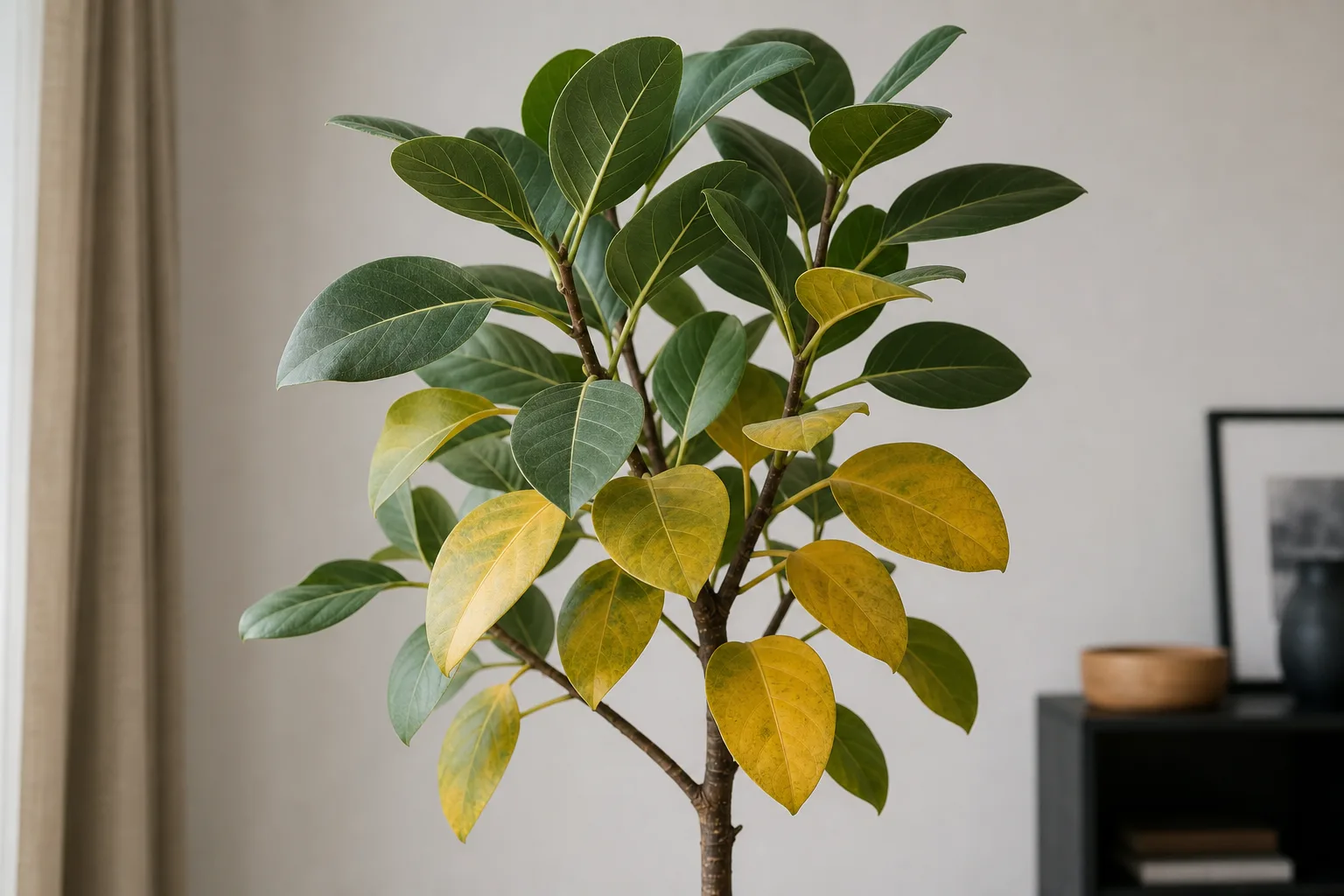
Yellow Leaves on Ficus Audrey: Causes, Checks & Fixes
This guide covers yellow leaves on Ficus Audrey. See also the general Yellow Leaves guide, watering, and light pages for this plant.
Yellow Leaves on Ficus Audrey: Causes, Checks & Fixes
Quick answer
Yellow leaves on Ficus Audrey (Ficus benghalensis) never tell you the cause by color alone. On this upright banyan fig, blades turn yellow from overwatering, underwatering, low light, cold drafts, relocation stress, pests, or the normal aging of older lower leaves on the trunk-each pattern looks similar until you check the pot.
First step: lift the pot and probe the top 2 to 3 inches of soil. That depth is Audrey’s standard dry-down checkpoint. A heavy wet pot with soft yellow lower leaves usually means roots are stressed from too much moisture. A light dry pot with crisp yellow blades usually means drought. A single yellow lower leaf on an otherwise firm tree with healthy gray-green tips at branch terminals is often harmless senescence. Full species context: Ficus Audrey overview.
What yellow leaves look like on Ficus Audrey
Healthy Ficus Audrey holds oval, gray-green leaves with velvety undersides clustered at branch tips on a smooth pale trunk. Yellowing shows up in distinct patterns depending on the cause.
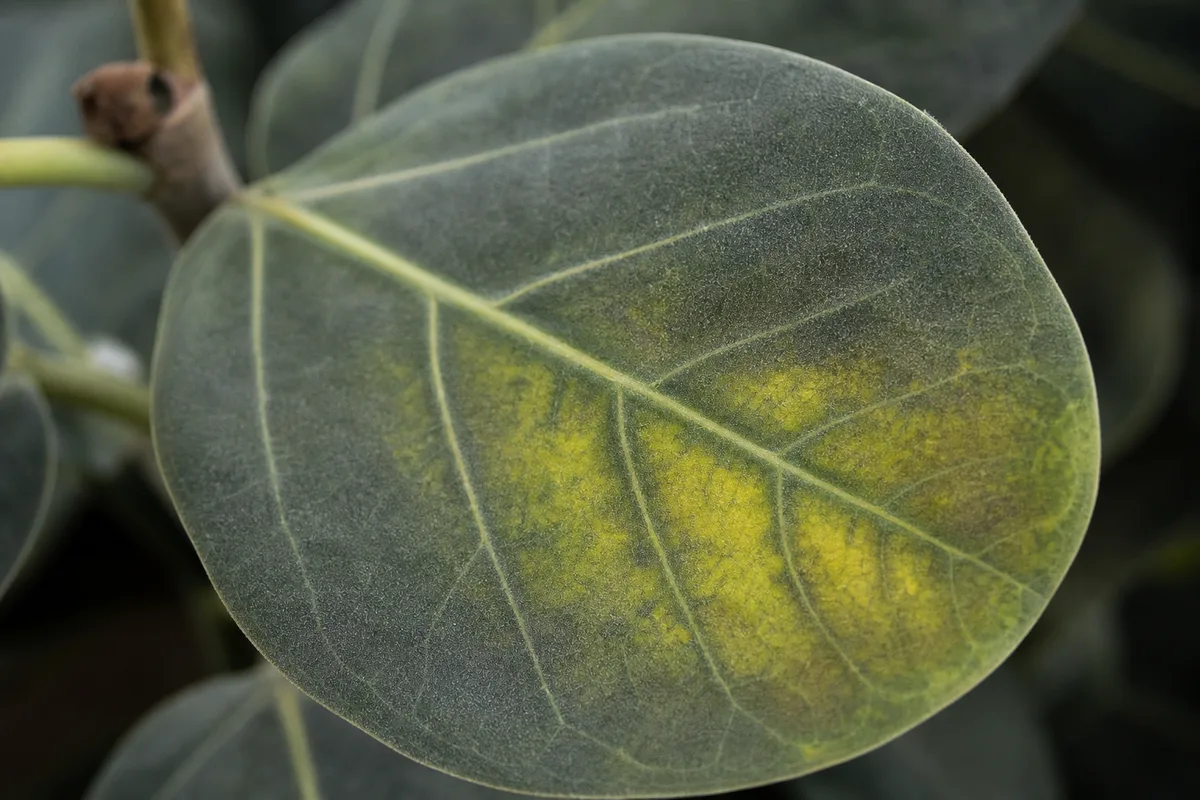
Yellow Leaves symptoms on Ficus Audrey - compare with healthy tissue on the same plant.
Yellow lower leaves only (normal aging)
- One or two oldest leaves on the lower trunk fade from green to yellow over weeks or months
- Crown tips and upper branch terminals stay firm gray-green with steady new leaf expansion
- Pot weight and soil moisture match your normal rhythm-neither heavy-wet nor bone-dry
- Yellow blades feel papery but petioles detach cleanly when spent; no sour smell from the mix
On a branching Moraceae fig, lower-leaf senescence is normal as the canopy grows upward-not the basal crown pattern of rosette succulents.
Soft yellow lower leaves on a wet heavy pot (overwatering / root stress)
- Multiple lower leaves yellow while soil stays damp for days after the last drink
- Pot feels noticeably heavy; saucer may hold standing water
- Leaves feel soft and limp, not crisp; petioles may droop before blades fully yellow
- Root rot can occur from overwatering; fungus gnats may hover over a surface that never dries
- Crown tips may still look green early-lower canopy fails first on a tree-shaped ficus
See overwatering on Ficus Audrey for early wet-soil triage before roots fail completely.
Bright crisp yellow leaves on a light dry pot (underwatering)
- Yellowing may start at leaf edges or spread across blades that feel dry and papery
- Pot lifts light; top 2 to 3 inches of mix are fully dry-sometimes the whole ball is dry in severe cases
- Dry, light brown spots can accompany drought stress on leathery foliage
- Stems often stay firm; leaves may droop before they yellow
- One thorough watering sometimes halts spread within days if roots are still healthy
See underwatering on Ficus Audrey when drought is confirmed.
Rapid yellow-and-drop after cold draft or window chill
- Several leaves yellow and fall within days of a temperature swing
- Plant sits near a winter window ledge, AC vent, frequently opened door, or hot radiator blast
- Soil moisture may be normal; timing matches the environmental change
- Prefers temperatures between 65 and 80°F and needs protection from cold drafts; sustained chill below that preferred range stresses foliage
Pale stretched upper leaves in dim light
- Upper canopy leaves turn pale yellow-green while internodes stretch
- Growth has been slow; the tree leans toward the brightest window
- Soil stays wet longer than expected because the plant is not using water at summer rates
- Bright indirect sunlight supports firm foliage; dim corners produce weak chlorophyll and thin blades before solid yellowing spreads
See not enough light on Ficus Audrey when stretch pairs with pale upper leaves.
Widespread yellowing after recent relocation
- Yellowing begins within days to two weeks of a move, repot, or furniture shuffle
- Multiple leaves across the canopy change color before some detach entirely
- Moisture and light may have been fine before the change-ficus species often lose foliage when moved to a different environment
- New tips may pause briefly, then resume once placement stabilizes
See leaf drop on Ficus Audrey when whole leaves shed rather than only yellow in place.
Yellow leaves vs. other Ficus Audrey problems
| Pattern | Pot weight | Soil at 2–3 inches | Leaf texture | Crown / tips | Likely cause |
|---|---|---|---|---|---|
| Normal aging | Normal | On schedule | Papery lower leaf only | Firm gray-green tips | Senescence on lower trunk |
| Overwatering | Heavy | Wet, clings to finger | Soft, limp yellow | Tips green early; base may soften later | Saturated roots |
| Underwatering | Light | Dry, crumbly | Crisp yellow or brown edges | May droop before yellowing | Drought |
| Cold draft | Normal | Unchanged | Yellow then drop | Tips may yellow too if chill is severe | Temperature stress |
| Low light | Medium-heavy | Stays damp longer | Pale, thin upper leaves | Stretched stems | Weak photosynthesis |
| Relocation | Normal | Often unchanged | Yellow then shed | Paused then resumes | Environmental shock |
| Advancing rot | Heavy | Wet, sour smell | Soft yellow lower canopy | Soft crown with wet soil | Root failure - see root rot |
Drooping leaves often arrive before or alongside yellowing on Audrey-especially the wilt paradox where wet soil and limp blades mimic thirst. Read pot weight before you treat color alone.
Why Ficus Audrey leaves turn yellow
Ficus Audrey leaves are leathery, elliptical to ovate, and clustered at branch tips-large enough that any disruption in root uptake or photosynthesis shows on those broad blades quickly. Yellowing means chlorophyll is breaking down faster than the plant replaces it. On this species, the why almost always traces to water, light, temperature, or age.
Overwatering and root stress. Moraceae ficuses hate chronically wet mix. Watering on a calendar in a cool dim room keeps the center soggy while the surface looks acceptable. Roots in waterlogged soil cannot absorb oxygen and begin to fail, so lower leaves yellow first while the tree still tries to push growth at the tips. Poor air circulation and excessive moisture can cause leaf spots that appear as brown and yellow patches spreading slowly-distinct from uniform drought yellowing.
Underwatering. When the root ball dries too long-especially in bright summer windows-cells lose turgor and blades yellow from the margins inward. Audrey tolerates an occasional missed check better than a fiddle leaf fig, but repeated drought still strips lower foliage.
Low light. In genuinely dim offices, Audrey stretches toward light and produces pale, weak upper leaves before steady yellowing. Slow growth also means slow water use, which compounds overwatering risk in winter.
Cold and drafts. Tropical banyan relatives expect stable warmth. Repeated hot or cold air across fuzzy leaves triggers yellow-and-drop even when you have not changed the watering can.
Relocation stress. Ficus species are notorious for shedding foliage after environmental change-plants may lose foliage when moved to a different environment. Yellowing often precedes drop; patience plus stable placement matters more than fertilizer.
Normal senescence. A mature upright trunk naturally loses its oldest lower leaves as the canopy extends. One fading leaf over months with firm tips elsewhere is not a crisis.
Pests and disease (less common first guess). Monitor for spider mites, mealybugs, and scale insects on velvety undersides. Stippling, webbing, or honeydew with localized yellow patches points away from pure water mismatch. See spider mites on Ficus Audrey if webbing appears.
How to confirm the cause
Work through this checklist before you change fertilizer, repot, or stack multiple fixes:
- Count the leaves - One or two lower yellow blades over months vs. many lower leaves at once?
- Lift the pot - Heavy and wet, light and dry, or normal weight for your watering rhythm?
- Probe 2 to 3 inches deep - Wet clinging soil, dry crumbly mix, or damp center with dry surface (prior overwatering signature)?
- Feel leaf texture - Soft and limp (wet stress) vs. crisp and papery (drought)?
- Check crown firmness - Tips and upper stems firm gray-green, or soft/mushy at the base with sour smell?
- Review placement - Recent move, new window, winter ledge, or HVAC blast in the last two weeks?
- Measure temperature risk - Night temps below the 65 to 80°F preferred range near the pot?
- Inspect light - Stretchy stems and pale upper canopy in a dim corner?
- Scan fuzzy undersides - Webbing, bumps, or sticky residue?
- Judge new growth - Healthy unfolding leaves at branch terminals mean the tree is still viable.
If wet soil, heavy pot, and soft lower yellowing align, treat as overwatering first. If dry soil and light pot align, see underwatering. If only one lower leaf fades slowly with firm tips, remove the spent blade and watch-no emergency overhaul.
First fix for Ficus Audrey
Lift the pot and check moisture at 2 to 3 inches depth before any other action. Yellow leaves are a symptom; the first fix depends on what the pot tells you.
If soil is wet and the crown is still firm
Stop watering until the top half of the mix dries. Empty standing water from saucers and cachepots. Do not fertilize, repot, or prune heavily while roots recover. Let the tree use stored water and air out the root zone. Resume only when a probe at depth reads dry-often one to two weeks in cool dim conditions.
If soil is dry and the pot is light
Water thoroughly once until a small amount runs from the drainage hole, then empty the saucer. One deep drink-not repeated sips-rehydrates a dry root ball. Recheck in 24 hours; thirst-corrected foliage often stops yellowing at the margins within days if stems stayed firm.
If the crown is soft or mix smells sour
Treat as advancing root failure-see root rot on Ficus Audrey. Stop watering, unpot, inspect roots, and trim mushy tissue before Ficus Audrey repotting guide into fresh airy mix. Soft crown tissue with wet soil is not thirst.
If the plant sits in a cold draft
Move it away from the chill source-winter window glass, AC vent, or door draft-to a stable spot with Ficus Audrey light guide. Hold watering changes until temperatures stabilize for a week. Do not compensate for yellow leaves by watering more unless the pot is genuinely dry at depth.
If only lower leaves fade slowly over months
Remove the spent yellow leaf and continue normal care. One lower senescent leaf on a firm tree with healthy crown tips requires no moisture overhaul.
If yellowing followed a recent move
Leave the tree in one place for at least two to three weeks. Match watering to actual dry-down, not panic. Avoid repotting, fertilizer, and repeated relocations while it adjusts.
Step-by-step recovery by cause
After the first fix above, work in order-one stressor at a time suits Ficus Audrey better than a bundle of changes.
Overwatering recovery:
- Let mix dry to depth before the next drink.
- Confirm drainage holes are clear; lift inner pots out of cachepots to drain.
- Remove fully yellow spent lower leaves for appearance and pest hygiene.
- Resume watering only when the top 2 to 3 inches are dry-stretch intervals in winter.
- Inspect roots if yellowing spreads despite dry-down; repot only if tissue is mushy.
Underwatering recovery:
- Thorough soak once; verify water penetrates the whole ball, not just the surface.
- Wait for normal dry-down before the next session-do not flood daily.
- Trim fully crisp brown-yellow blades that will not green again.
- Increase check frequency in bright warm rooms where large leaves transpire heavily.
Low-light recovery:
- Move gradually to brighter indirect light-east window or filtered south/west exposure.
- Reduce watering to match slower winter or dim-room uptake.
- Rotate the pot monthly for even canopy fill.
- Accept that pale stretched leaves will not fully recover-judge new firm gray-green tips.
Cold-draft recovery:
- Relocate away from chill; avoid hot radiator blasts on the other extreme.
- Maintain humidity in the 50 to 80% range when heating air is dry.
- Let dropped leaves go; do not overwater a thinner canopy.
Relocation recovery:
- Stable light and temperature for two to three weeks minimum.
- Water on probe results only.
- Expect some yellow leaves to shed; watch for clean new tips resuming.
Recovery timeline
Fully yellow leaves will not turn green again-they drop or you remove them. Recovery is measured by new gray-green leaves at branch terminals and stopped spread of yellowing down the trunk.
- Thirst corrected: Yellowing often halts within days; new tips stay firm within one to two weeks.
- Overwatering corrected: Lower yellowing usually stops spreading after the mix dries; new clean tips may take two to four weeks once roots regain function.
- Cold or relocation stress: Adjustment yellow-and-drop can last two to three weeks after conditions stabilize before fresh growth looks normal.
- Low light corrected: New firm foliage appears over several weeks; old pale leaves may remain until replaced.
Worsening signs: Yellowing climbing the trunk while soil stays wet, soft crown tissue, sour smell, or every new tip emerging yellow-escalate to root rot assessment.
Lookalike symptoms to rule out
- Brown tips only - Often humidity or salt stress, not whole-leaf yellowing; see brown tips on Ficus Audrey.
- Drooping without much yellow - Turgor loss first; moisture check still applies on drooping leaves.
- Whole leaves falling green - Shock or draft; see leaf drop.
- Mold on wet surface - Soggy mix clue; see mold on soil alongside watering fixes.
- Nutrient deficiency - Rare as a first explanation on potted Audrey; rule out water, light, and temperature before fertilizing a stressed tree.
What not to do
Do not fertilize a yellowing Ficus Audrey when soil is wet-salt buildup and forced growth on failing roots worsen yellowing.
Do not increase watering because leaves look thirsty on a heavy wet pot-damaged roots cannot absorb water even when soil stays wet.
Do not repot during active yellowing stress unless root rot is confirmed; relocation plus wet mix stacks stressors.
Do not assume every yellow lower leaf is aging-check pot weight and crown firmness first.
Do not move the tree repeatedly while it yellows from relocation shock; stability is part of the fix.
Do not place Audrey in direct hot sun to “fix” pale leaves-acclimate slowly; scorch yellows tissue differently from low-light fade.
Ficus Audrey care cross-check
Yellow leaves usually mean one pillar of care slipped:
- Water - Top 2 to 3 inches dry before watering; empty saucers; slower rhythm in winter dim light. Details: watering guide.
- Light - Bright indirect exposure; dim rooms produce pale stretchy growth and slow dry-down mismatches.
- Temperature - Stable 65 to 80°F; avoid cold drafts and HVAC blasts.
- Humidity - 50 to 80% supports velvety leaves; very dry winter air favors mites more than uniform yellowing.
- Pot and mix - Well-draining potting mix with perlite; avoid oversized pots that hold excess wet soil around a small root ball.
- Stability - One placement during recovery; ficus species drop foliage when moved often.
How to prevent yellow leaves next time
- Probe before every drink - Calendar watering in changing light is the most common trigger for winter overwatering yellowing.
- Match winter intervals - When growth slows, stretch time between waterings even if the tree still looks large.
- Bright indirect light year-round - Prevents pale upper canopy and soggy-mix mismatches in dim rooms.
- Draft-free placement - Keep the trunk away from winter glass and AC blasts.
- Remove spent lower leaves - Reduces pest hiding spots and clarifies whether new yellowing is stress vs. aging.
- Quarantine and inspect - Check fuzzy undersides when bringing new plants home.
- Acclimate moves slowly - Shift light and placement in steps when possible.
Prevention aligns with the Ficus Audrey overview and watering guide-this page covers diagnosis; those guides own daily rhythm.
When to worry
Most Ficus Audrey yellow-leaf episodes resolve once moisture, light, or temperature align. Escalate when:
- Multiple lower leaves yellow weekly while soil stays wet and the pot feels heavy
- Crown tips soften or collapse while mix is saturated-possible advancing root rot
- Sour or rotten smell from the pot when you lift it
- Yellowing climbs the trunk toward the canopy despite corrected watering
- Every new leaf emerges yellow for more than one flush-systemic root or severe light failure
- Pest signs spread with sticky residue, webbing, or stippling on fuzzy undersides
A large established tree with firm trunk wood can outgrow moderate lower-leaf loss if crown tips stay healthy. A young specimen losing most of its canopy on wet soil needs faster root intervention.
Related Ficus Audrey problems
- Ficus Audrey overview - species biology, toxicity, and care hub
- Ficus Audrey watering - top 2–3 inch dry-down and seasonal rhythm
- Overwatering - early wet-soil triage before roots fail
- Underwatering - drought patterns on velvety foliage
- Root rot - mushy roots and soft crown escalation
- Drooping leaves - wilt paradox and moisture checks
- Leaf drop - relocation stress vs. rot-driven shedding
- Not enough light - pale stretchy upper canopy
Conclusion
Yellow leaves on Ficus Audrey demand context, not panic. Lift the pot, probe the top 2 to 3 inches of soil, and match the pattern-wet heavy pot, light dry pot, cold draft, dim stretch, recent move, or a single aging lower leaf on a firm trunk. Fix one confirmed cause before you fertilize or repot. Recovery shows in clean new gray-green leaves at branch tips, not in blades that already turned fully yellow. Keep placement stable, water on dry-down, and protect the tree from cold drafts, and Audrey usually returns to the velvety canopy that made you choose this ficus in the first place.
When to use this page vs other Ficus Audrey guides
- Ficus Audrey watering guide - Use for routine moisture checks before assuming yellow leaves is the main issue.
- Ficus Audrey problems hub - Browse all 17 common issues on this species.
- Overwatering on Ficus Audrey - Different entry point when symptoms overlap with yellow leaves.
- Underwatering on Ficus Audrey - Different entry point when symptoms overlap with yellow leaves.
- Not Enough Light on Ficus Audrey - Different entry point when symptoms overlap with yellow leaves.