Overwatering on Ficus Audrey: Causes, Checks & Fixes
Quick answer
Overwatered Ficus Audrey sits in wet mix too long-lower velvety leaves yellow, the trunk wilts despite damp soil, and the pot may smell sour. First step: stop watering until the top 2 inches of mix are dry and confirm drainage holes are open.
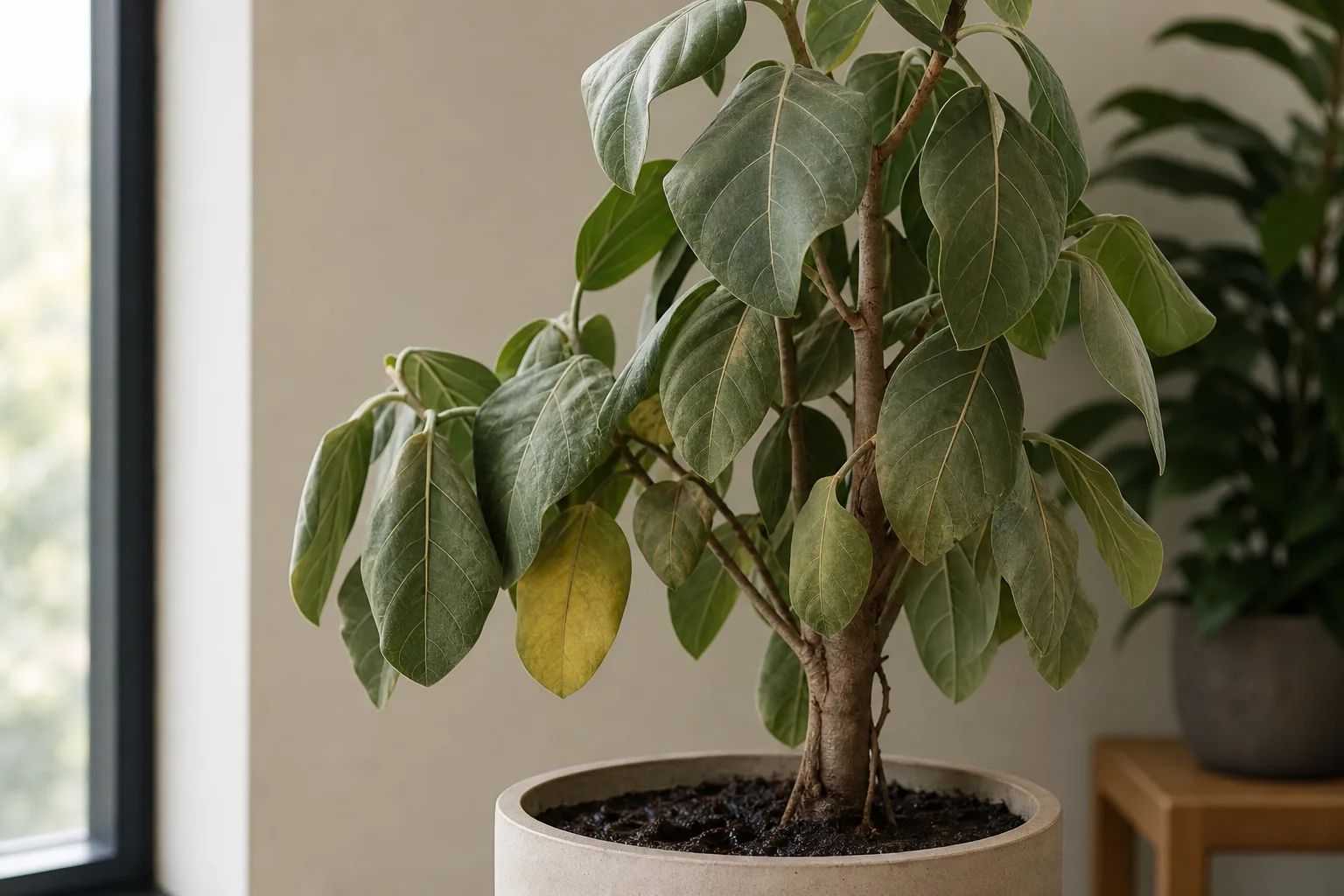
Overwatering on Ficus Audrey: Causes, Checks & Fixes
This guide covers overwatering on Ficus Audrey. See also the general Overwatering guide, watering, and light pages for this plant.
Overwatering on Ficus Audrey: Causes, Checks & Fixes
Quick answer
Overwatered Ficus Audrey (Ficus benghalensis) sits in wet mix too long. In its native range across India and South Asia, monsoon rains arrive in heavy pulses, then soil dries down under strong sun. Indoors, calendar watering and sealed cachepots recreate the opposite-constant dampness that suffocates tree roots. The plant shows yellow lower leaves on velvety gray-green foliage, a limp upright trunk, and sometimes a sour smell from the pot-even though the soil feels damp.
First step: stop watering until the top 2 inches of mix are dry throughout the pot. Confirm drainage holes are open and no saucer is holding standing water. NC State Extension notes that root rot can occur from overwatering on Bengal fig houseplants-one of the few problems that can undo an otherwise forgiving tree quickly.
For baseline watering technique, see the Ficus Audrey watering guide. If mushy roots or a collapsed stem base appear during inspection, move to the root rot guide - this page covers early wet-soil intervention before decay is confirmed.
What overwatering looks like on Ficus Audrey
Ficus Audrey does not always announce wet roots at first glance. Early signs are subtle; advanced cases overlap with root rot and can be mistaken for wilting from underwatering or yellow leaves from other stress.
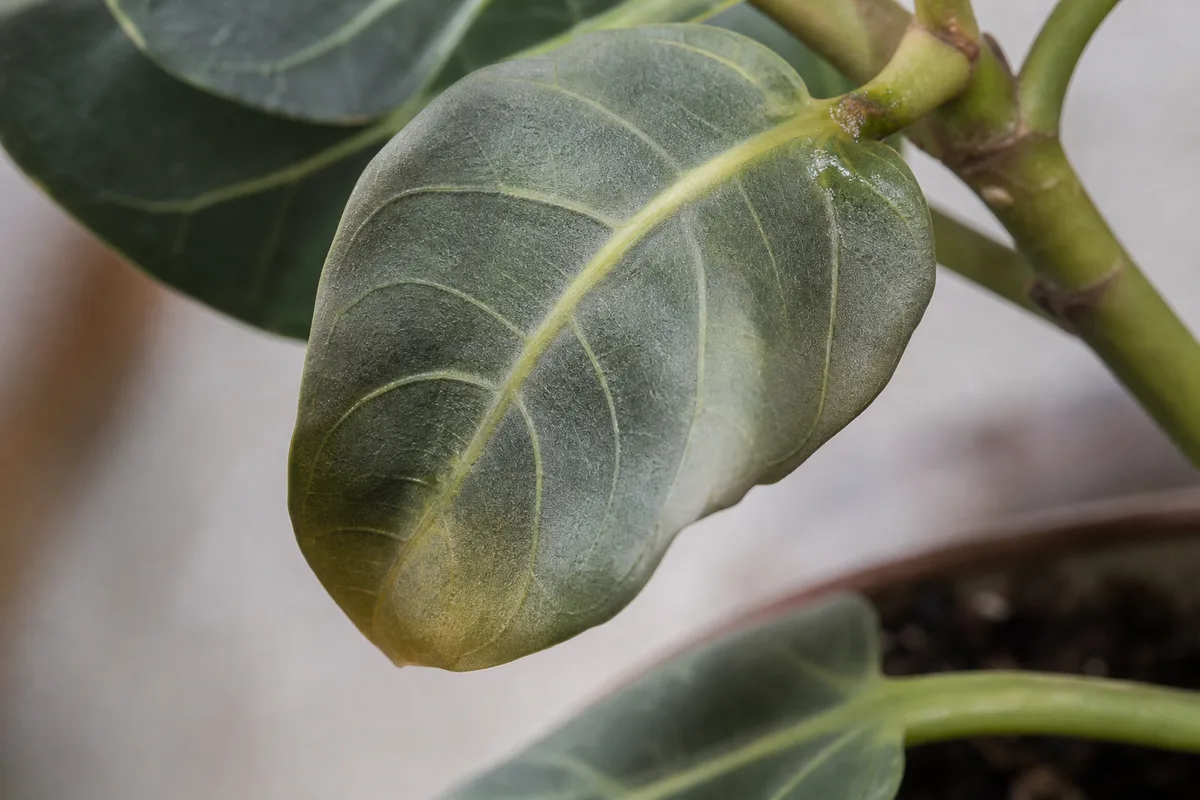
Overwatering symptoms on Ficus Audrey - compare with healthy tissue on the same plant.
Typical overwatering pattern on Ficus Audrey:
- Yellow leaves, often starting on lower, older foliage while the upper canopy still looks intact-bottom-up yellowing on matte gray-green, slightly fuzzy leaves
- Limp, drooping trunk and branches even though mix at 2 inches depth is still moist
- Soft or darkening stems at the soil line on moderate to severe cases-the diagnostic signature many growers miss until tissue dents under light pressure
- Soggy mix that stays wet for ten or more days after one watering in an average indoor room
- White mold or algae on the soil surface
- Fungus gnats hovering near the pot-NC State Extension lists fungus gnats among common Bengal fig problems, and larvae thrive in constantly moist peat; see fungus gnats on Ficus Audrey
- Leaf drop in clusters while the pot still feels heavy
- Edema or brown spots on leaves when roots cannot take up water properly despite wet soil
- Sour or musty smell when you lift the plant or disturb the surface
Healthy Ficus Audrey leaves feel firm and velvety. Overwatered tissue often turns soft yellow rather than the crisp, papery brown you see with severe underwatering or the dry light brown spots NC State Extension associates with drought stress on this species.
The wilting paradox is the tell: damaged roots cannot move water upward, so the tree looks thirsty while the mix is wet. Watering again makes the problem worse-a common mistake on ficuses because owners interpret limp foliage as thirst.
Why Ficus Audrey gets overwatered
Ficus Audrey has a reputation for being more forgiving than fiddle-leaf fig, which pushes many owners toward generous, scheduled watering. That habit backfires indoors because evaporation depends on light, pot size, mix, and season-not the day of the week.
Misreading monsoon biology is the root cause. Ficus benghalensis wants a full drink followed by a real dry-down, not faint surface dampness every few days. Thick, fibrous roots store water efficiently-brief dryness is tolerated; chronic saturation is not.
Calendar watering in low light is the most common trigger. Ficus Audrey needs bright, indirect sunlight indoors but uses less water in dim corners. A weekly summer schedule in a north-facing room keeps roots saturated through winter.
Oversized pots surround a modest root ball with a large wet zone. Mix stays damp at the center long after the surface looks acceptable-especially dangerous on a tree-form plant where the trunk sits above a deep, unused soil column.
Heavy, old peat mixes hold water like a sponge. Dense, broken-down media suffocates roots even when you water lightly. Penn State Extension notes that pebbles at the pot bottom do not improve drainage-a real drainage hole and empty saucer matter more.
No drainage or full saucers trap water at the bottom. Decorative cachepots without clearance are a frequent cause of chronic wet feet on tall indoor ficuses.
Seasonal mismatch matters. Short winter days and cooler rooms slow transpiration. Continuing summer frequency into October or November is a classic overwatering path-many growers overwater in cool, dim apartments because the mix never dries, not because they pour too much at once.
Fresh Ficus Audrey repotting guide plus immediate soak adds stress. New mix around an established root ball holds moisture differently until roots explore the space-hold off on extra water until the 2-inch test confirms readiness.
Ficus Audrey stores moisture in stems and roots, so it survives brief dryness better than chronic wet feet. That tolerance makes owners underestimate how long wet mix has already been damaging fine root tips underground.
How to confirm the cause
Work through these checks before repotting or trimming:
- Soil moisture at depth - Stick your finger 2 inches into the mix (or use a dry skewer to the bottom). Wet at that depth many days after watering confirms saturation, not a one-time mistake. NC State Extension recommends watering when the top 2 to 3 inches feel dry-if you have not reached that dry point since your last pour, you are overwatering.
- Pot weight - Lift the container. A heavy pot with limp foliage points to waterlogged mix; a light pot with limp leaves suggests underwatering instead.
- Leaf pattern - Soft yellow on multiple lower leaves plus wet soil fits overwatering. Crisp, curled leaves with dry soil fits drought. Scattered leaf drop after a move with normal dry cycles may be placement shock, not wet roots.
- Stem base - Press tissue at the soil line. Firm is reassuring; soft, dark, or mushy means escalate toward root inspection.
- Drainage check - Water should exit holes within minutes. Saucer water sitting for hours means roots may be standing in liquid.
- Light and season - Note room brightness and recent weather. Dim, cool conditions extend drying time and make your usual schedule excessive; see not enough light when slow drying is environmental, not habitual.
- Root spot-check (if unsure) - Slide the plant out gently. Healthy Ficus Audrey roots are firm and whitish or tan. Brown, slimy roots that collapse between fingers confirm advanced damage-see the root rot guide next.
If the mix is dry throughout, the pot is light, and leaves are crispy, underwatering is more likely. Do not withhold water further without checking.
First fix for Ficus Audrey
Stop watering until the top 2 inches of mix are dry.
That single pause lets oxygen return to the root zone and stops the cycle of wet soil → failed uptake → “it looks thirsty” → more water. Move the pot to brighter indirect light if it has been in deep shade-faster photosynthesis uses water and helps the mix dry evenly without scorching velvety leaves.
Empty any saucer water. If the plant sits inside a decorative outer pot, pull the nursery pot out so air reaches the bottom holes.
Do not fertilize, mist heavily, or repot on day one unless stems are already soft or roots are clearly mushy on inspection. Most early overwatering cases stabilize with dry-down plus better light alone.
Step-by-step recovery
If symptoms are mild (yellowing lower leaves, wet mix, firm stems):
- Hold water until the top 2 inches are dry, then water thoroughly once and pour off excess from the saucer within 30 minutes.
- Adjust placement - Bright, indirect light speeds recovery without burning fuzzy foliage.
- Remove spent leaves - Yellow foliage will not re-green; snip at the petiole base for a cleaner look once the plant is stable.
- Monitor new growth - A fresh velvety leaf at a branch tip means roots are working again.
If symptoms are moderate (persistent wet mix, multiple yellow leaves, fungus gnats):
- Scrape the top inch of moldy or gnat-infested surface soil and discard it.
- Let the pot dry until mix at 2 inches is dry-this may take one to two weeks in cool rooms.
- Set yellow sticky traps near the pot to reduce adult gnats while soil dries-fungus gnats breed in moist potting mix.
- Resume watering only when the finger test passes; never on a fixed weekday.
If symptoms are severe (soft stems at soil line, sour smell, mushy roots on unpotting):
- Unpot and rinse roots under lukewarm water. Wear gloves-Ficus sap can irritate skin and Ficus species are toxic to cats and dogs if chewed.
- Trim all brown, mushy roots with clean scissors, keeping firm white or tan tissue. If you remove more than half the root mass, prune top growth proportionally.
- Repot into fresh, airy mix with perlite in a pot only slightly larger than the root ball, with drainage holes.
- Wait twenty-four to forty-eight hours before the first light watering so cut roots callus.
- Hold fertilizer until new growth appears. Expect some leaf drop while the plant reallocates energy.
Recovery timeline
Stabilization often takes one to two weeks after you stop watering and the mix dries-wilting should ease before new leaves appear.
New leaf buds are the best success signal. Expect firm, velvety growth at branch tips in two to four weeks during spring or summer active growth; winter recovery may take longer in cool, dim rooms.
Old yellow leaves will not turn green again. They may drop on their own or stay until you trim them.
Full canopy fullness rebuilds over several months as branches push new growth. Severe root loss slows the timeline even when the plant survives.
Worsening signs: stems soften further after dry-down, yellowing spreads up the trunk, or new leaves emerge small and pale then collapse-those point toward active rot, not simple overwatering.
Lookalike symptoms
| What you see | Likely cause | Quick check |
|---|---|---|
| Limp leaves + wet heavy pot + soft yellow lower leaves | Overwatering | Stop watering; confirm 2-inch dry-down |
| Limp leaves + light dry pot + crisp brown edges | Underwatering | Deep soak once; resume dry-down checks |
| Leggy pale leaves + dry healthy mix | Low light | Move closer to window; do not water more |
| Mass green leaf drop days after a move | Placement shock | Stabilize location; soil may be fine |
| Soft stem base + sour smell + mushy roots | Root rot (advanced overwatering) | Trim and repot; see root rot guide |
| Darkened limp leaves after AC vent exposure | Cold draft | Fix placement; soil moisture may be normal |
Normal old-leaf drop - One or two lower yellow leaves on an otherwise firm plant with appropriate dry cycles; no action beyond removing the leaf.
Nutrient deficiency - General pale yellow with dry mix and steady watering; confirm moisture first before feeding a stressed tree.
What not to do
Do not water because leaves look limp when soil is already wet-that feeds the failure loop. Avoid repotting into garden soil or a much larger pot; both hold excess moisture. Do not fertilize a waterlogged plant; salts on damaged roots add stress.
Skip misting as a fix; it does not dry wet roots and wet velvety leaves in dim corners can invite fungal spotting. Do not assume forgiveness means frequent water-Ficus Audrey tolerates drought more willingly than saturation.
When unpotting, wear gloves if sap irritates your skin. Keep trimmed leaves and exposed soil away from cats and dogs-Ficus contains compounds that cause vomiting and oral irritation in pets. Wash hands before touching other plants or pets.
Ficus Audrey care cross-check
Before changing fertilizer, pot size, or humidity hardware, confirm these basics match your environment:
| Factor | Overwatering risk when wrong | Fix |
|---|---|---|
| Pot size | Oversized pot keeps unused soil wet | Size up one inch at repot only |
| Mix | Heavy peat holds water for weeks | Add 20–30% perlite; refresh compacted mix |
| Light | Dim rooms slow drying | Ficus Audrey light guide; see light guide |
| Season | Winter schedule matches summer | Stretch checks to 14–21 days in cool months |
| Cachepot | Standing runoff re-wets roots | Lift inner pot; empty saucer after every drink |
| Drainage | Sealed decorative pot = root bath | Use inner grow pot with holes |
How to prevent overwatering on Ficus Audrey
Match water to soil dryness, not the calendar. Water when the top 2 to 3 inches of soil feel dry, soak thoroughly so moisture reaches the whole root ball, then empty the saucer so the pot does not sit in runoff.
Use light, well-draining potting mix with perlite and pots with open drainage. Size up only one inch at a time when repotting so excess mix does not stay wet around modest roots.
Reduce frequency in winter or dim rooms-many homes need half the summer watering rate when growth slows. A pot that dried in seven days in July may need two to three weeks in January.
Lift before you pour-a noticeably lighter pot plus dry mix at 2 inches means it is safe to water again.
Check, do not guess-pick two or three days a week to inspect soil moisture rather than watering on Sunday because the calendar says so.
When to worry
Escalate immediately if stems dent at the soil line, soil smells rotten, or more than a third of roots are mushy on inspection. Those signs mean root rot is active-dry-down alone is unlikely to save the plant. Shift to the root rot protocol immediately.
Slow yellowing on one or two lower leaves with firm stems and mix that dries normally within a week can wait for a schedule adjustment.
If the lower trunk softens while mix stays wet for ten or more days, treat as urgent even before repotting-honest root trimming early gives the best chance; a collapsed crown may not be recoverable.
Conclusion
Overwatering on Ficus Audrey is a moisture-timing problem, not bad luck. Confirm it with wet mix at depth plus limp velvety leaves and bottom-up yellowing, then stop watering until the top 2 inches dry. Adjust light, drainage, and pot size so the mix breathes between drinks the way monsoon biology expects. Ficus benghalensis rewards dry cycles with firm new leaves; it rarely forgives roots that never get oxygen.
For species context and year-round watering rhythm, see the Ficus Audrey overview and watering guide.
When to use this page vs other Ficus Audrey guides
- Ficus Audrey watering guide - Use for routine moisture checks before assuming overwatering is the main issue.
- Ficus Audrey problems hub - Browse all 17 common issues on this species.
- Root Rot on Ficus Audrey - Different entry point when symptoms overlap with overwatering.
- Yellow Leaves on Ficus Audrey - Different entry point when symptoms overlap with overwatering.
- Wilting on Ficus Audrey - Different entry point when symptoms overlap with overwatering.